The Princeton ITA Resolution Passes
Part 1 of this series.
Well, readers, it passed: the “Princeton Resolution of the Mayor and Council of Princeton Supporting the Passage of the Immigrant Trust Act” passed unanimously tonight, 5-0, with two absences. Having read the texts of several of the ITA municipal resolutions out there, I would say that Princeton’s is probably the best of the bunch: the strongest, clearest, and most explicit about its political aims.
Here is the most relevant part:
NOW, THEREFORE, BE IT RESOLVED by the Mayor and Council of Princeton, County of Mercer, State of New Jersey, as follows:
1. The Mayor and Council hereby call upon the State Legislature to pass the ITA with all deliberate speed.
2. The Mayor and Council hereby call on Princeton’s representatives in the New Jersey State Assembly and Senate to co-sponsor and vote affirmatively for the ITA.
3. The Mayor and Council hereby call on the Governor to sign the ITA into law.
4. The Mayor and Council strongly encourage other New Jersey municipalities to consider adopting a similar resolution in support of the ITA.
5. The Municipal Clerk shall cause a certified copy of this resolution to be transmitted forthwith to New Jersey State Senator Andrew Zwicker, New Jersey State Assemblypersons Mitchelle Drulis and Roy Freiman, New Jersey State Senate President Nicholas Scutari, New Jersey State Assembly Speaker Craig Coughlin, the principal sponsors of the ITA, and New Jersey Governor Phil Murphy.
6. This resolution shall take effect immediately.
This piece from TapInto Princeton gives a good (not perfect) summary of the issues, and the full text of the resolution.
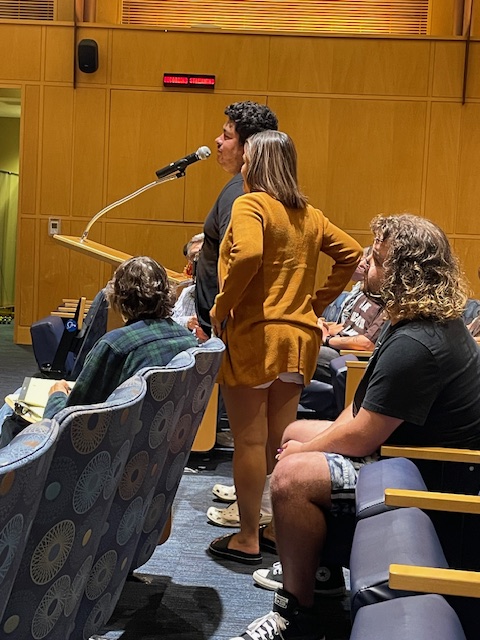
Juan Regalado, a local day laborer detained for almost seven months at ICE’s Elizabeth, New Jersey Detention Facility, expressing his satisfaction with the Council’s work. Ana Paola Pazmiño translates.
It is, no doubt, a night to celebrate. But the passage of the resolution was not an unmitigated success, and the evening’s discussion had its share of rancor. One Council member used the occasion to give Resistencia’s activists a hectoring, pedantic lecture about the right and wrong ways to do activism. Another decided to haul out and litigate some tired old grievances, claiming to stand ceremony on “the facts,” while managing to get the relevant facts exactly wrong. I’ll revisit these claims in a later post on the Council’s many missteps over the last eight or nine months.
While some Council members may have been irritated at Resistencia, in fact, Resistencia’s activists had good reason to reciprocate the sentiment. In addition to passage of the resolution, activists have been asking municipal government to help generate a “community-led safety plan” in response to ICE incursions here. The Council is clearly opposed to the idea, but its reasoning is totally obscure. From TapInto Princeton:
That idea [of a community-led safety plan], in contrast to the approval of a resolution, seemed to have the support of no one on Council. Mayor Mark Freda stated flatly that, while Princeton police do not work with ICE agents, they also do not attempt to obstruct them, which would be a violation of law.
Freda’s claim that Princeton police do not work with ICE agents flouts the text of the Immigrant Trust Directive (ITD) as well as the Princeton Police Department’s General Order 4-13, both of which legally mandate local police cooperation with ICE under specified conditions. Since the whole point of the ITA is to eliminate those conditions–“carve outs,” as they’re called–and the whole point of tonight’s resolution was to urge the passage of the ITA, it’s puzzling what Freda thinks was accomplished by tonight’s vote. The usual understanding is that passage of the ITA would limit the existing extent of local law enforcement’s cooperation with ICE. But if there’s already zero cooperation, the ITA is rendered pointless: there’s no need to limit what’s already at zero. The problem is, we’re not at zero, and never have been. So Freda’s comments are a strange combination of muddle and mystery.
I can see why Freda thinks that the ITA is pointless if he thinks that local law enforcement currently has the authority to decline all cooperation with ICE. What I can’t see is how any mayor in New Jersey could think something so ridiculous. From the text of the Princeton Police Department’s General Order 4-13:
Although officers should assist federal immigration authorities when required to do so by law, they should also be mindful that providing assistance above and beyond those requirements threatens to blur the distinctions between state and federal actors and between federal immigration law and state criminal law (emphasis mine).
The text just comes out and says that local law enforcement is legally required to assist federal immigration authorities by law. Section II-C of the ITD consists of ten conditions under which local cooperation with federal law enforcement is mandatory. Depending on how one counts, either four or five of these mandate cooperation with federal immigration authorities (conditions 1, 3, 8, 9, and 10). Sections III and IV of the ITD contain a further page of conditions mandating cooperation. Princeton Police General Order 4-13 merely codifies the ITD at greater length and greater specificity than the ITD’s own text. So it’s really impossible to claim, as Freda does, that Princeton’s Police Department doesn’t work with ICE. Every police department has to work with ICE when required by law. And there are times when the law requires it.
Freda’s implicit claim that a community-led safety plan would obstruct ICE and violate federal law really makes no sense whatsoever. A community-led safety plan involves the exercise of constitutional rights. No valid federal law can be violated by the exercise of constitutional rights. So I have no idea what Freda is talking about, and doubt that he does, either.
The activists’ basic criticism of the Council is one I share: while the resolution tells us that the Council’s heart is in the right place, it doesn’t tell us what, if anything, the Council intends to do about the physical threat from ICE we face. Establishment wisdom, always eager to circle the wagons, disagrees. Journalist Richard Rein’s views are typical: “If it hasn’t already been made clear through numerous statements and actions over the past 10 years or more,” he writes (in the TapInto piece I’ve linked above), “the municipality of Princeton supports its immigrant residents.”
Actually, much less is clear than Rein seems to think. What’s particularly unclear is what the Mayor and Council think should happen when ICE comes to town. Imagine that ICE rolls in at midnight tonight in the vicinity of Witherspoon and Quarry Streets, and starts throwing people into unmarked vans. Can we call the Borough and report an incident at that time and location? If so, whom should we call? The police? Suppose we do. Will they respond in real time? Will they respond at all? If they do respond, what will they do? No one in municipal government seems to know the answers to these crucial questions. The only thing that the Borough has made clear is that we have a duty not to “interfere with federal operations.” But even if we set aside the elasticity of ICE’s understanding of “interference” (and we really can’t), there’s a lot more to dealing with ICE than not interfering with them. The overall situation is only “clear” to those who have the luxury of avoiding ICE when it shows up. Not everyone does.
If Princeton were invaded by a marauding gang of shoplifters, bike thieves or burglars, you can bet that the entire borough would be up in arms, demanding a “plan” from the Council and Police Department for dealing with the nightmare of lost merchandise, lost bikes, and lost electronics. I’m not sure why it’s unreasonable to expect the same alacrity in a case where an armed gang of kidnappers invades the town, leaving us to deal with the nightmare of wrecked families and missing persons. But like it or not, that’s where we are.
Just a few weeks ago, members of the Council derided the proposed ITA resolution as empty, feckless verbiage. Tonight, in taking credit for it, one member of the Council described it as a “shield.” It is in fact neither, and its passage, though welcome, leaves many pressing issues unaddressed. All of it convinces me that what seemed at first an inconsequential dispute over an innocuous resolution has ended up dredging up some fraught and difficult issues worth discussing. More on that soon.
 Policy of Truth
thank you for this excellent piece of writing. It has really shown what many have not seen for years in the immigrant community. We must keep going forward to protecting what we want and know is right for the community. From the bottom up we keep going.
LikeLike
You’re very welcome! I have more stuff coming. Incidentally, I persuaded a friend from work, someone not at all involved in Resistencia, to come to yesterday’s meeting. He said he was very moved by the testimonials. He lives in Montgomery, and people there are discussing the idea of passing an ITA resolution. I believe it’s to be discussed at their September 4 town council meeting. I’m thinking of going, and hoping that we can turn this into a regional or even state-wide movement.
LikeLike
Pingback: Resistance in Action (4) | Policy of Truth
Pingback: ITA Resolution for Montgomery | Policy of Truth