Complicity, Exposure, and Activism
This is part 3 of a five part series. For part 1, go here. For part 2, go here.
At this point, the Stakeholders have criticized, the Institution has half-responded, and the Stakeholders have rebutted that half-response. What’s most likely to happen next is that because the Institution controls the terms of the debate, it will insist on a purely procedural discussion. The substantive issues are to be set aside as “too complex and controversial.” The issue of complicity is quickly to be submerged in a broth of procedural acids and left to corrode. The Institution, it will be repeated, must be governed in an orderly fashion—a fashion that just happens to give a systematic, unyielding presumption to stasis and the status quo, that places a nearly impossible burden of proof on anyone who seeks to change it, and that then describes doing so as a binding norm.
Meanwhile, all of the following questions have effectively been ruled out bounds:
- What is the nature of the Institution’s investments?
- To what degree do these investments make the Institution complicit in injustice?
- To what degree does the Institution accept a duty to avoid complicity in injustice?
- Assuming that it accepts a duty to avoid complicity, what justification can it offer for making its investments?
Any attempt to raise such questions with the Institution will be dismissed as irrelevant, or as virtue-signaling, and brushed aside. The investments, injustices, and complicity will continue. The Stakeholders will be marginalized and neutralized. Business-as-usual will continue without interruption.
I think most readers will be able to concretize the issues I’m raising here without my having to become explicit about it. I’ve deliberately put things in an abstract way, if only to keep the normative controversies separate from the factual ones. My aim here is not so much to get you to agree that the scenario above describes Berkeley or Columbia ca. 1968, or Princeton ca. 1978, or Harvard, Princeton, Columbia, Penn, Rutgers, Emory, Bowdoin, and NYU et al today. My point is that a discussion of campus unrest that fixates on procedural issues like politicization and standing is myopic by design. It insists that we focus on the issues most comfortably discussed by the powers-that-be while avoiding everything they self-righteously decide to evade.
The problem with almost all recent debate about campus activism is that it threatens to drown the substantive in a tide of distractions. The essential issue is straightforward: supposing that we have a duty to avoid complicity in evil, how, if at all, does it apply to higher education? More specifically, how does it apply to University investments in immoral enterprises? I don’t claim that any part of this issue is beyond question. Maybe we don’t have an obligation to avoid complicity. Maybe the obligation lacks application to higher education, or to investing. Maybe American universities aren’t investing in unjust enterprises, or maybe such investments are inescapable and unavoidable.
But these are not the questions being pursued in the current debate, much less being encouraged by university administrators. Just ask them–as I have–and listen to how archly, how self-righteously, they evade the issue and change the subject.(1) That’s what they’re paid to do.
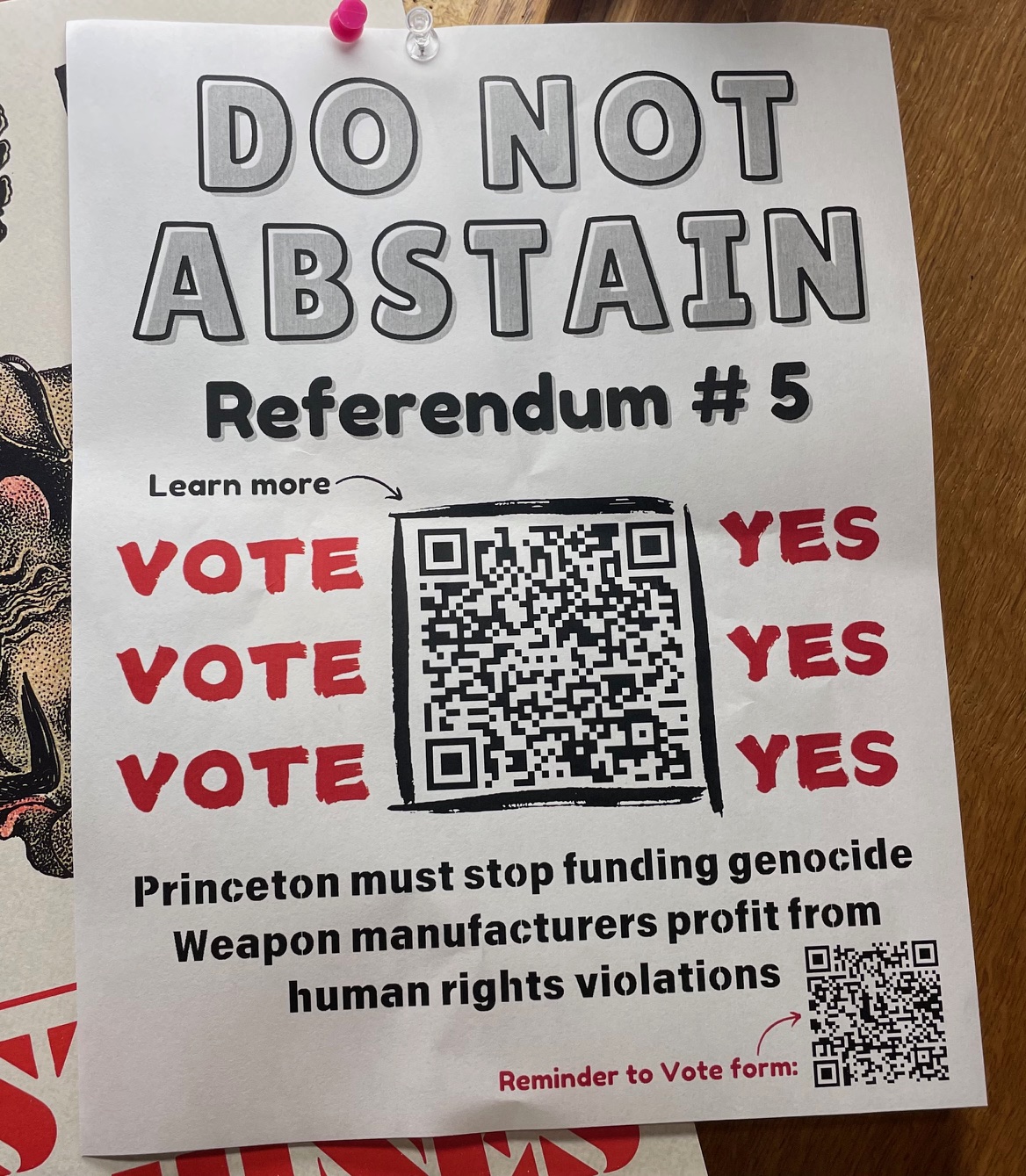
Divestment referendum flyer, Firestone Library, Princeton University (photo: Irfan Khawaja)
At a certain level, it doesn’t really matter whether the activists can force dramatic real-world change in higher education. Ought implies can, and the odds are stacked against them. If you look carefully at past divestment campaigns, including apartheid South Africa, you realize with a bit of a shock that none of them really succeeded.(2)
In most cases, the pattern was the same: activists demanded divestment; the university prevaricated and stalled; the activists upped the ante by employing “uncivil” methods of protest; the university then offered them some crumbs. And then admin did what it does best–run out the clock. Eventually, apartheid fell of its own weight, relieving these administrative prevaricators and cowards (by design) of the responsibility of having to make any difficult divestment decisions about it. The world took on the burdens of their responsibility while they functioned as moral free riders, grinning and bullshitting their way through it all.
The only weapon that activists hold against such people is a single truth: complicity can’t be wished away by procedural means. If you’re complicit in evil, you got yourself there. If you have a duty to avoid complicity, you have to get yourself out. You can refuse to acknowledge the facts. You can demand that others ignore them. You can drown your pro forma acknowledgment of the gravity of the issue in an impenetrable soup of “procedural impartiality.” But once you’re done with these charades, the fact remains: you remain complicit in evil. You can spend more time fighting the people trying to undo the mess you’ve made than in helping to clean it up. Yet the responsibility remains yours. You can tie the messenger up in procedural knots. But doing so won’t untie the knot you’ve fashioned for yourself.
Ultimately, exposure and pressure are the only sanction that contemporary campus activists have against the administrators they seek to reach, and divestment from complicity in evil the only remotely feasible aim. It is beyond the power of the campus movement to enforce the ceasefire in the Middle East, to stop the Israeli genocide, or to pre-empt Trump’s Gaza proposal. It is beyond its power to create a “popular front” of concerned anti-war Americans. Campus activists should not be set up for failure by being tasked with things they can’t possibly accomplish, then castigated for not accomplishing them.
Try as it might, the campus movement probably won’t succeed even at the most modest aims of forcing particular institutions to divest from militarism, or forcing ROTC off campus, or ending on-campus recruitment by the likes of Raytheon and Northrup Grumman. To paraphrase an old activist saying: you have to be prepared to fail before you can begin to succeed.(3) In any case, its concern must be internal, bearing on the academy itself.(4) Right now, the only thing it can actually succeed at doing is to rip the facade away from the contemporary academy, to reveal it for what it is, and to demand (however fruitlessly) rights of student and faculty self-governance that reverse the complicity that decades of supposedly “sober,” “realistic,” “civil,” and “responsible” administrators and trustees have foisted on the rest of us.
These administrators, in turn, have to stand exposed as the moral cowards, liars, and frauds that they really are, and have to answer for the unscrupulous deals they’ve made with the so-called “defense” establishment, whether of the United States or its allies (e.g., Israel, Saudi Arabia, the Arab Gulf States, Ukraine). Campus activists have to fight single-mindedly for one thing: the restoration (or transformation) of higher education into a military-free space, a place where academic values are conceived in a way that declares independence from the values of militarism, imperialism, and inevitably, conquest, occupation, torture, ethnic cleansing, genocide, and the propaganda that covers it all up. It’s a waste of time and energy to demand more than this of a campus-based movement. This by itself is enough of a crusade to last generations. But now is the time.
For part 4 of the series, go here.
Endnotes
1. As an illustration, I will, in the near future, be posting the written statement on divestment I sent to Princeton University’s Council of the Princeton University Community this past October, along with their supposed “response” to it.
2. I’ll discuss the case of divestment from apartheid South Africa in a future post.
3. “You have to be prepared to die before you can begin to live.” See Paul Kix’s book by that name, about the SCLC’s May 1963 de-segregation campaign in Birmingham, Alabama. Arguably, some version of the thought traces back to Plato’s Phaedo.
4. Here I disagree with what strike me as the overly-ambitious views of various friends and allies, e.g., Suzanne Schneider and Norman Finkelstein. I see no logistical route to the goals they have in mind, however laudable. I’ve discussed the issue of academic hiring here and here.
 Policy of Truth
Pingback: Complicity, Neutrality, Atrocity (2/5) | Policy of Truth
Pingback: Complicity, Neutrality, Atrocity (4/5) | Policy of Truth
Pingback: Complicity, Neutrality, Atrocity (5/5) | Policy of Truth
Pingback: We Won’t Stop | Policy of Truth