I have spent my whole adult life as a libertarian or classical liberal of one kind or another. And throughout this long period—for I am not young—I have been puzzled as to whether I should think of myself as leftwing or rightwing or centrist, or whether I should, like many libertarians, reject the conventional left–right political spectrum altogether. So now, herewith I propose to try to sort this out.
I would like to get to the bottom of a distinction that seems fundamental and eternal, which since the French Revolution has gone under the heading of “right wing” vs. “left wing.” I definitely don’t mean whatever distinguishes “liberals” and “conservatives” in contemporary American politics. I mean to pick out the distinction that seems to run very deep in social conflicts that are not merely about competing material interests, but that have an ideological root or at least a strong ideological component. The distinction I’m looking for—assuming it really exists—would be deeper than any ideology and would in fact would be a psychological, structural basis of ideologies. This is something as old as the Gracchi vs. the Roman patricians, as Cleisthenes vs. Isagoras, as Thersites vs. Odysseus, and probably older.
Is there such an eternal, fundamental opposition as I’m looking for? Or is there just a mess of conflicting values and concerns, à la the Schwartz theory of basic values? I suspect what I’m looking for exists, or why do political contests so often seem to be recognizably “left” vs. “right”? But then, what is fundamental to this opposition?
To begin with, here is an unsystematic list of ideas that seem to me to be central to the opposition I’m looking for.
| Left | Right | Remark |
| Openness to experience | Conscientiousness | OCEAN |
| “Barbarism” | “Civilization” | Right interpretation (per Kling) |
| “Liberation” | “Oppression” | Left interpretation (per Kling) |
| Equality | Inequality | |
| Anarchy | Hierarchy | |
| Change | Stability | |
| Disruption | Preservation | |
| Innovation | Tradition | |
| Chaos | Order | |
| License | Rules | |
| Subversion | Authority | |
| Risk | Safety/Security | |
| Empathy | Distance |
On the other hand, some ideas that do not seem to capture the Left–Right opposition:
| “Left” | “Right” | Remark |
| Universalism | Nationalism | |
| Internationalism | Patriotism | |
| Communitarianism | Individualism | Or vice versa?? |
| Liberty | Subjection | Or vice versa?? |
| Collectivism | Individual rights | |
| Command economy | Free market | |
| Smart | Stupid | |
| Reason | Dogmatism | |
| Flexible | Inflexible | |
| Weakness | Strength | |
| Female | Male | |
| Impurity | Purity | |
| Autonomy | Heteronomy/Control | |
| Adventurous | Timid | |
| Nurture | Nature | |
| Progress | Stasis |
Analysis
Looking at the first table, it seems clear to me that the “first principal component,” as it were, of the left–right split is what I might call “equality–hierarchy,” and the second principal component is something like “change–tradition.” Thus, the main conflict is between those whose main concern is the plight of the marginalized and those whose main concern is to maintain the existing order, including the prerogatives or authority of those who rank higher in that order. This can take many forms: aristocrats vs. commoners, rich vs. poor, educated vs. uneducated, masters vs. slaves, strong vs. weak, rulers vs. subjects, star-bellied Sneeches vs. plain-bellied Sneeches. The “marginalized” in this opposition need not be wronged or oppressed in any way, although they often may be. Moreover, the authority or rank of the elites need not be illegitimate or socially harmful. Indeed, some sort of hierarchy seems to be a practical necessity for the good functioning of any community larger than a few dozen people.
The second component of conflict is between those who want to introduce new ways of doing things and those who want to preserve the traditional ways. On the one hand, traditions gratify our natural preference for the familiar and predictable and safe; on the other, change gratifies our liking for novelty, surprise, and risk. We all have both sets of preferences; the question is one of balance. We cannot do without both tradition and change. Without tradition, culture would not accumulate, and cumulated culture is the storehouse of human know-how at the root of our success as a species. But without change, growth is impossible.
It is obvious how concern with preserving hierarchy and with preserving tradition go together, since hierarchies (or at least the social structures within which hierarchies emerge)—like every other cultural asset—are maintained by traditional practices. By the same token, concern with the marginalized and with promoting change go together, since improving the lot of whole classes of people is making a change and often a profound change in cases where their marginalization is due to deeply embedded traditional practices.
Test Cases
We can test the account of left vs. right given above against our intuitions about specific cases.
According to the present analysis, movements like abolitionism for chattel slavery, ancient Athenian democracy, English anti-monarchism in the 17th century, the French revolutionaries, the communist revolutionaries of the 20th century (Russian, Chinese, Cuban, Vietnamese, Cambodian, etc.), trade unionism, and Fabian-style welfare programs in advanced Western countries (such as the New Deal and later Great Society) all code as left.
On the other hand, Nazism and Italian Fascism code as right, despite being—like communism—totalitarian, revolutionary, populist, and redistributionist, because their ideological rationale emphasizes (a) preservation of traditional values/culture/blood, etc. rather than change, and (b) promoting the glory and strength of the nation rather than the interests of the marginalized. Thus, the insight of the horseshoe theory of the political spectrum is preserved at the same time that the intuitive left–right distinction between communism–fascism is accounted for.
Note that context matters in making these determinations. The views of John Locke or a pro-democracy Athenian citizen in 500 BC might not seem leftwing today, but in their time they clearly were.
Note also that an advocate’s own conception of an issue is an important element in explaining its “left” or “right” status. For example, environmentalism today codes as left, even though it is preservationist and not about helping marginalized people. I interpret this as due to the association of environmentalism with antagonism to commercialism, consumerism, industrialization, and business and capitalism in general. From the beginning, environmentalism has seen itself as fighting industrial business practices (think industrial waste, exploitation of natural resources—forests, minerals, fossil fuels—air pollution) and consumerism (garbage, plastics, personal consumption). None of this strikes me as inherently left, but combined with anti-business sentiment, it becomes so. Business is associated with wealth- and income-inequality, the hierarchy of business organizations, and the unequal size of corporate behemoths vs. small business and consumers. The left is thus naturally hostile to business (more on this below), so it makes sense that they would embrace the environmentalist cause—and similarly the global warming cause when it came along later.

The anti-business sentiment of the left also helps explain another potential puzzle case: nuclear power. My understanding of the history of this is that left opposition was originally focused on nuclear weapons and later expanded to include nuclear power. I interpret the left’s hostility to nuclear weapons as due to pacifism and hostility to militarism. Again, I don’t see these as inherently left (as neither would Lenin, Mao, or Che), but it’s easy to see why the left would embrace pacifism in the context of warring nation states. Wars between nations—which are less common now but were formerly ubiquitous up through WWI—were often essentially wars between monarchs competing for glory, territory, and loot, in which the people were pawns. This includes the soldiers, although it’s not clearly irrational for poor young men with little other prospect of advancement to seek it through military service. But war is nearly always counterproductive, and it is the common people who suffer most from it. Moreover, military values reinforce hierarchy and its associated traditions. In this context, it makes sense that anti-war sentiment codes left. Thus, the pump was primed particularly on the left for campaigning against nuclear weapons. It didn’t hurt that our leading adversary of the time was the Soviet Union, which the left was sympathetic to. Nuclear power came to be bundled with nuclear weapons in the simplifying slogan “No Nukes.” The simplification was encouraged by the association of nuclear power with business interests, utility companies, and the cozy relations between these and government.
Anti-abortion codes right, which might seem puzzling on two counts. First, the unborn are clearly marginalized. Second, whether or not the arc of history bends towards justice, it does seem to bend towards tender-heartedness. More accurately, there is a clear correlation between prosperity and tender-heartedness. As societies become wealthier, they provide ever more generous private and public support for the indigent. What is considered acceptable vs. “indecent” neglect of the poor shrinks relentlessly, in step with increases in people’s ability to help. (I have often thought, for example, that John Locke’s non-inclusion of “welfare state” services among the functions of government had less to do with his supposedly being a proto-libertarian than with the simple fact that even the richest countries in the 17th century were too poor to seriously contemplate such things.) Also, the scope of those considered worthy of concern and assistance expands as wealth increases, as new groups of the marginalized are progressively discovered, today including even nonhuman animals. It seems likely that the compassionate feelings that drive the increasing levels of concern and assistance that accompany increasing wealth are not newly aroused by that wealth. Rather, the compassionate feelings were always there, only they were inhibited by practical necessity. And it is pretty obvious, on the analysis given here of left vs. right, why the leading edge of expanding compassion should code left. For, on this analysis, the foremost component of left thinking is concern for the marginalized. And this is why left support for the practice of abortion might seem puzzling. The expansion of tender-heartedness ought to include expanding concern for the unborn, as it has for the elderly and other groups. In hunter-gatherer societies, the abandonment to death of unsupportable old people and infants is nearly universal. As societies increase in material capacity, such practices come to seem abhorrent and are disallowed as immoral. So it makes sense that this attitude should eventually include the unborn, independent of the idiosyncratic dictates of any particular religion, and that the left should be at the forefront of this development. And yet the left, in the U.S. at least, vigorously supports the practice of abortion.
But of course, the origin of the left position on abortion in the U.S. today isn’t really mysterious. Historically, the interests of the unborn were preempted by the interests of an earlier-recognized marginalized group: women. The advocates of women’s interests from very early on included among their demands contraception and abortion rights. Moreover, these prerogatives really are in the interests of women, and women and feminists remain an important component of the left coalition in the U.S. Meanwhile, left support for abortion has been hardened by the fact that various enemies of the left oppose the practice of abortion. These include the Catholic church, whose deep traditionalism (especially in regard to its treatment of women) raises hackles on the left, and evangelical Christians, who are if anything even more traditionalist than the Catholic church—and certainly more rightwing—and moreover plausibly embrace an anti-abortion position precisely as a weapon against both sexual liberation and women’s liberation. Given this situation, the left today is pretty well locked into support for the practice of abortion, even though, given a different historical trajectory, it might well have been otherwise. But I will make a prediction: within the next 100 years, assuming our civilization continues to make material progress of the kind it has made over the past three centuries, the left will flip on this issue. More broadly, a general lesson from consideration of this issue is that to understand which policy positions will code left vs. right, historical contingencies are important. It is not enough to examine the objective merits of an issue.
A more truly difficult left–right split to explain on my theory might be gun control. On one side, I think the left is motivated to support gun control mostly by the desire to prevent harm and sees gun violence as a major source of needless suffering, especially among the urban poor. On the other side, gun ownership began as legal and has been for a long time, so a traditionalist will be averse to seeing this changed. These seem like relatively weak reasons, however—especially the latter—and indeed gun control is the norm in most advanced countries. It is reasonable to suppose that what makes America nearly unique among advanced countries on this issue is the 2nd Amendment, which enshrines gun ownership as a constitutional right. This has given the right a weapon with which to resist the left’s utilitarian, harm-reduction-based calls for gun control, a weapon which the right has proved eager to exploit. It is this eagerness which I find somewhat difficult to explain. I think it must be due to a combination of rightwing hostilities: to government and to the left. I think that in the U.S., the right has inherited a mistrust of government power that goes right back to 1776, which has been sustained in part also by a traditional celebration of self-reliance on the right. Meanwhile, the left for its part, especially since the New Deal, sees state power as an ally to which it accordingly shows far less mistrust. In addition, rightwing resentment of and hostility to the left is a strong force that probably helps explain its intransigent resistance to gun control. This is reinforced by a rural vs. urban cultural split on gun use. The gun violence of concern to the left is mostly urban, which codes left, whereas gun ownership is most likely to be seen as natural and normal in rural communities, which code right. These factors together seem enough to explain the sharp split between left and right on gun control in the U.S. Still, most of these factors are contingent from the point of view of my theory of left vs. right. Of course, this actually confirms the theory to the extent that the gun control issue is not inherently right–left valenced. Gun rights, like free speech rights, tend to be embraced more or less warmly depending on a party’s relationship to those who are in power. Would V. I. Lenin have advocated gun control in pre-1917 Russia? One suspects not.
Finally, I think any theory of left vs. right ought to be able to explain the longstanding penchant of the left for vilifying the United States. I don’t refer to leftwingers on X tweeting about how “ashamed,” “not proud,” etc. they are of their country because of whatever current or historical event they happen to be bloviating about at the moment. I mean rather the animus against America per se—against Americanism—that seems to have been embedded deeply in the left from practically the beginning of the 20th century on. This rarely erupts in full-blown diatribes against the U.S.—though sometimes it does just that, of course—but it comes out in incidental digs and obiter dicta all the time, such as in remarks along the lines of how the U.S. would be so much better of a place if it were more like Europe, etc. This is interesting in part because of the historical change it represents. In the late 18th century, the U.S. coded left in world historical terms, and very much so, and I think this remained mostly true through the 19th century. But by the mid-20th century, the situation was reversed. Why?
Clearly, at its inception, the U.S. was the rebel upstart fighting the monarchical power of England. The fledgling U.S. was founded on the new liberal principles of liberty and legal equality and the abolition of hereditary status, freedom of religion, and so forth. All this codes left in a big way, but as I have pointed out, historical context matters. In the late 18th century, the liberty and legal equality of commoners and bourgeoisie vis-à-vis monarchical power were leading political issues. By 1950, such issues were long-settled in all advanced countries, and the left had moved on long ago to other concerns. Principal among these were the hardships endured by the working classes, especially as contrasted with the comparative opulence of the “capitalists.” It is obvious in terms of my theory how compassion for the hard lives of working people codes left, but I doubt that that is sufficient to explain leftwing hostility to Americanism. After all, working class hardships were not unique to America. Moreover, they were ameliorated in time due to various factors, not least of which was a general rise in living standards brought about by capitalism itself. But leftwing hostility has remained constant to this day. What seems essential is the market order (“capitalism”) itself and the ideology of economic freedom that goes with it. These both seem essential to America, particularly the ideology of “free enterprise,” for reasons I have to admit I don’t really understand. I believe that this ideology, and to a lesser extent the practices it encourages, are what fundamentally arouse leftwing hostility, for three related reasons. First, the emphasis on personal responsibility makes no provision other than voluntary charity for those who cannot stand on their own two feet. From the left standpoint of concern for the marginalized, this seems callous. Second, even worse, the system seems driven by selfishness and even to present the pursuit of self-interest as a good thing. As Adam Smith famously says, “It is not from the benevolence of the butcher, the brewer, or the baker, that we expect our dinner, but from their regard to their own interest. We address ourselves, not to their humanity but to their self-love, and never talk to them of our own necessities but of their advantages.” Third, however beneficial to everyone the consequences of the market order demonstrably are, including for working people, those consequences are certainly not the result of conscious design, much less benevolent intentions. In short, there is no compassion or concern for the poor and marginalized anywhere in the system of capitalism. As a result, to a person whose central political motivation is compassion and concern for the poor, capitalism must be an object of deep mistrust at best and of deep hatred at worst.
It gets worse. Thus far, I have described why capitalism even as a theoretical ideal should arouse leftwing hostility. Unfortunately, as we all know, the actual practice of capitalism is never ideal. Furthermore, the typical failures of actual markets to live up to the ideal are just such as to invite further leftwing ire. I am thinking of the cozy relationships between business and government in the form of protectionist measures, laws and regulations that place outsized burdens on small competitors or impose barriers to entry by potential new competitors, subsidies, tax loopholes, regulatory capture, abuse of eminent domain and other coercive measures imposed on the public for the benefit of business interests, and so on. All these practices tend to benefit business interests over the public interest and big businesses over small ones, in a cycle that works to preserve a coterie of vested interests at the top of the economic pyramid in perpetuity. To the extent that actual business practices work this way—which is substantial, even in the U.S.—support codes right, opposition codes left, and capitalism, even as a theoretical ideal, is stigmatized by association. And so the U.S., the capitalist nation par excellence, is a special target of left hostility.
In summary, the present model of the left–right opposition posits equality–hierarchy as the primary dimension of difference, with the impulse to equality motivated by concern for the interests of marginalized people and the impulse to hierarchy motivated by concern for effective social systems, competence, and fairness (in the sense of reward for merit and for success under the established rules), as well as for the interests of already-advantaged people. It posits change–tradition as a secondary dimension, with change motivated by desire for novelty and innovation and improvement and tradition motivated by caution and the desire to preserve what is tried and true. Although independent, it is evident that these dimensions dovetail, with the desires for equality and change mutually supporting each other, as do the desires for hierarchy and tradition. These two main dimensions seem sufficient to explain most observed left-right divides, in the present-day U.S. as well as in other eras and other countries. No doubt, however, the model could be improved by adding further dimensions. When it comes to explaining particular cases of left–right opposition, it is important to pay attention to historical context and to each party’s own conception of the issues, not only to the objective features of each case. Although historical contingencies often somewhat influence which positions code as left vs. right, I believe my discussion has shown that the particular constellations of positions that count as “left” vs. “right” are less arbitrary than is sometimes alleged.
Classical Liberalism: Left, Right, or What?
Lastly, I stated at the beginning that the stimulus for this investigation was to settle for myself the question of what view a classical liberal or libertarian should take of the left–right opposition. Is a classical liberal on the left, the right, the middle, or somewhere else altogether? Given all I’ve said so far, I think the answer is pretty clear.

I’m going to take it without any further elaboration or justification that the defining concern of classical liberalism or libertarianism is liberty vs. oppression. “Liberty” here means personal liberty in the sense of freedom from coercion, including freedom of association and respect for property. Given this definition, it seems clear that the classical liberal/libertarian concern is pretty well orthogonal to the left–right opposition. An indication of this has already been alluded to above: that a pro-liberty view coded left in Locke’s time (and for a century and a half thereafter) but is usually coded right today. If the context is the struggle for liberation from monarchical and hereditary-aristocratic coercion, then classical liberalism/libertarianism codes left; if the context is better working conditions for impoverished laborers, then classical liberalism/libertarianism codes right. And this is true even though the classical liberal/libertarian stands for the exact same legal and institutional rules at both periods.
What explains this, I think, is that whereas the classical liberal/libertarian concern is defined by a relatively fixed set of principles, the left–right opposition is much more contextual. What individual liberty requires, where this is defined negatively as absence of coercion, is relatively determinate, despite all the latitude for variation and fuzziness we know it allows. By contrast, “concern for marginalized people” can crop up in almost any social context, since there is almost no context where some group of people (or animals or whatever) cannot be regarded as marginalized individuals apt for compassionate concern.
In general, the main dimension of difference for the left–right opposition is equality–inequality, yet no particular basis is specified for what is considered equal or unequal. That is, the equal and unequal are not rooted in any special conception of justice or fairness or harm or marginalization. Therefore, practically any inequality can be regarded as a case of marginalization. In cases where the marginalization on a left analysis involves coercion, the left analysis is liable to align with the classical liberal/libertarian analysis; but where it is not, not. Thus, classical liberalism/libertarianism and the left–right opposition are more or less independent of each other, just as many classical liberals/libertarians have always said.
I note that this fact seems to have become widely recognized in recent years, as evidenced by what seems to be a new standard for depictions of the political spectrum, which are two-dimensional instead of the traditional one-dimensional left–right spectrum. For instance, when “ChatGPT” (3.5) was released a year and a half ago, one of the controversies surrounding it was whether ChatGPT was “woke.” Attempts to measure this were usually presented in the form of charts like this:

Note that the left–right and “authoritarian–libertarian” dimensions are depicted as orthogonal, consistent with my model (as an approximation: I doubt the two dimensions are literally orthogonal).
Two-dimensional graphs of this kind have become commonplace, though of course not universal. Figure 4 shows some examples.
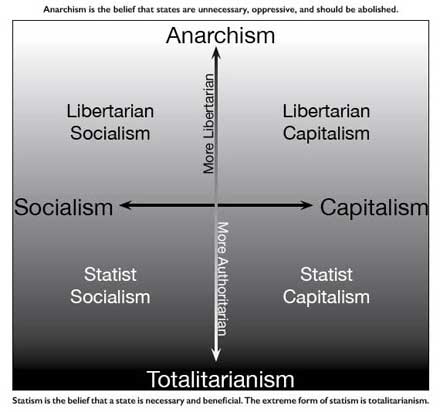

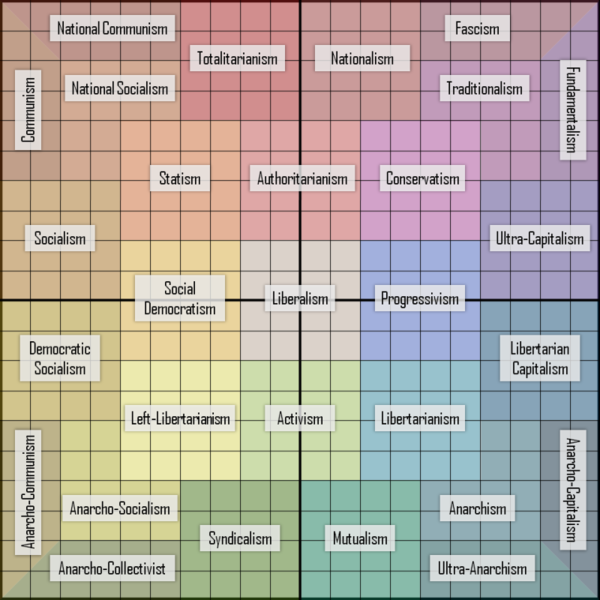
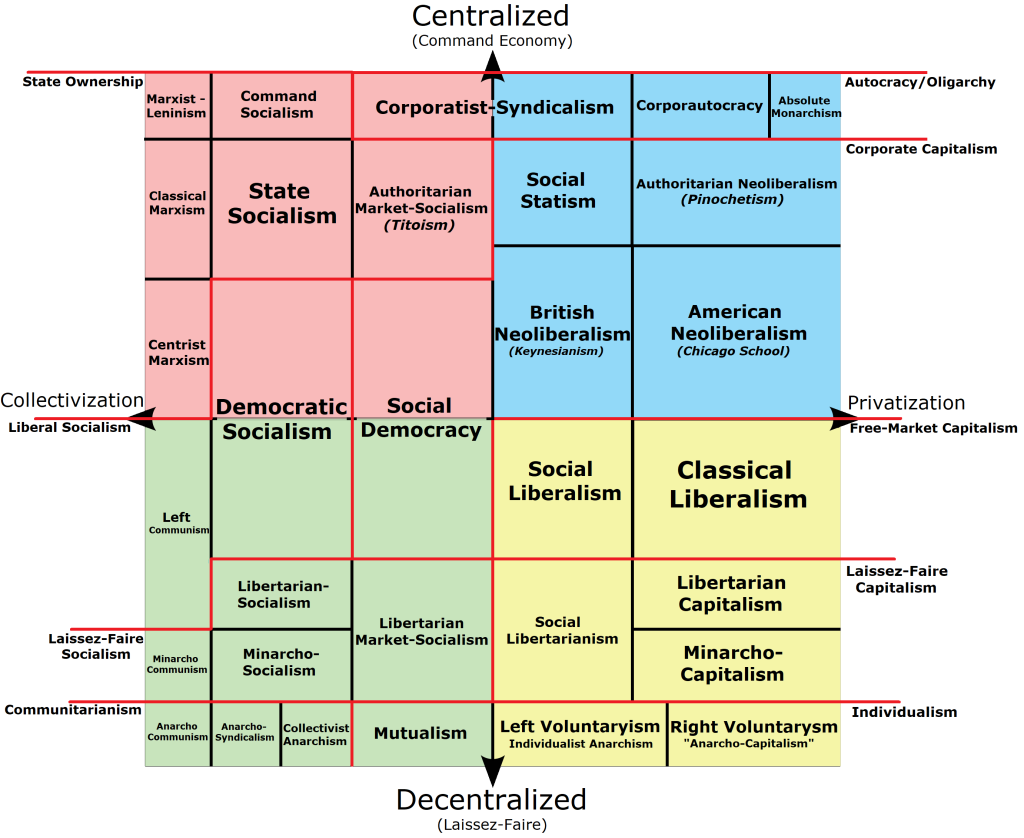
Predictably, there is a fair amount of variation, not to say confusion, about what “left” and “right” represent. This seems right, actually. My argument has been that there is really nothing stable about the left–right opposition, which varies greatly from one context to another.
What then is the place of the classical liberal on the political spectrum? I wouldn’t care to try to make my own 2-D political spectrum diagram for the present-day U.S. However, I’m inclined to see classical liberalism as being more-or-less equally concerned with the interests of the marginalized and the interests of hierarchy. So, whatever such a diagram would look like exactly, I imagine the classical liberal would be somewhere near the middle of the left–right axis and somewhere near the “liberty” pole of the liberty–oppression axis. But what distinguishes the libertarian or classical liberal is not a position on the left–right dimension, but being toward the liberty pole of the liberty–oppression dimension.
 Policy of Truth
An alternative perspective:
https://bleedingheartlibertarians.com/2012/11/the-distinctiveness-of-left-libertarianism/
LikeLike
I don’t think that the Left can be understood in abstraction from a concern with justice. The standard left-wing criticism of classical liberalism is that its focus on liberty understood as freedom from coercion and respect for individual rights is too narrow to cover the range of moral concerns relevant to social life. And the Left’s critique of the Right is that the Right is either indifferent to injustice, or actively committed to perpetuating it. I don’t think this concern for justice can be reduced either to individual rights or to compassion. It’s a distinctive, normatively irreducible commitment. And it’s at the heart of what makes the Left the Left.
Personally, I don’t think it’s necessary or desirable to come up with an account of the Left that precedes the Enlightenment or the French Revolution. The Left strikes me as a distinctively modern phenomenon, a response to a certain aspect of modernity. I don’t think it can coherently or usefully be applied to the world prior to that. The application of Left and Right to, say, Thersites and Odysseus strikes me as strained. There are huge swatches of history where the Left/Right distinction has no clear application. But once we get to the part of history that’s driven by the specifically European conception of modernity, the distinction starts to make sense.
Phrased in terms of justice, the idea behind the Left is this: We inherit from both ancient Greek and traditional religious thought the idea of an all-things-considered justice. Aristotle has “general justice,” and religious traditions have divine justice. Aristotelian general justice is the application of all of the moral virtues, considered as a unity, vis-a-vis others within the context of a common good, on the model of the polis. Divine justice is the idea that our overall virtue is judged in each moment by an omniscient and omnibenevolent authority whatever our circumstances.
Now recall the thought we associate with Kant: unless justice prevails, human life is pointless. Suppose this is true. In that case, modern life really seems pointless. It’s not clear how to put a zealous, moralistic commitment to justice into practice in the modern world, i.e., the world that comes into existence in Europe via the Renaissance. This is the world brought into being by Machiavelli, Francis Bacon, and Hobbes: of ruthless, amoral mastery over the world and over others. What we gain in power in a world of this sort, we lose in the capacity to enact a comprehensive conception of justice.
Adam Smith’s understanding of capitalism makes this obvious (the passage you quote from The Wealth of Nations makes it particularly obvious), but the modern theory of the firm makes it grotesquely explicit. Capitalism is driven by the profit motive. The profit motive has nothing to do with justice. The two can sometimes accidentally coincide, but there is no inherent connection between them. This is painfully obvious to me working in health care, but it’s fairly obvious anywhere you look. Everyone in a capitalist society feels the tension between virtue and the profit motive in virtually everything they do. If they don’t, it’s either because they’re broke or because they’ve forgotten what justice really is. Honesty, integrity, and justice are obvious liabilities in market competition and obvious liabilities in modern political life as well. To try to live by them in a fully zealous, fully consistent, fully committed, and totally uncompromising way is a death wish.
Given this, classical liberalism invites us to ditch justice and settle for liberty, but that’s as unsatisfying as the “free will theodicies” of natural theology, and for much the same reason. Something inside us tells us that we deserve more than mere freedom, not just in terms of what we get from others but in terms of what we give them. So there’s always a temptation to rebel against someone or something that says, “No, you don’t deserve more. Shut up, stop striving, and be content with the fact that you’re better off than everyone who’s worse off than you. And here are the statistics to tell you exactly how many of those people we’ve counted up.”
In short, the price of enjoying the riches of modernity is the loss of one’s virtue, and of one’s soul. As far as prosperity is concerned, the inhabitant of modernity is either producer or consumer, but as far as justice is concerned, he or she is put in the position of a perpetual spectator, watching the perpetual defeat of justice–with a big salty box of popcorn in one hand, and an ice-cold Coke in the other. The instruments of modernity make prosperity possible at the price of injustice. Every modern liberal regime began in horrific, unspeakable injustice. Every such regime demands amnesia about those beginnings. Every one anesthetizes virtue along the way, then celebrates the plenty that results from the taming or domestication of virtue.
The moral and political outlook of the Left is a party-pooping rebellion against the preceding predicament. The Left insists, in the face of what seem impossible odds, that justice must be done in the Old Testament spirit (“justice, justice you shall pursue”) so that life can have whatever meaning it’s supposed to have. Often, this commitment seems completely quixotic, such as when people figure out that the only collective power they have to put justice into action is the power of punishment-through-cancellation. But, they figure, a quixotic power is better than nothing. Often, it comes across as an inchoate longing for the primitive. That’s a crude acting-out on the realization that our noblest conceptions of justice have no traction in the modern world. But modern capitalism is interested in production and consumption, and justice isn’t something you produce or consume. There is no real market for it, just limitless demand served by a pitiful supply.
I don’t really regard myself as a member of the Left (or the Right). What I find admirable about the Left is that it represents the last gasp of justice on Earth–justice making its last stand before it’s swallowed up by State and Corporation. It’s easy to bring up the worst features of the Left (or the worst versions of the Left) as a means of discrediting the Left as such, but it’s not an accident that across the last century, every movement for justice in American life has come from the Left: the civil rights movement, feminism, the anti-war movement, the labor movement, the movement for transparency in government and commerce, the movement for gay liberation, etc. It’s hard to think of anything comparable from the Right or center, both of which had to be dragged kicking and screaming toward justice in every one of these cases.
But whether you share that estimation or not, justice strikes me as an essential motivation of the Left. There is no Left without justice. The contrary may also be true.
LikeLiked by 1 person
Hi Irfan,
Thanks for this stimulating comment. Naturally, I disagree with pretty much all of it 😊, but that’s how our thinking develops. Speaking of development, I have to say that I am working out these ideas as I go along. Right from the beginning of my participation on this blog, I have noticed, somewhat to my surprise, that I seem to be a conventionalist about morals. What caused me to notice it is that everyone else here seems like a staunch realist. And so there has been this contrast. But it has remained inchoate, at least on my part. Moral and political philosophy is at the opposite end from my specialization, so I’ve never felt very qualified to talk about it. My primary goal for the next let’s say two years is to change that. The last couple of months have been pretty hectic, as I arranged my retirement, and the summer will probably be as well. So, progress may be slow at first, but eventually I hope to produce something worthwhile—and to blog a lot more than I’ve been able to do in the past seven years.
I don’t know how much of an irrealist I actually am, and one of my top priorities will be to figure that out. I find it very difficult to accept that there’s no such thing as the human good. In that way I seem to be a realist. On the other hand, I regard “morality” as a special way of thinking about or framing decisions: distinctive in that it precludes cost–benefit considerations. The effect of framing an issue as “moral” is precisely to rule questions about cost and benefit out of bounds as inappropriate. There are various reasons why we might have evolved the capacity for moralistic thinking. The obvious reason—or anyway, what comes to mind first for me—is to solve collective action problems. But I think there are many other cases where utility-maximizing reason falls short (sticking to an exercise plan, for instance). In this light, “morality” is simply the code of rules that we frame in this special manner. They may help us live better—but not necessarily. There are plenty of examples of unfortunate moral rules. But whether good or bad, moral rules are cultural-evolutionary products downstream of other factors, especially material conditions, but also emotional reactions and other things. A simple example is food taboos, which may evolve for various reasons. When they are a response to material conditions such as toxicity of certain foods, they are liable to be beneficial. But regardless of that, their status as moral—i.e., as non-negotiable prohibitions—consists in nothing more than that we treat them that way. And we treat them that way, namely as “moral,” ultimately because if our respect for them depended on finding good reasons, then we wouldn’t be able to respect them. So, this is a pretty deflationary view of morality! Morality as such has no special value. Moral rules sometimes contribute to the human good, sometimes not, hopefully more often the former than the latter. It is no different than dietary or child-rearing or hunting practices in this regard.
So, part of the reason I don’t identify the left as “the party that is concerned with justice” is that I don’t think justice is a fundamental. On the other hand, the opposition between chaos and order is fundamental to human experience, as I briefly described in the post. In a lesser way, I think the opposition between equality and hierarchy is also fundamental. Hierarchy per se is necessary and good, but it is very often abused (even when the form of hierarchy itself is unproblematic, which it often isn’t), and this sets up conflict. I don’t see any reason to suppose these two fundamental oppositions only arose or became important with European modernity. Maybe consciousness of a left–right opposition only arose late. Probably this is true, since I can’t think of any discussion that gives a central role to anything like a left–right opposition (or a chaos–order or equality–hierarchy opposition) in any pre-modern literature. But that’s no reason to suppose that these forces were not at work. If you think about the history of ancient Athenian democracy, for example, there were basically two parties, for and against, and it seems pretty natural to describe them as left and right.
But the main reason I wouldn’t say justice is an essential motivation of the left is that I don’t agree, in very many cases—maybe even in most cases—that what they are fighting for is justice. Leftwing fights to ban nuclear energy, pass environmental protection legislation, address climate change, enact some kind of universal medical care, free childcare, forgive student loan debt, ban plastic straws, and the like—none of these are justice movements. Notwithstanding that their advocates use phrases like “climate justice.” Calling it justice doesn’t make it so. These movements are often rooted in a desire to aid those deemed less fortunate, as my analysis predicts (and I addressed many of the nuances in the post), but that is just not the same thing as justice.
Your own list of “movements for justice in American life” isn’t much different: “the civil rights movement, feminism, the anti-war movement, the labor movement, the movement for transparency in government and commerce, the movement for gay liberation.” The civil rights movement I’ll grant you, but the status of the rest as “movements for justice” is at least questionable. Take feminism. Taking the long view—beginning in the year 1800, say—this was a movement to give women equal legal status, voting rights, and, most importantly, social equality with men. Is any of this really about justice? Maybe, but I’m not so sure. The patriarchal arrangements of the past were rooted in material conditions that encouraged a pretty strong sexual division of labor in which women were homebound while men did heavy labor, hunting, and fighting. This was the situation for the entire history of our species until just a few hundred years ago. I don’t think it was generally regarded as unjust (which is not to say women were happy about their status). This is an example of what I meant when I said above that morals are downstream of material conditions. What happened in the 19th century isn’t that we suddenly gained insight into moral reality that had eluded us before, but that the material conditions changed. The machine age arrived, and with it prosperity, eased living conditions, far less brutality, and “knowledge work.” In short, women’s liberation happened because it became possible. But this was a 200-year cultural evolutionary process, part of which required rethinking women’s nature and capacities. That is, I think women used to be considered men’s natural inferiors. This justified (or rationalized) women’s inferior social status. This would be why women’s second-class citizen status wasn’t regarded as unjust and why the crusade for female equality doesn’t feel like a justice crusade to me. To be clear, all I’m challenging here is whether feminism should be considered a justice movement. I would not deny that the early advocates of women’s equality were visionary and of the left.
The same sort of thing is true of gay liberation. The social position of gays was rooted in the public perception of homosexuality, which was divided between whether it was morally degenerate or a psychological malady. Changing the social and legal status of gays required changing that perception. It wasn’t a simple matter of identifying and calling out an injustice, because whether there was any injustice in the first place depended on that perception. As for anti-war, labor, and official transparency, these might in certain ways be about making the world a better place, but I don’t see any of them as primarily about justice.
Along with your list of left-initiated justice movements, you remark: “every movement for justice in American life has come from the Left… It’s hard to think of anything comparable from the Right or center, both of which had to be dragged kicking and screaming toward justice in every one of these cases.” I mostly agree, and this fits my analysis. The right is the party of stability, the left of change, both for better and worse. So, even where the right does mount a crusade for justice, it’s often not on behalf of something really novel. Rightwing crusades aren’t unheard of, however. The mid-20th century liberty movement, in the Mont Pelerin Society and others, is an example, I think. (Unless you want to say they’re actually leftwing, but I don’t think they’re usually thought of that way. On my own analysis, they’re neither.) Rightwing resistance to communism, when the left was pushing it and denying what was going on in the U.S.S.R. and other communist countries, would be another example. I don’t think this should be regarded simply as pigheaded resistance to progressive ideas. I think they thought communism was morally wrong. One could also name the anti-abortion movement, which I discuss in my post. That’s not a movement I would embrace myself, and one could say they have mixed motives there. But most movements have mixed motives, and I don’t think the justice element in the anti-abortion movement is deniable.
It is evident that we have quite different ideas about what justice is. Just as an ordinary language concept, it seems that justice is done when people get what they deserve. But that’s just to say that the concepts of justice and merit are analytically tied together. It does not much constrain what justice substantially is. Different ideas of justice reflect different conceptions of what people deserve, and these can vary quite a lot. What is due to a person can be thought to depend on their personal merit or virtue, on their actual accomplishments, on their contributions to a project, on nobility of birth, on bare personhood, citizenship status, age, profession, and on and on. Also, exactly what is due to an individual in light of his status can vary quite a lot. There are people today who think that if someone cannot obtain healthcare when others can, that is unjust. There are or have been other places where people think that if the prerogatives of noble birth aren’t respected, that is unjust. And so on. You may think that there is a real justice, which particular community standards of justice approximate with varying degrees of success and by which particular community standards should be judged. But, as I explained above, I don’t think this.
Capitalism is a system of justice, isn’t it? Isn’t this a pretty standard libertarian view? Justice is what happens when people’s rights are respected. Injustice is what happens when people’s rights are violated.
On behalf of capitalism, I would suggest that it is a system that aligns the rules of justice with economic efficiency. That’s not everything, perhaps, but it’s a lot. All things considered, prosperity beats the hell out of poverty. (In cultural-evolutionary terms, this probably helps explain the rise and spread of capitalism and its correlative conception of justice.) Plus, it leads to profound knock-on benefits—see the discussion of feminism above.
It might seem to be a flaw in capitalism—maybe this is part of your complaint—that it doesn’t distribute economic rewards on the basis of moral merit. As Hayek points out (Constitution of Liberty, chapter 6), this is a necessary feature of a system of liberty. In such a system, there is no central authority distributing goods or rewards. Rather, rewards are distributed to those who offer something that others want to buy, and people are much better able to judge the value to themselves of goods for sale than the moral merits of those who offer them, the effort and ingenuity that went into producing them, and so on. I would add that the disconnect between moral merit and material reward is probably a necessary feature of any social system, not just capitalism, and for the same reason as with capitalism: it is no easier for a central authority than for anyone else to know the moral merits of individuals. There has never been any social system where material rewards corresponded to moral virtue, and it is hard to see how there ever will be.
However, it is not at all true that capitalism is amoral. Capitalism depends essentially on people’s virtue. In fact, I seem to recall posting a long essay on this blog about this very matter. It is true that the game of capitalism is about the self-interested pursuit of money. But it’s not a free-for-all. The game has rules, without which it cannot function. These rules are the rules of justice (capitalism style: respect for others’ rights). Moreover, for capitalism to function optimally, greater moral virtue is required from community members than merely refraining from violating others’ rights. High economic efficiency requires that people be scrupulously honest, forthcoming with information, including information unfavorable to their own interests, trustworthy, non-litigious, and so forth. And remarkably, life in a market order and the inclination to fairness seem to reinforce each other: fairness in economic games such as the Ultimatum Game and Dictator Game is correlated with exposure to markets (Henrich et al., 2010). Again, market-based societies tend to be high trust societies, and vice versa. My interpretation of this is that in a market-based society, people are accustomed to seeing cooperative and fair-minded behavior working to everyone’s advantage and become habituated to such behavior. In non-market societies, people’s situations are more often zero-sum, and they are habituated to behave accordingly (i.e., “every man for himself”). Whatever the explanation, the correlation between markets and “impersonal prosociality” is what we empirically observe. (For much more on this, see Joseph Henrich, The WEIRDest People in the World.)
Which brings me, finally, to your remarks about the “predicament” of the modern world of “ruthless, amoral mastery over the world and over others,” in which “honesty, integrity, and justice are obvious liabilities,” virtue and justice are dead, and life is meaningless. These claims strike me as bizarre, frankly. I’m reminded of this cartoon, which I saw just yesterday. The weirdest part is the idea that modernism, starting with Machiavelli, Hobbes, and Bacon, initiated a soul-destroying world of amoralism, as though previously there had been somewhere—in Europe, apparently!—a moral paradise of justice and virtue. Whereas it seems clear to me that there has never been a gentler, kinder, more upright, accommodating, helpful, and nurturing world than one we are blessed to inhabit today. Life is precarious, of course, and not everyone is nice. But if there’s ever been a better world in actual reality than what we enjoy today, name it.
Unfortunately, it’s taken me a while to make this reply, and on Sunday I’m leaving for the Galápagos Islands and won’t return for nearly two weeks. So, I don’t know if there will be time for another round before I leave. But I would be happy to pursue this further in however disjointed a manner.
LikeLike
David,
I definitely intend to respond to this, but unfortunately, my schedule is very tightly packed, so that I only have a single day in any given week on which to write. So my response will be much delayed, but I’m not ignoring you.
LikeLike
Good timing. I have connectivity for the first time in 3 days, sitting in a restaurant called Muelle Darwin in Puerto Ayora on Santa Cruz island, Galapagos. (They have wifi.) If our luck holds, will be back in the U.S. on Friday.
LikeLike
For the next week, I will almost certainly have connectivity, and will have it for the duration, but will have it while sitting in cubicle C-37 on the eighth floor of the BASF Building, in the Business Analytics and Reporting Division of the DRG Downgrades Unit of CorroClinical, in a town with the confected corporate name of “Metropark, New Jersey.”
I could rest my case there. Where is the justice?
LikeLike
David,
I’d certainly welcome your blogging more, and working out your throughts here on realism or whatever else strikes your interest. I haven’t quite lived up to my “vow of silence,” but my aim is to go relatively quiet for at least the next six months, if not more than that. I have a lot of reading, thinking, private journaling, traveling, and other things to do, and blogging is a distraction from it, especially on my schedule.
My own views have changed as well over the years. The realization I’ve made over the last decade or so is more specifically political. I’m the same moral realist I ever was, but before, say, 2012 or 2013, I’d always thought of myself as a political moderate, even at times as something of a self-conscious centrist. I started my political life in my teens as a conventional Democrat, went through a phase of libertarian fellow-traveling in college and grad school (I was a Republican in name at least into my forties), and then circled back to being a conventional Democrat for a short while. That’s changed. Though I don’t really identify with the Left, most of my political views now overlap with the farther (even the farthest) reaches of the Left. I regard much of what I previously believed–about America, about capitalism, about world history and politics–as positively delusional. And much that I would candidly want to say about politics now is either cancel-worthy or flat-out illegal. So I now face a dilemma I’ve never faced before: I can only be as candid as prudence allows. As a person used to running his mouth, this is an unexpected and unwelcome novelty in my life. It mostly doesn’t affect what I say in this comment.
Both of our comments sprawl over far more than can adequately be handled by yet further comments of the same length (or any comment of manageable length), so instead of trying to respond to every last thing you say, I’m just going to focus on clarifying the basic issue. The rest I’ll either have to leave, or leave for another occasion. Despite the length of my comment, I’ll have to assert some things without laying out explicit arguments for them, or offering evidence that’s close to sufficient to clinch the case.
Your original post is an exercise in explanation and understanding. You’re trying to identify what the right-wing/left-wing distinction is about. My assumption is that in doing this, you first have to produce an account of what each party takes themselves to be doing. In other words, you first need to produce an account of the Left and the Right that a leftist or a rightist would recognize as their own. Having done so, you can then offer a debunking account of, say, the Left that reduces the Left’s high moral aspirations to something lower than it claims. But a reductionist project presupposes an adequate account of the thing you’re seeking to debunk. An account of the Left that omits justice is like an account of the Right that omits liberty. It’s too truncated to count as an adequate account of the relevant target.
So I would insist that you need an account of the role that justice plays in leftist thought. I don’t think it helps things to say that “chaos and order” are more fundamental than justice. I would say that both “chaos” and “order” are parasitic on a conception of justice. Order is a settled state, and chaos a substantial deviation from order. If the settled state is evil, then order is a bad thing, and chaos maybe undesirable, but not quite as bad. If the settled state is good, then order is preferable and chaos problematic. But in abstraction from the goodness or badness of some baseline, “chaos” and “order” have no real meaning, or at the very least, no real normative valence.
Is a heavy metal concert chaotic? How about a street protest or a strike or a riot or a military manuever? Neither a bare “yes” nor a bare “no” tells us very much of normative significance about these events. The apparent chaos of a heavy metal concert is the very definition of order to a metalhead; it will seem like chaos to someone who hates heavy metal. That’s because the issue is there purely aesthetic; justice can legitimately be factored out of the equation, and replaced with a specifically aesthetic standard. But aesthetics aside, it’s hard to set justice aside and then try to evaluate human affairs in terms of “chaos” and “order.” I’ve been in a few riots. Since I sympathized with the rioters in every riot I’ve been in, I saw order in their resistance to injustice where others might have been inclined to see chaos. I only saw “chaos” in the actions of the people who came to stop the riot. As I saw it, the rioters had justice on their side; the army and the police did not. What chaos there was arose from the injustice the other side brought to the scene. What order there was arose from the justice we brought to it. Anyone watching, say, the Al Aqsa Riots of 2017 on TV might well have equated the thrown rocks, loud chants, and angry gesticulations of the one side with “chaos,” and the rigid, supposedly rule guided law enforcement of the troops as “order.” That, I would say, is an illusion of perspective.
The preceding doesn’t require agreeing that the Left has been correct about the causes it’s pursued in the name of justice. I understand that you may reject the substantive justice claims of the Left. But the question is not whether the Left is right or wrong about the substantive justice of the social or political causes it’s pursued. The question is whether the Left has been motivated by the conception of justice I mentioned (and will elaborate on below) or by something else.
To reduce the sense of the bizarre that you perceive in what I say, let me spell out what I have in mind–meaning, spell out what I mean by justice, and spell out the connection between justice and the loss of meaning in the modern world. To do this, I have to help myself to some familiar concepts in ancient Greek ethical thought. The locus classicus of the conception of justice I have in mind is Aristotle, whose ethical aspirations, for better or worse, find their way to the Left via Marx and his successors. Another version of Aristotle’s conception of justice finds its way to the modern world via Thomism, which also comes in right- and left-wing versions, but Thomist leftism is decidedly a minority view in intellectual life. Objectivist-influenced classical liberals like to cite a third version of Aristotelian justice that finds its way to classical liberalism via Locke and Mill, but this is a much pared-down version of justice, one that leaves much of what’s distinctive to Aristotle behind. For instance, Locke’s liberalism really substitutes rights for justice, and while Mill is in some sense a justice-oriented Aristotelian, his over-all view is a complex mess of its own, complicated by his simultaneous commitments to utilitarianism, socialism, nationalism, and imperialism. Anyway, Aristotelian justice travels to the Left via the Early Marx.
Back to Aristotle: Aristotle famously draws a distinction between ‘internal’ and ‘external’ goods. The internal goods are somehow internal to the agent’s character, or I would say, his moral character, the part of his character within his volitional control. The external goods are genuine goods, but auxiliary and subordinate to the internal ones; necessary but such that their possession or not is in some sense out of the agent’s control. Virtue is an internal good, wealth an external one. Justice is one of the central (or cardinal) virtues, and ‘general justice’ is the central (though not exclusive) part of that central virtue. That’s what makes justice fundamental to the human good: we are fundamentally social animals, and general justice is the most fundamental part of the good most fundamental to us, expressed in the context most natural to us. Even in solitude, human beings think about and talk to others, and how they do that is, on Aristotle’s view, governed by justice.
Here is Aristotle’s account of what Irwin translates as “general justice” at Nicomachean Ethics V.1:
This conception of justice is as broad as any that I know of. As I’m sure you know, the relevant term for justice is dikaiosune, which effectively translates to ‘righteousness.’ The essential idea is that justice consists in acting on the sum of the requirements of virtue toward others, and expecting the same with respect to ourselves. It’s a matter of exercising all of the virtues, all of the time, within a community or polity geared to doing so.
To explain this properly, I would need to spell out the requirements of all of the virtues, then explain how, when summed and integrated, they add up to general justice. Since I can’t do that, the best I can do for now is to gesture at or cite examples. Some anodyne literary examples: Jean Valjean in Les Miserables, Jane Eyre, Dorothea Brooke in Middlemarch. Somewhat more contentious example: Robert Jordan in Hemingway’s For Whom the Bell Tolls. The activists of the various movements I mentioned in the earlier comment are examples. Frederick Douglass and Ida Wells are good examples. James Baldwin is another. Martin Luther King is a good, if imperfect, example. So is Theodore Hesburgh. I recently saw a documentary film, “A Time for Burning,” which featured a young firebrand named Ernie Chambers, now a State Senator in Omaha, Nebraska. He strikes me as another example.
Beyond that, my examples get contentious, and require a descent into nitty-gritty details. For instance, I regard the Weather Underground, the Black Panthers, and the PFLP as imperfect exemplars of justice. I unapologetically admire Sirhan Sirhan for killing RFK, and for being willing to suffer lifelong imprisonment for it. Such examples will not be to everybody’s taste, but you get the point.
The demands of justice so conceived are far broader than respect for rights or respect for liberty. Nor is justice reducible to reward for merit or punishment for legalistic infractions. Nor, obviously, is it simply a matter of improving one’s material circumstances, or expanding one’s opportunities, etc. There is no implication in Aristotle or Aristotelianism that morality requires the abandonment of cost-benefit considerations, but there is the denial that there are any ‘justice-free’ zones in socio-political life, i.e., large swatches of life where the concepts of moral rightness and wrongness lack application altogether, and must therefore be suspended. Thus, MLK’s commitment to justice was, on this view, compromised by his infidelities, and would be compromised to the point of nullification if the worst rumors about him turned out to be true.
I’ll return to the implications of this, because as far as I can see, I think it’s obvious that Aristotelian ‘general justice’ is flatly incompatible with capitalism as conceived by almost all of its defenders, whether moderate or radical. The activists I’ve just mentioned were all in some way critics of capitalism. This is not because they had a better alternative in hand, but because much of what they said in criticism of capitalism was right. You don’t need an alternative to criticize something. I had no alternative to the parents I grew up with, and yet it’s pretty clear to me that there was much to criticize in them. It’s difficult in my circumstances to leave the United States, but that’s no conceptual obstacle to my passing a completely adverse judgment on the place.
Most defenders of capitalism have not ventured to claim that capitalism entails or presupposes justice in any sense, much less Aristotle’s. At best, they’ve tried to reduce justice to its least common denominator (and sometimes to something lower than that), and then insisted triumphantly that capitalism is a system of justice. This is what the Mt Pelerin Society has done for its entire existence. It has reduced justice to The Liberty of Western Man, and treated that as a proxy for “justice.” It’s no such thing.
In general, classical liberals have not only not give much weight to justice, but spent a lot of time inveighing against the very idea of justice or ‘social justice’ or ‘social justice warriors’ or (at their most narrowly polemical) ‘woke culture’ or ‘cancel culture’ as pathologies of justice. When Rand asserts in “What Is Capitalism?” that capitalism is “the system of justice,” she has in mind a minimalist conception of justice as trade or reciprocity that is light-years away from Aristotelian general justice. The Fountainhead is as close as Rand ever gets to the idea that justice is possible under capitalism, but The Fountainhead is to a theory of capitalist justice what Grimm’s fairy tales are to a theory of human virtue. It’s an epic-length fairy tale. While Howard Roark is Rand’s gesture at a man of justice, I don’t find it a credible portrait. Still, it’s telling that Rand feels the need to produce such a portrait, and that many of her readers find The Fountainhead her most satisfying novel.
Suppose that the aspiration to Aristotelian general justice, as the deepest expression of our moral aspirations as social beings, is a large part of what makes life meaningful. If so, then if a society was structured so as to make Aristotelian general justice impossible, it would literally have succeeded at extinguishing the meaning of life. It wouldn’t matter how well such a society might do at the production of external goods. It wouldn’t matter that no prior society in human history had ever achieved general justice. It wouldn’t even matter that every prior society had systematically violated general justice. You can grant all of those facts and still reach the following conclusion: a society that sacrifices justice to external goods has rendered life meaningless. Indeed, the more its existence depends on this trade-off, the more it renders life meaningless. Rendering life meaningless eventually becomes its residual proxy for meaning.
No matter how bizarre it sounds to anyone, I would say: that is the kind of society we live in. We live in a society that doesn’t just systematically violate general justice, but offers us a trade-off: the more we violate justice, and the more calmly we evade the fact of our own complicity in injustice, the louder becomes our collective self-congratulation for having created the greatest society of all time. A society like this will destroy whole peoples, threaten the existence of the whole world, and find itself addicted to perpetual warfare while claiming at the same time to seek peace. Having engaged in these mental contortions, it will then console itself with the thought that at least it’s having a great time destroying all of those barbarians. It will talk the most incredible game about its having reached the acme of civilization just as it finds itself descending into moral sewers the likes of which no one had ever seen.
If what I’m saying seems “bizarre,” consider what one has to normalize to avoid looking at it. Consider the foreign policy of the United States right now.
1. The United States, with Israel, is committing genocide in Palestine after having spent the last seven or eight decades avidly promoting conquest, military occupation, and apartheid there. The underlying assumption is that the US must guarantee an outpost of geostrategic stability in Western Asia, and if doing so requires an eighty-year commitment to ethnic cleansing, apartheid, and genocide, well, that’s just too bad for the victims. If Israel decides to invade Lebanon and drag us into a war with Iran, well, regional war will just have to become a sunk cost. This is the same thought that motivated the US’s support for apartheid South Africa (including its conquest and occupation of Namibia), along with its support of West Pakistan (in its genocide of East Pakistan), along with South Vietnam (requiring virtual genocide of North Vietnam), along with its having fomented civil wars in Syria, Iraq, and Libya, and one in Yemen. Etc. Just the highlights.
2. The US is fighting a proxy war in Ukraine, even to the point of courting nuclear war with Russia, despite the fact that doing so serves no defensive purpose. The US government has offered no credible defensive reason for engaging in this war, and the American people have not demanded one. It is just taken for granted that the United States must preside over a unipolar world, even if doing so results in the wholesale destruction of the world itself. If our Ukrainian allies (including the Nazis among them) decide to play a game of chicken with the Russians’ nuclear missile defenses, threatening to drag us into nuclear war with them, well, that’s the price of being #1. Nuclear war aside, if Joe Biden decides that we must sacrifice thousands upon thousands of Ukrainians in order to exact an even greater cost on the Russians, well, what choice do we have? A doddering, delusional Grandpa couldn’t be wrong. Not if he’s a Democrat, at any rate. Not only has that apparently happened, but its happening has been regarded with equanimity by a country unable to take in even close to that many Ukrainian refugees.
3. Despite decades of detente with China, the US is avidly preparing for a war with China–a war that’s to take place not in Taiwan but in our old imperial stomping grounds of the Philippines. (We’re already in a trade-war with China, begun by Trump and continued by Biden.) Why are we obliged to do this? Why the insistence on going from one extreme to the other? Because both extremes have exactly the same explanation: the United States must have a unipolar world. Either it guarantees that world through dominance in trade or dominance by force. But one way or another, the world must be made safe for unlimited acquisition.
Can we hope to win a war with China? No, but that doesn’t matter. Are we really obligated by treaty to defend Taiwan against China? No, but that doesn’t matter, either. What does matter? Just the fantasy of moralized belligerence married to the dream of worldwide hegemony plus total complacency about it. Why, after all, would anyone “back home” worry about the prospect of World War III? Unless “they bring back the draft,” the task of fighting World War III with China will be outsourced to “other people,” people that our intelligentsia doesn’t really have to deal with. But that’s the price of liberty and “civilization”–in other words, the price of shopping until you drop. Hundreds of millions of people entertain this bat-shit crazy thought without pausing to reflect on what it means. It means that one class of human beings consists of cannon fodder, another of shopoholics, and a third of spectators content to watch the sacrifice of the first to the folly of the second.
This is just the tip of the iceberg–and it’s mostly a swatch of the present, not the past. The last hundred years of American history, and the hundred years before that, have consisted of uninterrupted warfare: one war after another, after another, after another. Warfare is so much a constant of American life that we tune it out and ignore it, along with the sociopathic rationalizations our leaders offer for each new adventure, each new atrocity, each new pushing of the frontiers of brutality to some new brink of insanity. In this context, it’s the anti-war movement that comes across as crazy, not the warmongers. The warmongers seem perfectly normal to everybody. I happen to live right by Princeton University, my alma mater, and was part of the anti-war protests here in April and May. The anti-war protesters were treated with unmitigated contempt by the university, as presumptive criminals and pariahs. Who received an honorary degree at the university’s commencement? General Mark Milley. For what? For the “courage” of his standing up to Donald Trump. What courage? He raised his voice in anger at The Donald. Meanwhile, the people who called the police on the anti-war protesters, who defamed us as anti-Semites, and who greeted the university’s complicity in genocide with complacent acquiescence, sat around lecturing us about “civility.”
Suppose, for argument’s sake, that what I’ve just described really is the gentlest, kindest, most upright, most accommodating, helpful, and nurturing that humans have ever been. Wouldn’t that just serve to accentuate the distance between what human beings currently are and the conception of justice I mentioned a few paragraphs back? That’s precisely why there is a Left. A world in which normalized sociopathy–habituated insouciance about genocide, nuclear annihilation, the prospect of world war–is re-described as “gentle” and “kind,” is a world in which moral discourse has lost its connection to reality. It’s a world in which justice is not merely unrealizable, but has become an object of mockery. In a world of that kind, whatever the flaws of the Left, it serves one priceless function: it reminds us that we can do better.
The world we live in only seems “kind” or “gentle” if we re-conceive those traits in such a way as to require the evasion or minimization of the sociopathy that surrounds us. Right now, the two main candidates for the presidency of the United States are an indictable war criminal and a convicted felon. Hundreds of millions of people not only take this choice for granted, but regard voting for either Biden or Trump as a moral duty or even a moral achievement. Suggest to them that there is something wrong with doing so, and once again, they think you are crazy.
There is no way to explain pathologies of this kind away by suggesting that we live in a “kind,” “gentle,” and “upright” world. We live in a world ruled by some of the most vicious moral trash among us. And for all of the progress and power we enjoy, there’s absolutely nothing we can do about any of this–nothing that will change it in any substantive way. It’s our job to grin and bear it. The only real power we have is the power to turn away from it all–to abdicate the realm of politics altogether. But the abdication of politics is an abdication of justice–an abdication, I grant, that’s required to preserve any semblance of a sense of sanity or self-respect, but that also constitutes a kind of moral defeat. I would say: anyone who regards that as a “blessing” is asking too little of the world. Justice has fallen out of the equation.
I don’t dispute that life in the United States is, for a middle class person, more pleasant than life has been for most of human history or right now, in other parts of the world. But pleasurable comfort is not the meaning of life.
From a purely financial perspective, I live an impoverished life. My income is below the poverty line. I rent a single room in someone’s house. I’m tens of thousands of dollars in debt. But substantively, I live a pleasant life despite all that. I live in a nice, affluent town with nice facilities. I have good health care. I eat well. I have a Y membership. I travel. My home is air conditioned. Of late, I’ve even managed to snag a cute girlfriend. And so, it would appear, I have achieved the human good.
But I haven’t. My enjoyments are made possible by a regime that demands (and half-gets) my complicity in genocide. I can’t escape this. I can’t do very much about it. But I am undeniably involved. The more I acquiesce in their uses of me, the more I serve their ends. The more I do that, the more my life is tainted by complicity in evil. If I were a hedonist, this might not matter. But I’m not. If justice is part of my good, I have no choice but to fight a quixotic fight against injustice that’s rendered meaningful only insofar as there is some meaning to be derived from the sheer act of resistance. I know I will lose this fight. That’s why my life is meaningless. The people around me, for the most part, don’t even know that there’s a fight to be had. That’s why their lives are meaningless. It doesn’t matter how much stuff they have. It doesn’t matter how much pleasure I have. Whatever one can say about that, the story that the old, apparently mad religious prophets have told us about this predicament, from Ecclesiastes on, is correct: a life that substitutes pleasurable experiences for meaning while ignoring the fact that the world is burning is as meaningless as any life can be. To valorize a society that makes such a lifestyle possible is like valorizing a society of Nero’s. The Nero comparison is in fact apt, because so many American intellectuals, particularly on the Right, seem to think that “The Ancient Romans” are the moral model for us to follow.
I could tell a parallel story about our political economy right here at home. I don’t for a minute believe that capitalism incentivizes honesty or fair dealing. It incentivizes the very reverse. This would take longer to explain than I have time for right now, but consider just six important features of American capitalism: at-will employment; limited corporate liability; asymmetrical corporate bargaining power; corporate impunity for wage theft; the power and ubiquity of private equity, and the legal structure of a leveraged buyout. Take any company with all of these tools at its disposal. What incentive does it have to be honest about anything? None.
Suppose that I’m part of the C-Suite at some large corporation backed by a private equity funder. My aim is to make money, full stop. My tactic is, let’s say, the leveraged buy out. I buy ‘distressed’ companies, make them ‘efficient’, increase their ‘value’, and then sell them to the next buyer when the price is right. What part of any of that requires honesty? Suppose that I take a company that has some flaws, fire people at random with no regard whatsoever for their merit, hire on the basis of some ad hoc combination of nepotism and instrumental rationality, inflate the company’s value by cooking the books, sell it, leave, and repeat the same process for the rest of my career. Suppose that doing so requires me to tell ten lies a day and break twelve promises a week. Suppose that I ruin the lives of 100 people a year. Suppose that my underlings follow suit. Suppose that the whole company is based on a pyramid of lies. What would stop any of this from happening? It happens every day, all over the country. If the C-Suite and its managers have power over a workforce, and that workforce must eat in order to live, and be paid in order to eat, then the entire problem of profitability is one that’s been outsourced to the front line workforce. So yes, someone has to be working. But that doesn’t mean that the system is just. Nor does it mean that the system incentivizes honesty or integrity. Not if it’s run by thieves and frauds. And it is.
If this is an accurate description of how capitalism really works, then it marks a departure from justice in the name of privatized prosperity. It says: play the game, and you shall prosper. Forget everyone else. Just focus on you. But do it by pleasing the guy just above you. If you dream it, you can get it. If we dream it for you, you’ll get it even faster. The fastest way to get it? Dream what we want for you, then do what we tell you. The game is called Please Your Overlord. Everyone plays except the person who lacks an overlord. Call this game whatever you want, but it’s got nothing to do with honesty, integrity, or justice. It’s an invitation to mutual corruption. We get this “moral ideal”–as well as the insouciant conception of imperialism I described earlier– from Machiavelli, Bacon, and Hobbes. It’s really Machiavelli who inaugurates it and brings it to fruition during the Renaissance, a period of history widely regarded as the most wonderful thing since sliced bread. It’s governed us ever since. It’s no accident that Machiavelli is the political theorist in the Western tradition with the greatest popular cachet, the guy anyone can bring up without boring everyone to tears. There’s Machiavelli for Women, Machiavelli on Business, and Machiavelli for Queers. You can’t get bigger than that.
There’s much more to say, but I’ve already gone on a bit. Let me end with a thought about the Left:
What motivates the Left is a grasp, however dim, of the archaic, “comprehensive” conception of justice I quoted from Aristotle, plus the sense, however confused, that contemporary life is predicated on the subversion of the Aristotelian ideal.
The more committed one is to the premises of liberal modernity, the more plausible it will seem that you live the best life any human being could conceivably live. It will seem so obvious that the only response to criticism will become: name something better than the status quo. But “name something better than what we have right now” is a demand for a past realization of a so-far unrealized ideal. That demand misses the point.
The Left’s point is that the ideal of Aristotelian general justice remains unrealized, and that liberal modernity is on a zealous quest to destroy it altogether while engaging in the pretense that our very well-being requires its destruction. They’re right about that. The more committed to, say, capitalism you are, the farther the distance you travel from “general justice.” Yes, you gain material comfort. But the foundation of capitalist prosperity is constant, amoral acquisition–of territory, of stuff, of profit. Liberalism can place the acquisitive impulse under constraints. It can describe the constraints as “rights.” It can equate respect for rights with “justice.”
But the ideal so conceived is not an expression of justice. It’s an expression of constrained rapacity. It’s Thrasymachus for the 21st century. When the constraints prove too constraining–when the price is right–the underlying rapacity comes to the fore, and becomes the thing that it was all along. This is why we are committing a genocide in Palestine, why the foremost propagandists for this genocide are big shot manipulators with deep pockets, and above all, why mentioning this screamingly obvious fact is the deepest, darkest discursive taboo in American life. The fact I’ve just identified has become unsayable because its assertion is reflexively equated with anti-Semitism. But the real reason it’s unsayable is that our ruling class needs to hide it from the world in order to commit the injustices on its agenda. It’s only by equating veracity with fascism that they can get away with genocide. Kant was right to say that the triumph of that aspiration would render human life meaningless. A world of forced subservience to the likes of Joe Biden, Donald Trump, Keir Starmer, Benjamin Netanyahu, and Bill Ackman is not worth living.
The politics of the Left is a rebellion, however quixotic, against such a world. And better a quixotic rebellion, I would say, than none.
LikeLike
Hi Irfan,
There are three main points in your comments that I want to address: whether the left is centrally concerned with justice; the status of Aristotelian “general justice”; and the relation of capitalism to justice. I’ll take these one by one.
With regard to the left and justice, I don’t agree that my account of left and right must necessarily be acceptable to their exponents. As you say, I’m trying to explain and understand them. I’m not having an intellectual debate with them where I have to show that I grasp their own understanding of their position. I just need an account that is true. If they don’t recognize its truth themselves, that might be because of a lack of insight on their part or a reluctance to acknowledge their real motives or for other reasons. For instance, I don’t think my account of the right is particularly flattering. Who wants to be told they stand for inequality and blind adherence to tradition? Their own self-concept might say they adhere to sacred values and natural social order or that their central concern is individual liberty. But I don’t have to take that seriously if I don’t think it’s true and I can account for their behavior—including their own self-concept—with my theory.
Now, what goes for the right goes for the left as well. Justice just does not seem to be as central to leftwing thinking and motivations as you say it is. There are lots of leftwing positions that have little or nothing to do with justice, and I enumerated some of them last time. Just offhand as another example, I remember in the 1980s a big flap about baby seals in the arctic that were said to be being clubbed to death by evil hunters. It got to be kind of a trope of the time, and I remember there was a conservative group that sold bumper stickers that read, “I ♣ Baby Seals,” to own the libs (as they would say today). The point is that this baby seal issue has little to do with justice and a lot to do with Jonathan Haidt’s Care/Harm moral foundation. The left has a big heart for the vulnerable, and that seems to be the fundamental factor. Of course, this can easily be moralized (that’s why Care/Harm is a “moral foundation”). And the left is often eager to do this, because it converts the issue into one of right-and-wrong instead of the personal preferences of leftists. And often this works. Even when it does, though, moralization alone doesn’t always comfortably make the issue in question a matter of justice.
Furthermore—also as I said last time—justice is not universal, but unstable and variable depending on societal/historical/material context. What justice consists of varies with time and place. Whereas sympathy, an impulse to equality, and openness to change are deeply embedded human attributes.
(On the chaos vs. order point, I would say that order is characterized by predictability, especially predictability in light of the immediate past. Chaos is unpredictable. Whether a heavy metal concert is orderly depends on how much it follows a pattern and the novelty of the plan. I think this is a pretty objective distinction, and it is psychologically fundamental, for human beings and for animals in general. See for example Daniel Kahneman, Thinking, Fast and Slow, chapter 5. Mere repeated exposure generates cognitive ease and elevated mood in response to a stimulus. Familiarity and predictability signal a safe habitat and unthreatening others. They encourage the organism to relax and let its guard down, make friends, establish relationships, etc. At the same time, the wider world beyond the familiar is out there. It can’t be avoided forever, and it’s not good to avoid it, because it comes for you eventually. It’s the realm of development and growth. This is an existential problem—the need to balance order and chaos—fundamental to human experience. Also on this point, check out (now don’t laugh) Jordan Peterson, 12 Rules for Life, pp. 35–44. This issue is much more fundamental to human experience than justice, and it does explanatory work that concern or lack of concern with justice can’t do. I think the right has a need for safety, security, and order that the left does not feel nearly so much. The left is high on openness to experience and low on conscientiousness; the right is the opposite.)
Again concerning justice in left wing thought, despite the love affair today’s leftists have with the word “justice,” it’s not so clear to me that left wingers have always been so partial to the word. The French Revolution slogan was “liberté, égalité, fraternité,” not “la justice.” The left has historically advocated for many different particular causes on particular grounds. Maybe there was tons of justice talk included in these, but that hasn’t been my impression. You could say that the causes in question were often issues of justice, whether that word came up frequently or not. But as I have already noted, many leftwing causes are amenable to moralization, and it can be rhetorically advantageous to give them that treatment. But that doesn’t mean that the root impulse behind them was necessarily moral to begin with. My impression is that leftists of the 19th and early 20th centuries were more likely to frame their goals in terms of progress and humanitarianism than justice. They were idealists who upheld forms of socialism and collectivism (and other schemes) as ways to make the world a better place, not as demands for justice. (For what little it may be worth, this page describing the history of the Fabian Society illustrates my point.)
Finally, another problem I have with associating the left especially with justice advocacy is that everybody thinks they stand for justice. Often opposite sides in a dispute have different conceptions of what justice requires. For example, “affirmative action” preferences in hiring and admissions on racial or gender grounds are both advocated and opposed in the name of justice. In this case, in my opinion, those opposed have at least as good a ground to claim the mantle of justice as those in favor. Which brings us back to the point that justice itself is kind of fuzzy.
So, on to Aristotelian general justice. I think it is odd to say the least to attribute to the Left in general a specifically Aristotelian conception of justice which you furthermore claim to have been transmitted to the Left via Marx. You don’t really say anything to support these claims. Were not pre-Marx leftists concerned with justice, then? And who is this Left? V.I. Lenin and Margaret Sanger and G.B. Shaw and Saul Alinsky and Bernie Sanders and the kids camped on the Columbia U. quad protesting the war in Gaza? How many of these are devoted to Aristotelian general justice? In their personal lives? I see the Left, as the Right, as extremely diffuse groups of individuals with vastly different beliefs and agendas only very loosely related into Left and Right camps.
However, the Aristotelian conception of justice you cite is certainly appealing. The key line is, “This type of justice, then, is complete virtue, not complete virtue unconditionally, but complete virtue in relation to another.” So, it is treating others as a completely virtuous person would do. It is being upright, fair, honest, brave, moderate, generous, judicious, understanding, and so on in one’s treatment of others. And this gives meaning to life because being a good person is the meaning of life; it is the central element of eudaimonia. I note that there has been a bit of a slide here from “complete virtue in relation to another” to “complete virtue unconditionally,” but never mind that. I’m inclined to agree that this is an apt description of a just person, as an ideal, and also that being a good person is the most important thing in life. If I could sum up what I take to be overall the most important value in my life, I’d say that I am trying to be a good human being. And I’m grateful that I happen to have something like the freedom that Aristotle thought was prerequisite to aspire to be that.
I would add some further elements to this, though, which I also take to be Aristotelian. “Virtue” in Greek, aretê as you no doubt know, originally meant excellence, and in Aristotle as I read him this remains important. This is why he includes in his table of virtues traits that aren’t usually regarded as moral virtues, like wit, friendliness, and being even tempered. Excellence is derived from a thing’s function (the ergon argument): a good eye sees well, a good flute player plays the flute well, etc. And so with the excellences of character: bravery is handling dangerous situations well, moderation is reacting well to opportunities for bodily gratification, and so on. Eudaimonia consists mainly of virtue because life is activity, and so a good life is acting well; i.e., excellent functioning. A person of complete virtue is most of all a highly effective person—a well-oiled machine, a high-performance engine. I’m not an Aristotle scholar, so I don’t know how controversial this reading is, but it’s mine.
Now, the thing is that this means that virtue alone doesn’t provide much positive guidance in life. The eudaimôn individual is highly effective—at what, exactly? I don’t think virtue alone has much to say about this. I think the answer is that we go through life pursuing our particular goals and projects, most of which we have to determine for ourselves with little guidance from any sort of universal values. And it is our goals and projects that occupy most of our attention. I said above that what I want most in life is to be a good human, but that is rarely at the top of my mind. I never say, “I’ll do X because that will make me a good human.” I say, “I’ll write an essay on left vs. right politics so I’ll finally understand it better.” I’m always trying to improve myself, but it’s always by the way, incidental to the substantive project in hand. Analogy: A writer may want most of all to be as good a writer as possible, but this alone doesn’t tell him very much about what to write. Furthermore, the primary focus of his attention are his particular writing projects. Honing his writing skills is done by the way. (And even if he makes a special project of, say, learning grammar or reading a book of writing style tips, this is not how he spends most of his time.)
This can help explain the paradox that, on the one hand, Benjamin Franklin’s portrait of himself in his autobiography seems like it could qualify pretty well as a picture of complete virtue. And I actually think that, despite some famous flaws such as philandering, he was actually a very high-performance individual and also morally good in more conventional terms. And yet, on the other hand, I appreciate Mark Twain’s remark that Franklin presents his actions “with a view to their being held up for the emulation of boys forever—boys who might otherwise have been happy.” Franklin’s relentless do-goodery is obnoxious after a while. It is not a requirement of Aristotelian complete virtue.
Finally, another point to be added is that what counts as an Aristotelian virtue will depend on what functions one’s mode of life requires. For example, Aristotle’s own list of virtues is rather gentlemanly, not to say aristocratic. It is not a list for people who work for a living, and indeed Aristotle thought that the banausic life was incompatible with full freedom and virtue. Contrast David Hume’s list of virtues, written in a more commercial age, which includes items like industry and frugality, which I doubt it would have occurred to Aristotle to regard as virtues. This is another example of the theme that morals are downstream of material conditions.
Lastly, on to capitalism. Capitalism seems above all to be a system founded on respect for the right of everyone to be free of coercion. Whether conceived in terms of individual rights or a non-aggression principle or a Hayekian “rule of law,” this seems to be the central principle: voluntary transactions and freedom of association. In this way it is a system of freedom from oppression, which is surely part of justice. It also establishes a sphere of each individual’s prerogative—particularly in the form of property rights—enabling people to freely pursue their activities, coordinate with others, and avoid conflict by setting boundaries.
This all seems like a pretty good deal to me—indeed, an excellent basis for civilized life—but you aren’t satisfied. To you, this is a minimalist, least common denominator, proxy for “justice” that sacrifices and violates true justice for the sake of mere external goods and thus renders life meaningless. Why or how this is so—that is, what is specially heinous about capitalism or modernity or liberalism—you never make clear. Indeed, you apparently reject the need to explain it:
But I think the demand is in fact to the point, because you evidently have a special ire for liberal modernity, which you seem to think represents a new level of depravity and vice zealously attempting to destroy Aristotelian justice, which may have been unrealized before but is now actively being stamped out. But it looks to me like the incentives to dishonesty, theft, violence, and corruption that we have today are the same as always and if anything are under better control today than they have ever been. But if things were better under feudalism, say, or the Roman Empire, because the overlords were pious and honest and never cruelly abused their subjects (who were often literally slaves), then you ought to say how. But if not, then your complaint seems to be a general misanthropy and despair that the human condition, at least since the invention of farming, is hopelessly meaningless and worthless and we should probably all just kill ourselves.
The support you provide for your attack on capitalism takes the form—in this comment and others—of an imagined scenario in which ruthless, corrupt, greedy, and cruel managers arbitrarily abuse, fire, and ruin the lives of their underlings for fun and profit and suffer no adverse consequences of their actions (except if the little people should somehow manage to cancel them by publicizing their outrages, a very rare occurrence). This would be an overwrought description even if we were talking about a non-capitalist society—feudal, imperial, totalitarian, banana republic, etc. These are the places where there is the greatest latitude for such abuse, because the institutions of power in non-capitalist societies are baked in by tradition or heredity or political and military force. Therefore, short of the downfall of the entire regime, they are guaranteed to continue. By contrast, under capitalism businesses can fail. And even short of outright failure, they are subject to competitive pressure from rival firms, and this threat strongly incentivizes them to care about doing a good job. And this is what we see in practice.
Every system of human organization and cooperation at scale has structure and therefore has points at which that organization can be manipulated and exploited for personal benefit. The most obvious case is a hierarchical structure with positions of power at the top, characteristic of armies, churches, corporations, and governments, but the phenomenon is general and applies to any large, structured organization. Therefore, people in such organizations are incentivized to exploit those pressure points. This is a totally general phenomenon not specific to capitalism. The incentives to injustice are with us everywhere and always. The difference between capitalism and the others is that capitalism has evolved a system of free enterprise and competition in which anyone can enter the market, and everyone is vulnerable to failure and therefore incentivized to do what is best for the successful performance of their organizations. As far as I can see, capitalism is the only system ever developed that has this feature. That’s why capitalism is not the problem; capitalism is the solution. It’s why there is less injustice under capitalism than under any other system.
(By the way, concerning your specific example of a leveraged buyout, I have an opposite view to yours. LBOs are good! They are another way capitalism keeps management on its toes, because inefficient, underperforming businesses will be bought out and reformed. And this is what we see: the operating performance of purchased companies is largely improved. Also, employment typically increases post-buyout, though by less than other, competing firms (which is to be expected of a more efficient firm). One reason that LBOs have declined in prominence since the 1980s is the introduction of new rules designed to make them more difficult to accomplish. This has been done, I think, in the interests of management. Of course, the great threat to capitalism is obstacles to competition introduced by government, usually at the behest of economic agents eager to escape that burden and the incentive to good performance that it imposes. This would be an example.)
For an analogy, consider democracy. Democracy is a shitty system in which demagogues are incentivized to pander to numbskulls whose political irrationality is exceeded only by their political ignorance. The situation is bad enough to make one wonder what democracy is good for after all. And yet there is an answer: democracy is the one political system in which the governed can dismiss their governors and in which therefore the governors are incentivized to care about doing a good job. And we can observe in practice that democracies as a rule are much better regimes to live under than the available alternatives. (Cf. Amartya Sen’s well-known remark that there has never been a famine in a functioning democracy.) Now, this being the situation, what should be your attitude? Are you going to say, “Well, then, we’d better have democracy,” or “Democracy reeks of injustice! Life is meaningless! And don’t ask me what system is better. That’s missing the point! I want Aristotelian general justice or bust!”?
You say capitalism does not incentivize honesty or fair dealing. I hope this is not supposed to be a reference to my own view. I have been crystal clear about this. Capitalism incentivizes profit seeking, just as everyone knows. At the same time, however, capitalism depends on an institutional framework and culture of virtue. Somewhat paradoxically, the egoistic profit seeking that goes on within capitalism requires—for it to be a space of freedom and productivity, for it to be capitalism—an external shell of justice and virtue. At a minimum, this external shell consists of the observance of individual rights. But that’s only the bare minimum. Optimally, the external shell of virtue goes considerably beyond that, as I detail in the long essay from eight years ago that I linked in my previous comment. It is perhaps odd that people living under capitalism by and large go along with these requirements of virtue—and the more capitalistic the place, the more they tend to do so. I have only speculative explanations for that (see previous comment, with references given there). Multi-level selection theory says that intergroup competition (e.g., between firms and between nations) selects for pro-social virtues, while intragroup competition (e.g., within a firm and within a nation) selects for egoistic virtues. Since most Americans think of themselves economically as competing within America against other Americans, the high level of prosociality in America seems to cut against the theory. Nevertheless, it seems to be true: empirically, the members of more capitalistic societies are higher in trust and trustworthiness than are the members of less capitalistic societies.
You’re right to say that “most defenders of capitalism have not ventured to claim that capitalism entails or presupposes justice.” There seems to be a lot of confusion here. Historically, most defenders of capitalism have come from economics, where they are perhaps only interested in the operation of the economic system, not its presuppositions. So, maybe they just don’t think about it much. However, more philosophical theorists, who ought to know better, haven’t been much more insightful. This includes especially libertarians. Ayn Rand is a case in point, with her disastrous contention that egoism provides a suitable basis for capitalism and for morals more broadly. I think Mises is no different, from what little I’ve read of him. (He thinks all human action is “rationally” motivated, where rationality is understood as personal desire satisfaction.) The “Left-Wing Market Anarchists” of the paper by Roderick Long that you cited are just as bad: market anarchism is predicated on the idea that market incentives alone can sustain the institutional framework of capitalism—that’s just why they think government (or any political, non-market institution) can be eliminated. And of course many other libertarians think their political philosophy is free of any substantive moral commitments whatsoever. They don’t dictate morals, they say, unlike everyone else with their authoritarian impulses. No, they leave people free to choose their own morals, if any! This is all misconceived, in my view.
Nevertheless, there is intelligent discussion of the relation between capitalism and morality and the ways they depend on and encourage each other. I have a growing shelf of books with titles like Moral Markets and Economics and the Virtues. Three recent books I can recommend (besides what I recommended last time, especially Joseph Henrich’s book The WEIRDest People in the World) are Samuel Bowles and Herbert Gintis, A Cooperative Species, David C. Rose, The Moral Foundation of Economic Behavior, and especially Deirdre McCloskey, The Bourgeois Virtues: Ethics for an Age of Commerce. Henrich and McCloskey are the closest to my own view.
LikeLike