See update at the end of the post, July 12. Second update, July 25.
One of the many problems with the “culture wars” in the United States is that almost all of the contested terms used in the debate have gone undefined. It’s common for people to speak loosely about “wokeness,” “cancellation,” “cancel culture,” “the Left,” and “Cultural Marxism,” as though these terms had some obvious meaning known by all. They don’t. In fact, in the absence of explicit definitions, all of these terms are mysterious to the point of meaninglessness. So despite contrary appearances, no one really knows what they mean. The absence of definitions of contentious terms tends to benefit people who don’t know what they’re talking about, but would like to conceal that fact from others. That might explain why so much talk on this subject has such a nonsensical quality about it, at once insular, enigmatic, and histrionic.
It’s almost refreshing, then, to encounter an actual attempt at definition from one of the most prominent anti-woke warriors on the anti-woke battlefield, Professor Robert George of Princeton University. Robert George is the McCormick Professor of Jurisprudence and Director of the James Madison Program at Princeton. He’s been a fixture at the university for decades; he started there in 1985, and by the time I matriculated in 1987, had become a kind of campus legend. He is, among other things, a devout Catholic, and a stalwart defender of the Catholic natural law tradition, with a long list of publications on that subject, much of it in defense of the policy implications of his theological views. Though it’s very hard to see Professor George as an oppressed person himself, he’s been an outspoken defender of Princeton’s most oppressed minority, its conservatives. Indeed, the defense of this oppressed minority seems to have become a consistent theme of his polemical efforts for the last several years.
Professor George recently moderated a panel discussion at Princeton called “When Professions Go Woke, Can Dissenters Survive?”* Here is Professor George’s attempted definition of “wokeness.” Wokeness, he says, is
the attitude of a person who regards his or her opinions as so obviously correct and so profoundly enlightened that those opinions may not legitimately be challenged or questioned, and that only hate and bigotry can explain other people holding different beliefs.
Well, that’s clear enough. Three comments.
1. Surely on some subjects, there’s nothing unreasonable about being woke by this definition. If the topic of discussion is the flatness or non-flatness of Earth, or whether the Holocaust really happened, the partisan of non-flatness or the reality of the Holocaust might reasonably adopt an attitude of wokeness without necessarily inviting censure. We’re all woke about David Irving. I doubt that Professor George or his panelists would disagree.
The unwoke David Irving. Photo credit: Allen Warren on Wikipedia.
2. Setting aside subjects like the preceding, the next obvious question is: who has the attitude Professor George holds out for criticism? Put differently, how many people hold it, and across how many domains? Either a lot of people hold it, or very few do.
If a lot are claimed to hold it, I’d like to see real empirical evidence that they do. Go back and re-read the definition before you hunt down this evidence. Note that the definition says that the woke explain disagreement by way of “hate or bigotry.” Just a common sense point: you don’t need to explain someone’s views by way of “hate or bigotry” in order to cancel them or refuse to invite them somewhere. You may simply think that the person in question doesn’t deserve an airing in the space you control, or is somehow inappropriate or inapposite to the position or occasion in question. So out they go. Nothing personal.
This is likely why, for instance, despite the application I’ve made to Professor George’s own program, I haven’t been accepted there. Is it that Professor George regards me as a hateful or bigoted figure? Or is it that he just didn’t want me around? The latter, I think. It could be that my pro-choice, pro-euthanasia, anti-American and generally irreligious views played a role here. Who knows? It’s not as though anyone gave me a candid explanation, not that I ever expected one.
I’ve made this point before, and suppose I’ll have to make it again and again until it gets through. But it’s a really, really obvious point: Selections and de-selections are made throughout professional life, some of them consequential for the person on the receiving end. That’s how American business works, and has always worked.
That the criteria of selection are now, in some places, becoming political and tinged by left-wing considerations is not that dramatic a development. It does not show us that personnel decisions have suddenly, abruptly become unfair through the power of the Left. Most workplace decisions are made by unknown non-criteria, and always have been: throughout the professional world, people are invited, disinvited, hired, fired, promoted, demoted, etc. for absolutely no known reason whatsoever. The affected people deal with it, pick up the pieces, and move on. No one invites them to Princeton to talk about it. No one writes it up in the pages of newspapers and magazines. It just happens, again and again and again, without anyone noticing or caring–every day, hundreds or thousands of times a day, with consequences far more serious than anything that Robert George or his panelists have ever experienced or imagined.
In the three years since I’ve left academia, at least a dozen of my academic colleagues have been fired from my old institution (Felician University), and countless colleagues have been “let go” from the firm at which I currently work. Two dozen were fired at Felician in the decade before that. The AAUP has published a list of censured academic institutions since 1969, all censured for violating the norms of academic freedom. It’s a long list, involving an even longer list of wrongful terminations and demotions. But little of it has anything to do with specifically left-wing cancellations. The list precedes the issue of “woke culture” by decades, and involves issues completely orthogonal to wokeness. What about these cases? Do they all lack moral weight because they fail to fit Robert George’s ideological template? No one regards them as newsworthy. Somehow, an academic termination story only becomes newsworthy if it’s re-described as a “left wing cancellation.” A non-academic termination story only becomes newsworthy if it’s re-described as a left-wing cancellation. Otherwise, it’s all taken in stride. I have not heard a cogent explanation for this striking double standard, certainly not from Professor George or his panelists.
Abrupt terminations or cancellations are not breaking news. They’ve been happening for decades if not centuries. That Professor George and his cohort are just now freaking out about them raises the question of where they’ve been for the last sixty, eighty, or a hundred years. What professional life have these people seen, and what entitled expectations must they have, that they think that American personnel managers owe anyone a measure of fairness or transparency about decisions to hire, fire, or demote? Have these people ever heard of the labor movement? Of strikes? Of scabs? Of at-will employment? Of unemployment, foreclosure, or bankruptcy? That’s where the consequences and stakes of ordinary terminations become real. Can we really talk about the ups and downs of life in “the professions” while averting our eyes from these very basic, elemental things? Apparently Professor George and his students think they can. But once you focus there, the issue of wokeness recedes into insignificance.
Anyway, I’ve looked for evidence of a huge population of woke people stalking the land, and found literally nothing confirming it. If Professor George et al have better evidence, it’d be nice to see it. But I seriously doubt that the “woke” by Professor George’s definition amount to very many people, much less a “culture” of oppression dominating the country. One panelist half-apologetically acknowledges that he only has anecdotal evidence to cite, but none of the panelists say anything to upgrade the epistemic status of the anecdotes they offer to get us very far. It’s nice to acknowledge the limits of your evidence, but it’s not much of an acknowledgement, if in the next breath, you pretend not to have made it or grasp what it implies for your argument.
If very few people hold the view in question, we can reasonably ask why so much effort is being spent to attack the views of such a tiny minority–taking Professor George’s definition literally, a minority whose numbers hover around the null set. The idea that a tiny minority of people control a whole nation or culture is generally thought to be the mark of a far-out conspiracy theory, like invoking the Protocols of the Elders of Zion to explain the foreign policy of the United States. Conspiracy theorizing of this sort is at least as bad as anything that the woke are being accused of doing. Surely Professor George is familiar with the precept that wrongness must not be done that rhetorical victory may come. But wild exaggerations are wrong, aren’t they? A couple of anecdotes of cherry-picked malfeasances in the talk shops of America is not an account of “survival in the professions.” It says absolutely nothing about what it’s like, as a general matter, to function in the workplace in the United States.
3. If Professor George means that wokeness is merely a matter of approximating his definition (or that his “framing” wasn’t meant as a “definition”), I guess I would tell him to stop approximating, stop “framing,” start defining, and start trying actually to get things right. The debate is not advanced by approximations or exaggerations. If we’re going to have a culture war–his choice, not mine–we need to employ a degree of precision in the words we use that minimizes collateral damage. We need, for instance, for people with little experience of anything but academic or journalistic talk shops to stop slinging bullshit about what it’s like to work in “the professions,” implying, nonsensically, that life in say, the corporate business world is in general an exercise in non-stop wokery, which it obviously, patently, plainly is not. You can only make such claims if you have literally no idea what you’re talking about, and outside of their very narrow ambit, these panelists don’t. It’s time to stop valorizing ignorance in the name of anti-woke politics, and demanding that this debate be brought somewhere back to the vicinity of reality.
I don’t meant to suggest that absolutely no one fits Professor George’s definition. Some leftists, I’m sure, do. But so do a lot of people beyond the Left. Some of them are kind of surprising. Consider a few examples.
The woke Robert George? Photo credit: Gage Skidmore, Wikipedia.
I wonder if anyone on Professor George’s panel has read the Bible lately from cover to cover, as I have, and am in the process of re-doing. If anyone fits Professor George’s definition of “wokeness” it’s the God of the Judeo-Christian tradition, along with His anointed ones, from Abraham and Moses in the Hebrew Bible, to Jesus and Paul in the New Testament, along with their faithful followers from the early Church Fathers to the evangelical churches of the present day. In general, infallible deities and the people claiming direct knowledge of His prescriptions tend to have precisely the attitudes that Professor George ascribes to the woke. Not only do they do this, but they tend to invoke visual metaphors that are cognates of wokeness when they do, implying that they can see what the rest of us cannot, and implying that it’s their job to wake us up to see the light. It was God who started this whole trend with his “Let there be light” shtick, separating “light from darkness,” and demanding belief in the otherwise invisible. So let’s give credit where it’s due.
Whole branches of theology and religious studies have been devoted to the topic of light metaphors in the Bible, which I won’t try to recapitulate here. Just consider one famous passage and doctrine, from the Gospel of St Matthew, 5:13-16, that Christian believers are the salt and the light of the world:
You are the light of the world. A town built on a hill cannot be hidden. 15 Neither do people light a lamp and put it under a bowl. Instead they put it on its stand, and it gives light to everyone in the house. 16 In the same way, let your light shine before others, that they may see your good deeds and glorify your Father in heaven.
What is this but a clarion call to wokeness? It says, explicitly, that faith is a light in the darkness, and that those without faith remain in darkness. The faithful, therefore, are enjoined to shine their light in everyone’s faces, like cops at a traffic stop, the better to guide the spiritually blind to God and salvation. People who stumble in the darkness are half-asleep. People who can see in the darkness are fully awake. The latter are ordered by God, the source of Light, to guide the former. Isn’t this wokeness? And this is Jesus speaking. So is Jesus woke? How about John Winthrop, who in the seventeenth century famously borrowed Jesus’s metaphor to describe America’s destiny as a nation? Or Ronald Reagan, who borrowed Winthrop’s phrase to describe the America of the 1980s? Or Reaganite conservatives since then, who never tire of throwing this “shining light on a hill” rhetoric in our faces? How is it that the Left has become the province of “wokeness” when its actual provenance is Old Time Religion?
As for the punitive attitudes mentioned in George’s characterization of wokeness–those who deny its dictates are to be treated as evil–it’s hard to see how the contemporary American Left exceeds any of the three exemplars I’ve mentioned (Jesus, Winthrop, Reagan) in hard-assed belligerence for the non-woke. The woke, George tells us, tend to anathematize those who disagree with them. Well, it was Jesus who condemned non-believers to Hellfire and insulted the Jewish critics who rejected his teachings. It was Winthrop who led a feudal theocracy in Massachusetts. And it was Reagan who enthusiastically espoused the doctrine of mutual assured destruction with nuclear weapons during his presidency. Have the defenders of DEI gone as far as that?
If you want to dispense with visual metaphors and get literal about things, it’s the popes of the Catholic Church who claim infallibility when they speak in an ex cathedra capacity on matters of dogma. Go back to George’s definition. To claim infallibility is to claim to be obviously correct and profoundly enlightened. Such a claim, made on these terms, cannot “legitimately be challenged.” Those who make them regularly level charges of heresy against those who dissent. And as someone who was educated and worked in the Catholic university system, I can testify without hesitation to the fact that if anyone thinks that moral error can be equated with evil, it’s the Catholic priesthood. As a professor at a Franciscan university for thirteen years, I was forced to sit through literally dozens of homilies where this theme was hammered into our heads: the secular world was evil; only the Church could save us. So is the Catholic Church woke? Isn’t it, in fact, a bastion of institutionalized wokeness going back for centuries?
To change the metaphor a bit, it was Socrates in the Apology who at his trial complained about the Athenians’ torpor as a society, bragging about having woken them up through a lifetime of dialectical challenges. Was Socrates an early avatar of woke culture? If so, is it really something we should be attacking?
You might describe what I’ve said here as an uncharitable exercise that misses Professor George’s real point. Actually, what I’m demanding is that he have a point, and clarify the point he and others claim to be making. Until anti-woke warriors like him clarify the esoteric terminology they’re using, they won’t have one. And until they do, they can’t complain if people like me miss the point they’re failing to make.
*For a write-up in Princeton Alumni Weekly, see this, and scroll down.
Postscript, July 12, 2023:
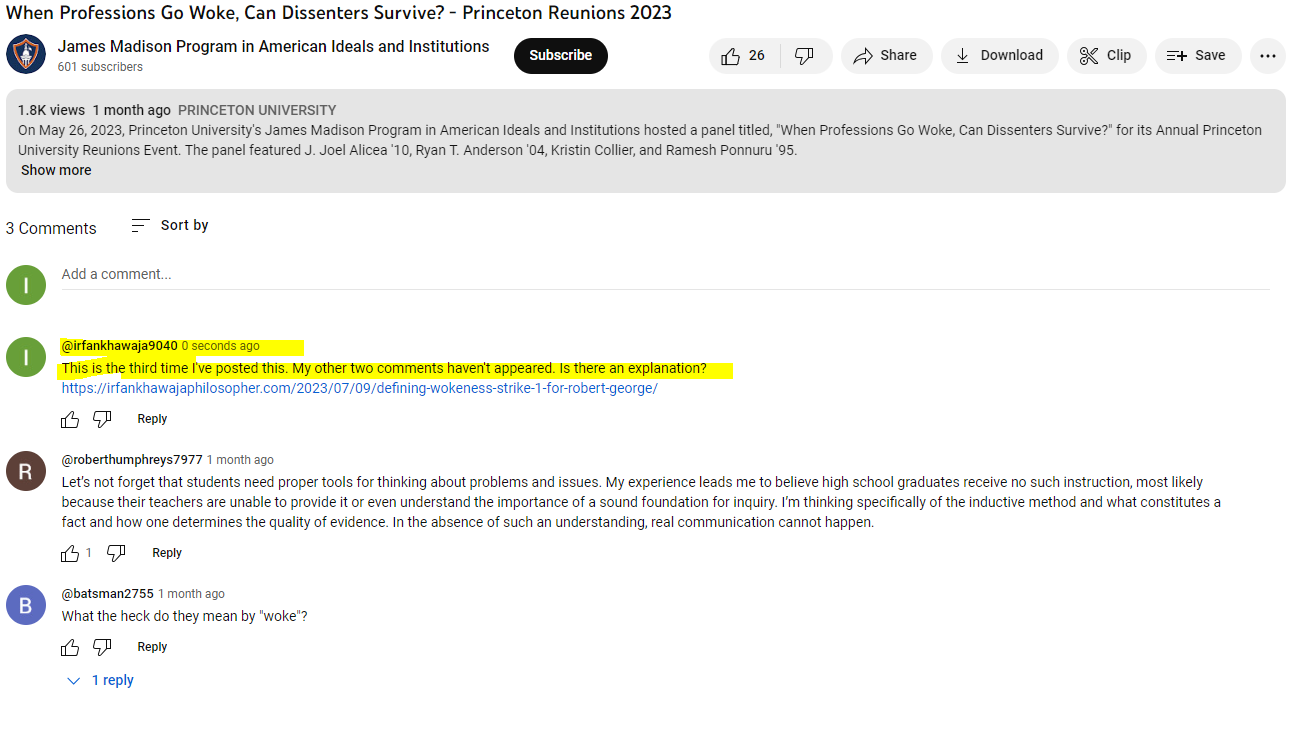
July 25, 2023: I had an email exchange on July 18 with Debra J. Parker, Program Manager for the James Madison Program, who writes: “I can confirm that the Madison Program communications staff does not remove any comments from our social platforms.” Fair enough. So either there’s been some persistent technical glitch, or else YouTube itself is taking the posts down, perhaps via some algorithm that treats them as spam. I’ll try again when I get the chance.
 Policy of Truth
This is my favorite of your posts on wokeness.
I take George to be attempting to define something that anyone (or any group or any ideological or political movement) might be guilty of. Now: what is missing? I can think of a few things.
First, a motivation of righteousness (which, however imperfect or flawed, is at root genuinely idealistic — so false-consciousness moralistic defense of Jim Crow would not count, but dedication to communism in the 1900s or 1930s or 1950s probably would).
Second, a broader arsenal of moral brow-beating, used in place of debate when this is out of place. It is not just painting one’s opponents as racists or whatnot. I think you are right that it could include ostracizing in a “nothing personal” sort of way, but the point is that pretty much the full moralistic arsenal is put to use. One has given up on debate in a pretty fundamental way, somewhat in the manner that is (alas, at least in present social conditions) required for successful political activism.
Third, I think the context here is one of contention about pretty fundamental norms in society — which are to dominate in our society — being at issue. One is participating in this kind of power struggle, but inappropriately not debating and instead ostracizing and brow-beating. This brings up the issue of violating fundamental ethical and political (and perhaps rational) norms — roughly of liberalism and democracy broadly construed — aimed at achieving adequate consensus about fundamental values and norms (in a way that respects individuals and their convictions, often including convictions that are bat-shit crazy).
Fourth, there is something especially bad about approaching or crossing the line of inappropriate moralism (and associated action) when one’s faction is in the dominant position. As one’s faction comes to dominate (in some context), the disregard for one’s fellows becomes more serious because one is in a position to, and might be, simply dominating them. (This is also dangerous because, ultimately, clubs and sticks and guns will beat moralistic pushing and shoving. The reward for winning an inappropriately aggressive moralistic battle might be “fascism” and getting the shit beat out of you.)
Fifth, as you emphasize, the tricky thing is saying when such attitudes and behaviors (or some subset of them) unambiguously cross the line into inappropriately aggressive or disrespectful moralism (either generally or when one is in a position of potential domination of others) — for anyone, whether or not the current crop of overly-zealous left-wing moralizers.
Sixth, the precise location of this line (in any given respect, in any given social situation) is inherently socially contestable. I think the right sort of general case for less resort to strongly moralistic social regulation (especially from the dominant position) appeals to a liberal ideal of free-reasoning individuals and rational cooperation (and to the idea that strong moralistic measures are usually toxic to this ideal). I’m pretty sure I’m overly-sensitive (for personal but also idealistic reasons) to the damage that moralism can do here (and insensitive to the good and to the compatibility in some cases with rationality and autonomous thinking and decision-making). I’m sure more (and stronger) moralism than I would like is required to keep people in line. I prefer the Quaker meeting house (or the seminar room) but I know this is unrealistic.
(I suppose these comments reflect something of a “post-modern” — or even “anti-Enlightenment” — approach to this issue, since I’m happy to “deconstruct” (and make a matter of social choice and creation and of what is more or less reasonable) many things that others (both the anti-woke and, ironically, the woke) will want to say there is a simple truth of the matter about.)
LikeLike
With or without your additions, I would insist on a prior empirical point. What is the actual, non-confabulated empirical evidence that people hold either the view that George describes or the modified version of that view that you describe?
The evidence cannot be an inference from the sheer fact of cancellations. Cancellations, as I said, can be motivated by things other than what’s included in his definition or what would be included in a revised definition along your lines.
In the panel discussion, an academic physician, Kristin Collier, describes her experiences at U Michigan Medical School: she was chosen as the speaker for the “White Coat Ceremony” (the equivalent of an honorary graduation speech), but students soon discovered that she was ardently Catholic and anti-abortion, and so, demanded that her speech be cancelled. As it happens, she was not cancelled. So her horror story is: I was almost cancelled.
I don’t mean to be entirely flippant, since Collier did receive death threats, and I think that’s a red line that should not be crossed (and a criminal act that should not be tolerated). But I raise this example because there is no reason to think that this case fits George’s definition of wokeness. “I was almost cancelled because my peers did not want an anti-choice physician representing them at a White Coat ceremony for graduating med students” does not clearly fit George’s definition of “wokeness.” Yet it’s offered as Exhibit A for the invasion of wokeness in American medical schools. Sorry, but that makes no sense. The example flouts the definition. So what is it an example of?
The cancellers didn’t need to regard their own views on abortion as “so obviously correct that they may not be challenged.” Nor did they need to ascribe hate or bigotry to Collier. They only need to think that abortion is an essential, legitimate part of health care, and that it is a mistake to honor someone who explicitly, loudly rejects that view. If I had been among the med students or the med school faculty, I would have called to have Collier’s speech cancelled, too. If abortion is a right (and I think it is), then the med school should not be honoring physicians who deny that right.
I would also say that such a person has no business going into obstetrics or gynecology. Collier self-righteously tells the audience that she thinks anti-abortion physicians should have every moral right to enter OB-GYN, presumably to dissuade patients from getting abortions.
We live in a country in which physicians who do abortions are under explicit legal threat through the activism of people like Robert George and Collier. Abortion rights have not been this embattled since the early 1970s. This is a battle, and George, Collier et al are our adversaries. We need to stop pretending that they are harmless, or that the debate over abortion is a neutral academic squabble. This is not a game. It’s a fight to the death, over matters of life and death. We need to act accordingly.
When the shoe is on the other foot, physicians like Collier (with the support of academics like George) go out of their way to insist that the right of “conscience” demands that they should be able to refuse to do abortions–even if they specialize in OB GYN. Apparently, that is not Georgian “wokeness.” It’s an exercise of “conscience.” But when pro-choicers say: “We don’t want such people representing the medical profession,” apparently, that is “wokeness.”
It actually just sounds to me like an exercise in double talk. When they have power, they unapologetically exercise it over us to our detriment, and in violation of our literal rights. When we have power, they cry crocodile tears over the mildest exercise of that “power” over them. I’m not saying the physician should be fired. I’m just saying she should not be honored, or placed on a pedestal. If that makes me “woke,” so be it.
I can’t help mentioning that I’ve now twice tried to leave a comment on the YouTube page for the panel discussion, and every time I do it, they remove it. I’m a Princeton alum trying to leave a comment on a Princeton Alumni You Tube page, responding to a Princeton professor who’s complaining about wokeness and cancellations. So far, I haven’t been able to get a word in edgewise. For now, let’s call it a technical glitch. But what’s the word we use for it if I keep trying all week, and they keep taking it down?
LikeLiked by 1 person
I can’t help adding one more thing. Collier gives the impression that her experiences at U Michigan Med School were representative, so that all hospitals are as woke as the one she worked at. That claim is absolute nonsense.
When I worked at Hunterdon Medical Center during the second COVID wave, half of the nursing staff was anti-vax, the entire maintenance staff was pro-Trump, and members of the operating room’s janitorial unit expressed reluctance to clean or set up rooms where abortions were done, on the grounds that abortion was “murder” and they refused to have anything to do with it. I would regularly walk into the ICU and find visitors walking around–with COVID+ patients in the unit–without masks because they “didn’t believe in” masks. The clinical staff refused to challenge them either because they sympathized or were too intimidated.
Does that sound “woke” to you? There was literally nothing woke about the experience of working there–not one experience, not one day, not one minute. Racism was openly expressed. Sexist attitudes abounded. I had a nurse try to tell me, obliquely, that the town she lived in was great until minorities moved in and ruined it. We took things like that in stride. They happened every day. Woke it was not.
If Collier’s anecdotes have probative value, so should mine. But apparently some anecdotes are more probative than others.
LikeLiked by 1 person
The vice of motivated moral certainty (in a context of moral contestability) and of tending to settle public moral disputes with moral-psychological incentives (or outright bullying) at the expense of mutual respect and reason seems common enough. Plausibly, such attitudes and actions are appropriate only in cases of willful moral blindness or perversity (as with slavery and Jim Crow). Plausibly, the woke (but also others) often rationalize their moralistic vice by talking themselves into the idea that those who oppose them in our social struggle over values are willfully moral blind or perverse (one case: a quite-liberal friend of mine experienced a young, woke take-over of his AA group; the arrangements for collecting dues and renting the space were not egalitarian enough; meaning people had to pay their minimal dues and could not plead poverty and then not pay with no questions asked or proof; cue Lord of the Flies; they lost the space and my friend, now tagged as some kind of reactionary moral misfit, left). We all probably do this sometimes at least in small ways (and so we should recognize this vice). People should knock it off. Lighter moralistic nudges, combined with respect and rational dialogue, constitute the best tools of moral suasion in most cases (the only obvious exceptions involving willful moral blindness or perversity).
LikeLiked by 1 person
I guess I don’t really see how that connects with my argument.
Suppose someone defines “being cool” as “hating work on principle.” He then seizes on the fact that lots of people are quitting their jobs, then concludes that they’re all trying to “be cool,” hence hate work on principle. He then assembles a panel at an Ivy League university in which the panelists tell the story of a cool person they know who hates work on principle. They then conclude that “coolness” is one of the fundamental problems of the modern world.
The ridiculousness of this line of reasoning should be transparent. “Being cool” doesn’t really mean “hating work on principle.” The fact that people are quitting their jobs doesn’t entail that any large proportion of them hate work on principle. So it’s beside the point to inveigh against coolness, conceived of as “hating work on principle.” So conceived, “coolness” is a red herring. It’s not obvious that “hating work on principle” explains very much about the labor market. Anyone who thinks it does needs to provide evidence that it does.
Suppose that instead of providing evidence, they just insisted, over and over, on how terrible “coolness” is, and how it’s taking over the world. And suppose that, on top of this, they simply ignored the fact that there are plenty of plausible explanations for quitting one’s job besides hatred of work per se.
The ridiculousness of George’s argument is equivalently transparent. He admits that “wokeness” once meant something relatively benign. He then re-defines it to mean something more culpable and sinister. He then points to highly ambiguous events, like cancellations, and somehow concludes that “wokeness” explains it all.
Three extremely obvious problems:
His definition of “wokeness” is tendentious.
The events he cites to support the supposed ubiquity of wokeness don’t do so.
There are other issues in the vicinity that George ignores but that contradict his “wokeness” script.
He seems totally unfazed by all of this, as do his panelists, as does his audience.
The example you cite seems a counter-example against the view you’re defending. In your example, some highly motivated ideologue takes over a group. So how should anyone respond, as a practical measure? You seem to imply that the only practical measures anyone is permitted to use involve “light moralistic nudges.” That seems a recipe for quixoticism and failure against anyone likely to resist such nudges. If the stakes are low, no big deal. But what if the stakes are high? What if they’re sky-high? Sometimes they are.
You seem committed to the proposition that even if the stakes are sky-high, we have to adopt a posture of semi-passive, quixotic, abstinence: we nudge a little, then give up at the first bit of resistance. Why? Why would anyone do this, unless they wanted to surrender everything of value to all of their adversaries? “Well, if we pushed harder, we might come across as pushy and rude.” Right. But depending on the situation, the penalty of refusing to push harder is injustice, violation or destruction. It isn’t obvious to me that anyone is obliged to endure injustice, violation, or destruction because otherwise, their oppressors might find them impolite or uncivil. You can’t even get a medical bill corrected without being rude. The idea that you can face down, say, the pro-life movement in a “nudging, civil way” has zero going for it.
This is a story from today’s New York Times–a totally average story that could be multiplied thousands of times over. What it shows is that the opponents of abortion are willing to take on the biggest sacred cow of American culture, the US military, and spit directly in its face.
These are people who are saying, by their actions, that the women who fight for this country have no right to control their own bodies–from conception to birth. What would nudges do against such people but urge them on?
People like Robert George and Kristin Collier and Ramesh Ponnuru et al give every outward appearance of “civility.” But what they want by their own admission and actions is the world that Tommy Tuberville is fighting for. They want a population that is either willing to suffer and die on command, or will be forced there. I don’t give a shit what these people think of me, or how I appear before them. The relation we bear to them is adversarial, or it’s nothing. And unfortunately, as long as we’re around, and so are they, it can’t be the latter.
LikeLike
I think that, in my example, the woke ideologues are actually worthy of the treatment that they are unjustly meting out on others. For they are being morally blind and perverse — I mean to set this bar high, but not too high. I’m not sure my criterion here is exactly right, but I think it is in the right ballpark. The key question is what, precisely, justifies moving from moralistic nudges + reasoning things out to “going nuclear” with our moralistic cudgels. This is where the action is at. The answer is probably pretty highly context-dependent (so somewhat different answers for different contexts). I would insist, first of all, on recognizing the virtues of the former and the vices of the latter. I probably could use some cognitive and emotional education in the vices of the former and the virtues of the latter. Alas our world is not that of seminar rooms and Quaker meeting houses. (I agree that the stance of “Shame on those overly-aggressive moralists for being so moralistic” runs the risk of pretty hilarious inconsistency.)
LikeLike
No matter where you set the bar, at a certain point you have to ask yourself, empirically: what in the world are we really talking about? How much of the actual world is characterized by the thing that satisfies your criterion, or his definition? It strikes me as a problem, to put it mildly, if huge amounts of discourse are consumed by something simply because it meets a certain criterion, even if the criterion is exemplified by far, far less than the discourse encourages anyone to believe. Meanwhile, patently obvious, demonstrable things that flout the “Woke Are Taking Over” script are being ignored.
It simply is not plausible to suggest that American business is dominated by woke attitudes or interests. I work for a major corporation. We have dozens of clients, all large hospitals or hospital systems around the country. We have dozens of vendors. Our clients have dozens of vendors. There is nothing even remotely woke about anything I have ever encountered anywhere in this business. I’m not exaggerating for effect here. I’m really just coming up dry. And I don’t think that’s just me, but if someone thinks it is, how about providing some actual evidence of how American business is run?
Nor is it plausible to suggest that a country that voted for Donald Trump–an electorate that’s pushed the Republican Party past even the most right-wing conception of what it once was–is somehow dominated by the woke Left, or teetering on the brink of socialism. Anyone who believes such ridiculous things needs to cough up actual evidence for it. But I wasted a fair bit of time watching that panel discussion, and no one did.
Likewise, listening to this panel, you would get the impression that Princeton is a “woke” university by your criterion or George’s definition. It really is hard to convey in words how ridiculous that is. It’s not even in the ballpark of accuracy. But the panelists don’t seem interested in that.
The controversy over wokeness is a controversy about how politics actually works. It’s not an exercise in pure conceptual analysis. So one can’t leave things at the abstract level of saying, “Well, here is my verbal formula about wokeness; I insist that it’s a big problem, but I intend to remain totally agnostic about how it relates to anything in the actual world.”
I’m just in the dark here about why it’s wrong to disinvite an ardent, active, militant opponent of abortion from giving a White Coat talk at a medical school. Do professions not have an interest in maintaining their professional integrity in the face of literal, blatant assaults on it? How else to characterize the so-called pro-life movement? These are people unmoved by the plight of rape victims (including children), whom they want to force into unwanted labor and unwanted parenthood. They tell us, outright, that they have a full agenda for health care and the biomedical sciences. Is opposing them really such a problematic idea?
LikeLike
I’m not sure about the prevalence of woke in society or the definition of it, but i think it’s one of those things of which you can say, ‘I know it when I see it ‘. For instance, my niece recently walked out on a discussion with my daughter about whether transgender people are actually the gender they claim to be, on the grounds that she didn’t want to share space with transphobic people. Ok. My sister labelled me a racist for being unsure about an upcoming referendum on indigenous rights and said my view was the result of white privilege. Ok. A cousin refuses to consider any evidence presented to her (and I’m talking about research) that suggests that transwomen are not in fact women. Ok. Every time I open the centre left newspaper I subscribe to, I’m fed this line about white colonial guilt, cisgender transphobia, Australian racism, etc. I’m not saying we’re not racist and that in some communities people don’t make unkind remarks about guys in frocks. But it gets tiresome. Worse, it drives people who would normally be fairly tolerant towards the other end of the spectrum, especially when the facts as people experience them are being absolutely denied by left wing apologists. You think that’s a guy in a dress? Wrong! It’s a woman. You’re suspicious of Aboriginal people moseying around your supermarket? That’s racist stereotyping, no matter that Aboriginal people shoplifting is a regular occurrence. I mean, it sounds like I’m on a racist transphobic rant, but this sort of cognitive dissonance is hyped up by the right wing media and used to drive the relatively ignorant into a lather of outrage. So in a way I agree with you… the actual source of the irritation is minor… but it would be much more strategic for the left to focus on peoples actual economic and social problems rather than allowing themselves to be painted as perpetually guilty guardians of public righteousness.
LikeLike
I agree; those are all problematic instances of “wokeness” in its invidious sense. But you yourself have diagnosed the problem here. A certain class of people–Right, Centre, and Left–has, under the influence of its professional wordsmiths, become completely consumed by a very, very narrow set of concerns. It doesn’t follow–and isn’t true–that those narrow concerns are actually, objectively the biggest or most important problems we face. And yet people ubiquitously now speak as if they were.
How would I give content to the idea of “objectively the biggest or more important”? Pick any plausible metric you like. If we have trouble arriving at a plausible metric, I guess my response is: that problem by itself is of greater significance than all the debates about “wokeness” put together. But I would say: by any plausible measure, climate change, warfare, and issues of public health are of overriding significance. If we get them wrong, huge numbers of people will die.
I agree that invidiously woke discourse is tiresome. I recently took an online course based in Melbourne and began to wonder whether Australians were perhaps more extreme about this than we are. But it’s tiresome because it’s a distraction. The Left indulges it because they feel powerless in “the neoliberal context.” And the Right attacks it because they have nothing better to say or do. But it buys into their delusions to think that wokeness in that problematic sense actually dominates the world, or even a country like the US or Australia. To think so is to lose sight of what actually dominates the world–people with actual resources and actual power. The hyper-woke and their opponents are irrelevant to that. But that’s where the action is.
LikeLiked by 1 person
You’re now forcing me to adopt Australian spellings of ordinary words, like “center.” You see how insidious a thing domination can be?
LikeLike
I do agree that there are bigger problems than wokeness. I noticed working in government that there is a strong tendency to favour symbolic action over real change because it’s cheaper and less controversial. In this case pronouns are easier to tackle than climate change and where opinion leaders on the right tend to emerge from exclusive private schools and on the left from the educated elite you get the middle and the bottom of society led by the nose. Alphabet politics etc is to some extent a distraction from more fundamental and difficult issues. However, among the many things I get annoyed about or concerned by when I have time… not that often… having my identity as a woman usurped by men does bother me. Interestingly, men don’t seem to mind women claiming to be men, but also resent men joining the ranks of women, a sort of gender betrayal. Got to be some interesting research there. The point is that we don’t always line up our indignations in order of broader significance. But politicians should.
LikeLike
I didn’t know you worked in politics. In what?
I don’t have a strong, worked-out view on trans issues. It seems to me that there are two things that I would take as defining the boundaries of reasonable debate.
At one end, I would say that there are clear cases where someone’s transition from their gender-assigned-at-birth to something else is, on the whole, beneficial to them. The condition of being stuck in the wrong body, and having to change, is a real one, not made up, and the people who make this transition really do make a change from one gender to the other, and for good reasons. People sometimes fixate on the social costs (meaning the economic costs) of having to pay for gender-transition treatments and surgeries, but setting that aside, I don’t see how anyone is harmed by transitions in these cases. (I set aside the economic costs because while transitions are expensive, in the American case at least, they have very little overall budgetary impact, and I doubt they do anywhere else.)
At the other end, I think it’s generally a mistake (not just re trans issues) to assume that anything anyone says about their “identity” (not just their gender identity) is to be taken at face value simply because they’ve said it. People say all kinds of things about “identity,” and make all kinds of demands about it, some of them absurd and unreasonable. A mere expression of skepticism or agnosticism can’t be equated with an identity-annihilating affront, or treated as a threat to “safety.” Of course, it depends on how the skepticism or agnosticism is expressed.
Having said that, it’s also true that some professions of skepticism or agnosticism either mask bigotry or complacency. That’s why a US Senator can claim, on TV, with a straight face, that it’s just a matter of “opinion” whether white nationalism is racist or not.
I don’t dispute that there are problematic cases of wokeness. What I would insist on is that opinion leaders on the Right, in the US and elsewhere, have a very strong ideological incentive to exaggerate about it in really, wild, sometimes nearly insane ways. And they do. Their exaggerations are now driving the debate. The idea that American business is “woke” is just, wild Orwellian nonsense. But even claims about the wokeness of academia are misleading at best. I spent 26 years in academia. I taught at ten institutions in three US states. That gives me more academic experience than anyone on that panel, arguably including Robert George. (He’s taught for longer than I did, but I’ve taught at a far greater diversity of institutions.)
The picture that people like George et al are painting of academia is simply unrecognizable to me (and to many academics besides me). In fact, the pictures they paint of institutions I know very well, like Princeton, are just all-out fabrications. In this very case, the same people moaning about cancel culture and wokeness–the people discussed in the post–refuse to allow a link to this discussion on their YouTube channel. I’ve put it up three times; they’ve taken it down three times. Yet they’re the ones complaining about cancel culture! Every person on that panel occupies a prominent place in American life, from The Washington Post to the University of Michigan’s medical school. They’re engaged in a wholesale assault on everyone to their left, but can’t understand why anyone wants to push back. It seems to me they’re better at complaining than proving that they have anything to complain about. They’ve gotten away with that game for far too long.
LikeLiked by 1 person
Well yeah, that does seem ironic that your views are cancelled. Mind you, I’ve recently done some minor cancelling myself, mostly because the person, who was advancing pro Putin and anti western views, was doing so very rudely. As for trans issues, I flat out don’t believe, and understand there is no evidence for, the theory that your body can be one gender and your brain another. Yes you can be a masculine woman who’d rather be a man, but you’re not one. I agree that adults who want to change apparent sex should be able to do as they like, but I’m not happy to pay for it. I think that trans ideology is quite harmful to children though so on that, I’m with de Santis. Anyway as you say, wokeness is probably exaggerated. There’s certainly little of it in my rural neck of the woods.
LikeLike
Well, we just disagree on the trans issue. I do think that gender dysphoria is a case where the body is one gender and the psychological dispositions another. I knew a small handful of people in that situation who went through full transition and came out much the better for it. How to characterize their gender at the outset is unclear, but once they make the transition, I would say (and they would say) that their gender is the one to which they transitioned. This is a difficult issue, but I think it should be obvious that if there are people in this situation, and there is fundamental disagreement on what gender they are–with the person insisting on one, and third parties insisting on another–there is no avoiding hard feelings on all sides, and no point in discussing the hard feelings per se. It’s a zero sum situation. One party wants their gender identity recognized, and the other regards recognition as a usurpation. Since hard feelings are predictable, these two parties just have to avoid one another. The alternative is constant, inadjudicable conflict.
I know which commenter on your blog you’re referring to, but in a way, she’s a perfect example of my argument. I would have canceled her, too, and this despite my opposition to the Ukraine war. Her comments were disruptive, dishonest, and stupid. There was no point engaging with her because she wasn’t commenting in good faith. Much of what she said contradicted obvious, established facts, and in many cases, what she said was overtly totalitarian (pro-Soviet). So there was nothing wrong with canceling her. In fact, it would have been a mistake not to.
But notice that the explanation for your cancellation has absolutely nothing to do with “wokeness” as George defines it. You are not saying that your views on, say, Ukraine are so obviously correct that no one can challenge them. Nor are you saying that only hate and bigotry can explain their rejection. Nor do you need to attribute hate or bigotry to this particular commenter. It’s sufficient to say that she was disrupting the conversation or the blog in ways you have no obligation to support. Your blog has certain aims, and her comments disrupted them. Done. No need to invoke “wokeness” here at all–not in your case, and not in a million others. Bouncers have been “cancelling” unwanted people from bars and night clubs for hundreds of years now. Are bouncers woke?
It’s ironic that both you and Michael brought up examples of disruptive people and what to do about them. Michael came up with an example of a woke take-over of an Alcoholics Anonymous group. But the moral of his story is the opposite of the one he’s drawing. He seems to be suggesting if wokeness has found its way to a single AA group in Providence, Rhode Island, that proves that wokeness is everywhere. It proves nothing of the sort. What his story proves is that if someone is taking over your group, you’d better figure out how to cancel them, or else they will take over. What it proves is that sometimes cancellation has a perfectly legitimate rationale, a fact that should become even more obvious than it already is when you realize that in ordinary English a “cancellation” is just the nullification of a prior arrangement. Are prior arrangements always so great that they should always be kept in place, no matter what?
Often, the reasons for canceling people are blatantly obvious: you have built something valuable, and your adversaries are taking it over by strong-arm methods. If you cancel such people, whether they’re Left or Right, you’re not being. “woke.” You’re using common sense.
Cancellation can be used or misused, but there are times and places where it must be used. We divorce spouses. We end friendships. We quit jobs. We fire employees. We stop supporting someone’s problematic habits. We cancel appointments (!). If we can do all this for non-political reasons, we can do it for political ones.
LikeLiked by 1 person
Note my July 12 update to this post, at the end.
LikeLike
Highly relevant, highly on target, and more nicely phrased than my post, but exactly consistent with what I was trying to say.
Worth making explicit: Polgreen correctly explicitly woke companies as paper tigers, but the vast majority of capitalist firms make no pretense at being woke at all. To fulminate over wokeness while ignoring all of this is to miss the forest for a bunch of weeds.
LikeLike