It’s customary to celebrate Independence Day in the United States by recalling the glories of the American Revolution, and hauling out the idols of our “civic religion” for worship–primarily the Declaration of Independence treated as Scripture, and tales of the Revolutionary War treated as hagiography. I don’t find the American Revolution a particularly glorious event, and find most celebratory discussions of our “civic religion” tiresome. So this Independence Day, I’d like to change the subject. There are other things about America worth celebrating and discussing: not its politics or military valor, but its art. It’s always been a question whether American art has ever managed to declare independence from its European forbears, and always been a fear that it hasn’t. Those questions generally go unasked on Independence Day, but maybe they shouldn’t.
The New York Times recently asked its columnists to name a work of art that “explains America.” I don’t particularly like this way of putting things. Works of art aren’t meant to “explain,” and “America” isn’t, to my mind, the kind of thing you can explain. Art is not a cause that produces a nation as effect. Does the Taj Mahal “explain” India? Does “The Birth of Venus” explain Italy? Does Umm Kulthum “explain” Egypt? Not really.
But change the question a bit, and you get an inquiry worth pursuing. Maybe it makes more sense to ask whether it’s possible to name works of art that express America–or even “the American vision”–at its best. Is there something distinctive to the American way of looking at the world, as captured by its art, that’s particularly worth consideration? Assume for argument’s sake that we’re looking for a set of objects d’art, not a single conclusive winner. Anything that goes on the list will have genuine merit, but will also in part be a matter of someone’s personal tastes. Not every choice will be everyone’s cup of tea, but ideally, each choice will add something to a picture of the whole.
There are many candidates out there, but my personal choice would be American painting, particularly oil painting, done between, say, 1830 and 1950, from the beginnings of the Romantic landscape tradition to the tail end of the urban “Ashcan” school. It took some doing to arrive at those dates: I started with a narrower range, but found that I had to keep expanding it to include all the stuff that was “worth including.” It’s a scandalous confession, I guess, but I’m sort of promiscuous about American painting; I can find something to like in almost any period or genre from beginning to end. But I was particularly taken at an early age–call it late high school or early college–by American landscape painting of the so-called Hudson River, Luminist, and Tonalist schools.*
These terms are notoriously hard to define, but they refer in general to a distinctively American style of landscape painting, strongly influenced by French, English, Dutch and German models, but intent on capturing the peculiarities of American geography and topography while moralizing and humanizing it. What makes this painting distinctively American is not just that it makes a point of depicting and valorizing specifically American scenery (though it does) but that it does so by projecting a recognizably heterodox Protestant-American ideal onto the scenes it depicts. The light we see and the silence we perceive in these paintings is a naturalistic form of sola scriptura: the world itself is the work of God, and each of us bears witness to it by direct perceptual encounter. American painting, we might say, democratizes and secularizes the sensus divinitatis, marrying Protestant fundamentalism to pagan pantheism.
There is, as you might expect, a partly autobiographical explanation for my attraction to it. At the most primitive level, the two paintings tacked to the walls of my childhood home were cheap, department store imitations of Hudson River and Luminist works–a mountain scene imitating the work of Thomas Cole, and a maritime scene imitating the work of Fitz Henry Lane. For a long time, those two prints were the only visual art I ever looked at, so it’s no surprise that I had a sentimental attachment to paintings of this sort from the start.
At a more fundamental level, I grew up as a rather sad, lonely child who compensated for that loneliness and angst through semi-fanatical bouts of religiosity. I never actually managed to see God anywhere, but I did a lot of walking, much of it in nature, and saw what I took to be His glorious handiwork before mine very eyes. Or so it often seemed, particularly at dawn or dusk, or in the middle of the woods, or in the full radiance of autumn, or at quiet moments at the seashore. As it happened, many of the best American painters painted these very things, and in roughly the same places in which I saw them, the woodlands and coastlines of New England and the mid-Atlantic northeast. So it became natural to mediate my responses to my own environment through their interpretations of it, and vice versa.
Beyond that, by high school, I’d read and been inspired by the literature that inspired these painters, particularly the Transcendentalists (Emerson, Thoreau), and more generally what the critic F.O. Matthiessen called the writers of the American Renaissance (Hawthorne, Melville, Whitman, etc.). So my sensibilities were in some sense structured as theirs were. By my mid-teenage years, I’d had the luck of having easy access to museums and galleries carrying some of the best work of the best of these painters. In fact, I’d grown up in two obscure Jersey towns–Montclair and Lambertville–central to the development of Luminism and Tonalism. So I was immersed in great painting at an early age, even if I didn’t really grasp its meaning until much later.
There are many European grand masters of arguably greater technical proficiency than their American counterparts. Go through any museum containing both American and European painting, and you’ll probably see this. Or ask an expert, and they’ll probably tell you. Manet and Corot are probably superior to Cole or Church, as Gerome is to Eakins, or Turner to George Inness or Winslow Homer. There is no American Vermeer, Rembrandt, or Titian, and some American painting is just an attempt to imitate Lorrain or Constable in an American style or setting. The grand masters of Europe cast a long shadow over the art world, one that was hard to escape, and once escaped, hard to equal in merit. So the Americans had their work cut out for them.
Sanford Gifford, “Hook Mountain, Near Nyack on the Hudson” (1866)
But they managed. The vision they expressed was, as I’ve said, an unapologetically religious one, drawn in part from watered-down versions of Romanticism and Idealism (Kant, Rousseau, Swedenborg), but expressing what Cardinal Newman, in The Idea of a University, called “the repose of faith,” the semi-sacred solitude and tranquility little prized and seldom found in the hectic chaos of American life, but projected onto its “unspoiled” landscape. The landscape itself was, or was seen, as distinctly amenable to that interpretation: vast, apparently (or mostly) undeveloped and uninhabited spaces where time and activity seem to stand still. In some ways, American painting is Wordsworth’s poetry brought to life on a different continent, a generation after Wordsworth himself had composed it: the same sacralization of stillness, the same valorization of the ordinary, the same “intimations of immortality,” all taking place in apolitical space under the watchful eye of a caring, benevolent, decidedly non-sectarian God.
My single favorite American painter is George Inness, who lived a century before me, a block away from me, on the street on which I grew up as a child–Grove Street in Montclair, New Jersey. The kitschy paintings on the wall of our Grove Street apartment were in some sense the echoes of his work a century before and a block away. Inness managed to capture the strange magic of the apparently banal world we both inhabited, the non-descript suburbs of Newark and New York. And yet, in investing that landscape with a certain enchantment, he seemed to be capturing something really there, as real for him in the 1880s and 90s as it was for me a hundred years later: the lambent glow of the Jersey sky at twilight, the ghost-like apparition of fading sunlight on a sycamore tree, the haunted weirdness of a night-time walk through the snow on Christmas night.
It’s easy to crap on the Jersey suburbs, to deride the absurdity of New Jersey’s pretensions to being “the Garden State.” I do it myself. But Inness somehow revealed what it was that gave those “gardens” a place in the hearts of those touched by them. His paintings cemented a highly personal, almost sacral attachment to the place, a deeply personal and yet commonly valued realm beyond the pageant, fanfare, and bullshit artistry of “love of country.” “The American Way of Life” is an insipid, pointless abstraction, but the places Inness depicted were places deeply imbued with meaning–places associated with the milestones of actual lives–love, loss, bereavement–or what Leibniz called the petites perceptions, the wholly private sensations that inhabit the corner of one’s eye, and are ignored until brought to conscious attention.**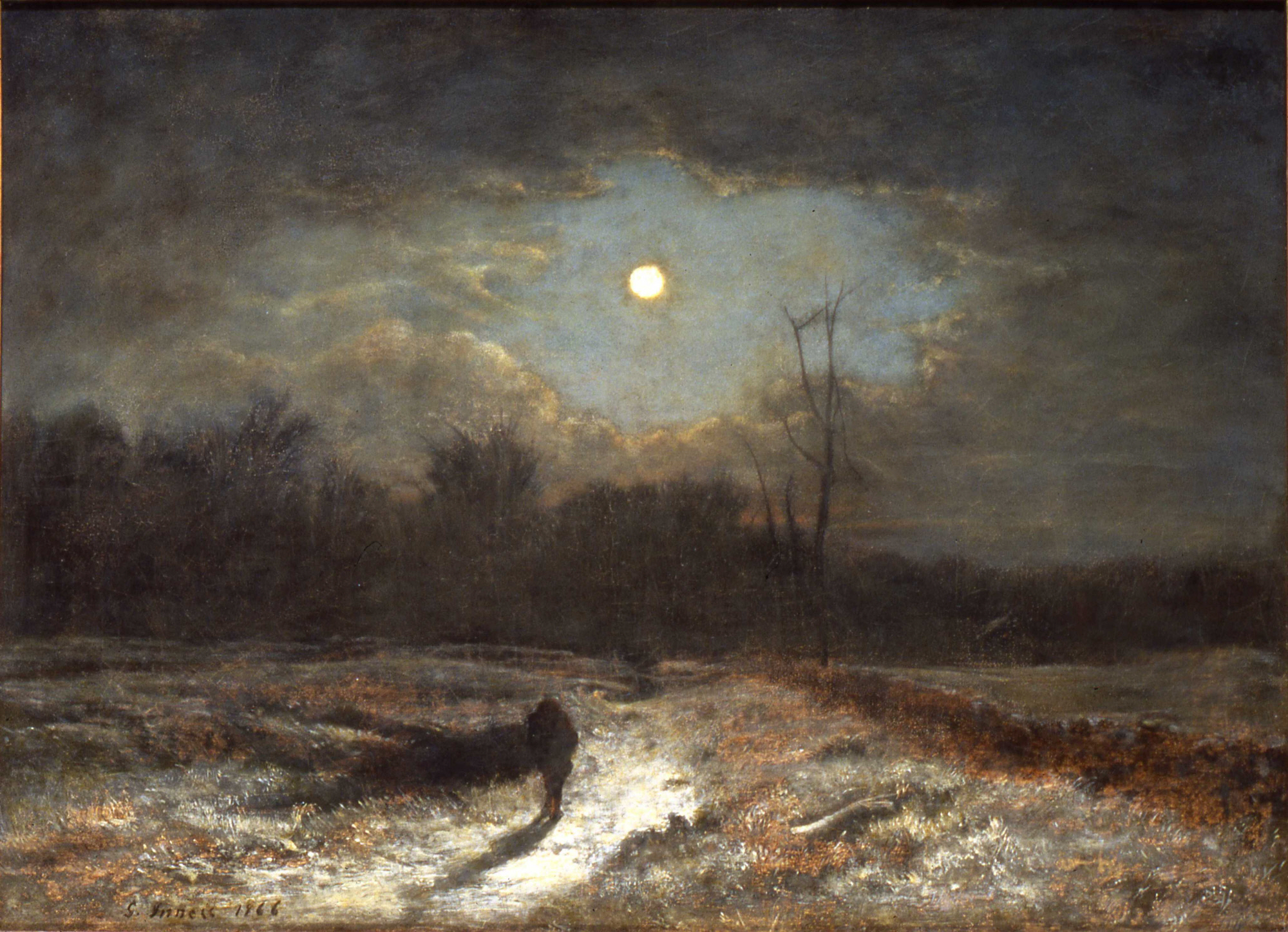
George Inness, “Winter Moonlight” (1866)
Those subliminal Leibnzian perceptions are what one sees in Inness’s paintings: the very rocks, trees, stones, and sky somehow refract the human spirit. The same goes in different ways for Cole, Kensett, Gifford, Church, Heade, Blakelock, and all the rest: that, I would say, is America. Not a party or regime or even a constitution, but a radical re-imagining of the fallen or at least jejune world we inhabit.
Here is one of Inness’s early, tamer paintings, “The Lackawanna Valley” (1856). Commentators have typically drawn attention to the synthesis of French and American styles at work here: it’s a Corot-like Barbizon painting set in the Lackawanna Valley in northeastern Pennsylvania, near modern-day Scranton.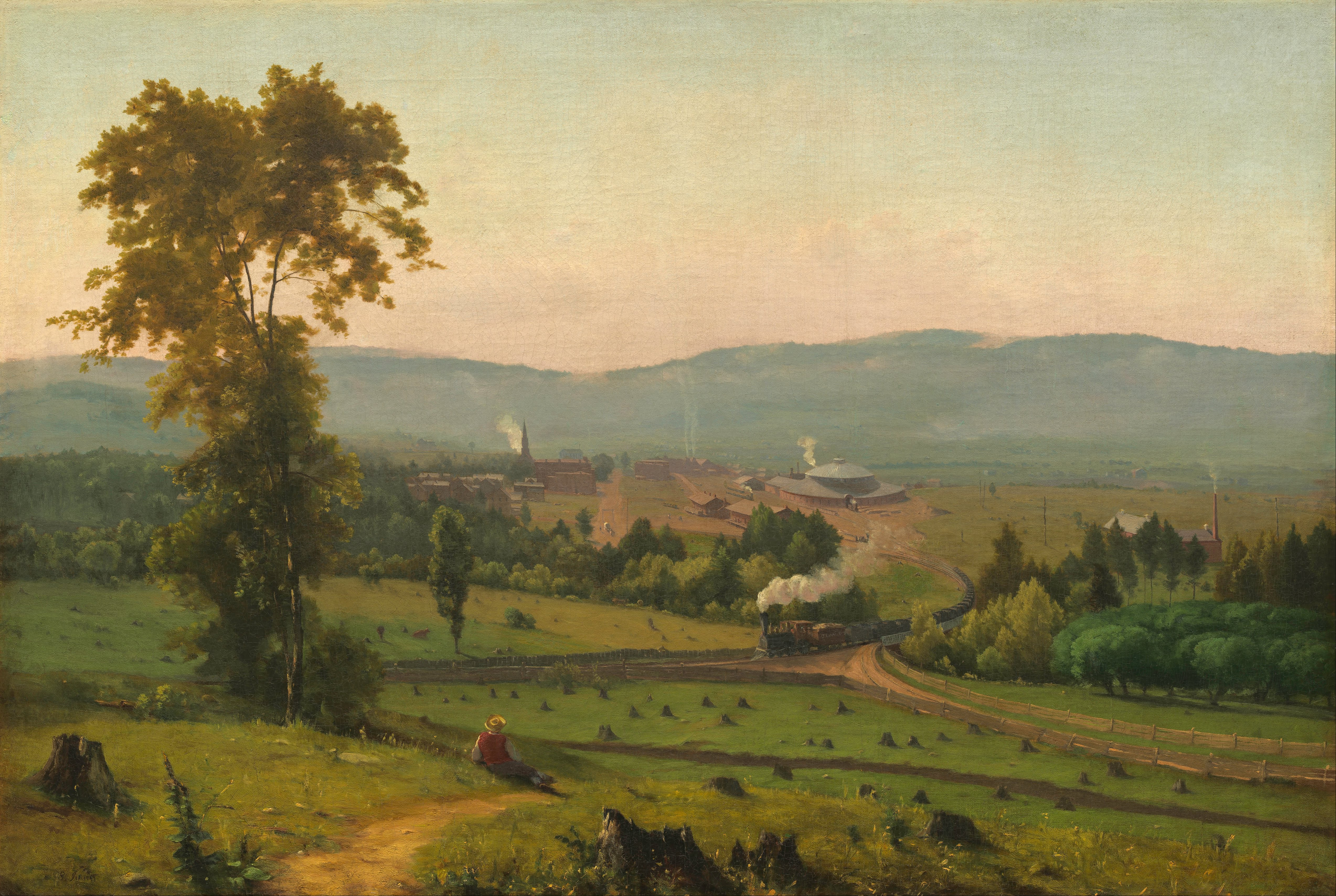
Commentators differ as to the pessimism or optimism expressed by the painting: is it a depiction of nature destroyed by technology, or of technology idyllically in harmony with nature? I’d say it’s a bit of both and a bit of neither: it’s the depiction of a scene of imminent contestation over nature and technology, not quite there, but like the train puffing through the center of the painting, en route to it, and facing a fork in the tracks.
It’s an irony that New Jersey Transit eventually built railroad tracks through what had been Inness’s property and home on Grove Street. In my thirties and forties, living near Montclair, I’d ride that very train each day to work in New York, seeing living vestiges of the scenes Inness had painted a hundred years earlier. Some things had changed, but as many things hadn’t. A century may have passed, but Inness had, in his genius, managed to capture the continuities that survived the changes. If you suspend your disbelief, you can, around dusk, take the Midtown Direct through the Meadowlands, or drive I-280 West through East Hanover, and still imagine yourself in an Inness painting. The railroad or the interstate fades away to leave the sun-flecked clouds or eerie shadows of Inness’s imaginative world. You forget for a moment that this is New Jersey. And then you remember that indeed it is.
Inness’s work got wilder and better–more “tonalist”–as he matured. This one captures the weird, sublime magic of his craft as he practiced it at near end of his life, a monument of “late style,” a sort of visual equivalent of a magic spell.
George Inness, “Early Autumn, Montclair” (1891)
Fireworks are loud and pretty, patriotic speeches are briefly stirring, flags are garish and bright. But America’s artists have dug deeper than all that, capturing a world both subterranean and familiar, both fleeting and permanent, and putting it on canvas. The world they depict stands there in plain view before our eyes while somehow managing to inhabit the deepest recesses of our souls, and finding its way into our dreams. We tend to ignore all that. They make sure we notice.
The American empire will, as Thomas Cole predicted, some day fall into destruction and desolation, but as long as there are prints and eyes to see them, its artists’ vision of America will always remain: at its best, not a picture of conquest, triumphalism, or bravado, but of the otherworldly stillness we seek in this world but can never quite seem to find. Their vision is about as close to that stillness as we ever come in waking life. Not knowing how else to reach it, I’m content to approximate.

Thomas Cole, “Desolation,” from The Course of Empire (1836)
All images from Wikimedia Commons, open access, for non-profit use.
*Call the date range here 1850-1900. A slight qualification: “Tonalism” is not a distinctively American school of painting, but there arguably is a distinctive quality to American works of tonalism.
**I’ve half-filched the latter half of this sentence from Firmin DeBrabander’s Life After Privacy: Reclaiming Democracy in a Surveillance Society (Cambridge, 2020), p. 111. It was too good not to steal. On petites perceptions, see Leibniz’s “Preface to the New Essays,” in Philosophical Essays (Hackett, 1989), pp. 295-99.
Thanks to Adrienne Baxter Bell, Carrie-Ann Biondi, and Charles Persky for decades of stimulating conversations on these topics, occasionally without realizing what they were stimulating. I also owe a deep debt of gratitude to my high school English teacher John Dufford, who first introduced me to Emerson and Thoreau, and to my history teacher, Frederick Fayen, one of the quiet patrons behind the Inness exhibit at the Montclair Art Museum.
(Slightly edited for style after posting, 7/8.)
 Policy of Truth
The word “explain” is ambiguous. It can mean “cause,” as in “The recent lightning strikes explain the forest fire”; or it can mean “give an account of,” as in “The scientist’s theory explains the forest fire.” I assume asking for art that “explains” America is using “explain” in the second sense, so I’m a little puzzled as to why you make the point that “Art is not a cause that produces a nation as effect,” as though the first sense had been meant.
LikeLike
I agree; there are two senses to “explain.” But I couldn’t think of a snappy way of rejecting both in two separate formulations, so I used a single ambiguous formulation and a set of examples to do it.
My point is that nations are not explananda in either sense. There is no clear sense in which you can causally explain or “account for” India, Italy, Egypt, or the United States (etc.) by means of a work of art, or even a set of art works. The explanandum is too diffuse an object to get an explanation, and art isn’t meant to explain things in either sense anyway. Arguably, in contemporary English, the distinction between “causally explain” and “account for” maps onto the Aristotelian distinction between efficient-causal and formal-causal explanations. So while the statement of mine you quoted is ambiguous, on one interpretation it’s literally true.
But even if you don’t buy the preceding mapping, I meant for my examples to do some of the work here. The examples are meant, implicitly, as reductios (rhetorical questions suggesting reductios). What does it mean to “account for” (say) India? And how does the Taj Mahal do it? I find the whole thing mysterious. Lots of things are true of India, both good and bad. What are you accounting for, and by what principle of selection? Does Mughal architecture really “account for” the partition of India and Pakistan? Only in a very, very contrived way. At best, Mughal architecture might “account for” the India of the Mughal period, but it’s not going to account for “India.” The question needs more specification.
The participants in the Times symposium came up with some interesting examples, but they did so by producing an antecedent narrative of “America,” then finding a work of art that fit their narrative. If “America is the land of heedless go-getters,” then The Great Gatsby captures it. If “America is a fundamentally noble land, marred by occasional, if serious, moral backsliding,” then the movie “Arrival” captures it. Etc. But there’s something misleading about that exercise. The real work that’s being done there is the construction of the background narrative. The art work is merely an illustration of it. So in practice, the art work is treated as a vindication for an unargued narrative. What about the narrative itself? There’s no discussion of that, a problem implicit in the way they put the question.
The question I pursued in my post is better specified than theirs, but even my question is problematically broad. That’s why I alluded to having to play around with the date range (from 1850-1900 to 1840-1920 to 1830-1930, etc.), and confessed to the “scandal” of liking American painting across genres and time periods. And it’s why I stressed the personal and idiosyncratic nature of my selections.
Robert Hughes has a great, famous book on American art, American Visions: The Epic History of Art in America. Arguably, Hughes tries to “account for” America through its art. The book is something like 600 pages long, and probably does as good a job at it as anyone could at that project. You finish the book with a better understanding both of American art and of America (the parts where art might be relevant). But it’s not as though you could read it, thoroughly internalize its contents, and reasonably come to the conclusion, “Ah, now I truly understand America!” full stop. He himself describes it as a highly personal non-exhaustive outsider’s introduction to American art for “the general intelligent reader” (he was Australian). Fair enough, but you couldn’t read it and conclude, “Well, now I understand why Americans have failed to pass national health insurance!” Yet if you wanted to “account for America,” that’s one thing you’d want to explain.
I say all that to distance myself from an approach to art I often see (and suspect that you often see), of cherry picking a bunch of art works, offering a commentary on them, and then concluding by that exercise that you’ve discovered the Key to All Explanatory Mysteries about the milieu in which they appeared. Duchamp’s “Urinal”? Well, we live in an age of nihilistic moral inversions. Munch’s “Scream”? Well, we live in an age that regards reality itself as a disintegrated swirl. Dali’s surrealism? Well, that explains/accounts for our society-wide descent into Kantian idealism. I mean, come on. Analyses of this sort don’t account for anything beyond the widespread desire for understanding-on-the-cheap-through-propaganda. Art deserves better than that.
LikeLike
“Arguably, in contemporary English, the distinction between ‘causally explain’ and ‘account for’ maps onto the Aristotelian distinction between efficient-causal and formal-causal explanations.”
I’m not sure what you mean by that. Seems to me there are four things in play there, not two: a) X’s actually being the efficient cause of Y; b) X’s actually being the formal cause of Y; c) someone’s identifying X as the efficient cause of Y; d) someone’s identifying X as the formal cause of Y. And then the distinction divides (a) and (b) on one side from (c) and (d) on the other, not (a) and (c) on one side from (b) and (d) on the other.
LikeLike
“Art is not a cause that produces a nation as effect”:
Art is neither an efficient nor a formal cause of a nation, whether identified by someone with one or the other type of cause or not.
LikeLike
“Art is neither an efficient nor a formal cause of a nation, whether identified by someone with one or the other type of cause or not.”
Um … yes, right? Not what I was asking about though.
LikeLike
“I don’t find the American Revolution a particularly glorious event”
Think of it as an intifada. Which is largely what it was at the beginning, before it got hijacked by the high rollers.
LikeLike
I think the war was avoidable, and the cause itself mostly wasn’t worth fighting a war over, except insofar as violence was required to retaliate against British or Hessian aggression when things got to that point. (And that didn’t require a full scale war, just retaliatory responses that kept them at bay.) With better diplomacy, things didn’t need to go that far. As occupations go, the British occupation was weak tea, if you’ll pardon the pun. We committed worse atrocities liberating ourselves from it than they did in imposing it on us. And one of the problems with any war is that it’s a single unitary event. It can start well but go downhill, but once it does, the beginning doesn’t rescue the end.
LikeLike
And an intifada is an uprising–a “shaking off,” not a war. There’s a big difference between driving the Israelis out of, say, Jenin and declaring war against Israel.
The aim is to shake them off hard enough so that they know better than to come back any time soon. That’s what Hezbullah did to the Israelis in Lebanon in 2006. A full scale war of Hezbullah against Israel would just have meant re-creating an Arab version of the Israeli occupation, but over Israel. They didn’t do that, which is why I regard Hezbullah’s approach to warfare as more praiseworthy than Israel’s.
The idea of embarking on an invasion of Canada and opening a western theater to finish the subjugation of the Native American tribes, merely in order to deal with a rather weak and half-hearted occupation and “taxation without representation” is a paradigm of wartime disproportionality. What amazes me is how Americans can celebrate such an event, then wonder why Palestinians want the Israeli army out of Jenin.
LikeLike
Well, that was my point. The initial rebellion got hijacked by people with a different agenda. (Not for the first time. Not for the last time.)
To quote myself:
“The American founding went through (at least) three phases
First there was the rebellion, largely by ordinary people, smugglers and rabble rousers, who weren’t taking orders from the Continental Congress. They were busily bypassing and routing around the dictates of authority, sometimes by stealth, sometimes by violence.
In the second phase, the rebellion was co-opted by the revolutionary government in Philadelphia.
In the third phase, the revolutionary government got co-opted by the still more centralist regime of the Constitution.”
LikeLike
A beautiful post! This phrase in particular, unsurprisingly, caught my eye: “the lambent glow of the Jersey sky at twilight, the ghost-like apparition of fading sunlight on a sycamore tree, the haunted weirdness of a night-time walk through the snow on Christmas night.”
LikeLiked by 1 person
Thank you! It occurs to me in talking to a transplanted Floridian that I’ve always focused so much on Inness’s New Jersey paintings that I’ve often neglected his Florida ones. But he had a second home in Tarpon Springs, Florida, and his Florida paintings are as good as his Jersey ones.
LikeLike
Or so I claimed. A bona fide expert just emailed me off line to tell me that that’s all wrong, and that even my examples are wrong. American art is fully on par with European: “Eakins knocks Gerome to his knees” is an almost direct quote from this eminent historian, only slightly embellished to eliminate superfluous subtleties. Who knew that art historians could be so bellicose?
Truth is, I was trying to capture what I thought was a consensus view, not to express my own view. I don’t really have a worked-out view on the comparative merits of American vs European art. I just like what I like. But point taken, before any more art historians come after me with knuckle dusters.
LikeLike
Pingback: American Light: John Wilmerding (1938-2024) | Policy of Truth