how Justin Snedegar’s main argument against the non-contrastivist view of reasons (having-reason) goes wrong

We speak, not only of X having reason to A (or of R being a reason for X to A), but also of X having reason to A rather than B (or to A as against B). According to Justin Snedegar, we should always read ‘rather than’ or ‘as against’ in such constructions as meaning but-not. So if I have reason to write this post rather than start scrolling down my Facebook feed, this means that I have reason to take the former option and do not have reason to take the latter option.

And this leads to the following strange result in certain ordinary-enough cases like the one below. (Adapted from Snedegar. The main difference between his case and mine is that I put the [X having reason to A] feature as against the [R is a reason for X to A] feature front-and-center, roughly in line with Daniel Fogal’s framing or reasons and having-reason.) Here is the case:
Continue reading

Double Double Toil and Trouble

Future historians will look back at the history of the u.s. in the 20th (and early 21st) century with the gravest suspicion.

According to the received chronology, they’ll note:

  • From 1901 to 1909, a president named Roosevelt, formerly governor of New York, held office, promoting policies of corporate elitism in the guise of economic populism.
  • From 1933 to 1945, a supposedly different president named Roosevelt, likewise formerly governor of New York, held office, likewise promoting policies of corporate elitism in the guise of economic populism.
  • From 1914 to 1918, a worldwide war waged, pitting Germany on one side against France, Britain, Russia, and the u.s. on the other; Germany lost.
  • From 1939 to 1945, a supposedly different worldwide war waged, pitting Germany on one side against France, Britain, Russia, and the u.s. on the other; once again, Germany lost.
  • From 1950 to 1953, the u.s. was involved, on the southern side, in a war between northern (Communist) and southern (anti-Communist) divisions of a formerly unified country on an Asian peninsula bordering China, with China and Russia giving assistance to the northern side.
  • From 1961 (or so) to 1975, the u.s. was involved, on the southern side, in a supposedly different war between northern (Communist) and southern (anti-Communist) divisions of a formerly unified country on a supposedly different Asian peninsula bordering China, with China and Russia once again giving assistance to the northern side.
  • In 1988, a New England preppy turned Texas oilman named George Bush was elected president; shortly after being elected, he sent troops to invade Iraq in opposition to Iraqi leader Saddam Hussein.
  • In 2000, a supposedly different New England preppy turned Texas oilman likewise named George Bush was elected president; shortly after being elected, he too sent troops to invade Iraq in opposition to (the same) Iraqi leader Saddam Hussein.

The historians will say:  it’s clear enough what’s happened here.  Evidently two somewhat inconsistent chronologies have been overlaid on each other, creating a series of artificial doublets.  Surely there was just one president Roosevelt, just one Germany-versus-u.s.-plus-everybody war, just one northern-Communists-versus-southern-u.s.-allies Asian peninsular war, just one president George Bush, and just one u.s.-versus-Iraq war. 

After all, no one in their right mind would choose to live through any of those things twice.

If another member of the Trump family gets elected president in the next few years, the hypothesis will only be confirmed. (As it would likewise have been had a second president Clinton been elected in 2016.)

Meanwhile, in a Parallel Election

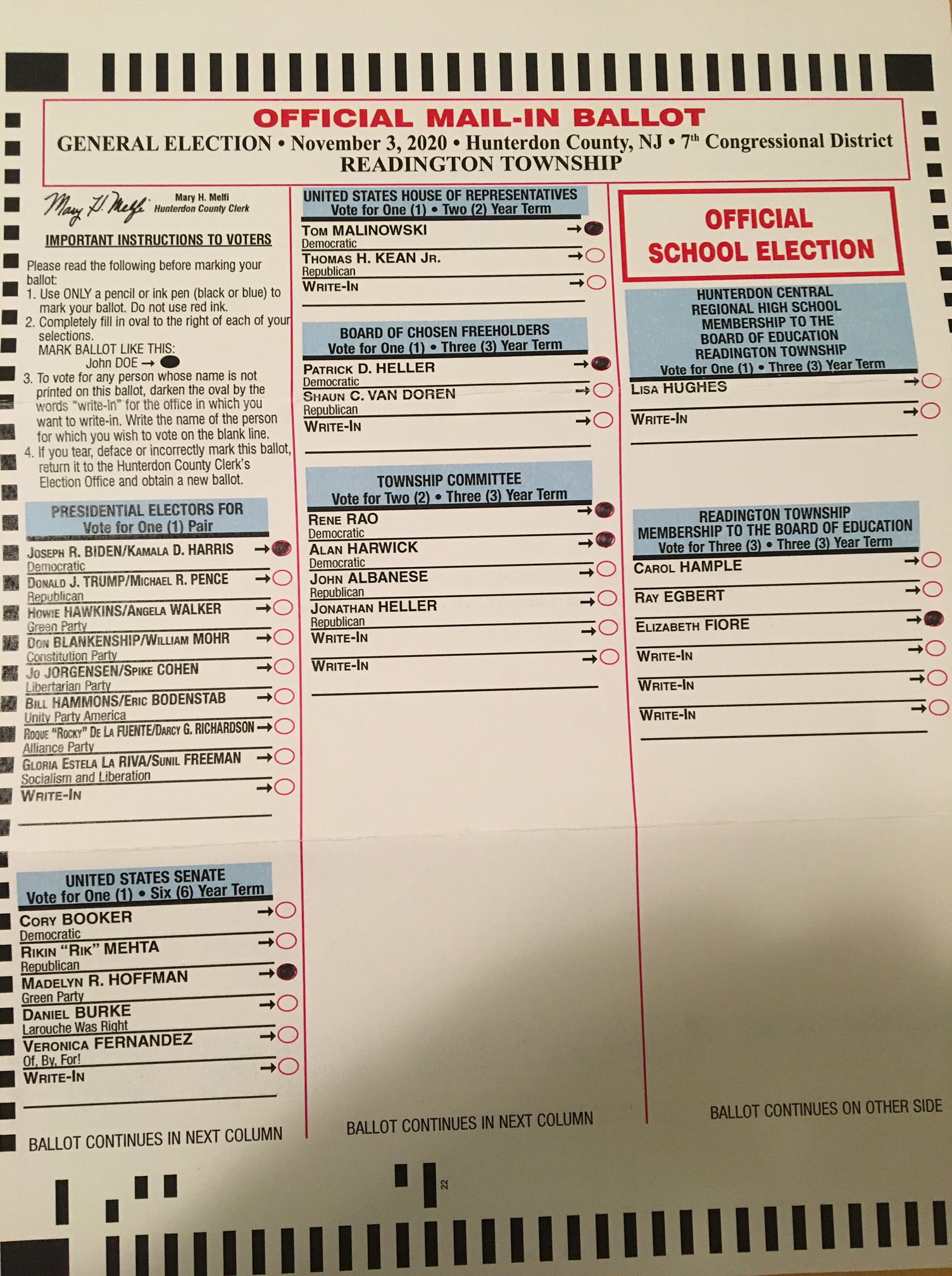
I voted!

No, not in the u.s. election – Ἀθηνᾶ κρείττων!

Nah, I voted for which book we will read next in the Auburn Science Fiction and Philosophy Reading Group.

This was a more cheerful and civilised affair than the u.s. election in at least seven ways:

1. Minority choices have no trouble getting on the ballot; any individual member of the group can nominate a book (or several), without having to collect multiple signatures on a petition.

2. The number of participants is small enough that any individual vote has an actual chance of making a decisive difference to the outcome.

3. Voting involves rank-ordering the candidates via an online Condorcet poll, so no one has to choose between voting for their favourite among the front runners and voting for their favourite absolutely.

4. We choose a new book every month or two, so there’s strict rotation in office with very short terms – no perpetually incumbent books.

5. The reading group is a purely voluntary association. If any members aren’t happy with the winning choice, and want to go off on their own to read and discuss a different book, the rest of us wouldn’t dream of trying to stop them, let alone telling them that by voting (or by not voting) they have committed themselves to reading the winning book.

6. All the books nominated look worthwhile, and I would be happy to read and discuss any of them.

7. Facebook has not been reminding me every few minutes to vote for the next book.

O idéal lointain!

EVS Journal (1): Kill ‘Em All

Some readers may remember that back in May, I resigned my position as Associate Professor of Philosophy at Felician University in protest at malfeasance I encountered at the university, malfeasance that upper-level university administration wanted covered up. These same administrators apparently expected me to help them cover it up, but I wouldn’t and didn’t; after a ten-day standoff with these assholes, it became clear that they wanted me off of payroll and out of the way. As an at-will employee at a non-tenure-granting institution (five years on the AAUP’s censure list), I had no viable institutional options for dealing with corruption that willful and entrenched, so I quit before they fired me. I’m glad I did. As I’ve been saying for years, Felician is a sinking ship. It’s only a matter of time before it goes under. Continue reading