Were Rousseau’s Children Victims of His Moral Theory?

Yes, it’s true: Jean-Jacques Rousseau, philosopher of compassion, fierce defender of the weak against the strong, the man who never tired of talking about equality and justice and virtue, who wrote a long book (Emile) about just the right way to raise children, sent all his own children to the Paris Foundling Hospital immediately upon birth.  He never knew or even saw them.  Rousseau’s admirers sometimes write as if there might be some doubt about this (e.g., Riley 2001, 6).  But not usually.  More commonly the fact is accepted without question (e.g., Cohen, 1953, 13; Bertram, 2012, 4; Edmonds and Eidinow, 2006; Kelly, 2001, 315).  Indeed it’s hard to see what doubt there could be when Rousseau refers repeatedly to it in his Confessions (1953, 320–22, 332–35, 387, 437, 515–16, 549, and possibly 583–84).  As Cohen (1953, 13) points out, several of the people Rousseau claims to have confessed the secret to were still alive when the Confessions were published, and if it weren’t true, some of them surely would have said so.

Now, being no fan of Rousseau’s brand of social thought, I admit that I am not sorry to find evidence of his hypocrisy.  I’m inclined to smile along with Deirdre McCloskey: “A house ‘filled with domestic cares and the noise of children’ would make a poor place for discoursing on social justice and the raising of children.  Thus on five occasions did Jean-Jacques Rousseau act, that great pre-Romantic teacher of good behavior in love and education” (2006, 114).  But being also at present the teacher of a class on Critical Thinking, my conscience is pricked with the thought that this is ad hominem.  Rousseau’s hypocrisy does not make his social and moral theories false.

My own thought when I learned of this episode in Rousseau’s life was, “if Rousseau had spent less time cultivating his conscience and more time cultivating his character, maybe he wouldn’t have done that!”  That is, it struck me that Rousseau’s actions in this case illustrate a fundamental problem with his conscience-centered morality and thus are philosophically relevant after all.

To judge from the statements of the Savoyard Vicar, which are confirmed repeatedly by statements made in Rousseau’s own voice in the Confessions, conscience is the lone pillar of Rousseau’s moral view.  Rousseau espouses a form of moral sense theory that makes conscience the sole and infallible oracle of right and wrong.  Rousseau’s moral view can be summarized in eight points.  (a) “All the morality of our acts is in the judgment that we ourselves pass on them” (1975, 259).  This seems to be a statement of subjectivism, though how far to take it is questionable.  The same Savoyard Vicar who makes this statement also believes that God rewards the virtuous and punishes the wicked after the death of the body.  Still, if there is any other basis of right and wrong, Rousseau gives no hint of it.  (b) The “judgment” in question is a matter of feeling, not reason or cognition.  “[W]e feel before we know, and just as we do not learn to will our own good and avoid what is harmful to us, but receive that will from nature, love of good and hatred of evil are as natural to us as self-love” (1975, 262–3).  (c) Our moral feelings are the product of an innate faculty called conscience.  It is the inner voice of right and wrong.  It not only allows us to recognize the good, it motivates us to love and pursue it.  It is to the soul what passions and instincts are to the body (1975, 258–9).  (d) Conscience is infallible (1975, 264).  (e) The judgments of conscience are universal; that is, essentially the same across persons and cultures (1975, 261–2).  (f) Although infallible, conscience can be misled by false information or sophistical reasoning.  The Savoyard Vicar doesn’t discuss this point, but it is clear and important in the Confessions (see for example 1953, 190–1, 218–9).  The same point is made concerning the general will in The Social Contract: the general will is infallibly good but not necessarily very wise (II.iii, vii).  It can be misled.  For Rousseau, the general will is to the body politic what the conscience is to the individual.  (g) The voice of conscience can be ignored or denied (1975, 264).  Indeed this happens all too often, usually from personal interest.  When we are disinterested in a case, the voice of conscience is typically clear and easy to discern; when our personal interests are engaged, our passions compete with conscience and frequently overwhelm it.  (h) A person whose conscience is misled is not morally culpable.  It is not a moral requirement that one be wise or smart.  But it is morally wrong to deny or ignore one’s conscience.  Moral goodness consists in listening to and following the voice of one’s conscience.  This is a matter of degree.  One can be more or less guilty, depending on the degree of temptation, the seriousness of the moral issue, one’s level of strength and personal development, and so forth.  Again the Vicar doesn’t go into these details, but the many moral judgments passed in the Confessions make this clear.

The Savoyard Vicar summarizes the view:

Conscience!  Conscience!  Divine instinct, immortal and celestial voice!  You are the sure guide of a being who is ignorant and limited, but intelligent and free.  You are the infallible judge of good and evil; it is through you that man resembles God; it is to you that he owes the excellence of his nature and the morality of his acts.  Aside from you, I feel nothing in me that raises me above the level of the beasts, except the sad privilege of wandering from error to error by means of understanding without rules and reason without principles. (1975, 264)

We can see also how this moral view supports Rousseau’s famous thesis that we are born good and corrupted by society.  Conscience, the guide and motive force of our inmost soul, is inborn.  Unfortunately it is “timid” (1975, 264) and retires in the face of the raging passions stirred up by our personal concerns and the competitive pressures we are subject to in the world of affairs.  When we allow this to happen, it is due to our own weakness.  Nevertheless, that we allow it to happen is the rule, not the exception.

Now, what’s wrong with all this?  I believe there are several things wrong with it, but here I want to emphasize one in particular, which is that it is largely content free.  What does the voice of conscience say?  How do we know when we are hearing the voice of conscience and when we are hearing the voice of passion, prejudice, tradition, etc.?  Rousseau provides no criterion or even any discussion.  He seems to think it’s just obvious.  But of course it is not.  It is not even obvious—not to mention plausible—that a Rousseauan innate faculty of conscience exists in the first place.  Note the difference between Rousseau and the Scottish moral sense theories of David Hume and Adam Smith.  Hume and Smith, each in his own way, provide a specific psychological mechanism by which moral feelings (and hence judgments) arise from other, relatively uncontroversial, nonmoral feelings.  Thus they give us both a reason to believe that the sort of moral feelings they describe really exist and a guide to the content of those feelings.  Rousseau gives us neither.

He does supply some examples to give us an idea of what conscience dictates (1975, 258–60).  Conscience approves of compassion, kind acts, friendship, clemency, magnanimity, and Cato the Younger.  It disapproves of seeking our own good at the expense of others, malicious acts, insensitivity, violence, suffering, and Caesar.  But for the most part he describes the deliverances of conscience in terms that are already moral: conscience approves of goodness, virtue, heroic deeds, sweetness, the noble, justice, etc., and disapproves of wickedness, crimes, injustice, viciousness, depravity, etc.  Unless we already know good from bad, this hardly helps.

But of course, he thinks we do already know!  That’s the theory of conscience.  Perhaps, anticipating G. E. Moore, Rousseau would say that the good, right, etc.—in general, moral approval—is sui generis and irreducible.  We know it when we see it, or rather when we feel it, thanks to our innate faculty of conscience.  There is nothing more to be said.  We cannot identify the good in any other terms (such as flourishing, desire satisfaction, living in accordance with nature, etc.) or supply any standard by which to assess it.  If we would know the good, we must cultivate our “exquisite feelings” (1975, 259) and “tender emotions” (1975, 260), not deny or suppress them.

Moral development on this view is a matter of uncovering and encouraging these exquisite and tender feelings, and this in turn is primarily a matter of ceasing to deny and suppress them.  The feelings are natural; they are there.  But they are “timid” and driven underground by the passions, corruptions, artificialities, and concerns whipped up by society and its pressures.  To recover our innate goodness and cultivate our conscience depends on returning to nature and its simplicity.  This is quite different from a traditional view of moral development as requiring that one master some set of substantive principles and acquire the habit—the strengths of character—of following them.

If Rousseau’s basic moral precept and advice is to cultivate one’s tender and exquisite feelings, then no one can say he didn’t practice what he preached.  The Confessions consists almost entirely of the history of Rousseau’s feelings.  Every episode is described principally in terms of how Rousseau felt about it, the feelings that motivated his own actions and the feelings that resulted.  The feelings are often intense, sometimes all-consuming.  Rousseau’s thoughts on the other hand take a decided second place.  And if one approaches the Confessions expecting something like an intellectual autobiography, one will be disappointed.

The point of the Confessions is not exactly to justify Rousseau and defend his reputation—well, not before Book IX anyway—but it is to reveal Rousseau’s soul to the reader in such a way as to make clear that Rousseau is a good man.  Notwithstanding a few bad moments, Rousseau believed that “I am on the whole the best of men” (1953, 479), and he proposed to demonstrate this by presenting an account of his life that would be as complete and truthful as he could make it, with respect to both his actions and their motivations.  It is evident that a key component of this project of displaying the goodness of his soul is to tell the history of his exquisite and tender feelings.  By showing what “tender feelings” underlay his every action, his actions are rendered, if not always quite good, at least not viciously motivated.

We see the exculpatory power of tender feelings repeatedly in the Confessions, not just in Rousseau’s own case but in the cases of other people he loves and is determined to think well of.  His father, whom he refuses to criticize, effectively abandoned him at the age of ten and never supported him thereafter, although he could have done so.  Indeed, Rousseau effectively supported his father through an inheritance from his mother (who died of puerperal fever nine days after he was born), money that belonged to Jean-Jacques but which was at the disposal of his father as long Jean-Jacques wasn’t around to collect it.  Hence, according to Rousseau (1953, 61), his father’s neglect.  But his father wasn’t bad.  On the contrary, he was good, affectionate, and “a man of scrupulous integrity, and possessed of that strength of mind that makes for true virtue.”  How does this evaluation square with his father’s actual behavior?  Evidently the idea is that his father meant well—his tender feelings never wavered—but unconsciously (“obscurely without his being conscious of it”) his self-interest in the money influenced his behavior.  Thus he could remain good in his heart even though his actions were not what they should have been.

Another person Rousseau loved and was determined to think good was Madame de Warens, whom he met shortly after running away from home at the age of 16 and with whom he lived during most of his twenties.  His senior by about fourteen years, she was a mother figure to Rousseau (he called her “Mamma”) and remained so even after she became his lover.  She was surely the most important person in his entire life.  He insists throughout the Confessions that her character was one of angelic purity and goodness.  Her M.O., at least during the period of her life that Rousseau describes, was to attach men who could do things for her to herself by sleeping with them, for as long as the arrangement was useful and no matter what other men were simultaneously in her life.  To this reader, it seems evident that Rousseau’s own relationship with her was not exceptional in this regard.  She informed Rousseau that they would have sex at about the time it became apparent that he might otherwise be seduced by other women.  Later, when he became sickly and incapable of doing much, she replaced him with another man.  Or perhaps “supplemented” would be more apt, since, although the other man took the primary position, she did not propose to withdraw her favors from Rousseau.  (He however declined to accept them anymore and soon moved away permanently to Paris.)  Rousseau himself does not regard her sexual behavior as morally appropriate.  How does he reconcile it with her goodness?  She had mistaken ideas.  “All her faults, I repeat, came from her lack of judgment, never from her passions” (1953, 190).  To be specific, she was led astray by her philosophy teacher!  In an attempt to seduce her, which succeeded, he plied her with sophistries and convinced her that sexual intercourse is intrinsically unimportant and that marital fidelity need be kept up only in appearance, not in reality.  Thus hers was a case of a misled conscience: innocent and good although mistaken.

These two cases set the pattern: wrongdoing can be compatible with goodness of heart if the wrongdoing can be put down to weakness, such as unconscious corruption in the case of Rousseau’s father and weakness of understanding in the case of Mme. de Warens.  This is the strategy Rousseau applies to himself as well.  He has, he says, every virtue but strength of character (1953, 261).  I do not mean that he completely lets himself off the hook for every wrongdoing.  He clearly blames himself (in a mild way) for certain acts, though not many.

To return at last to les enfants, what does Rousseau say about his actions in this regard?  He insists that at the time of the decision, he was morally untroubled (1953, 322).  The only reason he did not boast openly of his actions was to save the feelings of his mistress (the mother), who did not agree with the decision (1953, 333).  He claims he got the idea that abandoning one’s children at the Foundling Hospital was “the custom of the country” (1953, 322) from the ribald stories told by the “fundamentally decent” men at the dining establishment he frequented.  He regarded children as a considerable inconvenience, abandoning them was a socially acceptable way to relieve oneself of it, problem solved.  So like Mamma, his heart was good but he was misled.  He asks himself whether he might have been callous or lacking in humanity in abandoning his children, and answers: “No, I feel, and boldly declare—it is impossible.  Never for a moment in his life could Jean-Jacques have been a man without feelings or compassion, an unnatural father.  I may be been mistaken, but I could never be callous” (1953, 333).  He then alludes, in all seriousness, to reasons that persuaded him to abandon his children that were so powerful that they cannot be revealed, lest they corrupt other young men!  Some other reasons he does give in this passage include imagining himself as a guardian in Plato’s Republic who must turn over his children to the state and never know their identities, and the reflection that it would be better for them to be brought up “as honest people” (at the hands of an 18th century state orphanage) than with money, as would have happened if one of Rousseau’s aristocratic patrons had taken them in, as some offered to do.  A final reason was that he wanted to keep his children away from the influence of his mistress’s bad family (1953, 334, 387).  Whatever Rousseau’s all-powerful hidden reasons may have been, one has to agree that he could safely reveal these others.

Rousseau eventually developed a considerably bad conscience about the way he had disposed of his children.  He considered making a public confession of the fact at the start of Emile, but thought better of it.  (He does make a veiled allusion to it in that book, 1979, 49.)  Nevertheless, in spite of his later bad conscience, he insists that the action was innocently done at the time and with a good heart.  I believe this raises a serious existential challenge to Rousseau’s whole conscience-based moral view.  A baby at the Paris Foundling Hospital in these years had only a two thirds chance of surviving its first year and only a five percent chance of reaching maturity.  These are facts which Rousseau could have determined without much difficulty if he had felt motivated to bother (Johnson 1988, 21).  One can imagine the Dickensian conditions that must have prevailed in the place.  What is the use of a moral view that can’t tell a modern European he shouldn’t treat his kids that way, like so much garbage?  Less rhetorically, can it be true that we possess an innate, infallible oracle of right and wrong if Rousseau could not hear that oracle telling him it is wrong to dispose of his children in the way he did?  Rousseau, after all, was “the best of men” and “never for a moment in his life… without feelings or compassion.”  He must have been fully attuned to the voice of his conscience if anyone ever was.  Even without any explicit moral theory or moral code, his conscience would be there, according to his view, and he as a man of tender and exquisite feeling should have been in a position to hear it.  But by his own account, he didn’t.

His own account is that he honestly thought he was doing the very best for his kids, better than raising them himself and better than letting one of his aristocratic patrons take them in and better than any other avenue he might have pursued but didn’t.  But can conscience be supposed really to be so utterly detached from cognition as to accept without a murmur the idea that it is better for a child to be in an orphanage than in the home of his parents or on an aristocrat’s estate?  Can conscience really be so passive and accepting of what cognition says as not to at least raise concerns and push for a clear examination of conditions at the Foundling Hospital?  Conscience is supposed to at least be able warn against suffering and seeking one’s own interest at the expense of others.  Can it not be expected to recognize when these conditions are liable to be going on or at least to motivate cognition to make proper inquiries?  If it can, then Rousseau’s account of the case of his children is inadequate and we must suppose his conscience failed him.  In which case, we must be skeptical about the existence of such a thing as a Rousseauan conscience.  If it can’t, there is a serious theoretical problem of how conscience is supposed to provide the guidance it is supposed to provide.  If conscience cannot tell you the suffering of your children is morally important, what can it tell you?

Of course, really the best account of Rousseau’s actions in disposing of his children at the Foundling Hospital is that he callously eliminated them from his life because they interfered with the way he wanted to live it.  He doesn’t want to admit this, no doubt even to himself, and the story of his being misled is his form of denial.  In which case Rousseau might not after all have been the best of men, but at least his moral view might be saved.  His conscience did speak, but only timidly and was drowned out by the passions of self-interest.  But this solution will not do for reasons similar to the ones that scuttled the solution in terms of his being misled.  We can’t just say Rousseau was depraved so naturally he didn’t listen to his conscience.  He may not have been the best of men, but he was hardly depraved.  Surely he was a basically decent man and as full of tender feelings as he describes.  (No one could make that stuff up, or would want to, who wasn’t really of that character.)  He was in as good a position as anyone could reasonably be to hear and heed the voice of his conscience.  But he didn’t.  Although not depraved, and motivated by tender feelings, it seems he was morally somewhat rudderless.  So if we are still to believe in the existence of conscience in the Rousseauan sense, then as before we will have to radically reduce its supposed efficacy.  There seem to be two choices: either the voice of conscience speaks so softly as to be barely audible even on such questions as the fate of one’s children, or its content is so vague as to provide no real guidance, again even on such a question as Rousseau was facing.  Either choice seems hardly distinguishable from the skepticism they are being proposed to avoid.

We are driven to the conclusion that Rousseau’s own case raises serious doubts about the existence of an infallible, innate faculty of conscience that operates in something like the way Rousseau describes.  Rousseau would have done better, both in his moral philosophy and in his life, to cultivate substantive moral principles and the character to go with them than to wallow in exquisite and tender feelings with the idea that they are a sufficient guide to life.

There is one further point.  Rousseau’s theory of conscience is a poor source of moral guidance, but it is a rich source of excuses for moral failings.  Consistently in the Confessions, we see Rousseau excuse his own bad behavior and that of the people he loves on the claims that they were misled or at worst a bit weak.  Not coincidentally, his theory makes this easy to do.  Since the theory articulates no substantive principles a person is expected to follow or character they are expected to exhibit, and since a good heart is unobservable, it can always be claimed that a good heart is really present but let down by bad advice or weakness, and this is sufficient to make a person good according to the theory.  So the people Rousseau loves, like Rousseau’s father and Mme. de Warens, can be claimed to be pure and good despite their bad behavior, while the people Rousseau is on the outs with, like Denis Diderot and Friedrich Melchior Grimm, can be base and wicked.

It is tempting for a variety of reasons to believe that we just know by an innate faculty what is good.  But it is false.  The effect of holding that we have such a faculty in Rousseau’s case, and probably in any other, is to leave him with no standard of moral evaluation either in theory or in his own life.  It is thus to leave him without moral guidance.  It is tantamount to no moral view at all.

WORKS CITED

  • Bertram, Christopher.  2012.  “Jean-Jacques Rousseau.”  Stanford Encyclopedia of Philoosphy.
  • Cohen, J. M.  1953.  “Introduction.”  In Jean-Jacques Rousseau, The Confessions, J. M. Cohen, translator, Penguin, pp. 7–14.
  • Edmonds, David, and John Eidinow.  2006.  “Enlightened Enemies.”  The Guardian, 28 April.
  • Johnson, Paul.  1988.  Intellectuals.  Harper & Row.
  • Kelly, Christopher.  2001.  “Rousseau’s Confessions.”  In Patrick Riley (ed.), The Cambridge Companion to Rousseau, Cambridge U. P., pp. 302–328.
  • McCloskey, Deirdre N.  2006.  The Bourgeois Virtues.  University of Chicago Press.
  • Riley, Patrick.  2001.  “Introduction: Life and Works of Jean-Jacques Rousseau.”  In Patrick Riley (ed.), The Cambridge Companion to Rousseau, Cambridge U. P., pp. 1–7.
  • Rousseau, Jean-Jacques.  1979.  Emile, or On Education, Allan Bloom, translator, Basic Books.
  • ———.  1975.  The Creed of a Savoyard Priest, Lowell Bair, translator.  In Jean-Jacques Rousseau, The Essential Rousseau, New American Library.
  • ———.  1953.  The Confessions, J. M. Cohen, translator, Penguin.

Beyond Chutzpah: Chase, Israel, Palestine, and OFAC

Here’s an actual conversation I had about two hours ago at my local Chase branch office.

Chase Banker: Hi, can I help you?

Irfan: Yes, I’m going abroad for two months, so I wanted to alert you to the fact that my debit and credit card transactions will be taking place in foreign countries starting June 1.

Chase: OK, where are you going, and for how long?

Irfan: Well, first to Italy, then to Israel, along with the West Bank and possibly Gaza. For the months of June and July.

Chase (sharply): Those are all the same country. [I take it she meant Israel, the West Bank and Gaza are the same country, not that Italy is part of Israel or vice versa.]

Irfan: OK.

Chase (checking computer screen): Well, Italy is fine, but unfortunately, Israel is on the US government’s OFAC list, and we can’t guarantee the security of your transactions there. [“OFAC” stands for the Office of Foreign Assets Control of the U.S. Department of Treasury. The OFAC list is the list of countries sanctioned by the US Government. Israel is not specifically on it.]

Irfan: So my debit card won’t work in Israel?

Chase: It may or may not work. We just can’t guarantee it. Being on the OFAC list means that it’s been determined that financial transactions in that country are at high risk for fraud.

Irfan: Does it matter whether I use the card in Israel or in the West Bank?

Chase (sharply): Those are the same country. [No they fucking aren’t, but let it go.]

Irfan: Can I use my credit card there?

Chase: Yes. But there are transaction fees. Are you aware of the fees?

[Awkward puzzled WTF pause. Traffic roars by on Bloomfield Avenue. Grand Funk Railroad plays in the background on someone’s stereo, proclaiming the prima facie obvious fact that they’re an American band.]

Chase (brightly): Do you have a Traveler’s Reward credit card with us?

Irfan: No.

Chase: Well, if you get one, you can avoid all those fees. [All what fees? The ones that accrue to the transactions you supposedly can’t guarantee because Israel is supposedly on the OFAC list that it isn’t actually on?]

Irfan: Well, OK.

Chase: There’s no annual fee in the first year.

Irfan: Great!

Chase: And the annual fee is $90 in the second year.

Irfan (remembering that the same exact banker made the same same exact offer the last time I came in to inform Chase that I was traveling abroad, and that I had the presence of mind to decline it last time):

Chase: I’ve just run your information through the system and you’re approved! All you need to do is sign here.

Irfan (opening my mouth as if to engage in a speech act, but flummoxed at the unexpected silence that ensues):

Chase: Just sign here.

Irfan (sullenly): OK.

Chase: And here.

Irfan (yet more sullenly): OK.

Chase: And here.

Irfan (making lemonade out of self-made lemons): So I can use this card without any problems in Israel? [Of course, I’m not really going to Israel, but let it go.]

Chase: Yes, of course. [Apparently, Israel suddenly got off the OFAC list because I’ve decided to use the Chase Sapphire Traveler’s Reward Card with a 15.99% APR and a $90 annual fee, which I inexplicably agreed to use in order to avoid foreign ATM transaction fees that would probably be less than $90.]

Irfan (forgetting to ask: “So how the hell is the security situation of this card any different from the other ones?”): OK, thanks.

Chase: Have a safe trip!

Well, I guess it’ll be safe from transaction fees, if nothing else.

This is the first time I’ve encountered this “Israel is on the OFAC list” bullshit, despite having been to Israel/Palestine in 2013, having gone to Pakistan in 2012, and having gone to Nicaragua in 2014. But I’m not the only one who’s been fed this party line, and not the only to have complained about it. Here’s an online discussion at Trip Advisor. And here’s an article about the issue from the Times of Israel. An excerpt:

John Sullivan, a spokesman from the US Treasury Department, told the Times of Israel that “Israel is not on any OFAC lists whatsoever.”

‘We’re in the business of enforcing sanctions on rogue regimes – Iran, North Korea, and the like – and I can assure you that OFAC has nothing to do with Israel, an important US ally’

And yet: my Chase banker just told me, unequivocally, that Israel was on the OFAC list–and apparently, Chase has been telling its customers this for years.

What to make of this? If you go to the OFAC site, and put “Israel” into the search engine, you get nothing: Israel is not on the OFAC sanctions list per se. But if you look at the small print on the Sanctions List Search page, you’ll find this:

This Sanctions List Search application (“Sanctions List Search”) is designed to facilitate the use of the Specially Designated Nationals and Blocked Persons list (“SDN List”) and all other non-SDN lists, including the Foreign Sanctions Evaders List, the Non-SDN Iran Sanctions Act List, the Part 561 list, the Sectoral Sanctions Identifications List and the Non-SDN Palestinian Legislative Council List.

My hypothesis is that the Non-SDN Palestinian Legislative Council List consists of Palestinian entities that are blocked by OFAC. Taking advantage of the fact that the Palestinian entities or persons are blocked, and conveniently equating Palestinian entities with Israeli ones (on the grounds that the West Bank and Gaza just are Israel), Chase has taken to claiming that Israel is on the OFAC list, and used that as its basis for making whatever other claims it wants to make and adopting whatever other policies it wants to adopt. That, I take it, is the explanation for the otherwise puzzling (and pedantic) mantra I got from my Chase banker to the effect that Israel, the West Bank, and Gaza are “the same country,” when they obviously are not the same country by anyone’s reckoning–whether Israeli, Palestinian, American, European,  non-Palestinian Arab, or otherwise.

Since a bank is not the place–or is typically not thought to be the place–for a discussion about Final Status Negotiations and the fate of Oslo II, this set of bankerly mantras gets sloughed over by customers who want to get things over with and move on. But the technique in question is known as “deceiving one’s customers with double talk,” and there is some irony in the fact that Chase has the chutzpah to use the technique on its customers while claiming to keep those customers safe from fraud.

Extraordinary contexts aside, I don’t think that deception benefits anyone, and don’t think it should be tolerated in anyone, even if it’s supposedly well-intentioned, and even if no identifiable entity or person is harmed by it in some egregious or obvious way. If Chase has good reasons for singling out ATM transactions in Israel, it should be able to state what those reasons actually are without having to resort to deception. If the reasons have something to do with Palestinian entities, let’s hear that, and hear why. But there really can’t be a justification for claiming that Israel is on the OFAC list when it obviously is not, or claiming that the West Bank and Gaza (!) are “the same country” as Israel, a preposterous view that, perversely enough, puts Chase in the company of Hamas, Hezbollah, and Gush Emunim. Even the Likud Party recognizes the need to annex the West Bank. It doesn’t (yet) have the nerve to claim that the West Bank is Israel. I guess it reserves that sort of thing for American bankers.

Libertarians have long argued that commercial transactions should be regarded as essentially amoral and apolitical transactions, narrowly pecuniary in scope, subject only to the requirements of mutual consent, mutual monetary gain, and nearly unlimited toleration for ignorance and vice. Socrates knew better: honesty, justice, and self-respect demand more of us, and more of those with whom we deal in any kind of transaction, be it for money, sex, power, fame, or anything else. If Zionists and anti-Zionists can agree on anything, we should be able agree not to be bullshitted by a bunch of bankers about the political issues that divide us.

I regret my own pusillanimity on this score, and hereby opt for a different soundtrack for next time:

Nothing in the street–any street, from Cleveland to Al Quds–is going to look any different than it does right now if we put up with everything that’s served up by slick BS artists who exploit the amoral sanctuary they get from commerce as conventionally conceived. As Gandhi came close to saying, we have to become the change we want to see in the world–one transaction at a time, until the change comes. It may not suit everyone’s conception of “civility,” but as Barry Goldwater came close to saying, incivility in the pursuit of justice is no vice.

Postscript, June 15, 2015: In a monumental irony, a week after I posted this, someone somehow managed to use one of my Chase cards to run up eleven unauthorized purchases totaling $1700. No, not in Tel Aviv, Jerusalem, or Ramallah, but in Brooklyn, NY, a godforsaken place that should obviously be put on the OFAC list.

Incidentally, re my Chase Sapphire Traveler’s Reward Card? No one around here accepts credit cards.

Check Your Suburban Privilege

Perhaps I’m being petty, but I’m convinced that there is a distinctive ethos endemic to the suburban American northeast which might be called the suburban entitlement mentality. (I’m sure it ranges beyond that, but that’s the version I know best. I didn’t encounter it when I lived in the midwest–though I encountered other unsavory things.) I’m not a Kantian, but there are days when I think that some of the essential elements of Kant’s moral philosophy–action from the motive of duty, universalizability–were formulated in (over)reaction to a version of the mentality I have in mind. Continue reading

Adjuncting: Conversations Worth Having, and Not

BHL Moderator on Jason Brennan and blog policy:

Jason Brennan deleted Robert’s comments and banned them on his own. Per blog policy, he has the right to delete

Jason Brennan on BHL and blog policy:

There’s no official BHL policy.

Annotation by Matt Zwolinski, responding to a query of mine on blog policy:

How you leap from “I…think it is a good idea to publicly indicate when you have [revised a post]” to the conclusion that I approve of secretly deleting threads “simply so as to make the commenter look stupid while preserving the blogger’s illusion of infallibility” is beyond me.

Baffling, isn’t it? How could anyone “leap” to that crazy conclusion? The Moderator of a prominent blog is asked pointblank whether he approves of one of his bloggers’ deleting whole threads in the name of “revision.” He goes out of his way not to answer the question asked, but makes clear in what he says that it is permissible to delete whole threads so as to preserve the blogger’s illusion of infallibility. When he (or his blog) then comes out and ratifies the permissibility of thread-deletion via a “policy” that no one had ever heard of until he announced it, what are we to make of his previous bafflement at the very suggestion that such a policy might come into existence? Was it really a “leap,” or was it an inference to a conclusion that was obvious to anyone who’d bothered to connect a few dots–and that has now been made explicit by the very people who dismissed it as the ravings of an inconsequential troll?

Reading BHL on the adjunct controversy, I have trouble believing that I’m reading something written by reputable professional philosophers for public consumption. Could the profession be more thoroughly dragged into the mud than by an approach to discourse in which people start the conversation by insulting one another, change whatever claims they’ve made whenever they want, delete whole threads (and whole posts) whenever they want, and ban people in the middle of the conversation for any reason or none? How could anyone expect to be taken seriously on moral grounds after a performance like that?*

Not that the pro-adjunct side of the debate (especially the Twitter-based faction) has been all that elevated, either. Whoever had the brilliant idea of attacking Brennan-smiling-by-the-edge-of-a-lake etc etc. didn’t exactly do adjuncts any favors. What they managed to do instead was to divert attention away from the issues adjuncts actually face, and create the red herring of a class war/pissing contest between a guy who thinks that six months at GEICO gives him permanent credentials as a member of the proletariat, and people who think that a guy standing by a lake can be treated like a character out of a play by Brecht. But that’s the conversation we now have–along with the puerile tweeting about Brennan and Magness’s race, their facial characteristics, and their Mommy issues; the taunting of adjuncts as “losers,” the bad faith career advice, and the “barefoot-in-the-snow” Horatio Alger stories, etc. You’d think that educated people could do better than this.

Obviously, I’m not characterizing every contributor to the debate. But in many cases, the shoe fits.

I’ve been thinking of holding an event at Felician this coming fall on the adjunct issue, called something like “Adjuncting: Ethics, Politics, Economics.” I’m thinking it’ll be a panel discussion of some kind involving adjuncts, full timers, and maybe even some administrators (maybe), airing out issues of mutual concern. I’d like to think that we can discuss some of these issues in a more constructive way than we’ve so far seen. If an event like that is of interest to readers, and you’re in the New York/New Jersey area (or can get there) this fall, feel free to indicate your interest in the combox. If there is interest, I’ll look into the logistics of creating the event. No promises, but I think it’s a conversation worth having, and an event worth doing.

*All quotations current as of May 6, 2015 at 4:19 pm EST. But we’re talking BHL, so don’t expect to read the same post or thread twice.

Postscript, September 28, 2015: Here’s another illustration, from BHL, of the increasingly ludicrous contortions entailed by what for lack of a better term might be called its “editorial policies.” It’s from a post by Steve Horwitz, criticizing a post elsewhere by Sharon Presley. The original version of Presley’s post had cited Horwitz in a way that Horwitz evidently didn’t agree with. Horwitz complained out loud at BHL, prompting Presley to delete the offending sentence. Horwitz responds as follows:

[UPDATE:  Sharon has now edited her post to remove the reference to me and my work without providing any sort of explanatory note that an edit has been made. This is very bad academic and blogospheric manners.]

Yes, very bad.

Later, we get this explanation of one of Horwitz’s claims in the post:

[The first paragraph has been edited for clarity to indicate that Sharon’s piece is critical of EP and inappropriately enlists my work in her cause.]

Right, but that was what Presley was saying back in the day. So maybe the first paragraph should be re-edited for clarity to indicate that Presley’s piece doesn’t mention Horwitz at all. Got that? I’m just waiting for Matt Zwolinski to clarify everything by shrugging his shoulders and saying that he doesn’t see the problem.

Horwitz seems to have missed the fact that the very “bad academic and blogospheric manners” he criticizes here are par for the course at BHL, and have been for years–a fact alluded to four days ago in the BHL combox, but so far unacknowledged by him. At the end of the day, listening to BHL lectures on “bad manners” is like listening to a Donald Trump lecture on hairstyling. The difference is that Donald Trump has the sense to avoid the offending subject. They don’t.

Jason Brennan and Phillip Magness: A Request for Disclosure

Considering the number of times Jason Brennan has alluded, in the context of public discussion, to his once having worked at GEICO, I think it’s only fair that he disclose the following for public consumption:

  1. When did he work at GEICO, and at what location?
  2. What was his title while working there?
  3. What was his salary?
  4. Did he work there through a temp agency, or was he hired directly by GEICO itself?

If the GEICO job is important enough to bring up that many times, it’s worth clarifying the details by way of answers to the preceding questions.

A similar query is in order for Phillip Magness, who’s also been very autobiographically assertive on the subject. The article linked-to in the preceding sentence alludes to 1.5 years spent as a full-time adjunct (I’m presuming that “1.5 years” refers to the period 2008-2010, corresponding to the position of Lecturer at American University on his CV), then invites us to do some “arithmetic” about the income he claims to have earned during that period, and how he managed to live on it while being otherwise productive.

That’s fine, but Magness’s CV indicates that he received three grants during roughly the same period (2007, 2009, 2011). I regard the 2007 and 2011 grants as potentially relevant even though they strictly speaking fall outside of the 2008-2010 period. To be blunt, a year and a half of adjunct work cushioned by three grants is not quite as impressive as the impression one might get by reading the unadorned version of Magness’s apologia pro vita sua.

Three questions for Magness, then:

  1. What was the cumulative monetary value of those three grants?
  2. Does his CV exhaustively list all of his income sources for the relevant years (meaning 2007-2011)?
  3. Did he, during those years (2007-2011), live in a household with someone earning an additional income?

All three questions strike me as relevant to evaluating the story Magness tells.

One problem with both sides in the adjunct debate is that the most assertive people in it seem more interested in parading selective recountings of their valor or misfortunes than in documenting their claims in a way that demonstrates the credibility of what they’re saying to neutral or skeptical readers. If people are going to start going autobiographical in the Great Adjunct Debate–whether they’re adjuncts recounting their minimum-wage woes, or academic stars recounting their Horatio Alger stories–I think they owe us fuller disclosures than any of them have been making about the stories they tell us. Brennan and Magness clearly think of themselves as exemplars for the rest of the profession. How about exemplifying some disclosure about those stories you’ve been telling?

Postscript, 11 pm: I’m satisfied with Brennan’s answer, but on second thought, I have to say I’m not just puzzled but mystified by the autobiographical claims Magness has made in his increasingly-famous essay, “The Myth of the Minimum Wage Adjunct.

As someone who spent the last ~1.5 years of grad school as a so-called “full time adjunct,” constituting my only real source of income at the time, I can state first hand that it will not make you wealthy.

So he was an adjunct for 1.5 years, during which time adjuncting was his “only real source of income.” I take it that the word “real” implies that there was some other, secondary source of income. I’m curious what it was.

Later he tells us,

I can also speak to this first hand as it is something I learned to do quickly during my own period as a full-time adjunct ca. 2008-2009. I was not anything close to well off during this period of my career, but with a little basic time management I not only met my teaching obligations but I (1) finished a dissertation, (2) wrote several peer reviewed articles, (3) composed a substantial part of an academic press monograph, and (4) found more permanent employment.

The problem is, his CV lists a Doctoral Research Grant from George Mason University for the year 2009. I can see how the grant might not literally have overlapped with the adjuncting: if he started adjuncting in January 2008, and continued through fall 2008 and then spring 2009, that would be 1.5 years of adjuncting; he could then have gotten the research grant for the latter half of 2009. But I’m speculating. I think we’re entitled to hear the explanation directly from him.

Literal overlap or not, he cannot, on this basis, claim to “speak to this first hand,” where “this” refers to the experience of the average full-time long-term adjunct–which is what the discussion at BHL was about. One and a half years of adjuncting sandwiched between two grants, along with some undisclosed secondary income source, is not long term adjuncting in any sense relevant to the ongoing controversy. And we don’t even know what he did during the summer of 2008, when he was a “so-called ‘full time adjunct’.” According to Magness, adjuncts don’t teach during the summer months (point 5 of his enumerated points), from which it seems to follow that he didn’t. So did he simply go without income during the summer, or is that when the non-real income source kicked in? If so, what was the source? The answer surely has some bearing on the relationship between his personal experiences and the predicament of the long-term adjunct.

Whatever the answers, we’re left with a mystery in Magness’s account that’s worth clearing up. He wants us to believe that he knows what it’s like to be a long-term adjunct, but the story he’s telling is consistent with saying this:

I was a so-called full time adjunct during 2008-9. Of course, I got a grant in 2007, then one in 2009, and I wasn’t an adjunct during the summer of 2008. During the summer, I got a real job–a real job, albeit with an unreal income. Meanwhile, I had established a relationship with the Institute for Humane Studies, which eventually gave me an administrative job as Academic Program Director, a job I cheerfully hold while suggesting all over Twitter that the university’s problems could be solved if only we eliminated all of those useless administrators on the payroll. I realize that very, very, very few long-term adjuncts could get such a job, precisely because it’s sui generis, and I am now the person who holds it. And yet, I won’t hesitate to lecture long-term adjuncts about what bad time managers they are.

Say it ain’t so, Phil.

Ninth Annual Felician Ethics Conference: Saturday, April 25

Strictly speaking, it’s the Ninth Annual Conference of the Felician Institute for Ethics and Public Affairs. It’s taking place this coming Saturday, essentially all day (9 am – 6 pm), at Felician’s Rutherford, New Jersey campus (223 Montross Ave, Rutherford, NJ, 07070). Fairly easy access from New York City: take the 190 bus from Port Authority (bound for Paterson), and stop at Montross and Union Avenues in Rutherford; turn left onto Montross and walk about a quarter of a mile to campus.

I’m gradually getting permission from participants to post their papers on the Institute’s website. So far, five eight of them are up, and I’m hoping to put more up soon. I’m chairing/commenting on sessions on meta-ethics, evil and harm, and virtue ethics. Besides the ones I’m chairing, there are sessions on distributive justice, bioethics, meta-ethics, well-being, a session on economic issues (Rawlsian and BHL-oriented), and historical papers on Seneca, Sidgwick, Proust, and Kierkegaard.

The plenary is a defense of markets in political votes, by James Stacey Taylor of The College of New Jersey. If you’re in the area and in the mood for some ethics, consider stopping by; at least one PoT-head besides me, Michael Young, will be there. Registration is $10 for graduate students, $20 for everyone else. A bunch of us (so far five six  seven of us) will be going out to dinner after the conference; if you’re interested in coming along, please contact me via the email listed on the website (via the link in the preceding paragraph). (PS, April 23: The reservations have been made.)

I’ve been organizing this conference since 2009, and every time I do it, I’m struck again by how many talented philosophers there are out there, and how much sophisticated philosophy they’re generating. It’s a lot of work to organize a conference, but it’s been a privilege to work with the philosophers who attend the conference; that by itself has made it all worthwhile.

Rethinking Rights (and Freedom): A Series

I’ve decided to start what I envision as an ongoing series of posts here at PoT, called “Rethinking Rights.” A couple of posts have already implicitly discussed the topic: Though I focused on the “traffic ethics” angle at the time, part of the point of last summer’s series on honking at a dangerous intersection was to re-think how the concept of rights applies to noise-based nuisances. Rethinking rights is also related to Gordon Barnes’s post on the freedom fetish, and to my posts on self-defense and local government, among others. Though I meant it as a joke, my recent post on noisy neighbors was arguably on the same topic. There are probably some others as well. Since rights and freedom/liberty are on some accounts closely related concepts, feel free to regard the series as in principle extending to the topic of freedom/liberty as well. (I just happen to know a PoT reader chomping at the bit to become a PoT blogger and write on that topic.)

While any authorized PoT blogger can contribute to the series (and any approved commentator can comment on it), my own personal motivation for rethinking rights is that I find the issue overridingly important, but find myself dissatisfied by the conceptions of rights I’ve encountered in the philosophical literature and in ordinary discourse. The Objectivist conception of rights strikes me as either too narrow or ultimately indeterminate. The libertarian conception is on some accounts even narrower, but also problematically deontic. (Yes, I regard a commitment to deontology as a problem.) The standard left-liberal conception, which (on some accounts) includes a strong version of positive rights, and (on others) includes “collective” rights to ethno-national self-determination, strikes me as too broad, and problematically collectivist. (Yes, “collectivism” is a problem, too.) More radical conceptions of rights, which confer rights on embryos, fetuses, non-human animals, and non-living things, strike me as much too broad. Conceptions of rights drawn in positivist fashion directly from blackletter law strike me as arbitrary and insufficiently focused on moral essentials.

And yet I don’t want to let go of rights-talk, either: I don’t, for instance, buy the Benthamite, Burkean, Marxist, or MacIntyrean rejections of the concept of rights. I don’t even buy communitarian claims about the supposed excesses of rights talk. I’m convinced that there’s an account of rights “out there” that avoids the pitfalls of the existing accounts while bypassing the objections of rights-skeptics. It just needs to be worked out in an explicit way. (On PoT.)

My aim in the series (which need not be the aim of any other contributor) is to (begin to) work out a conception of rights that’s broader and more determinate than the Objectivist/libertarian conception, narrower than the left-liberal conception, and more focused on specifically moral essentials than the sort of account you’d get by perusing a standard textbook of criminal, tort, or business law. A further constraint on the theory is that it has to cohere with a recognizably Aristotelian conception of human flourishing and moral virtue. An aspiration of the series is to think about topics, or spheres of life, that go relatively (or completely) undiscussed in the Anglo-American analytic literature.

I don’t imagine that I can work out a theory of rights in a series of blog posts, even a few years’ worth of them. My aim is a bit more modest: to rebut some defective ideas; to sketch some promising new lines of thought; to uncover previously hidden areas of inquiry worth probing; and so on.

I have a first post in mind, which I’ll post sometime this weekend–most likely after I announce the publication of the new issue of Reason Papers (Spring 2015, volume 37.1).

Another Query: Retributivist Solutions for Noisy Neighbors

While I’m in bleg/query mode, maybe someone has a suggestion–hopefully a punitive, retributivist-type of suggestion–for what ought to be done to/with/about people like this.

I live under neighbors like the ones in the video, and have for about a year now. For the ultimate journey through cognitive dissonance, I’d suggest trying to make your way through Sartre’s Being and Nothingness while your upstairs neighbors are going at it and feral mice crawl into your bed.

But hey. “Be well.” This is no social crisis, just another tricky day at the apartment complex.

(ht: Kate Herrick)

Update: You’ve Got Another Academic Thing Coming

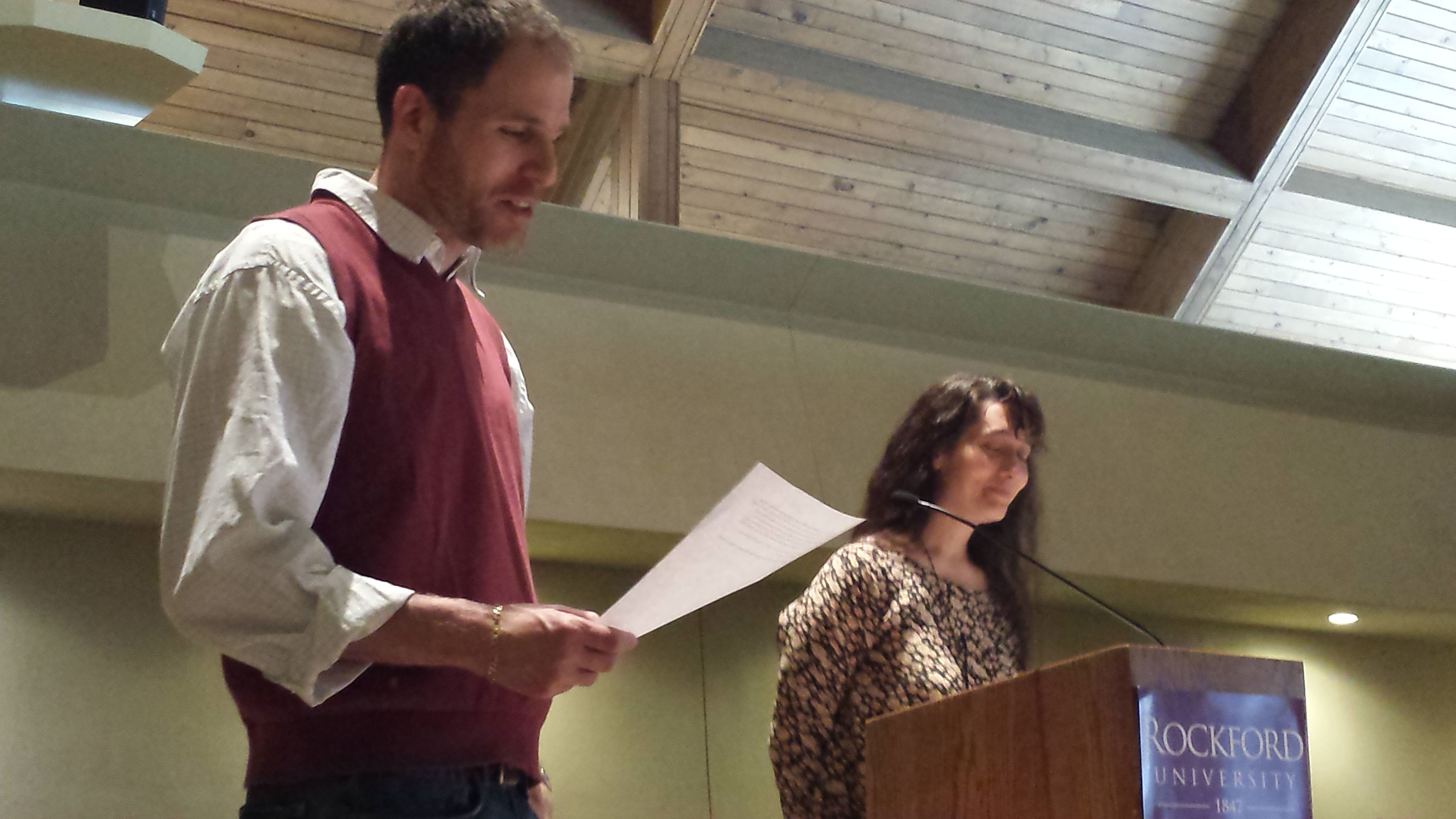
A little while back I mentioned that Carrie-Ann was giving a talk at Rockford University on Ayn Rand and Mike Rowe. The talk seems to have gone well; Carrie-Ann sends the following picture of herself at the podium, being introduced by Shawn Klein of Rockford’s Philosophy Department (photo credit: Stephen Hicks).

RU visit introduced by Shawn

Carrie-Ann tells me that she’ll be blogging her talk soon and eventually posting it at her Academia site, but in general (I’ve read a copy), it’s a discussion (comparison/contrast) of Rand’s views on the moral psychology of work and/versus Mike Rowe’s as laid out on Rowe’s show, his web writings, and in his recent book Profoundly Disconnected.

(Incidentally, though not directly related to Carrie-Ann’s topic, this profile of NOL editor Brandon Christensen’s experiences with homelessness is at least indirectly relevant to the topic and very much worth reading. Not quite a “dirty job” but a “dirty education”: the lengths to which some people will go to get a college degree!)

One basic claim that Rand and Rowe seem to have in common concerns the morally redemptive nature of productive work across the spectrum of types of work–from “clean” to “dirty” (in Rowe’s sense of dirty). A corollary seems to be that it’s more in your interest to work than receive a hand-out, assuming that you’re capable of working. Another corollary seems to be that it’s more in your interest to do dirty work than receive a hand-out while holding out for clean work, assuming that you’re capable of doing the work in question.

A related implication is that when you look for work, ceteris paribus, the choiceworthy features of the work are its not-necessarily-remunerative virtue-realizing features,* not how much money you make from it. In other words, faced with two jobs each of which pays a sufficient amount, you ought to pick the virtue-promoting job over the more remunerative (but less virtue-promoting) one. Similarly, faced with two jobs, one of which is virtue-promoting and pays peanuts, and the other of which pays a lot but is immoral, you ought to pick the former. Those are all, of course, large claims that would have to be developed in ways that go beyond the paper in its current form.

One topic not discussed in the paper but badly in need of discussion is what Randian egoism has to say about the tension between a commitment to egoism and the existence of dangerous-but-necessary jobs, or even a commitment to egoism and the existence of necessary-but-merely arduous-and-messy jobs.  Take jobs like military combat, policing (as well as prison work), fire-fighting, and certain types of construction work, farming, mining, and roofing, etc. They’re all necessary in the sense that they need to get done for the efficient or even minimal functioning of a modern society. If they didn’t get done, we wouldn’t have societies of the sort we’re used to.**

But what egoistic motivation beyond economic necessity or lack of better alternatives (in cases where those are applicable) would induce someone to take such a job? If there is no non-necessity-based egoistic reason for taking such a job, it seems rational to shun them. If it’s rational to shun them, then under ideal conditions, no egoists (or relatively few egoists) would be found in such jobs. Granted, conditions are rarely ideal, but the point is, the better the conditions, the fewer the egoists would gravitate toward such jobs, and under good conditions, few egoists would do them.

Suppose ex hypothesi that we’re in the near-ideal situation where the egoists are doing the “better” jobs and the worse jobs are done by non-egoists (by people whose reasons for doing those jobs is inherently incompatible with egoism). Then it seems that in order to enjoy the fruits of modern society–itself an egoistically rational aim–egoists must of necessity rely on the work (and motivations) of non-egoists. If so, egoism is vulnerable to the charge of failing the test of universalizability or (putting the same point another way) requiring a (conceptual) form of parasitism. Egoism only works, in social terms, if many people aren’t egoists and the egoists rely on them in the way that Aristotle’s virtuous aristocrats rely on natural slaves.

I don’t mean to imply that the preceding objection is necessarily sound, just to suggest that it hasn’t gotten enough sustained attention by defenders of ethical egoism as it deserves. That said, Greg Salmieri (Rutgers, Stevens Institute) has been working on the closely-related topic of exploitation in Aristotle’s social theory. I expect that there’s some convergence between Carrie-Ann’s paper and Salmieri’s.

Meanwhile, to move from the virtue of productiveness to the vice of bestial cowardice, I have to confess that I ended up not attending the ACTC conference at which I was supposed to give my paper on the Nicomachean Ethics and the Grant Study (mentioned in the same post as Carrie-Ann’s paper). I finished the paper the night before I was supposed to leave, then got home to discover that my apartment had been infested with mice. (I’ve had an ongoing sporadic mouse problem these past few weeks, but my point is, when I got home, things crossed the hard-to-define-but-easy-to-discern threshold from mouse problem into mouse infestation.) The damn things kept me up all night, and then obliged me to turn from humane-but-totally-ineffective methods of rodent deterrence to inhumane, lethal methods drawn from years of personal observation of U.S. foreign policy.

I had mentioned my mouse problem in passing to my critical thinking students, one of whom turned my random complaint into a teaching moment by asking, “So why assume that you can’t learn to co-exist with the mice in your house?” Part of it (I said) was that mice spread disease. (Response: “Yes, but people spread disease, too. So you’d kill people if you thought they’d spread disease?”) But part of it, I must confess, is simply that I’m skeeved out by the thought–and not just the thought, but the actual physical reality–of sharing my bed with a passel or herd (or whatever it’s called) of feral mice. Granted, as a divorced single man, I should probably welcome the presence of anyone in my bed, but unfortunately, I don’t. (Yes, they’ve crawled into my bed at night with me in it, I’m not making that up.) I know it’s crude of me to put things this way, but I also can’t help mentioning that the mice pay no part of the rent and do not help at all with household chores.

What would Aristotle do? I don’t know, but here’s what he has to say, in what I think is the only mouse-related passage in the Nicomachean Ethics:

If, for instance, someone’s natural character makes him afraid of everything, even the noise of a mouse, he is a coward with a bestial sort of cowardice. (NE VII.5, 1149a7-8).

Yeah, well, call it another chapter from my ongoing memoir, Profiles in Bestial Cowardice. I almost think it’s worse than bestial cowardice. I mean, if I were a bona fide beast–something terrifying, like a tabby or a terrier–I’d at least have the courage to attack the mice mano a mano. But I’m a middle-aged twenty-first century American professor. I haven’t had a fist fight in decades. As it stands, I’ve just armed my apartment with a series of ultrasonic devices, traps, and poison in the hopes that I can drive the intruders away by high-tech methods of shock and awe. I guess we have to invent another category for people like me: sub-bestial cowardice. Or: Not-even-bestial cowardice. Or: pathetic over-civilized wimpiness.

Anyway, my new surge strategy seems to be working about as well as Bush’s did in Iraq and Obama’s in Afghanistan (wish list item: weaponized drones), but too late for my presence at the ACTC conference. My session starts in an hour, but I’m six hours’ drive away.

The point is, I write about virtue. I never said I had it.

*I had originally written “non-remunerative,” but that seems too strong.

**For interesting but in my view inadequate discussion of this topic, see chapter 11 of Alasdair MacIntyre’s Dependent Rational Animals and “Politics, Philosophy, and the Common Good” (reprinted in Kelvin Knight’s The MacIntyre Reader). Though not an egoist, MacIntyre faces a version of the problem mentioned in the text, but contrary to the impression he gives, never really resolves it.

From the Nicomachean Ethics to the Grant Study

[Here as promised is a first draft of the paper I’ll be giving this Saturday at the annual conference of the Association for Core Texts and Courses in Plymouth Harbor, Massachusetts. Papers for the conference are supposed to be short, non-technical treatments of a core text or two appropriate for undergraduate teaching, along with a rationale for teaching them. This year’s theme is the relation between the arts and sciences in undergraduate education. Comments are welcome, though I probably won’t see them until next week. I’ll add hyperlinks next week as well. This discussion was quite helpful to me in thinking things through.]

Continue reading