The latest issue of Reason Papers, vol. 37, number 2 is now out; officially, it’s the Fall 2015 issue, but we only just managed to put it up on the website last night. This link will take you to a monster-size PDF to the whole issue (almost 250 pages). This link will take you to the journal’s Archive page, where you can access individual articles for this or any past issue (you have to scroll down a bit). Finally, this link will take you to three (time sensitive) Calls for Papers issued by the journal’s editors: one on “the philosophy of play” (March 1, 2016); one a fifteen-year retrospective on 9/11 (July 1, 2016); and one an Authors-Meet-Critics symposium on Douglas Den Uyl and Douglas Rasmussen’s forthcoming book The Perfectionist Turn: From Meta-Norms to Meta-Ethics (February 1, 2017).
Tag Archives: ethics
Student Papers Written via Translation Software: A Conundrum?
I’m curious what PoT readers think of this.
I just got out of a faculty meeting in which one of the faculty from the Dept of Communications gave a short presentation on a problem he said he’s recently encountered. The problem is as follows. Some of our students come from non-English-speaking households. Obviously, they can speak English in a functional way, but they feel more comfortable writing in their native languages, especially if they have to do so for credit. When assigned writing assignments for class, some students in this situation will write the paper in their native language (say, Spanish), translate the paper into English via an online translation app (e.g., Google Translate), and then submit the translated version of the paper for credit without disclosing what they’ve done.
CFP: The Ethics of Bodily Commodification
James Stacey Taylor of the Department of Philosophy and Religious Studies at The College of New Jersey has asked me to post this CFP on what turns out to be a rather timely topic.
CALL FOR PAPERS
“The Ethics of Bodily Commodification”
Saturday, April 2nd, 2016
Keynote Speakers:
Mark J. Cherry, St Edwards University
Samuel J. Kerstein, University of Maryland
To be held at The College of New Jersey, Ewing, NJ
The College of New Jersey’s attractive Georgian campus is located just a few miles from Princeton, and is easily accessible by public transport (just over an hour’s travel time) from both central Philadelphia and central New York.
Revised CFP: Tenth Annual Conference of the Felician Institute for Ethics and Public Affairs
I’ve revised the CFP for the Felician ethics conference to reflect the title of J.L.A. Garcia’s plenary talk, “Grounding the Metatheory of Morals.” So is this going to be an excursion into Aristotle, Aquinas via Maritain, Kant, all three, or something else? I have no idea, so save the date (April 23), show up in delightful Rutherford, New Jersey, and you can hear the answer for yourself.
Better yet, submit a paper–but hurry up, because there’s only five weeks before the deadline. (That means you, Gordon, Carrie-Ann, and Michael.)
Please circulate the CFP to interested parties in your networks, and especially to adjuncts with opinions on the controversy over adjunct employment conditions, since there’s a dedicated session on that topic.
2nd Call: CFP, Tenth Annual Conference of the Felician Institute for Ethics and Public Affairs
CALL FOR PAPERS
The Tenth Annual Conference of the Felician Institute for Ethics and Public Affairs will be held in the Educations Commons Building of Felician University’s Rutherford campus, 227 Montross Ave., Rutherford, NJ 07070, on Saturday, April 23, 2016, from 9 am – 6 pm.
Plenary Speaker:
J.L.A. Garcia (Boston College)
“Grounding the Metatheory of Morals”
Submissions on any topic in moral or political philosophy (broadly construed) are welcome, not exceeding 25 minutes’ presentation time (approximately 3,000 words). Please send submissions via email in format suitable for blind review by March 1, 2016 to felicianethicsconference@gmail.com.
Completed papers are preferred to abstracts, but abstracts will be considered. Authors should ensure that they are available to appear at the conference on the conference date before submitting.
Presentations are invited for a special panel discussion on the ethics, politics, and economics of adjuncting. The invitation is open to all, adjuncts and non-adjuncts alike, from within philosophy and outside of the field.
Please direct questions to Irfan Khawaja at felicianethicsconference@gmail.com.
American (and Muslim) Complicity in Saudi Theocracy
Here’s the best short commentary I’ve recently seen on our complicity in Saudi tyranny, from the letters section of today’s New York Times:
To the Editor:
What are American “interests” in this region, who determined them, and why have they not been shared with the American people?
We get energy from the Saudis and also used to buy significant amounts of oil from Iran. But we diversified our oil purchasing after the 1973 Arab-Israeli War and cut off all Iranian shipments after the Iranian Revolution in 1979. With the current glut of oil on the market, we have never been in a stronger position to press the Saudis for democratic reform. But we don’t.
The only plausible answer is that they continue to buy enormous quantities of American weapons and get support from that lobby. They also continue to invest tens of billions of their petrodollars in Western banks. So despite all our talk about human rights and democracy, it appears that our “interests” are being dictated by the arms industry and Wall Street, both of which have a lock on the White House and Congress.
We the people, who do have an interest in human rights, are left to write letters to the editor and hope that our so-called representatives will hear our voices above the money machine in Washington. Something is very, very wrong with this picture.
VICTOR GOODE
Long Island City, Queens
The writer is a professor at the CUNY School of Law.
Every element of that is right, but there’s one thing he doesn’t mention: no boycott of or blacklist against the Saudi regime can work unless Muslims, especially Sunni Muslims, decide to join in and boycott the hajj and umra pilgrimages to Mecca (and Medina).
I Swear, I Saw a Video of Dozens of Them Celebrating the Tragedy
A celebration “rumor” that turns out to be undeniable for a change. Here’s The New York Times, if you prefer getting the story from the mainstream media.
For the record, I regard what’s depicted in the video as free speech, and reject the idea that it involves (or should be regarded as involving) “incitement” in any legally actionable sense. Let them dance.
I guess this gives new meaning to that old line from Billy Idol: “Hey little sister–what have you done?” It’s a nice day to start again.
CFP: Tenth Annual Conference of the Felician Institute for Ethics and Public Affairs
CALL FOR PAPERS
The Tenth Annual Conference of the Felician Institute for Ethics and Public Affairs will be held in the Educations Commons Building of Felician University’s Rutherford campus, 227 Montross Ave., Rutherford, NJ 07070, on Saturday, April 23, 2016, from 9 am – 6 pm.
Plenary Speaker:
Jorge Garcia (Boston College)
Topic TBA
Submissions on any topic in moral or political philosophy (broadly construed) are welcome, not exceeding 25 minutes’ presentation time (approximately 3,000 words). Please send submissions via email in format suitable for blind review by March 1, 2016 to felicianethicsconference@gmail.com.
Completed papers are preferred to abstracts, but abstracts will be considered. Authors should ensure that they are available to appear at the conference on the conference date before submitting.
Presentations are invited for a special panel discussion on the ethics, politics, and economics of adjuncting. The invitation is open to all, adjuncts and non-adjuncts alike, from within philosophy and outside of the field.
Please direct questions to Irfan Khawaja at felicianethicsconference@gmail.com.
Killing in the Name Of: Jason Brennan on Abortion and Self-Defense (1 of 2)
Jason Brennan has a post a few weeks back on abortion and self-defense (Nov. 30), written in the wake of the Planned Parenthood attack in Colorado Springs (Nov. 29). The point he makes is simple, and the argument he offers is, very narrowly construed, sound. But construe the conclusion slightly differently than he does, and the argument misses the point in an obvious way.
The claim in short is that if you think that abortion is murder, and its victims are innocent, you have the right to defend the innocent by force. If the force in question requires killing those who perform abortions, so be it. Brennan invokes a lot of “common law” reasoning to bolster the plausibility of the conditional*, but the appeal to common law is a dialectical fifth wheel that does no real work here. He’s just assuming what we all assume–that you can kill a killer. After some thought-experimental invocations of superheroes, we reach the conclusion that if you believe that abortion is murder, it would be permissible for you to go around killing abortion providers. Here’s the conclusion of the argument, put in the mouth of the would-be fetus defender:
“I will, if necessary (if there are no equally effective non-lethal means), kill any would-be child murders to stop them from killing children.” Again, this seems heroic, not wrongful.
Note the parenthetical. What we have here is a conditional claim whose antecedent involves another conditional. Let me re-phrase it slightly, without loss of authorial intention, but with a little gain in clarity:
If necessary, and if there are no equally effective non-lethal means, then kill those whom it’s necessary to kill in order to stop the killing.
Lots of modal claims going on there. Let’s rephrase once again:
If necessary, kill those it’s necessary to kill in order to stop the killing, but if it’s not necessary, do not do so.
What does “necessary” really mean here? I take it that “necessary” means “necessary for bringing about some end.” But the end is not plausibly construed as “bringing abortions down to zero, full stop, by all available means, regardless of any other normative considerations.” The end in question is some complex goal, e.g., a just society or the common good or whatever, where superordinate higher-order features of the goal regulate subordinate features, including strategies for achieving this or that political outcome.
So the anti-abortionist’s ultimate goal is not plausibly described as “do what’s necessary to stop the killing.” It’s “do what’s necessary to bring about the common good, stopping the killing in a way that’s compatible with bringing about the common good.” I’m pro-choice, but it seems to me that anti-abortionists (or pro-lifers or whatever we call them) are entitled to a plausible conception of post bellum considerations, no matter how militant they are about ending abortion. They don’t just want to end abortion, full stop. They want to live in a just society without abortion, and it may not be possible to do that if you try to end abortion by killing people. In any case, the two things–stop the killing and live in a just society without abortion–are not the same thing.
Suppose that abortion really is murder. In that case, killing abortionists would be one obvious means of stopping abortions, but killing would also likely have seriously adverse consequences. It might increase hostility for anti-abortionists to the point of instigating widespread persecution against them. It might even start a civil war. Further, it’s easier in talk than in practice to kill all and only the “right” people during a terrorist/vigilante campaign. Once the killing begins, the enterprise of killing is often overcome by some terrorist/vigilante equivalent of the fog of war, and the wrong people get killed with amazing frequency. Any of those outcomes could obtain, and any of them might end up being worse for the anti-abortion cause (much worse) than not killing abortion providers.
It’s hard to be precise about expected outcomes of this sort, so people reasonably disagree about them. Some people think that a campaign of killing would, all in, be good for the anti-abortion cause. Others disagree. Obviously, both the complexity of the calculations and the possibility of disagreement about them might help explain why even fervent anti-abortionists have a (disjunctive) principled reason for not going around killing abortionists. They may either think that doing so is self-defeating, or they might think that doing so might very well end up being self-defeating, and not worth risking, as long as there are relatively peaceful (or at least orderly) political means for achieving the same ends with fewer collateral damages.
In recent times, the history of the abortion controversy begins with a deceptively liberating case from the pro-choice perspective (Roe vs. Wade) and proceeds from there to a series of restrictions on the original Roe vs. Wade restrictions on abortion, so that abortion, though nominally legal in the U.S, is in many ways embattled and under siege. In other words, opponents of abortion rights have done a pretty creditable job of subverting the right to abortion by purely legal means. Of course, abortions do still take place, and on the anti-abortion view, those abortions are murder. But the question is whether a campaign of vigilante killing would have purchased more for them than the political-judicial campaign they’ve actually enacted. Hardly as obvious as Brennan’s argument suggests.
It’s an open question whether anti-abortionists could, by purely legal means, do a better job of subverting abortion rights than they could by killing abortionists. The United States ended slavery by warfare in 1865; Brazil ended slavery without warfare in 1888. Anti-abortionists could in principle plump for a Brazilian approach to the abolition of abortion on the grounds that while that approach would take longer, it might prove more counter-factually stable than a faster-acting but more violent approach. Arguably, violence would be counter-productive and self-defeating, possibly catastrophically so.
Since it makes no sense to enact a self-defeating strategy, and it’s highly risky to enact what could be (catastrophically) self-defeating, anti-abortionists need not worry that Brennan’s argument pushes them into wanton murder. Contrary to Brennan, “the” issue involved in the abortion debate is not just the moral status of abortion (though I agree that that’s the fundamental issue) but what to do about the fact that abortion is a complex issue that elicits widespread disagreement. In other words, the philosophical issue is not just the theoretical one of whether or not abortion is murder, but the practical one of what to do about the fact that certain ways of disagreeing about it are potentially murderous.
Now consider Brennan’s list of would-be objections to his argument:
There are a number of objections to this line of reasoning, including:
- It’s wrong to engage in vigilante justice.
- Batman must allow people to murder children because he has a duty to obey the law, and the law permits child murder.
- Batman must not kill the child-killers, but must instead only use peaceful means.
- Batman must not kill the child-killers, because it probably won’t work and won’t save any lives.
- Batman must not kill the child-killers, because they mean well and don’t think they’re doing anything wrong.
- Batman must not kill the child-killers, because the claim that “killing six-year-olds is wrongful murder” is controversial among reasonable people.
- Batman must not kill the child-killers, because the government or others might retaliate and do even worse things.
I think these objections are either implausible (e.g., 2 is absurd), or are at best mere elaborations of the necessity proviso of defense killing. (E.g., #4.)
Putting aside (4), Brennan is right to say that these are pretty pointless objections. Objection (4) is where the action is. (Construed a certain way, [4] might well entail [1]: vigilante justice might be wrong because it’s likely to be ineffective, and it’s irresponsible to engage in a political strategy that might very well backfire. But I think Brennan intends [1] to mean that vigilante justice is deontically wrong qua violation of the law, full stop. So I’ll ignore it.)
Brennan dismisses (4) as a “at best a mere elaboration…of the necessity proviso of defense killing.” Well, that’s one way of putting things, and not a literally false one, I suppose. But it’s very misleading: a “mere elaboration” of a proviso can also explain why the proviso cannot be enacted under foreseeable conditions, and (4) does just that. In other words, what Brennan calls a “at best a mere elaboration” ends up explaining why, once we leave the thought-experimental laboratory, his suggestion makes no sense in the real political world where it’s supposed to have application.
Digression: the same sort of “elaboration” is the strategy behind what’s come to be called “contingent pacifism” in the just war literature; contingent pacifism is the strategy of justifying de facto pacifism by construing just war provisos in such a way that they can almost never be satisfied in the real world. This literature suggests that depending on how one construes its claims, just war theory (and its doctrine of necessity) can lead either to very hawkish policy prescriptions or to pacifism. But if the same theory leads different theorists to contrary outcomes with respect to the same issue, the differences between the different applications of the theory–the contingencies in question–can hardly be philosophically trivial. If my version of a doctrine leads me to wage war, and your version of the same doctrine prohibits you from ever going to war, it makes no sense to say, “Don’t worry, we’re agreeing on the theory; we just disagree on the contingencies.” In this case, the disagreement on the contingencies could mean the difference between a decade of war and a decade of peace. Conceptualizing that difference is a paradigmatically philosophical task.
Back to abortion: Not killing abortionists because you could get arrested, and/or because it would undermine the anti-abortionist cause, and/or because the collateral damages would be too high, and/or because it could start a civil war are not trivial considerations, whether “morally” or “practically.” From the first person perspective of an agent deciding what to do–not what to write in a blog post–these are all considerations of paramount importance. They make the difference between going ahead and killing someone and deciding not to. So a reader could grant 99.9999% of Brennan’s argument in principle, but still think that the 0.00001 remainder makes a crucial and theoretically significant difference to political practice. And he might insist that Brennan’s way of rendering the argument reveals a blind spot in his thinking about the relation between theory and practice.
I’d put the latter issue like this: Taken as an academic exercise, with all qualifications duly noted, and abstracting entirely from what would be necessary to enact his advice in practice, Brennan’s argument is perfectly sound. Taken as real-world political advice, however, and factoring in all relevant considerations–including prudential considerations about expected consequences–Brennan’s advice is myopic and insane. It seems to me that when the theoretical version of a prescriptive argument ends up sound, but the practical version of it is insane, we’re obliged to think harder about the relation between arguments, theory, and practice.
At a minimum, I think we’re obliged to note the huge gap that obtains between theoretical prescriptions and practical ones. It sounds oxymoronic, but it isn’t. A theoretical prescription is a prescription offered ex hypothesi, as an exercise in deontic logic, without pretending to guide real-life practice: it notes a normative entailment; it doesn’t claim to tell people what to do. A practical prescription is a prescription intended to guide practice, all things considered; it doesn’t just note an entailment, but tells us, all in, what to do.** Put differently, there is a huge difference between saying, “Your views entail that you should go out and kill people–but don’t actually do that, for God’s sake, I’m only pointing out where your views lead!” and saying, “Your views entail that you should go out and kill people–and if that’s where your views lead, so be it. So get your gun and hop to it!” Brennan is saying the former (I think), but you could be excused for interpreting him as saying the latter. The lesson here is paradox-like but not paradoxical: A prescriptive argument can be sound and yet defective as advice.
The underlying disagreement here, it seems to me, is a version of Hobbes versus Aristotle on prudence. Aristotle takes phronesis (‘prudence’) to be an intellectual virtue that guides individual, first-personal decisions. Despite its practical, individualized, contextualized, consequence-sensitive, first-personal nature, Aristotle insists that phronesis a legitimate object of philosophical inquiry and a legitimate source of knowledge (Nicomachean Ethics, VI.5-13). A view like this puts a certain premium on the nuts and bolts of deliberation, from acceptance of the premises that motivate an action down to the details of what ultimately produces the action in the real world. On an Aristotelian view, what’s philosophically interesting is not just the abstract schema that the agent accepts but how the agent translates that schema into the particularities of a particular action. “Translating a schema into the particularities of a particular action” is the work of phronesis.
Hobbes denies that prudence so conceived has any significant epistemic value (Leviathan, IV.46.1-6):
… we are not to account as any part thereof, that originall knowledge called Experience, in which consisteth Prudence: Because it is not attained by Reasoning, but found as well in Brute Beasts, as in Man; and is but a Memory of successions of events in times past, wherein the omission of every little circumstance altering the effect, frustrateth the expectation of the most Prudent: whereas nothing is produced by Reasoning aright, but generall, eternall, and immutable Truth.
Prudence, in short, is unscientific. It yields contingent, changeable, contextualized truths, neither important enough nor counterfactually stable enough nor wide enough in scope to count as genuine philosophical knowledge. How the agent translates an abstract schema into action is philosophically uninteresting. What matters is the schema–the model– itself. From this perspective, an inquiry into what the agent is, all things considered, to do seems too fine-grained, variable, and messy to be a genuinely philosophical or genuinely worthwhile activity.
Contemporary Hobbesians (as I’m thinking of them) prize thought-experimentation and social science at the expense of mere first-hand experience, and at the expense of an account of the requirements of first-personal deliberation (i.e., prudence). First-personal agents disappear from view, as do their deliberations and deliberative needs. From this perspective, the mere prudence required for intelligent political action is unworthy of philosophical inquiry. Anarchist Hobbesians have a plausible-looking rationale for this insistence: on their view, politics is an unworthy occupation, so it stands to reason that the epistemic virtues it require are themselves unworthy of sustained reflection.***
As I see it, one of the most valuable contributions of neo-Aristotelian theorizing (in the Nussbaumian mode) is to put social science and thought-experimentation in its place, and insist on the first-personal perspective of the agent and her deliberations–along with history, psychology, and common sense. On a view like this, it isn’t enough to know that if abortion is murder, and self-defense is justified, you can infer that defensive killing would be justified to save fetuses from murder. You need to know whether, even if that argument is sound, you should actually be out killing people. If so, you need to know whom to kill, when and how; how to prevent predictable disasters that arise when you start killing people; and how the killing enterprise fits into the larger aim of achieving the common good. That sounds like “mere strategy” to some people, but on an Aristotelian view, it’s precisely the kind of knowledge that the just and wise agent has, and that the political philosopher studies in order to grasp the nature of justice and wisdom.
Anyway, thought experiments and social science are of some, but relatively little value here. Eventually, thought experiments run out of prescriptive steam for the obvious reason that life isn’t an experiment. Social science runs out of useful things to say because we can’t do experiments on novel courses of action that no one has yet tried–but we can’t refuse to do novel things because there’s no existing social scientific literature about them, either. A virtue like phronesis is indispensable here, both for deliberative agents and for theorists theorizing about what such agents do. If you’re going to do something–e.g., engage in political action–you have to know how to do it, and the only way to know how to do something is to have done it (or have rehearsed doing something as much like it as possible). You need the kind of knowledge that Hobbes denigrates and that our neo-Hobbesians ignore.
Bottom line: even if you think abortion is murder, don’t do what Jason Brennan tells you. (PS: It’s not really relevant to my argument, but in case you’re wondering, I’m pro-choice on the abortion issue. I believe in abortion on demand from the moment of conception until birth, with some moral reservations about late abortion, while rejecting legal restrictions on it.)
*I corrected this sentence. It originally said, “antecedent of the conditional,” but what I meant was that Brennan invokes common law to bolster the plausibility of the conditional as such.
**I reworded the latter clause after posting. The previous version (which I’ve now forgotten) was wordier and somewhat unclear.
***”Anarchist Hobbesian” may sound like a contradiction in terms, but I don’t think it is. It could mean (a) an anarchist whose meta-philosophical views map onto Hobbes’s and/or (b) an anarchist whose account of political authority maps onto Hobbes’s, but who infers on that basis that no states have authority.
Hummus Summit in Paterson (2)
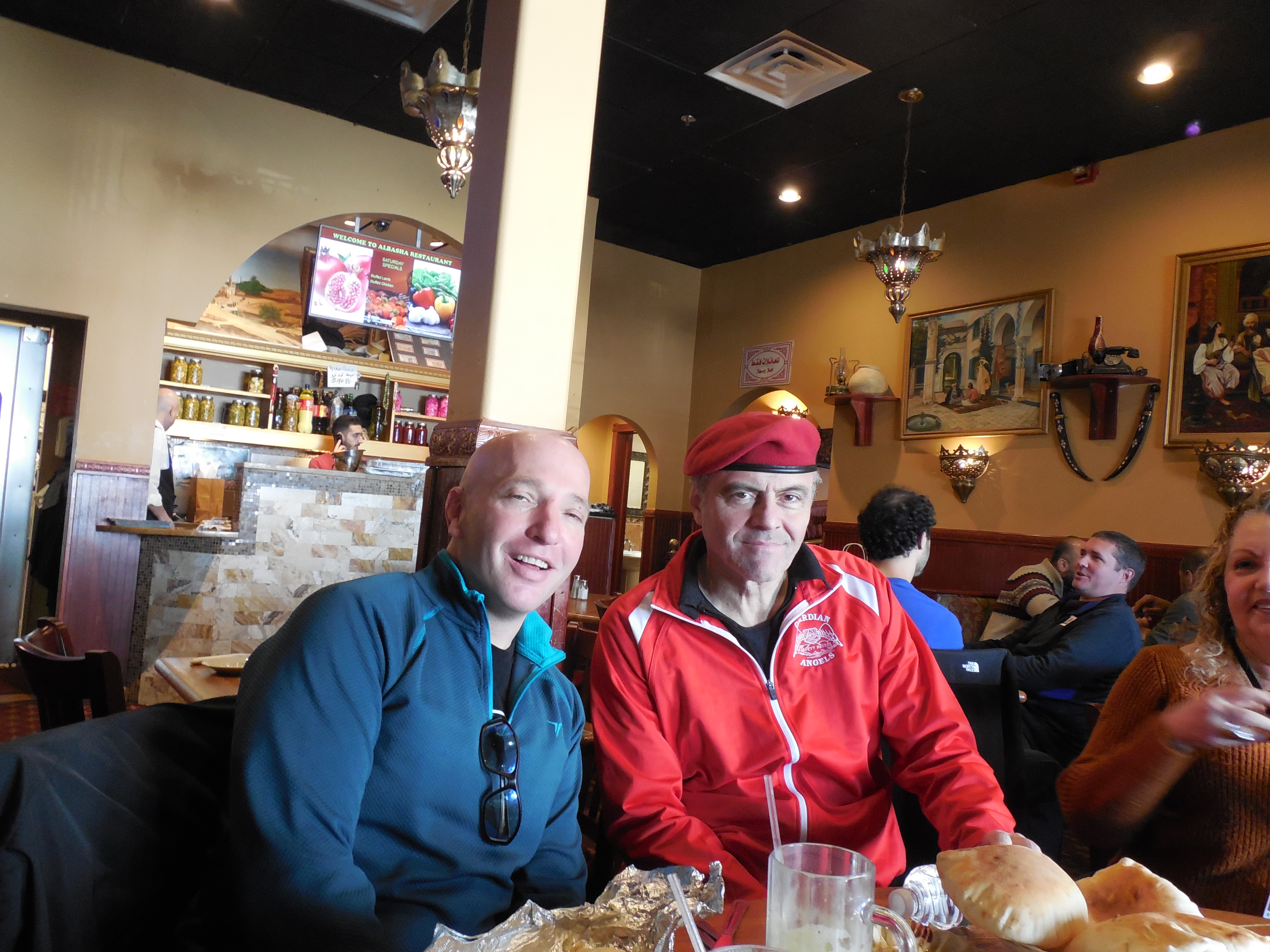
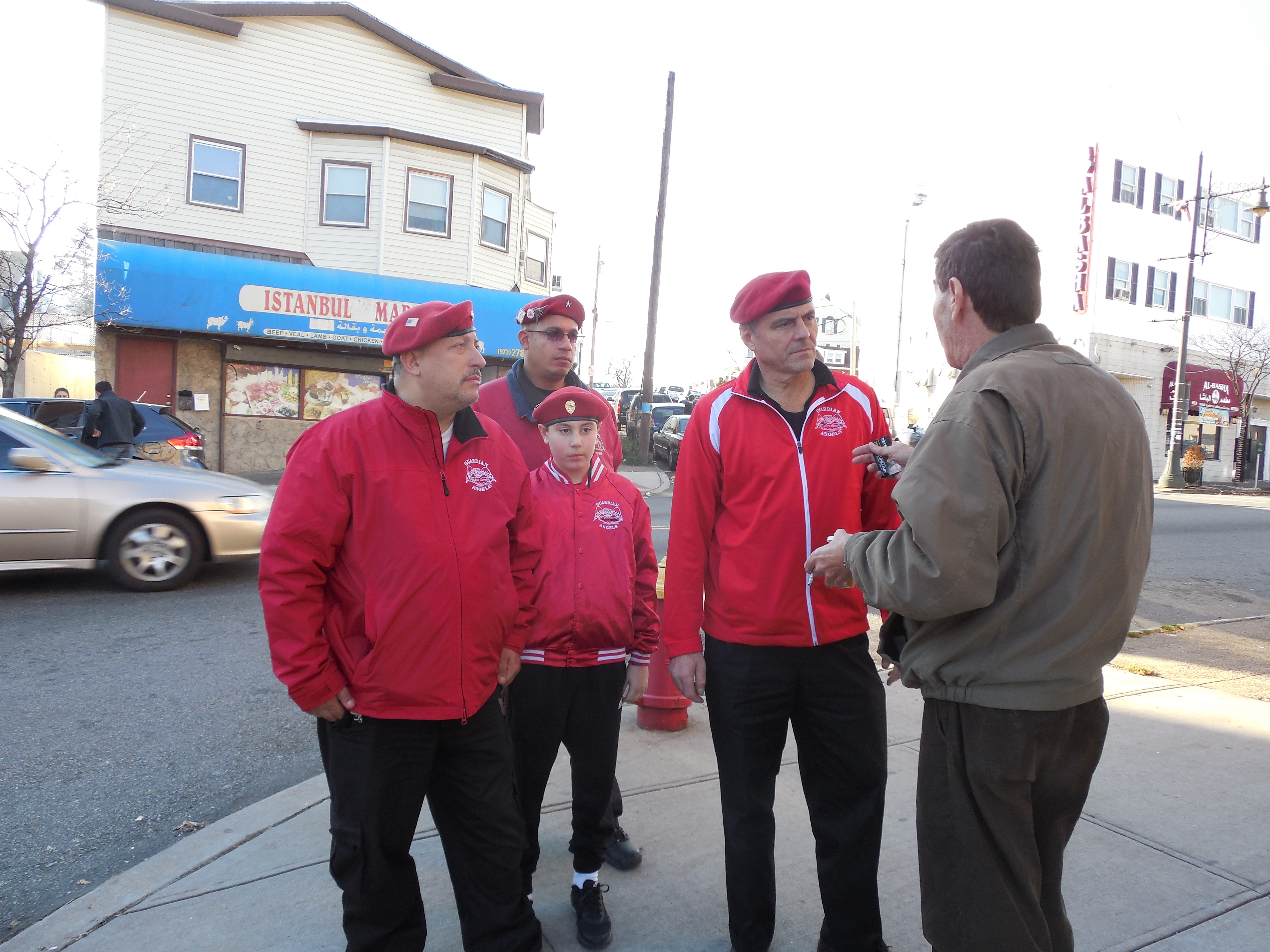
Just got back from the Hummus Summit with Curtis Sliwa this afternoon in Paterson. I’m pressed for time, as usual, so no time to write it up. For now, I’ll just post a few pictures (and silly captions), and write up a post later in the week.
Hey, what a town:

Oh wait, is there a double entendre here?

Curtis Sliwa and Noam Laden in Al Basha Restaurant.
A chance meeting on Main Street outside of the restaurant:
More later. And now, back to my day job as…what am I again, an assistant professor of something somewhere?
Postscript, December 7, 2015: Here’s coverage of the event in today’s Bergen Record. For obvious reasons, only bits and pieces of a wide-ranging two hour interview made it into the article.
Postscript, December 11, 2015: Now that I have a minute, I thought I’d comment on the significance of this event, over and above the opportunity to meet a celebrity and eat lunch at his expense (not that that’s trivial).
At one level, it was an opportunity for a show of solidarity: Curtis Sliwa and I make for unlikely collaborators, but the fact is that we agree on the celebration rumors. Contrary to the blanket rejections that we heard from Paterson city officials when we were investigating the celebration rumors, we both found credible evidence of a celebration-like disturbance in Paterson on 9/11. Contrary to Donald Trump’s defenders and Islamophobes across the land, neither of us found more than that, and neither of us have found the further stories that have been bruited about as plausible. (I’ll have more to say about those “further stories” in a separate post.)
I don’t know if Sliwa would agree, but I would add that the evidence we did collect was not itself definitive, either about the occurrence of an event, or about its celebratory nature. I regard it as likely that some such event took place, but I wouldn’t insist that it did, much less spread rumors (a la Fred Siegel) that small-scale celebrations were definitely occurring throughout the area. (I’ll have more to say about Siegel’s comments on MSNBC in a separate post. For now, I’ll simply note that in a week’s time, he hasn’t acknowledged an email I sent him care of the Manhattan Institute, asking for clarification of his references to me on Joe Scarborough’s show.)
At another level, the event was an opportunity to set the record straight. Trump used Sliwa’s name to spread his, Trump’s, lies. Fred Siegel has used my name to spread his, Siegel’s, confabulations. Sliwa said that there was a small disturbance in Paterson on 9/11; Trump used that to claim vindication for his own bullshit. I said that it was likely that there was a small disturbance in front of the public library in Paterson, and said in print that it was likely that a dozen or less were involved; Siegel has used that to claim that there were “demonstrations” (“a couple of dozen people at most”). I don’t know any better way of calling out bullshitters except to keep calling them out for their bullshit. In that respect, the Hummus Summit could well have been named The Anti-Bullshit Summit, except that that name probably wouldn’t have gone well with lunch.
At a third level, the event was a demonstration of the malign power of rumor. Noam Laden, the other invitee to the Summit, described how he had bought the Paterson celebration rumor hook, line, and sinker for fourteen years, inferring that Paterson would be unsafe for Jews (he’s Jewish) given what the rumor implied about the sensibilities of those who live there. Though he lives in Jersey City (an irony of its own), he hadn’t set foot in Paterson since before 9/11 for fear of having to deal with a neighborhood full of terrorist sympathizers. The result was that he stopped eating at one of his favorite restaurants and shunned Paterson until he was convinced by Sliwa to attend the Summit there. I give Laden credit for admitting all that, and for reversing his earlier views.
Incidentally, Laden told us that his brother’s name is Ben, and that in the wake of 9/11, his brother had endured a fair bit of serious, non-joke-intending harrassment for having the name “Ben Laden.” I know I overuse the line, but this story forces me to repeat it: is there any final answer to the question, “How stupid can you get?”
Though we didn’t happen to discuss the point at the Summit, I suspect that Noam Laden’s worries about Paterson were exacerbated by the Paterson Protocols controversy of 2002, in which I also happened to play a cameo role. The story was originally broken by Daniel Pipes, receiving widespread coverage at the time not just in the mainstream press, but in Marc Levin’s 2005-2006 documentary film “Protocols of Zion.” I think the 9/11 celebration rumors are best understood in the light of this later controversy; it’s the later controversy that retrospectively gives the rumors the apparent plausibility that they seem to have. (I have yet to collect all of my Paterson writings and all of my writing on Muslim anti-Semitism in one place, but I probably should.)
A final point: Laden’s story draws attention to a quiet but pervasive phenomenon in north Jersey, namely, the quasi-segregationist attitudes that north Jersey suburbanites have vis-a-vis its cities. In other words, I don’t think Laden’s pre-Summit attitudes are atypical, and don’t think that they’re limited to fears of Arabs or Muslims.*
Sad but true: North Jersey suburbanites treat north Jersey’s cities in the way that non-Arab Israelis treat the West Bank or Gaza. As far as they’re concerned, Jersey’s cities are scary, crime-ridden “no-go zones” where civilized people fear to tread. Mention “Newark,” “Paterson,” or “Jersey City” to the average north Jersey suburbanite, and with remarkable frequency you’ll get the response, “Oh, I don’t go there.” Unsurprisingly, the suburbs are a semi-gated, exclusively zoned echo chamber of genteel racial and class-based stereotypes. (In fairness, I should probably say that a person might legitimately want to avoid driving to Jersey City given the misery involved in getting there: driving into Jersey City during rush hour is not altogether different from driving into Jerusalem from Ramallah via Qalandia Checkpoint.)
These attitudes seem to be an artifact of the 1980s and 90s, when crime rates soared, and city streets were indeed unsafe to walk. But that was decades ago. It doesn’t seem to matter that crime rates have recently fallen to record lows. The fact remains that our cities are still alien territory. It shouldn’t be a surprise, then, that rumors flourish about them. That’s what rumors are for: they speak the otherwise unspeakable about the irredeemably alien, and north Jersey’s urbanites are apparently as alien to its suburbanites as literal aliens might be to earthlings. The lesson here seems to be that for all of the cosmopolitan pretensions of the New York metro area, we don’t seem to get out much.
One wonders how a country is supposed to hold itself together when its citizens are so alienated by and from the people who live a couple of neighborhoods away that they instinctively shun them on the basis of the wildest rumors about them. A house divided….?
*As a Jersey City resident, Laden is not a suburbanite, so the point I’m making here is not about him. My point is that his story draws attention to the phenomenon I’m describing, not that he himself exemplifies it.
 Policy of Truth