Republican Islamophobia: A Response

This is a much belated response to Peter Saint-Andre and Michael Young on Republican Islamophobia, from my post of January 5. Given its length, I’ve decided to make a new post of my response rather than try to insert it into the combox.

Looking over the whole exchange, I can’t help thinking that the point I made in my original post has gotten lost in a thicket of meta-issues orthogonal to what I said in the original post. I don’t dispute that the issues that Peter and Michael have brought up are worth discussing, but I still think that they bypass what I actually said.

Continue reading

Sad but True: The Republican Predicament

The conservative intellectual Peter Wehner has an Op-Ed in Thursday’s New York Times called “Why I Will Never Vote for Trump.” Though Wehner’s thesis is in many ways a belaboring of the obvious, it’s worth reading, as much for its condensed summary of the obvious as for the obvious things it manages to omit. The omissions offer an interesting glimpse into the thought processes of the most morally decent thinkers on the political right. What the glimpse reveals, I think, is that even the most morally decent thinkers on the political right are too clueless and bereft of original ideas to cure what’s wrong with it.

Continue reading

SMH at BHL: Munger on Trump, Locke, and Religious Toleration

Should I stop reading BHL? Or should I keep reading and stop criticizing it? You tell me, PoT readers, because I find myself shaking my head at some of the stuff they’ve been producing lately.

Take Mike Munger’s latest post on religious toleration. Munger opens with some comments on Trump’s views on Muslims, then quotes a bit from Locke’s Letter Concerning Toleration, then “concludes” (sort of, but not really) that while he thinks Trump is wrong, Locke’s Letter convinces him that he’s not sure that Trump is wrong. The conjunction of the two claims skates perilously close to Moore’s Paradox, but set that aside, if you can. What exactly is the argument that convinces Munger that Trump might be right?

It’s mainly this passage from the Letter, overtly discussing Muslims, covertly discussing Catholics, but taken by Munger to apply implicitly to Trump and to Muslims today:

It is ridiculous for any one to profess himself to be a Mahometan only in his religion, but in everything else a faithful subject to a Christian magistrate, whilst at the same time he acknowledges himself bound to yield blind obedience to the Mufti of Constantinople, who himself is entirely obedient to the Ottoman Emperor and frames the feigned oracles of that religion according to his pleasure. But this Mahometan living amongst Christians would yet more apparently renounce their government if he acknowledged the same person to be head of his Church who is the supreme magistrate in the state.

Munger’s comment:

The relevant question for present purposes is whether one can, and perhaps should, understand Trump’s point in the same context.  That is, the claim is not that religious freedom should be limited.  Rather, Trump’s claim is the same as Locke’s:  any religion that ipso facto requires loyalty to a foreign power,  or requires that an honest believer reject the civil authority and its laws, is a political threat and an overt incitement to violence and revolution.

I think the “relevant question” is how any commentary on this subject could get this confused this fast.

First, a pedantic opening criticism: Munger gets Trump’s views wrong. He describes them like this:

He [Trump] has apparently slathered onto this steaming dish the claim that even American citizens who travel abroad in Muslim countries should not be readmitted.

The link goes to a December 7 article in The Washington Post. A day or two later, however, Trump had changed his tune:

But on Tuesday Mr. Trump clarified his proposal, saying that he would exclude only foreign Muslims, not Muslim American citizens who travel abroad and then seek to come home. That distinction, legal specialists said, made it far less likely the courts would strike it down.

“If a person is a Muslim, goes overseas and comes back, they can come back,” Mr. Trump said on ABC. “They’re a citizen. That’s different.”

I quote this not just to score points–though I don’t mind doing that–nor just to make hay, for the nth time, of BHL bloggers’ strained relationship with the realm of fact. I say it because there’s something really implausible about thinking that Trump’s views are stable enough or theoretically interesting enough to have their roots in Locke’s Letter. Trump doesn’t mention Locke. Nor does he make arguments. What he does instead is to tweet 140 characters at a time, yell down his interlocutors, and let everybody else do his work for him by pretending that he’s said something that counts as political discourse.

So I have to wonder: what is the point of putting theoretical arguments in the mouth of a politician who doesn’t have any arguments of his own, and seems to want to turn the country into a police state? From treating Trump’s claim in heuristic fashion as if it were Lockean, Munger somehow skates in a clause or two to the claim that it just is a Lockean argument. At this rate, I guess BAIR is a Lockean organization, and an armed mob’s surrounding a mosque is a Lockean activity. What next? Lockean internment camps?

So let’s return to the text and try to understand the contorted route by which Munger wants to make Locke relevant to Trump. Though the passage is about Muslims, Munger takes it to be a shot against Catholics, then infers that what is true of the Catholics of Locke’s day might be true of the Muslims of ours. Here’s a suggestion: why not skip the pointless intermediate step and just read the passage as stated?

Here it is again:

It is ridiculous for any one to profess himself to be a Mahometan only in his religion, but in everything else a faithful subject to a Christian magistrate, whilst at the same time he acknowledges himself bound to yield blind obedience to the Mufti of Constantinople, who himself is entirely obedient to the Ottoman Emperor and frames the feigned oracles of that religion according to his pleasure. But this Mahometan living amongst Christians would yet more apparently renounce their government if he acknowledged the same person to be head of his Church who is the supreme magistrate in the state.

I won’t comment on how this passage applied to the Muslims of Locke’s day, but it has almost zero application to the Muslims of 2015.

First, the passage presupposes the existence of a caliphate, but there is no caliphate today (even ISIS only aspires to become one), and there hasn’t been a “real” one since 1924.

Second, the passage presupposes the existence of a caliphate to which Muslims universally or at least ubiquitously swear allegiance, but Muslims didn’t universally pledge allegiance to the Ottoman caliphate even when it did exist. To cite just the simplest and most obvious example, the Muslims of the Palestinian national movement rebelled against the Ottomans during World War I.

In fact, you’d be hard pressed to find universal allegiance to any caliphate since the death of the Prophet Muhammad (d. 632 AD). The disputes over caliphal succession began with his successor, Abu Bakr, and have continued to this day. Dispute over the legitimacy of this or that caliphate has been one of the major themes of Islamic history ever since. (Has anyone at BHL heard of the Sunni-Shia split?) To write about Islam and not know this (or not show any sign of knowing it) is like writing about Islam from the historiographical equivalent of a blank slate.  You might as well write about Christianity without having heard of the Protestant Reformation. It adds insult to injury when what you’re doing is making Trump into a Lockean while scratching your head about the plausibility of his proposals to violate the rights of American Muslims.

Third, caliphate aside, there is no global analogue to a “Church” among contemporary Muslims. The closest analogues might be individual mosques or Islamic Centers, or at best larger scale organizations like the Islamic Society of North America. But these don’t differ from their Protestant or Jewish analogues, and no respectable person is sitting around wondering whether we should deprive Protestants or Jews en masse of their rights because they belong to religious organizations that could conceivably (in someone’s morbid thought-experiment) rival the states we live in.

Nor is any decent person asking whether we should do the same for Catholics, despite the fact that the Catechism of the Catholic Church effectively makes adherence to consequentialism a sin against conscience (#1789), and regards abortion as morally on par with murder and genocide. The potential for conflict with the rule of civil law is pretty obvious on both counts: abortion rights are the law of the land, and “interest balancing” is an essential feature of contemporary jurisprudence. In fact, experts on the subject tell us that anti-abortion views entail violent civil disobedience, not that I agree. So  if we’re going to take Lockean worries about Catholicism seriously, we needn’t get lost in the thickets of Locke’s polemical intentions or the details of English history ca. 1688. Locke’s worries can be raised about Catholics today and used to buttress Trump-like proposals today–used, at any rate, by anyone whose commitment to the principle of rights is weak enough to be tossed about by the winds of Donald Trump’s oratory.

And then there’s the issue of the Church’s view on its lack of accountability to “the civil authorities” regarding accusations of pedophilia engaged in by Catholic priests. In the Apostolic letter Sacramentoriam sanctitatus tutela (2001), then-Cardinal Ratzinger  argued that “Cases of this kind [=accusations of pedophilia against priests] are subject to the pontifical secret,” i.e., that the Church has no binding obligation to report the findings of internal investigations into allegations of pedophilia to the civil authorities, even if it finds the accused guilty. I think by now we all know the story of how Cardinal Law escaped the law, whether or not we’ve seen “Spotlight” (I haven’t, yet).

The Vatican has long regarded itself, and its canon law, as above the civil law of any country and above international law as well, at least in cases of conflict between them.* And canon law binds all Catholics as firmly as sharia binds Muslims. So once again we confront a moral-political equivalence, not an idiosyncrasy of Islam: adherents of both faiths claim the right to supersede civil law, and both claim that God’s law stands above human law. (It should go without saying that I don’t mean that Catholics or members of any other religious denomination should be treated in the way that Trump wants to treat Muslims.)

Bizarrely, despite Munger’s misinterpretation of Trump, he doesn’t think Trump is limiting religious freedom, even if we (falsely) take Trump to be barring literally all Muslims from the United States. Here is Munger again:

That is, the claim is not that religious freedom should be limited.  Rather, Trump’s claim is the same as Locke’s:  any religion that ipso facto requires loyalty to a foreign power,  or requires that an honest believer reject the civil authority and its laws, is a political threat and an overt incitement to violence and revolution.

“The claim is not that religious freedom should be limited.” No, not at all. I wonder whether Munger has heard of Trump’s proposals to close down mosques. Or to put Muslims in internment camps. Or the suggestion (if that’s what it is) that Muslims be put on a registry–not ruling out the possibility that they have to sign up and register for it in the way that 18-year-old males currently have to sign up for Selective Service.  If these aren’t limitations of religious freedom, how would he characterize them?

But maybe he wants to focus narrowly on the issue of barring entry to Muslims, including citizens. Fair enough: here’s a real-life example. My parents spent the last three weeks in Pakistan, returning last night at JFK via Dubai. They’re both naturalized citizens. Though my mother is religious and my father is not, for present purposes let’s call them both believing Muslims.

So imagine that my parents arrive at JFK bearing visa stamps from Pakistan and the UAE, and bearing a Muslim-sounding name like “Khawaja.” On Trump’s original proposal, they wouldn’t be allowed back into a country that they had lived in for forty years. They’d never see friends or family again–and if Muslim, their American friends and family would never see them again, for fear of not being allowed back to their homes after visiting them abroad. My parents would forfeit all of their assets, including their house, and possibly including their bank accounts and their prospective retirement income. Since they’re not dead, their will wouldn’t apply, so all of those assets would revert to the state. They would have to find a home back in Pakistan, a place they left forty years ago–or else in the UAE, where they would lack citizenship and not know the language. They’re both in their 70s, but they’d have to begin their lives anew. (Would it be money laundering if I cut my parents a check or two for food? Would I be materially aiding the enemy if I sent them a care package of rice, lentils, and achaar?)

Perhaps Munger thinks that a barrier on entry back to one’s home country is not a limitation of specifically religious freedom, since the people in question are not returning home for a specifically religious reason. (Well, let’s be careful here. My mother is a kind of folk occasionalist, so as far as she’s concerned, every action is a divine action, and everything is a “religious reason.”). But obviously, their freedom would be limited on religious grounds–i.e., because they were Muslims. It seems obvious that Trump’s claim can accurately be characterized either by saying he wants to limit religious freedom, or more pedantically by saying that people’s freedom should be limited on a religious basis. One obvious way of reading “limited” would be to take it as a euphemistic synonym for “violated.” In other words, the proposition Munger is considering is: “Should we or should we not, on a Lockean basis, violate people’s rights, as long as they’re Muslims?” Is that really an improvement on Trump, or is it evidence that he’s managed to sweep libertarian academics into his juggernaut?

We’re left with one last issue. What if Islam “ipso facto requires…that an honest believer reject the civil authority and its laws”? Gee. In other words: what if Muslims were…anarchists, like half of BHL? Then we’d really have a case for keeping them out of the country. I guess this means that the next time Michael Huemer leaves the country, he’s indefinitely to be detained at the border and refused entry back into the United States. Same with Gary Chartier, Roderick Long, and all those other anti-authoritarians at C4SS. I can’t wait for the next time APEE holds a conference in Guatemala City, and half of the libertarian movement is stuck there for the rest of their lives. That’s a long time to have to pore over Locke’s Letter.

I guess the advice I’d offer here is: instead of speculating whether Islam “ipso facto requires” the rejection of non-Muslim civil authority, why not do some actual research and discover the answer? Every religion, and probably every major secular doctrine, can be interpreted in such a way that it entails a rejection of “civil authority and its laws”–Judaism, Christianity, Marxism, and (believe it or not) Lockean libertarianism. And every religion and every major secular doctrine has been interpreted so that it has implications that involve the rejection of such authority on particular occasions. The same is true of Islam. But the obvious inference is that every religion and every major secular doctrine can also be interpreted so that it’s compatible with civil authority, and compatible most or a lot of the time.

The vast majority of American Muslims interpret Islam in this latter “compatibilist” way. (The majority of them are garden-variety Democrats.) The relative minority who don’t accept Islam’s compatibility with “civil authority and its laws,” are, to be sure, a political, cultural, and security problem. But they aren’t a unique security problem, and we don’t need to target every adherent of the faith to deal with them. In case you haven’t noticed, Trump is focused on Muslims as such. He intends to target all of them. So it’s not to the point to haul out a version of Islam that no longer applies, to haul out centuries-old texts entirely irrelevant to our situation, and to wonder whether that’s why Trump is saying what he’s saying, and well, if so, maybe he’s got a point. That’s not why he’s saying what he’s saying, and he doesn’t have a point.  To write as Munger has is to ignore the obvious while creating mysteries where none exist.

Predictably, the BHL discussion devolves into claims like this:

Is there anything in American experience that could say that US government and laws cannot coexist with domestic radical Islam?

I suggest an experiment. Widely publicize and hold a Draw Muhammad Contest. Offer a $100,000 prize for the most insulting entry. Observe the results.

I’m sure the results would be pretty ugly. Of course, they’d be equally ugly if we widely publicized and held a Draw Fagin and/or Shylock Contest, offering a $100,000 prize for the most insulting entry, and permitting contestants to festoon their drawings with choice quotations from “On the Jewish Question,” “The Protocols of the Elders of Zion,” or Mein Kampf.  But even if all of the contestants of this would-be contest ended up dead at the hands of Jewish terrorists, it wouldn’t follow that we ought to embark on a witch hunt against “domestic radical Judaism.” Practically speaking, the implication would be that we’d have to exercise vigilance against these terrorists, and (without banning them outright) also have to question the wisdom of holding such contests. Exactly the same reasoning applies in the Muslim case.

Speaking of anti-Semitism, every passing day brings increasing confirmation of Edward Said’s much-derided but very prescient speculation that anti-Muslim bigotry (“Orientalism”) is a covert and modified form of anti-Semitism. He speaks in this passage of Arabs, but the point he’s making applies generally to Muslims, whether or not they’re of Arab ethnicity.

The transference of a popular anti-Semitic animus from a Jewish to an Arab target [is] made smoothly, since the figure [is] essentially the same. …

Thus the Arab is conceived of now as a shadow that dogs the Jew. In that shadow–because Arabs and Jews are Oriental Semites–can be placed whatever traditional, latent mistrust a Westerner feels toward the Orient. For the Jew of pre-Nazi Europe has bifurcated: what we have now is a Jewish hero, constructed of a reconstructed cult of the adventurer-pioneer-Orientalist…, and his creeping, mysteriously fearsome shadow, the Arab Oriental (Orientalism, p. 286).

Try that hypothesis on for size. I think it explains a lot about life in the Age of Trump, Cruz, and Carson.

In any case, witch hunt is a good description of what Trump is after. I realize that one isn’t apt to discern a witch hunt if one has never been accused of witchcraft, but take it from someone who has: Trump & Co are out hunting witches. It’d be nice for libertarians, of all people, to see that, and to deal with it with the seriousness it deserves.

——————————-

*For a book length argument, see Geoffrey Robertson QC, The Case of the Pope: Vatican Accountability for Human Rights Abuse (2010). Coming from the reverse political direction, many left-wing Catholics have insisted that illegal immigrants should enjoy legally incontestable sanctuary in Catholic churches. Regardless of whether one agrees or disagrees with the move, it’s a rejection of civil authority.

When I was a graduate student at Notre Dame, my mentor Alasdair MacIntyre used to make a special bragging point of Catholicism’s rejection of civil authority when it clashed with some claimed prerogative of the Church (e.g., the confidentiality of confession vs. the duty to report a crime to the police). He interpreted his liberal students’ indignant reaction to his views as evidence of their debt, and liberalism’s debt, to Hobbes’s anti-Catholicism (cf. Leviathan, Part IV).

Postscript, December 29, 2015: Having seen “Spotlight” since I wrote this post, I highly recommend it–for the acting, for the story it tells, and for being the rare movie to dramatize intellectual inquiry in an effective way. It also nicely focuses some of the issues discussed in the original post. The next time someone describes political Islam as being a unique threat to American liberty–there’s no Catholic equivalent of ISIS, Al Qaeda, or sharia, after all–it might be worth asking what Islamic institution has sexually violated as many children and done as much damage to the rule of law in the United States as the Catholic Church. Still, that’s not a reason for violating the rights of Catholics or of anyone else. It’s a reason for re-doubling our commitment to respecting and protecting rights on principle across the board.

Eleven years ago, by the way, I was writing online essays like this one. No one can legitimately accuse me of being uncritical of Islam or of events in the Islamic world. But my views haven’t changed. What’s changed are the double standards that surround us. From cutting Muslims a bit of slack in the name of multicultural tolerance, we now seem to have slid to the reverse extreme of demonizing Islam as the root of all evils in the contemporary world. A little objectivity and sense of balance would be nice.

Postscript, February 25, 2016: I know I’m beating a dead horse here, but I wish I’d said this in the first place. Munger had said:

Rather, Trump’s claim is the same as Locke’s:  any religion that ipso facto requires loyalty to a foreign power,  or requires that an honest believer reject the civil authority and its laws, is a political threat and an overt incitement to violence and revolution.

How is covert rejection of the civil authority and its laws an overt incitement to violence and revolution? That claim is self-contradictory.

On the other hand, if incitement is overt, and we assume that incitement is justly illegal, where is the puzzle involved in dealing with it? The solution is obvious: arrest all and only those engaged in the illegal activity.

Munger appears to avoid this dilemma by predicating “threat” and “incitement” not of agents but of “religion” as such. But since a religion is not an agent, its content only becomes threatening or inciting when an adherent makes it one. Threats and incitements that sit within the pages of some dusty tome can only sit there until someone makes use of them. If the sheer existence of claims is to be regarded as inciting or threatening, you may as well start legal proceedings against the books themselves.

Bottom line: in addition to all of the other problems Munger’s view faces, it faces a fatal and obvious dilemma. And yes, I’m done discussing it.

Hummus Summit in Paterson (2)

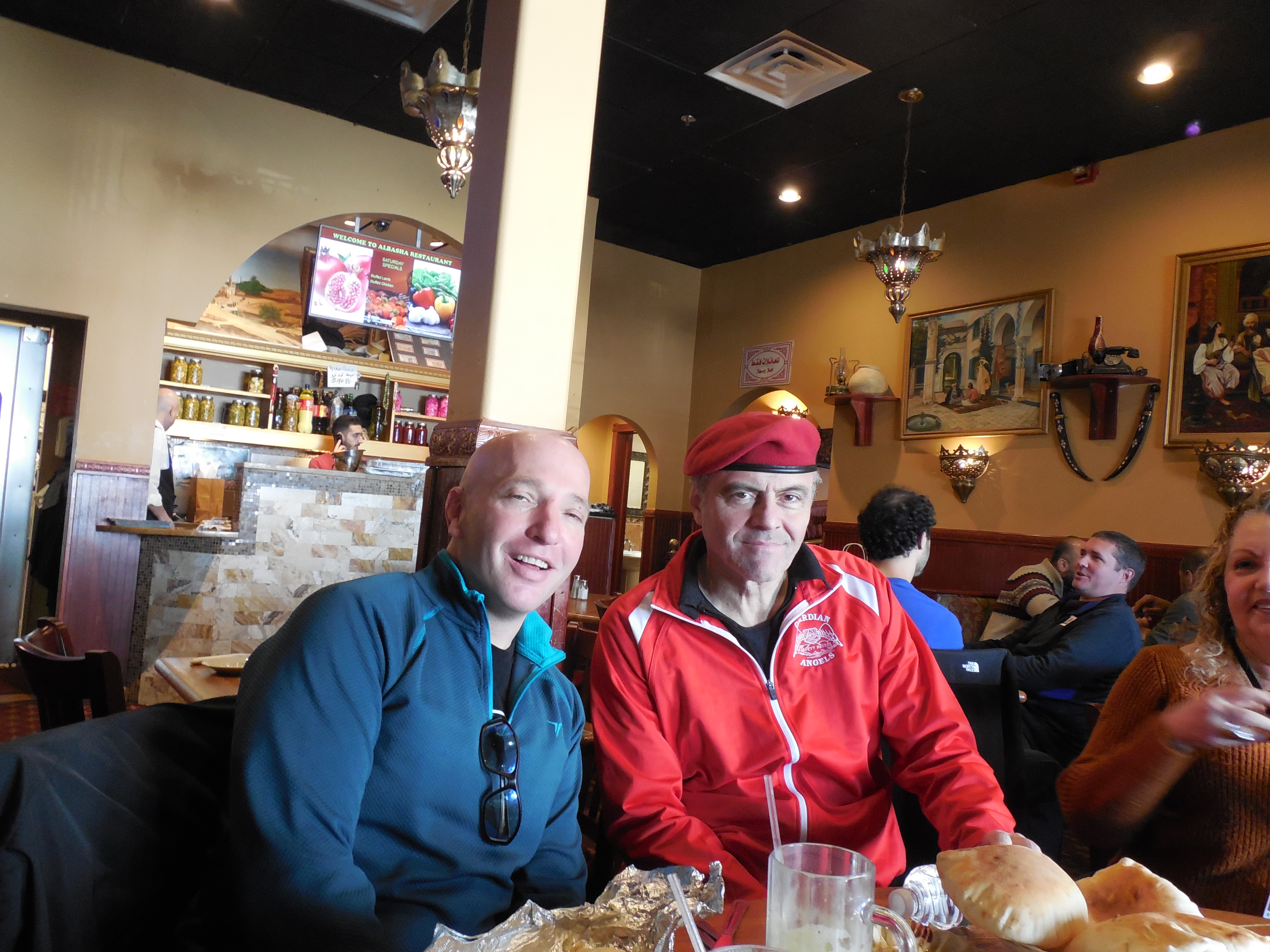
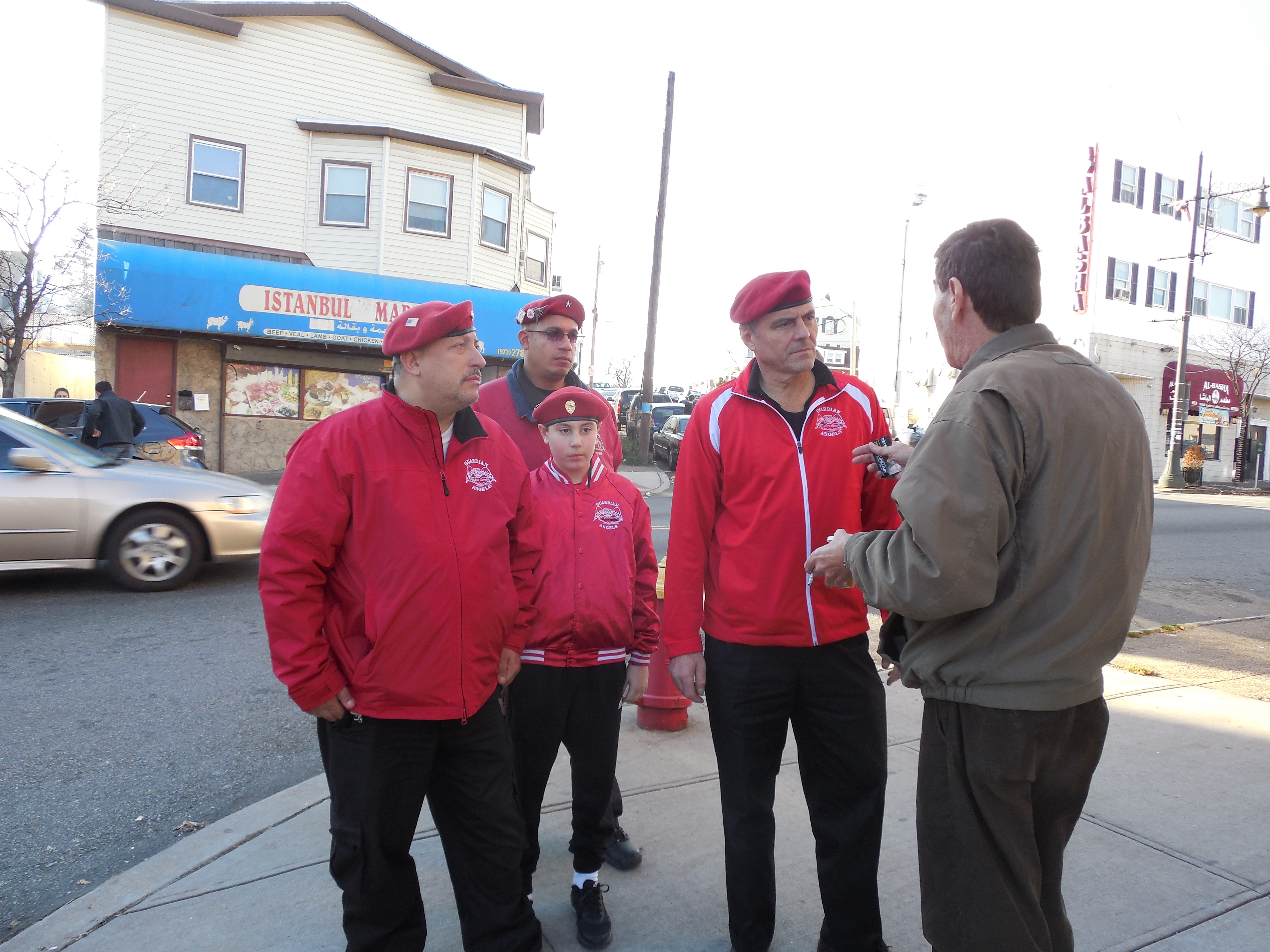
Just got back from the Hummus Summit with Curtis Sliwa this afternoon in Paterson. I’m pressed for time, as usual, so no time to write it up. For now, I’ll just post a few pictures (and silly captions), and write up a post later in the week.

Hey, what a town:

welcome

Oh wait, is there a double entendre here?

mainstreet

Curtis Sliwa and Noam Laden in Al Basha Restaurant.

curtisnoam

A chance meeting on Main Street outside of the restaurant:

curtis1

More later. And now, back to my day job as…what am I again, an assistant professor of something somewhere?

Postscript, December 7, 2015: Here’s coverage of the event in today’s Bergen Record. For obvious reasons, only bits and pieces of a wide-ranging two hour interview made it into the article.

Postscript, December 11, 2015: Now that I have a minute, I thought I’d comment on the significance of this event, over and above the opportunity to meet a celebrity and eat lunch at his expense (not that that’s trivial).

At one level, it was an opportunity for a show of solidarity: Curtis Sliwa and I make for unlikely collaborators, but the fact is that we agree on the celebration rumors. Contrary to the blanket rejections that we heard from Paterson city officials when we were investigating the celebration rumors, we both found credible evidence of a celebration-like disturbance in Paterson on 9/11. Contrary to Donald Trump’s defenders and Islamophobes across the land, neither of us found more than that, and neither of us have found the further stories that have been bruited about as plausible. (I’ll have more to say about those “further stories” in a separate post.)

I don’t know if Sliwa would agree, but I would add that the evidence we did collect was not itself definitive, either about the occurrence of an event, or about its celebratory nature. I regard it as likely that some such event took place, but I wouldn’t insist that it did, much less spread rumors (a la Fred Siegel) that small-scale celebrations were definitely occurring throughout the area. (I’ll have more to say about Siegel’s comments on MSNBC in a separate post. For now, I’ll simply note that in a week’s time, he hasn’t acknowledged an email I sent him care of the Manhattan Institute, asking for clarification of his references to me on Joe Scarborough’s show.)

At another level, the event was an opportunity to set the record straight. Trump used Sliwa’s name to spread his, Trump’s, lies. Fred Siegel has used my name to spread his, Siegel’s, confabulations. Sliwa said that there was a small disturbance in Paterson on 9/11; Trump used that to claim vindication for his own bullshit. I said that it was likely that there was a small disturbance in front of the public library in Paterson, and said in print that it was likely that a dozen or less were involved; Siegel has used that to claim that there were “demonstrations” (“a couple of dozen people at most”). I don’t know any better way of calling out bullshitters except to keep calling them out for their bullshit. In that respect, the Hummus Summit could well have been named The Anti-Bullshit Summit, except that that name probably wouldn’t have gone well with lunch.

At a third level, the event was a demonstration of the malign power of rumor. Noam Laden, the other invitee to the Summit, described how he had bought the Paterson celebration rumor hook, line, and sinker for fourteen years, inferring that Paterson would be unsafe for Jews (he’s Jewish) given what the rumor implied about the sensibilities of those who live there. Though he lives in Jersey City (an irony of its own), he hadn’t set foot in Paterson since before 9/11 for fear of having to deal with a neighborhood full of terrorist sympathizers. The result was that he stopped eating at one of his favorite restaurants and shunned Paterson until he was convinced by Sliwa to attend the Summit there. I give Laden credit for admitting all that, and for reversing his earlier views.

Incidentally, Laden told us that his brother’s name is Ben, and that in the wake of 9/11, his brother had endured a fair bit of serious, non-joke-intending harrassment for having the name “Ben Laden.” I know I overuse the line, but this story forces me to repeat it: is there any final answer to the question, “How stupid can you get?”

Though we didn’t happen to discuss the point at the Summit, I suspect that Noam Laden’s worries about Paterson were exacerbated by the Paterson Protocols controversy of 2002, in which I also happened to play a cameo role. The story was originally broken by Daniel Pipes, receiving widespread coverage at the time not just in the mainstream press, but in Marc Levin’s 2005-2006 documentary film “Protocols of Zion.” I think the 9/11 celebration rumors are best understood in the light of this later controversy; it’s the later controversy that retrospectively gives the rumors the apparent plausibility that they seem to have. (I have yet to collect all of my Paterson writings and all of my writing on Muslim anti-Semitism in one place, but I probably should.)

A final point: Laden’s story draws attention to a quiet but pervasive phenomenon in north Jersey, namely, the quasi-segregationist attitudes that north Jersey suburbanites have vis-a-vis its cities. In other words, I don’t think Laden’s pre-Summit attitudes are atypical, and don’t think that they’re limited to fears of Arabs or Muslims.*

Sad but true: North Jersey suburbanites treat north Jersey’s cities in the way that non-Arab Israelis treat the West Bank or Gaza. As far as they’re concerned, Jersey’s cities are scary, crime-ridden “no-go zones” where civilized people fear to tread. Mention “Newark,” “Paterson,” or “Jersey City” to the average north Jersey suburbanite, and with remarkable frequency you’ll get the response, “Oh, I don’t go there.” Unsurprisingly, the suburbs are a semi-gated, exclusively zoned echo chamber of genteel racial and class-based stereotypes. (In fairness, I should probably say that a person might legitimately want to avoid driving to Jersey City given the misery involved in getting there: driving into Jersey City during rush hour is not altogether different from driving into Jerusalem from Ramallah via Qalandia Checkpoint.)

These attitudes seem to be an artifact of the 1980s and 90s, when crime rates soared, and city streets were indeed unsafe to walk. But that was decades ago. It doesn’t seem to matter that crime rates have recently fallen to record lows.  The fact remains that our cities are still alien territory. It shouldn’t be a surprise, then, that rumors flourish about them. That’s what rumors are for: they speak the otherwise unspeakable about the irredeemably alien, and north Jersey’s urbanites are apparently as alien to its suburbanites as literal aliens might be to earthlings. The lesson here seems to be that for all of the cosmopolitan pretensions of the New York metro area, we don’t seem to get out much.

One wonders how a country is supposed to hold itself together when its citizens are so alienated by and from the people who live a couple of neighborhoods away that they instinctively shun them on the basis of the wildest rumors about them. A house divided….?

*As a Jersey City resident, Laden is not a suburbanite, so the point I’m making here is not about him. My point is that his story draws attention to the phenomenon I’m describing, not that he himself exemplifies it.

Hummus Summit in Paterson (1)

I’m writing this between performances of Felician Live, but just a little note to say that I’ve accepted Curtis Sliwa’s invitation to appear at his Hummus Summit at noon tomorrow at Al Basha Restaurant in notorious Paterson, New Jersey. I’m honored to be invited, it’s in a good cause, and I’m not one to decline a meal (or even a bit of hummus) at Al Basha. Looking forward to it and will definitely blog it when my schedule returns to sanity. More later.

Postscript, December 6, 2015:  Here’s an item at a blog called “Western Journalism,” mentioned on Donald Trump’s Twitter feed. It’s called “Watch: ‘Chilling’ Video Just Surfaced That Could PROVE Trump Was Right About 9/11 Celebrations.” Yeah, I watched it all right. What’s “chilling” is the caliber of this commentary on it:

Fox News host Eric Bolling emerged Tuesday as one of the few media voices to support Trump.

“I remember specifically the news reports about Jersey City,” Bolling said. “They said people were on the roofs watching the planes fly in. They were tipped off prior to the thing, and this was a narrative that was going on. I remember video. I don’t remember if it was Pakistan or Paterson.”

Pakistan, Paterson: what’s the difference? And what difference does it make that neither place is Jersey City? (Or that he’s probably confusing Pakistan with Palestine, and Palestine with East Jerusalem?) Contrary to the blog’s suggestions, what the item really proves is that there is no final answer to the question, “How stupid can you get?”

As for the “proof” itself, it’s worse than a joke. I’ve been away from things for a bit, but when I get the chance (hopefully mid-week) I’ll try to comment on the Pablo Guzman video mentioned here as well as the Giuliani-Kerik testimony and other interesting odds and ends on the celebration rumors that I’ve recently seen (or will end up seeing between now and then).

Episodes in Absurdity

I made The New York Times today. Kind of ironic. I subscribe to the Times, but my delivery guy failed to deliver my paper today.  I guess I link to the Times often enough here, so it’s about time they linked to me.

Kind friends tell me that I was mentioned on Fox News last night and MSNBC this morning.* The irony here is that I hate television and haven’t owned one in years, so I didn’t see either segment.

I just met the new Dean of our Business School. A colleague introduced us, and he said, “Oh, so you’re that guy.” I guess I am.

The funny thing is that I’ve been spending most of my time this week rehearsing for this. Just when you thought life couldn’t get any more absurd. For some reason the advertising for the event doesn’t seem to mention that humor is supposed to be involved, but then again, false advertising is illegal.

I have no intention of doing any TV interviews, but my brother has already started giving me advice on how to do them:

For Mom’s sake, wear something nice.

Postscript, 4 pm: Here’s the segment from O’Reilly’s show on Fox. I regard it as essentially solid. Here’s the segment from Scarborough’s show on MSNBC with Fred Siegel. I don’t regard it as solid, but I’m going to reserve comment on the specifics until I have the time to contact Professor Siegel and ask him for some clarifications. (*I’ve revised the original post to reflect the fact that I’d originally said that both segments were on Fox, but one was on MSNBC.)

I have to take a break from Trump and celebration rumors for a few days to get some work done. It’s the end of the semester, and I can’t afford to keep up this pace of blogging right now. So feel free to comment, but don’t expect much in the way of posting or commenting from me until at least next week. 

Curtis Sliwa vs. Donald Trump

As I’ve said elsewhere, I had a long conversation with Curtis Sliwa in the course of my research on the Paterson celebration rumors. He had gone to Paterson to do street-level interviews before I had done so. He told me what he’d heard, and urged me at the time to follow suit and talk to people on the street. I followed his advice, and ended up essentially re-confirming what he had told me: there was credible testimonial evidence of a disturbance involving 6-12 kids in front of the public library on South Main Street in the mid-morning of 9/11.

This testimony wasn’t air tight. It wasn’t clear that it was true, and it wasn’t clear exactly what it said. It simply indicated that something disturbance-like had taken place on the morning of 9/11 in that area, that it had involved kids, that it had dispersed quickly, and that the event in question had been interpreted as celebratory. Like me, Sliwa dismissed the idea that a large celebration had taken place, but he got flak from the Paterson authorities for claiming that anything at all had happened. The official story emanating from Paterson’s city officials was that nothing of any kind had happened anywhere in Paterson. I spoke with a few city officials, and am skeptical of that categorical rejection. In other words, I basically agree with Sliwa. There may be shades of difference between Sliwa’s view and mine, but on every important issue, I think we agree.

I found it unfortunate that Sliwa wasn’t taken sufficiently seriously at the time. Given his past history of controversy, he wasn’t regarded as a fully credible journalist. I was aware of the past history, but the fact remains that I found him credible, candid, and sincere. We interviewed different people at different times, but the stories they told converged.

He describes me on his Twitter feed as one of his defenders. I’m proud to say that I am, and I’d like to think he’s one of mine. He knows what this fight is about. He was there in the trenches when it mattered, along with the handful of us who chased leads until we were ready to drop, and obsessed about this story when everyone else thought we were crazy. That’s more than can be said of a lot of Johnny-come-lately BS artists who have decided to posture as experts after the fact.

Unsurprisingly, Sliwa is fighting Donald Trump in the same fight for truth and evidence that I regard myself as fighting. Check out his Twitter feed, and you’ll see yet another instance of Trump’s dishonesty at work. I’m completely in Sliwa’s corner on this. It’s not a case of “may the best man win.” As far as I’m concerned, the fight is over, and the winner has already been crowned.

Postscript: Crucial reading on this from MTV News. Sliwa and the reporter, Julianne Ross, are dead-on. It’s Trump who owes Sliwa an apology, not the other way around. Frankly, Trump owes the American people an apology. I would suggest making amends by dropping out of the presidential race and shutting his mouth for awhile.

Trump’s Celebration Story: The Latest Lies

Reuters has a story from Saturday afternoon, “Trump reframes claim that Muslims cheered 9/11.” This is how they report it:

Republican presidential candidate Donald Trump on Saturday reframed his claim that he saw Muslims in Jersey City, New Jersey, cheering the attacks on the Twin Towers of the World Trade Center in Manhattan on Sept. 11, 2001 by asserting the sentiment was shared worldwide.

“Worldwide, the Muslims were absolutely going wild,” the real estate mogul said at a campaign rally in Sarasota, Florida.

That wouldn’t be a “reframe.” It would be a wholesale concession.

Meanwhile, The Washington Post reports it this way:

Trump also doubled down on his initial claim. “I talked about Muslims celebrating in New Jersey. And everyone knows it’s true … people saw. So I made that statement. I didn’t think it was a big deal because I thought everybody knew, adding that “everybody admits worldwide, Muslims were absolutely going wild” over the events of Sept. 11. He later criticized “Barack Hussein Obama” for the administration’s response to terrorist attacks.

“Reframe” or “doubling down”? Well, Trump had originally said that he saw the celebrations:

VIDEO CLIP OF DONALD TRUMP, IN WHICH HE SAYS:“Hey, I watched when the World Trade Center came tumbling down. And I watched in Jersey City, New Jersey, where thousands and thousands of people were cheering as that building was coming down. Thousands of people were cheering.”

STEPHANOPOULOS:“You know, the police say that didn’t happen and all those rumors have been on the Internet for some time. So did you misspeak yesterday?”

TRUMP: “It did happen. I saw it.”

Asked whether he saw them, he changes his story in mid-stride:

STEPHANOPOULOS:“You saw that…”

TRUMP:It was on television. I saw it.

STEPHANOPOULOS:“…with your own eyes?”

TRUMP: “George, it did happen.”

So the new story is not that Trump saw the celebration either with his own eyes, or on TV, but that “people” saw it. That’s not a “reframe.” It’s a liar telling a new lie to get out of the last one he told because he never managed to get his story straight in the first place.

Trump is on record as saying that the celebration story was “well covered at the time.” But with just a few exceptions, almost all of that coverage denied that there were celebrations. The few exceptions were a couple of right wing outlets (The New York Post, City Journal), a stray sentence here or there in the mainstream press (e.g., the Kovaleski-Kunkle article in The Washington Post), and then “shock jock” radio reporting of the sort associated with the old Scott Shannon/Todd Pettingill radio show on WPLJ-FM. But the mainstream media almost unanimously rejected the veracity of the rumors. This fact is too obvious to require demonstration. If you doubt it, trawl through back issues of the Herald News, Bergen Record, Star Ledger, New York Times, Washington Post, and Wall Street Journal. When you find the celebration rumors mentioned, you’ll find their veracity denied.*

So, barring psychosis or brazen dishonesty, there is simply no way to claim, as Trump does here, that the veracity of the celebration rumor was ubiquitously taken as uncontroversial.  That claim is even more deranged than Trump’s original claim that thousands of people were celebrating 9/11 in Jersey City. It’s an Orwellian attempt to claim that everyone has always agreed that thousands of Muslims were celebrating 9/11 in Jersey City!

Given this, the Reuters reporting involves a subtle whitewashing of Trump’s deceptions. In abbreviating the direct quotation and describing it as a “reframe,” Reuters gives the impression that Trump merely confused the celebrations in East Jerusalem with celebrations he thought were taking place in Jersey City, so that what he’s now doing is merely backpedaling, i.e., claiming that he’d really been referring to the East Jerusalem celebrations the whole time. That would be dishonest enough, but as The Washington Post coverage makes clear, it’s not in fact what Trump is doing. What he’s doing is backpedaling while pedaling forward: he’s covering the old lie both by bringing up the celebrations in other countries, and by asserting that everyone knew that celebrations had taken place in Jersey City.

Now take a look at the actual footage of Trump’s Sarasota speech. He rambles a lot, but finally gets to the issue under discussion around minute 7 or so.

There is no “reframe” here at all except that celebrations in “Jersey City” have now become celebrations in unspecified “parts of New Jersey,” and the controversy over their occurrence has now miraculously disappeared under a storm of eleventh-hour tweets to Trump’s Twitter feed.

The Kasich camp has now released a video critical of Trump. The presentation is a bit melodramatic, and the Nazi allusion is a little over the top, but in some ways it’s quite appropriate, and something that Trump richly deserves.

There are reports out there that Trump’s popularity has fallen significantly this week. Opinion polls are about as reliable an indicator of the future as tea leaves or burnt offerings, but it would be nice to think that this is the beginning of the end of Donald Trump’s bid for the White House.

Postscript, 10:16 pm: Oh well, time to “reframe” that “reframe.” Trump just comes out and tells us that there was no “reframing” at all. He meant exactly what he said:

“I have a very good memory, Chuck. I’ll tell you, I have a very good memory. I saw it somewhere on television many years ago and I never forgot it — and it was on television, too,” Trump said.

The real estate mogul claimed he’s heard reports of the celebrations in different New Jersey cities. He said his staff is looking for clips of television reports from the time that will prove his claim.

If he has such a great memory, why can’t he remember where he saw it, or when? Or what he saw? Or where exactly it took place? Or what channel it was on? And what does he plan to say if they don’t find anything?

“I’ve heard Jersey City. I’ve heard Paterson. It was 14 years ago,” Trump said. “But I saw it on television, I saw clips, and so did many other people — and many people saw it in person. I’ve had hundreds of phone calls to the Trump organization saying, ‘We saw it. There was dancing in the streets.’ “

Let’s not get distracted, Donald. The question is not what he’s hearing now, but what he saw then. Wouldn’t an honest person interested in the truth have first found the clips, and then made accusations?

But here is the real underlying agenda:

On Tuesday, Trump’s chief counsel, Michael Cohen, stood by the comments, even as he was pressed by CNN’s Chris Cuomo on the fact that there’s no evidence to back up the claims and that accuracy matters in a presidential race.

“He’s probably right,” Cohen said of Trump on “New Day.” “There’s no way to say that it wasn’t.”

Cohen said the argument over the number of people celebrating is misplaced, and that Trump was making a broader point about enemies within the United States.

“Whether it’s thousands and thousands or 1,000 people or even just 1 person, it’s irrelevant. To celebrate this tragedy … it’s wrong,” Cohen said. “What the exact number is, I don’t know, and I don’t think it’s relevant. What’s important is that there are bad people among us.”

So here’s the million-dollar recipe: (1) Start with an ad ignorantium fallacy. (2) Then backpedal on your client’s claim while your client is doubling down on the maximal version of the same claim. (3) Relying on (2), commit an ignoratio elenchi. (4) End by stoking the prejudices of your audience.

I grew up as a teenager listening to this song, regarding it as a bit hyperbolic and ultimately inapplicable to the country I lived in. We live and learn: it’s on its way to becoming the soundtrack of American political life.

*Postscript, Nov. 30, 2015: Politico has a useful list of articles derived from a Lexis-Nexis search for the dates Sept. 11-Dec. 31, 2001. I agree with the conclusion they draw: “…there is no conclusive evidence that any New Jersey residents celebrated the attacks, and there is no evidence whatsoever of any demonstrations where ‘thousands and thousands of people’ cheered.”

But contrary to what they say, their “search of newspaper and television transcripts” is not “exhaustive” (in any case, their list is not; perhaps their search went beyond the items in the list). Their list doesn’t include reporting from the Herald News (e.g.,  by Hilary Burke), and doesn’t include all of the reporting done by the Bergen Record (e.g., reporting by John Chadwick and by Nicole Gaudiano, as well as statements by Robert Grant, the Paterson city spokesman). It also misses the items that Gary Alan Fine and I cited in our 2005 paper from The Wall Street Journal, Orlando Sentinel, New York Post, and City Journal, and omits most of the reporting, print and television, of the “five dancing Israelis” rumor. It misses the MTV show recently uncovered by The Washington Post. Finally, it misses the fact that the rumors were repeated by Daniel Pipes in his book Militant Islam Reaches America, and were debated online by Pipes and me in 2004 at the History News Network’s website.  (Granted, the latter debate is outside of their search parameters, but Pipes used the occasion to spread more rumors.) I’ll try to discuss some of this material in forthcoming posts.

Here’s a short list, not intended to be exhaustive:

  • Hilary Burke, “Nobody in City Celebrated, Officials Report,” Herald News (Sept. 15, 2001), p. A4.
  • Christopher Callahan, “Anatomy of an Urban Legend,” American Journalism Review (November 2001).
  • John Chadwick, “Battling Rumors and Hatred,” Bergen Record (Sept. 13, 2001), p. A8.
  • Anthony Colarossi, “Critics: Radio Shows Fuel Hate,” Orlando Sentinel (Sept. 14, 2001), p. D1.
  • Nicole Gaudiano, “Scares, Hoaxes and False Alarms,” Bergen Record, (Sept. 14, 2001), p. A19.
  • Robert Grant, “Yelling Fire in a Packed Theater,” Bergen Record (Oct. 1, 2001), p. I6.
  • Drew Limsky, “America’s Course: Of War,” Los Angeles Times (Sept. 23, 2001), p. M2.
  • Heather Mac Donald, “Keeping America Safe from Terrorism,” City Journal (Autumn 2001), and letter exchange with me.
  • Joanne Palmer, ” ‘Protocols’ of Paterson: Scholar Discusses American Muslim Anti-Semitism,The Jewish Standard (now The New Jersey Jewish Standard), Dec. 20, 2002.
  • Daniel Pipes, “Fighting Militant Islam without Bias,” City Journal (Autumn 2001), reprinted in Militant Islam Reaches America.
  • Fred Siegel, “Radical Islam at War with America,” New York Post (Sept. 14, 2001).
  • Jeffrey Zaslow, “Arab’s Restaurant Is Nearly Ruined by Rumor of Celebration on Sept. 11,” Wall Street Journal (March 13, 2002), p. A1.

The (Further) Implosion of Donald Trump’s 9/11 Celebration Story

MTV has finally released the notorious video that constitutes the only videographic “basis” for the 9/11 celebration rumor about Paterson, New Jersey. I’ve had “eyewitnesses” of this video swear to me over the years that they not only watched the video, but that the video itself depicted a celebration taking place in front of the public library in the 900 block of South Main Street in Paterson. It’s the video that I describe in my Jewish Standard interview as the one that I went “crazy” looking for. Incidentally, my own repeated inquiries to MTV in 2001 and 2002 went unacknowledged.

Ladies and gentlemen, behold Exhibit A in Donald Trump’s supposed case for “thousands and thousands” of Arab-Muslim celebrants of 9/11 in the streets of Jersey City, New Jersey:

I never spoke with Emily Acevedo during my research, but the story she tells is identical to the most credible story I’ve heard over the years. It’s also identical to the story that Curtis Sliwa told me in a long phone conversation I had with him back in 2001 or 2002.

Note that Acevedo points out that the disturbance was celebration-like, but that it was not clearly a celebration of 9/11. It could well have been a case of a bunch of high school kids making a disturbance simply because they’d been let out of school early.

As far as Paterson is concerned, I would essentially call this “case closed.” But I certainly have more to say, and though I have hundreds of pages of grading to do over Thanksgiving break, I’ll try to find time to offer a coda (or two) to the controversy.

HT: Glenn Kessler.

Postscript, 6:30 pm: As you may have heard, Trump is now under fire for seeming to mock Serge Kovaleski, the reporter whose September 18, 2001 Washington Post story (written with Frederick Kunkle) is the only (pathetic) basis for Trump’s claim about “thousands and thousands” of post-9/11 celebrants in Jersey City.  I’ve addressed the Kovaleski-Kunkle article–and my inadvertent role in facilitating Trump’s exploitation of a sentence in it–in the comments section of a previous post. (Here’s a CNN article where Kovaleski elaborates a bit on the story.)

As a substantive matter, a single obvious fact is worth making, or really, re-iterating for the nth time: as stated, the Kovaleski-Kunkle article doesn’t give credence to Trump’s claims as he originally stated them.  The Kovaleski-Kunkle article refers to alleged celebrations (the phrase used is “allegedly seen”), but as I’ve said in the comments I just mentioned, the alleged celebrations were never verified (reports of the celebrations were verified, not the celebrations themselves); Trump mentioned thousands of celebrants, but no such number is mentioned in the article; Trump claims to have seen the celebration on video, but no “video” is mentioned, and none has surfaced. Further: no location is mentioned for the alleged celebrations, no time is mentioned, no detainees are mentioned by name, and as far as I know, no members of the Jersey City Police Department who were involved in the detention have discussed the matter for the record.

At a minimum, if we’re going to take any claims about Jersey City celebrations seriously, we need to see documentation of who was detained, for what reason, what questions were asked of these people, and what was said in the questioning. Precisely none of that has surfaced, despite the fact that the 2001 report definitely asserts that detentions were made and questioning took place, but only asserts that celebrations were allegedly seen. So far, no publicly available evidence has emerged regarding detention, questioning, or celebrations. And though only an idiot would assume that an otherwise unconfirmed allegation of a celebration was by itself evidence of a celebration, evidently plenty of such idiots exist and insist that any allegation of a celebration is proof that one happened.

The current controversy concerns Trump’s apparently mocking Kovaleski’s physical condition (see the first link in this postscript for details). Apparently, Kovaleski has a medical condition called arthrogryposis, a congenital condition that attacks the joints. Here’s a juxtaposition of images of Kovaleski and of Trump making his speech. (Be sure to watch the video embedded in the very first link of this postscript.)

If anyone but Trump were involved, I might be inclined to accept Trump’s defense as deserving of the benefit of the doubt (the link goes to a statement Trump has released on the matter, tweeted at the site of CBS reporter David Goodman). Ordinarily, we might think that the apparent similarity between Kovaleski’s condition and Trump’s mimicking a flustered reporter was a coincidence. But given Trump’s proven history of mendacity, and his history of making fun of people’s appearance (e.g., Carly Fiorina), I think he’s forfeited the right to be believed. I’m inclined to believe that he’s dishonest enough, and malicious enough, to be lying even about something like this.

Though Trump claims not to remember Kovaleski, and therefore claims not to know what Kovaleski looks like, Kovaleski disputes that claim. Kovaleski claims, plausibly enough, to have met Trump on several occasions while covering his (Trump’s) exploits for The Daily News. Though we all know that Trump’s claims to have “the world’s greatest memory” (now demoted to “one of the all-time great memories”) was practically intended to be bullshit, it’s also an indication that Donald Trump is the sort of person who will spout any rubbish that occurs to him without regard for truth or consequences, and it’s entirely plausible to think that such a person would stoop to mocking a person with a physical disability. Hard to believe that political discourse in the United States has descended to this level, and that the person leading the charge is the Republican front-runner for the presidency.

Here’s an editorial from the New York Times calling for journalists to play a harder form of hard ball with Trump. (I actually think the Trump-Wallace comparison is somewhat unfair to George Wallace, who, to his credit dramatically changed his views late in life, and asked his victims for forgiveness.)

Paul Waldman puts things very well in a blog post at The Washington Post:

Trump represents one face of today’s racism (though not by any means the only face). It simultaneously insists that Muslims can be good Americans, and accuses them of hating America and says their places of worship ought to be kept under government surveillance. It says that some Mexican-Americans are good people, and says most of them are rapists and drug dealers. It says “I think I’ll win the African-American vote” and then tries to convince voters that black people are murdering white people everywhere. In every case, Trump proclaims that he’s no racist while tapping into longstanding racist stereotypes and narratives of the alleged threat posed by minorities to white people.

Since I can’t read minds, I don’t know whether Donald Trump is a racist deep in his heart. But he is without question making himself into the racist’s candidate for president. And that’s a subject the media needs to explore in more depth.

Critics will no doubt claim that there’s an inconsistency between the requirements of journalistic objectivity on the one hand, and the ascription to a public figure of a normatively charged term like “racism” on the other. The moral realist philosophers among us ought to be quick to see the false dichotomy there. And we shouldn’t hesitate to descend back into the Cave to say so.

Postscript, November 27, 2015: This New York Times piece adds some useful information on the Trump-Kovaleski controversy, including Kovaleski’s recollections of having met Trump in person:

In an interview on Thursday, Mr. Kovaleski said that he met with Mr. Trump repeatedly when he was a reporter for The Daily News covering the developer’s business career in the late 1980s, before joining The Post. “Donald and I were on a first-name basis for years,” Mr. Kovaleski said. “I’ve interviewed him in his office,” he added. “I’ve talked to him at press conferences. All in all, I would say around a dozen times, I’ve interacted with him as a reporter while I was at The Daily News.”

In other words, Trump expects us to believe that despite his world-class memory, he doesn’t remember the appearance of a person with a distinctive physical handicap who interacted with him a dozen times over several years, including in his office–but he definitely remembers seeing thousands and thousands of celebrants of the 9/11 attacks in a video clip that no one has been able to recover in fourteen years. He also doesn’t seem to be able to remember that the article he keeps referencing asserts that people were detained and questioned for allegedly celebrating the attack while not offering a particle of confirmation that anyone was in fact detained or questioned, much less found to be celebrating.

In some of his remarks, Trump seems to be implying that he saw the celebrations with his own eyes, not on video. So far, no one has been able to ask him where he was, what he saw, and where exactly the event he saw was taking place. He claims on 9/11 to have been in an apartment with a view of the World Trade Center, which allowed him to see people jumping from the towers. Does the same apartment provide a view of Jersey City that allows the viewer with the naked eye to discriminate a celebration there? If he’s serious, he should show us.

If he was in Trump Towers, we’re being asked to believe that he saw people jumping out of the WTC towers from four miles’ distance and saw a celebration in Jersey City from an apartment on Fifth Avenue in midtown Manhattan. If that’s not so, either he was elsewhere (where?), or his whole story turns on the phantom video tape. Since he insists so heavily on the Kovaleski-Kunkle article, he should be able to request the police reports of the detention and questioning, find the exact location of the alleged celebration, as well as the names of the people detained and questioned, and take it from there. I realize it’s an exercise in futility to expect people indifferent to truth to go through the motions of making a serious inquiry to discover it, but that’s what a serious inquiry would require.

It’s not clear to me that Trump “intended” to mock Kovaleski in the sense of self-consciously hatching a plan to do so and then enacting it. He might have done that (I wouldn’t close the door on the possibility), but I think it’s more likely that since mockery is second-nature to him, he reflexively mocked Kovaleski in the speech without thinking about it, then defaulted (without thinking about that) to the cheapest and easiest form of mockery, mockery of someone’s appearance. So it’s immaterial whether he “intended” to mock Kovaleski or not. More likely than not, what we saw was the ultimate Freudian slip–habituated mockery aimed at what Trump regards as another’s weakness. A bizarre irony: having defamed the people of Jersey City with his reckless disregard for truth, Trump is now insisting that his critics adhere to the truth when it comes to claims adverse to his reputation.

Sad but true: The Republicans are now desperately trying to dislodge Trump, but as Josh Marshall correctly points out at Talking Points Memo, the Trump phenomenon has been a long time in the making, and will be a long time in the undoing. Meanwhile, the spectacle involved manages simultaneously to be addictive and unbearable to watch.

Yes, Trump is Lying

A reporter just asked for my comment on Donald Trump’s recent claim about “thousands and thousands” of New Jersey Muslims celebrating 9/11. Here’s what I said.

The quotation from my co-authored piece with Gary Fine is my bottom line on the subject (quoted near the bottom). I did the interviews for the book chapter linked in the WaPo piece, and have interviewed Patersonians in the years since. No evidence has surfaced of any celebrations over and above the formulation of ours quoted in the WaPo from our book chapter. A small handful of people I’ve interviewed over the years claim to have seen something celebration-like in the mid morning of 9/11 around the 900 block of South Main Street (and claim to have been there in real time). I regard some of them as credible, and some of them as not credible. By all accounts, the “celebration” in question consisted of maybe a dozen or half dozen teenagers jumping around and yelling. It dispersed relatively quickly (i.e., within a few minutes). The police were patrolling the area and claim to have seen nothing. Reporters from the Herald News and Star Ledger were in the area; I interviewed as many reporters as I could find, and not one said that they had seen anything celebration-like. The only journalist who has ever defended the idea of a celebration has been Curtis Sliwa, who conducted a series of interviews in the area just after 9/11. I’ve spoken with Sliwa as well. To the best of my knowledge, his view coheres with mine–he regards it as likely that there was a mini-celebration consisting of 6-12 teenagers or young men, and that it dispersed relatively quickly.

To state the obvious: I don’t regard equivocal testimonial evidence of a bunch of teenagers jumping around and yelling as consistent with or supportive of Trump’s claims.

Also to state the obvious: Trump is the one who’s making the current claims. He bears the burden of proof for the claims he’s making. It seems to me he should be the one asked to bear it.

Irfan Khawaja

PS. Just to be clear: in case you saw my Jewish Standard interview from 2002, I do still stand by what I said there, as long as you take the interview as a whole with the July 2004 postscript. The 2004 postscript corrects a minor factual error in the original interview.

Bottom line: no matter how you slice it, Trump is lying.

Thanks to Michael Young, Joseph DeFilippo, and Susan Bernarducci for alerting to me to the story.

Postscript, 1:16 pm: Just to head off any misunderstandings, in the Jewish Standard interview, I make reference to a celebration “said to have” taken place at the Islamic Cultural Center in Paterson, New Jersey at 5 pm. I end my speculation about that anecdote by pointing out that I found the story implausible, intended to look into it, but never did look into it. What I recorded at the time was my hunch that the story sounded implausible. But precisely because I never actually looked into it, I don’t regard the story or my hunches as evidence of any substantive claim.

Postscript, November 24, 2015: I was gratified to see this piece by Benjamin Wittes in Lawfare. I’ve long admired Wittes’s work (have taught some of it, in fact), and this piece is no exception to the general rule. Here’s a small excerpt, but read the whole thing:

Let’s be blunt about this: They are either lying or they are delusional. And assuming they are not suffering both from the same hallucination, they are lying in a fashion calculated to instill anger and hatred against a minority population at a time when nerves are raw, fears are high, and tempers are short. There are a lot of names for this. None of them is nice.

The “they” is a reference to Ben Carson, who (briefly) joined Trump in what Wittes aptly (though qualifiedly) calls a “blood libel.” (Carson’s now backed off of the claim.)

Postscript, November 25, 2015: Here are some useful links on Trump and the celebration rumors: I’ve linked to Glenn Kessler’s Washington Post column above, but be sure to keep checking back, as he’s updated it several times. This item from the Bergen Record is practically a re-run of the sorts of items that regularly ran in the north Jersey papers in the fall of 2001.  The Record story mentions John Chadwick, who played an important role in the early reporting on this issue; here’s a link to some of Chadwick’s reporting from 2001. (Also important is the reporting of Hilary Burke, then of the Herald News. Unfortunately, Burke’s reporting isn’t easily available online, but I’ll try to remedy that if I can.) This piece from Talking Points Memo offers a useful summary of the issues, and a useful reminder of the other celebration rumor that circulated in the wake of 9/11–the “Dancing Israelis” rumor. Here’s a classic Snopes take-down of the celebration rumors.

Today’s New York Times has three interesting items on Trump’s mendacity and related matters. A front page item details yet another Trump fib, followed by a fairly cavalier expression of indifference to it from Newt Gingrich, who doubles in his post-political life as a historian. This piece provides a nice summary of Trump’s recent deceptions. And this column lays out John J. Farmer Jr.’s case against Trump. Farmer was attorney general of New Jersey in September 2001, and was stationed in Jersey City on 9/11. He’s currently the Dean of the Law School at Rutgers-Newark. According to Glenn Kessler of The Washington Post, Farmer’s claims have been disputed by Walter Zalisko, a former Jersey City police officer.

But Walter Zalisko, a former police officer in Jersey City, contacted The Fact Checker to say Farmer was wrong. He says he heard on the radio dispatch at the time that officers had found Middle Easterners “clapping and laughing” on a number of rooftops, even in one case knocking down a cardboard version of the Twin Towers. But he does not think a police report was filed. “It was at most a hundred people doing this,” he said, saying Trump’s description of “thousands and thousands” was an exaggeration. As for Farmer’s account, Zalisko said “John was holed up in his office and he didn’t know what was going on.”

Lots of things are said over the police radio, not all of them true. How does Mr. Zalisko know that these claims were true? How was the ethnicity of the people involved determined? Where and when did the event take place? He mentions “officers.” Who are they? And where are they? If he himself didn’t see the events in question, how is he better off than Mr. Farmer? If he did see the events in question, that would be worth knowing, but the passage seems to suggest that he didn’t see them. How does he know that the people in question were clapping and laughing at the attacks? The night that the space shuttle Columbia disintegrated on re-entry to Earth (February 1, 2003), I went for a walk in my neighborhood in Princeton, New Jersey and saw lots of people in bars and on the streets, clapping and laughing. Were the people of Princeton celebrating the crash?

Here’s a piece by The Weekly Standard, with a link back to this post, recording one of Chris Christie’s better moments. The author dutifully lines up the Kovaleski-Kunkle piece from The Washington Post and my claims about Paterson to put the best face on the idea that celebrations might have taken place. But he ignores something more obvious: surely the more obvious fact to consider is how many people lied and spread rumors about celebrations that clearly hadn’t taken place. Why mention the unverifiable possibilities but not the fully verified fact? (See my response to Derrick Abdul-Hakim on this issue in the combox below, responding to Powerline’s misuse of my research.)

In a repeat of the events of 2001-2002, my phone has started to ring once again with “eyewitness reports” of the Paterson celebrations. “Hi, my name is ___, I live in Paterson, and I was there on 9/11. Are you still doing research on the Paterson celebrations?” Somehow, I have a feeling I’ll always be doing research on the Paterson celebrations. It’s the gift that keeps on giving. Or do I mean taking. Anyway, I guess I’m back in business again.

Here’s an interview I just did with Kelly Heyboer of the Newark Star Ledger.