I don’t know who Kyle Sammin is, but props to him: this is hilarious.
ht: Suleman Khawaja
I don’t know who Kyle Sammin is, but props to him: this is hilarious.
ht: Suleman Khawaja
This is old news, but apparently, Al Ruddy, the producer of “The Godfather,” is planning to make a Netflix-type miniseries of Ayn Rand’s Atlas Shrugged. This is what he has in mind:
Mr. Ruddy, who is working up an outline for a writer or writers yet to be named, sees his rendition as a love story, built squarely around its commanding female protagonist, Dagny Taggart. (Angelina Jolie was in line for an earlier, never-made version.)
The main thing, Mr. Ruddy said, is to honor Ms. Rand’s insistence on making a film for the future. That means redrawing its capitalists and creators, who go on strike against creeping collectivism, as figures more familiar than the railroad heiress and industrial titans who figured in a book that was first published in 1957.
“When you look at guys like Jeff Bezos, he’s not only doing Amazon, he wants to colonize Mars,” Mr. Ruddy said. He spoke by telephone last week of his plan for a mini-series in which an Internet blackout led by Bezos-like figures might shut down cellphones, banks and almost everything else.
As for concerns about faithful Rand fans objecting to any liberties he might take with the book, Mr. Ruddy said he had none.
“If you can reimagine the Old Testament and the New Testament,” he said, “why can’t I reimagine Ayn Rand?”
Yeah, that sounds really great–Jeff Bezos meets Angelina Jolie on Mars after the Internet goes down. Can’t wait.
I’ve already given my two cents on this topic: if you want to do Rand, aim for low but solid ground; forget Atlas Shrugged for now and make an updated film version of We the Living. Not that I expect any of these media moguls to take my advice.
Meanwhile, I think Inspector Wang captures my essential reaction to the “re-imagining” of Atlas Shrugged that Al Ruddy has in mind.
Apologies for the “cultural appropriation.”
A little while back I mentioned that Carrie-Ann was giving a talk at Rockford University on Ayn Rand and Mike Rowe. The talk seems to have gone well; Carrie-Ann sends the following picture of herself at the podium, being introduced by Shawn Klein of Rockford’s Philosophy Department (photo credit: Stephen Hicks).
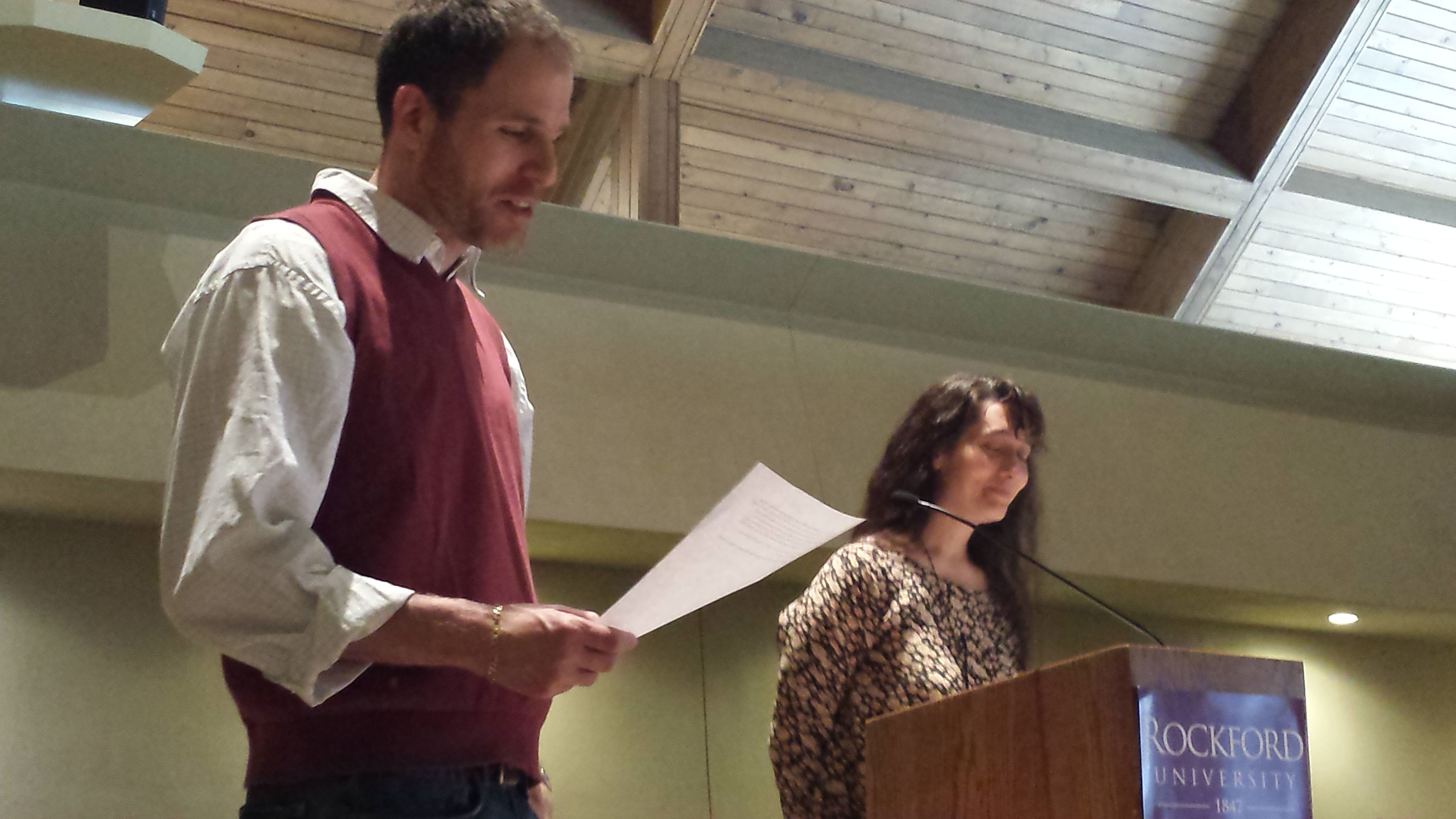
Carrie-Ann tells me that she’ll be blogging her talk soon and eventually posting it at her Academia site, but in general (I’ve read a copy), it’s a discussion (comparison/contrast) of Rand’s views on the moral psychology of work and/versus Mike Rowe’s as laid out on Rowe’s show, his web writings, and in his recent book Profoundly Disconnected.
(Incidentally, though not directly related to Carrie-Ann’s topic, this profile of NOL editor Brandon Christensen’s experiences with homelessness is at least indirectly relevant to the topic and very much worth reading. Not quite a “dirty job” but a “dirty education”: the lengths to which some people will go to get a college degree!)
One basic claim that Rand and Rowe seem to have in common concerns the morally redemptive nature of productive work across the spectrum of types of work–from “clean” to “dirty” (in Rowe’s sense of dirty). A corollary seems to be that it’s more in your interest to work than receive a hand-out, assuming that you’re capable of working. Another corollary seems to be that it’s more in your interest to do dirty work than receive a hand-out while holding out for clean work, assuming that you’re capable of doing the work in question.
A related implication is that when you look for work, ceteris paribus, the choiceworthy features of the work are its not-necessarily-remunerative virtue-realizing features,* not how much money you make from it. In other words, faced with two jobs each of which pays a sufficient amount, you ought to pick the virtue-promoting job over the more remunerative (but less virtue-promoting) one. Similarly, faced with two jobs, one of which is virtue-promoting and pays peanuts, and the other of which pays a lot but is immoral, you ought to pick the former. Those are all, of course, large claims that would have to be developed in ways that go beyond the paper in its current form.
One topic not discussed in the paper but badly in need of discussion is what Randian egoism has to say about the tension between a commitment to egoism and the existence of dangerous-but-necessary jobs, or even a commitment to egoism and the existence of necessary-but-merely arduous-and-messy jobs. Take jobs like military combat, policing (as well as prison work), fire-fighting, and certain types of construction work, farming, mining, and roofing, etc. They’re all necessary in the sense that they need to get done for the efficient or even minimal functioning of a modern society. If they didn’t get done, we wouldn’t have societies of the sort we’re used to.**
But what egoistic motivation beyond economic necessity or lack of better alternatives (in cases where those are applicable) would induce someone to take such a job? If there is no non-necessity-based egoistic reason for taking such a job, it seems rational to shun them. If it’s rational to shun them, then under ideal conditions, no egoists (or relatively few egoists) would be found in such jobs. Granted, conditions are rarely ideal, but the point is, the better the conditions, the fewer the egoists would gravitate toward such jobs, and under good conditions, few egoists would do them.
Suppose ex hypothesi that we’re in the near-ideal situation where the egoists are doing the “better” jobs and the worse jobs are done by non-egoists (by people whose reasons for doing those jobs is inherently incompatible with egoism). Then it seems that in order to enjoy the fruits of modern society–itself an egoistically rational aim–egoists must of necessity rely on the work (and motivations) of non-egoists. If so, egoism is vulnerable to the charge of failing the test of universalizability or (putting the same point another way) requiring a (conceptual) form of parasitism. Egoism only works, in social terms, if many people aren’t egoists and the egoists rely on them in the way that Aristotle’s virtuous aristocrats rely on natural slaves.
I don’t mean to imply that the preceding objection is necessarily sound, just to suggest that it hasn’t gotten enough sustained attention by defenders of ethical egoism as it deserves. That said, Greg Salmieri (Rutgers, Stevens Institute) has been working on the closely-related topic of exploitation in Aristotle’s social theory. I expect that there’s some convergence between Carrie-Ann’s paper and Salmieri’s.
Meanwhile, to move from the virtue of productiveness to the vice of bestial cowardice, I have to confess that I ended up not attending the ACTC conference at which I was supposed to give my paper on the Nicomachean Ethics and the Grant Study (mentioned in the same post as Carrie-Ann’s paper). I finished the paper the night before I was supposed to leave, then got home to discover that my apartment had been infested with mice. (I’ve had an ongoing sporadic mouse problem these past few weeks, but my point is, when I got home, things crossed the hard-to-define-but-easy-to-discern threshold from mouse problem into mouse infestation.) The damn things kept me up all night, and then obliged me to turn from humane-but-totally-ineffective methods of rodent deterrence to inhumane, lethal methods drawn from years of personal observation of U.S. foreign policy.
I had mentioned my mouse problem in passing to my critical thinking students, one of whom turned my random complaint into a teaching moment by asking, “So why assume that you can’t learn to co-exist with the mice in your house?” Part of it (I said) was that mice spread disease. (Response: “Yes, but people spread disease, too. So you’d kill people if you thought they’d spread disease?”) But part of it, I must confess, is simply that I’m skeeved out by the thought–and not just the thought, but the actual physical reality–of sharing my bed with a passel or herd (or whatever it’s called) of feral mice. Granted, as a divorced single man, I should probably welcome the presence of anyone in my bed, but unfortunately, I don’t. (Yes, they’ve crawled into my bed at night with me in it, I’m not making that up.) I know it’s crude of me to put things this way, but I also can’t help mentioning that the mice pay no part of the rent and do not help at all with household chores.
What would Aristotle do? I don’t know, but here’s what he has to say, in what I think is the only mouse-related passage in the Nicomachean Ethics:
If, for instance, someone’s natural character makes him afraid of everything, even the noise of a mouse, he is a coward with a bestial sort of cowardice. (NE VII.5, 1149a7-8).
Yeah, well, call it another chapter from my ongoing memoir, Profiles in Bestial Cowardice. I almost think it’s worse than bestial cowardice. I mean, if I were a bona fide beast–something terrifying, like a tabby or a terrier–I’d at least have the courage to attack the mice mano a mano. But I’m a middle-aged twenty-first century American professor. I haven’t had a fist fight in decades. As it stands, I’ve just armed my apartment with a series of ultrasonic devices, traps, and poison in the hopes that I can drive the intruders away by high-tech methods of shock and awe. I guess we have to invent another category for people like me: sub-bestial cowardice. Or: Not-even-bestial cowardice. Or: pathetic over-civilized wimpiness.
Anyway, my new surge strategy seems to be working about as well as Bush’s did in Iraq and Obama’s in Afghanistan (wish list item: weaponized drones), but too late for my presence at the ACTC conference. My session starts in an hour, but I’m six hours’ drive away.
The point is, I write about virtue. I never said I had it.
*I had originally written “non-remunerative,” but that seems too strong.
**For interesting but in my view inadequate discussion of this topic, see chapter 11 of Alasdair MacIntyre’s Dependent Rational Animals and “Politics, Philosophy, and the Common Good” (reprinted in Kelvin Knight’s The MacIntyre Reader). Though not an egoist, MacIntyre faces a version of the problem mentioned in the text, but contrary to the impression he gives, never really resolves it.
This may turn out to be the least-publicized call for a boycott ever, but I’m going to call for one anyway: Philosophers attending the APA Eastern Division Meetings this year should boycott the meeting of the Ayn Rand Society. Frankly, in my view, they should boycott the Society itself.
For twenty-five years now, the Ayn Rand Institute (ARI) has vilified libertarians as “nihilists,” and declared them too evil to “sanction,” i.e., too evil to endorse or deal with.
IS LIBERTARIANISM AN EVIL DOCTRINE? Yes, if evil is the irrational and the destructive. Libertarianism belligerently rejects the very need for any justification for its belief in something called “liberty.” It repudiates the need for any intellectual foundation to explain why “liberty” is desirable and what “liberty” means. Anyone from a gay-rights activist to a criminal counterfeiter to an overt anarchist can declare that he is merely asserting his “liberty” — and no Libertarian (even those who happen to disagree) can objectively refute his definition. Subjectivism, amoralism and anarchism are not merely present in certain “wings” of the Libertarian movement; they are integral to it. In the absence of any intellectual framework, the zealous advocacy of “liberty” can represent only the mindless quest to eliminate all restraints on human behavior — political, moral, metaphysical. And since reality is the fundamental “restraint” upon men’s actions, it is nihilism — the desire to obliterate reality — that is the very essence of Libertarianism. If the Libertarian movement were ever to come to power, widespread death would be the consequence. (For elaboration, see my essay “Libertarianism: The Perversion of Liberty.”)
Justice demands moral judgment. It demands that one objectively evaluate Libertarianism, and act in accordance with that evaluation. It demands that one identify Libertarianism as the antithesis of — and therefore as a clear threat to — not merely genuine liberty, but all rational values. And it demands that Libertarianism, like all such threats, be boycotted and condemned.
“Boycotted and condemned.” I like that.
Despite some tricky-looking verbal gymnastics, ARI has not disavowed that view (and explicitly says that it has not). So vilification of libertarianism and libertarians remains the official view of the Ayn Rand Institute despite its paradoxical (that is, hypocritical) decision to make common cause with a few libertarian organizations.
The Ayn Rand Society (ARS) is a nominally distinct entity, but every single member of its Steering Committee is in some way affiliated with ARI. In any case, this year, they’ve decided to invite Yaron Brook as the main speaker at their APA Eastern Meeting (see the very first link in this post). Yaron Brook is the Executive Director of the Ayn Rand Institute. He is therefore the man responsible for ARI’s continuing policy of defamation. ARS has invited him to address their meeting despite that fact, and absurdly enough, has invited two libertarians to respond to him. The Steering Committee’s knowledge of Brook’s institutional role–and of ARI’s ideological position–are, in my view, sufficient to justify a boycott of the meeting. (Read this exchange if you’d like a sense of Yaron Brook’s moral stature and his method of cognitive functioning. It’s best read in conjunction with this piece from the Chronicle of Higher Education.)
It makes things worse that intellectually, Brook is a shallow propagandist entirely lacking in bona fide qualifications as a political philosopher. (Nonetheless, like all Objectivist pseudo-intellectuals of his type, he insists on describing himself as an “expert.”) It’s therefore a mystery why ARS’s leadership would have invited him to speak at the APA. In 2012, I asked both the late Allan Gotthelf (ARS’s founder*) and James Lennox (the current co-chair of ARS’s Steering Committee) why Brook had been invited. Neither of them had an answer. If you’d like an answer, feel free to ask Lennox or his co-chair Gregory Salmieri for one, and share what you hear from them. But my own inference is that they have no defensible answer to give. I also find it a mystery why James Otteson and Peter Boettke would have accepted an invitation to discuss libertarian politics with someone responsible for a mass-movement campaign of anti-libertarian defamation, but I suppose one mystery begets another.
I’m happy to say that I’ve convinced at least one major philosopher to back out of an invitation to speak at an ARS event, and have convinced a few prominent libertarians to let their membership in ARS lapse (or in the case of those who had already let it lapse, not to renew their membership). I’d like to add indefinitely to that list.
Whatever you do, don’t seek refuge in the excuse that philosophers are obliged to have conversations with those with whom they disagree on moral issues. (Scroll down in the link to my exchange with Matt Zwolinski.) The response to that is: “no kidding.” The question is whether philosophers ought to help burnish the reputation of organizations that suborn and facilitate decades-long campaigns of character-assassination. If you want to be a part of that of effort, feel free. But then take responsibility for being a part of it. And don’t complain when you’re treated accordingly. You’ll have no one to blame but yourself.
*Correction (added after posting): To be precise, Gotthelf was ARS’s co-founder, along with David Kelley and George Walsh. ARS was co-founded by the three of them in 1990. But Walsh died in 2001, and Kelley has not been active at the leadership level in ARS for decades. Gotthelf was the central figure at the heart of ARS, and was responsible for the decision to invite Brook.
Postscript, December 18, 2014: I just happened to read an interesting article, “Meeting Ayn Rand on the Las Vegas Strip,” by John Paul Rollert (of the University of Chicago’s business school), that sheds interesting light on my call for a boycott of the Ayn Rand Society. The article is a report on this past summer’s ARI conference in Las Vegas, featuring Yaron Brook, among others. This passage, on a session on inequality, is particularly revealing of Brook’s approach to intellectual discourse:
“The Left dominates our intellectual world,” Brook declared. And yet, despite its success, the stated aims of the Left are merely a pretext for an agenda far more sinister than anything contained in the Democratic Party’s platform or, for that matter, a Michael Moore movie. Take the professed concern for the growing disparity between the very rich and the rest of America: The liberal impulse to address this gap may seem rooted in a sense of fairness or even a desire to promote social cohesion, but viewing it as such is extremely naïve. Indeed, it takes at face value the rhetoric of the Left, which keeps one from seeing it for what it really is: the language of a decades-long con game. “What they’re really after is not the well-being of anybody,” Brook explained. “They want power. They want to rule us.”
It gets worse. For if “the intellectuals” use fear-mongering around the so-called problem of inequality to seize power, they wield it in favor of a nihilistic vision of the human condition. They aim to systematically undermine and annul the great achievements of heroic men and women, an effort that will not only corrupt the “American sense of life” but one that stabs at the very heart of Ayn Rand’s vision. “We need to tell the truth about these bastards,” Brook said. “We need to reveal them for what they really are. We need to expose them to the American people for what their agenda really is. They’re haters. Their focus is on hatred. Their focus is on tearing down. Their focus is on destroying.”
ARI’s pretense at intellectual respectability is a laboriously-constructed affair. Those affiliated with it realize that if ARI’s intellectuals are to be taken seriously, they must convince their non-Objectivist interlocutors that they take those interlocutors seriously, and want to engage constructively with them. Taking them seriously means treating them with respect, and treating them with respect means not poisoning the well in disagreements about their views. The preceding passage shows those interlocutors what the rest of us have long known: it’s an act.
Anyone who attends Brook’s presentation at the APA will be treated to Brook-in-genteel-mode, Brook-as-he-presents-himself-in-a-prestigious-academic-setting, where his reasonability and ARI’s are under scrutiny and on the line. If you decide to attend his session (against my advice) ask him what he means by “We need to tell the truth about these bastards,” and “Their focus is on destroying.” What truth? What bastards? Who is focused on destroying what? Why not be explicit for a change? Does he mean the ones in the room next door? The ones who run the APA? The ones running the job interviews for the jobs his Objectivist Academic Center-groomed job candidates so desperately want? If so, tell him to say so. If not, ask him to explain.
It hasn’t occurred to Brook that someone might regard inequality as a proxy variable for structural injustices in an economy, including injustices caused by rights-violations. It hasn’t occurred to the apologists for the supposedly new and improved ARI that Brook’s well-poisoning is a direct implication of his avowed allegiance to Peikoff’s “Fact and Value.” Nor has it occurred to academic philosophers that their coy and “sophisticated” defenses of dishonesty and phoniness find perfect expression in the likes of Brook–someone they’d likely regard as a mortal enemy, but whose practices they’ve unwittingly come to rationalize. If there were any justice in the world, Thomas Nagel and David Nyberg would be forced to attend the ARS session and have an awkward conversation with Yaron Brook: Brook would have to call them “bastards” intent on destroying the world, and Nagel and Nyberg would have to face in Brook the perfect exemplification of both Nagelian concealment and Nybergian dishonesty. Frankly, if that meeting happened, I’d go to the session.
Incidentally, Rollert gets a lot of things right in his essay, but gets some things wrong. For one thing, he buys into the myth that “when it comes to ‘real’ philosophers–a designation that, for better or worse, indicates a perch in a Philosophy Department–Objectivism mostly goes unmentioned.” Not quite. Again, not quite.
He also seems to equate radicalism with “escapism.” But Socrates, Aristotle, and Locke were all in their own way radicals. Arguably, so was J.S. Mill. None was an escapist. Contrary to Rollert, there’s no intrinsic connection between escapism and radicalism.
Finally, this seems to me wrongheaded:
By and large, when it comes to questions about the structural shortcomings of capitalism, the most persuasive answers will be of a dry and technical nature. They won’t savor of the sulfurous clash between the forces of good and evil….
There’s no reason to think that questions about the structural shortcomings of any political system should be reducible to issues “of a dry and technical nature.” The structure of a political system is something set by people. People have free will, and can be held responsible, not just for what they choose to do, but what (and how) they believe. If people culpably embed injustice into the very structure of a system, claims about structural shortcomings will not merely be “dry and technical.” They’ll be about justice and injustice, and that will “savor” of the clash between good and evil. No one thinks that structural racism is a merely “dry and technical” issue. There’s no good reason to think that other structural matters are “dry and technical,” either.
That is something that Rand got right, and it’s something that non-Randians might (ironically enough) learn from her. “Nothing made by man had to be; it was made by choice” (Ayn Rand, “The Metaphysical Versus the Man-Made,” in Philosophy: Who Needs It, p. 37). What was made by choice can be judged in moral terms, and that goes for the structural shortcomings of political systems as well.
As I was saying, not all choices are dry and technical. Just look at ARS’s choice to invite Yaron Brook to speak at the APA.
A couple of days ago, I wrote a post dedicated in part to discussing the work of people I either don’t know, or barely know at all. Today’s post is just the opposite: a name-dropping attempt to bask vicariously in the glory of others’ accomplishments, simply because they happen to be friends or relatives of mine. There’s no credit like unearned credit! I’m going to bold everyone’s name below, just to make this post look more like the gossip column that it is.
My friend William Dale is Associate Professor of Medicine at Pritzker School of Medicine at the University of Chicago. (He has a half dozen other titles, but never mind.) He seems to make it into The New York Times every other day for his work on geriatrics, but here’s the latest, about the connections between his work and the National Social, Life, Health, and Aging Project at Chicago. And yes, that’s him in the header photo of their page.
I’m not sure I know Jose Duarte well enough to call us “friends,” but we have hung out a bit, so I’ll gloss over the niceties. Jose has been creating waves for his research, with Jonathan Haidt, on the political biases of research in social psychology. Here’s a piece in The New Yorker about his most recent publication. And here’s a link to the paper itself, “Political Diversity Will Improve Social Psychological Research.”
My friend Stephen Hicks is celebrating the tenth anniversary of the publication of his 2004 book, Explaining Postmodernism: Skepticism and Socialism from Rousseau to Foucault. It’s gone through God-knows-how-many printings, and at least five translations that I know of, with more on the way. (I’d like to put in a vote for an Urdu translation, by the way.) I’d like to think that I made some tiny contribution to the success of the book; as co-managing editor of Reason Papers, I happened to edit (all right, co-edit) one of the longer and more positive reviews of the book. But obviously, I couldn’t have done that unless Stephen had written the book (and Steven Sanders had written the review!) in the first place.
Finally, on the Famous Friend Front, my buddy Chris Sciabarra is featured in a piece on Ayn Rand in New York Magazine, improbably titled, “Ayn Rand, Girl Power Icon.” Amusingly, the piece opens with Chris’s professed puzzlement about the phenomenon, and only gets better from there.
I mentioned famous relatives. Did I tell you that my cousin Khawaja Saad Rafiq is the Minister of Railways for the Islamic Republic of Pakistan? I only mention that because here’s a piece featuring Saad bhai in the Pakistan Observer. In it, he takes issue with Jason Brennan’s thesis in The Ethics of Voting. According to Dr. Brennan, we have no duty to vote, but according to cousin Saad, the “Country Can Only Make Progress Thru the Power of Vote.” Well, Saad bhai doesn’t quite mention Dr. Brennan by name, but the implicit spirit of contention is there. I actually think that a conversation between Saad bhai and Dr. Brennan on voting would be a hilariously instructive affair for all parties. In fact, I offer in advance to serve as interpreter to overcome the language barrier* for the conversation. I rather doubt that the event will ever happen, but as a thought-experiment, I think it has a lot to recommend itself.
*PS, I kind of think that language would be the least of the barriers involved. Cf. Bernard Williams on real and notional confrontations, Ethics and the Limits of Philosophy, pp. 160ff.
Postscript, December 19, 2014: Amazingly, within a few weeks of my issuing a call for an Urdu translation of Explaining Postmodernism, Stephen Hicks has announced a forthcoming Hindi translation. Behold the power of PoT.
I realize that this post will only be inside baseball for people interested in the vicissitudes of and infighting within the Objectivist movement, but I’ll take that risk. Back in May, I took public issue with The Atlas Society’s invitation of David Harriman to The Atlas Summit, its summer 2014 event. That led to a predictably acrimonious argument at TAS’s site which ended with David Kelley’s issuing a snippy denunciation of me, and unceremoniously–or do I mean ceremoniously–closing down the combox.
My view is simple,and so far stands both unaddressed and unrefuted by Kelley and his associates. For twenty-five years, David Harriman made common cause with the most militantly dogmatic and defamation-happy elements of the Objectivist movement. And applied to ARI, “militantly dogmatic” and “defamation-happy” are literal descriptions, not exaggerations or metaphors. Like so many people associated with ARI–including people who spent decades attacking libertarians as “nihilists” but have now decided to make common cause with them–he’s recently done an abrupt and unexplained about-face, which TAS, in turn, has decided to accept at face value. My claim is that Harriman owes us a public accounting of, and apology for, his prior associations. Otherwise, he deserves condemnation and ostracism. Wrongdoing demands a response in kind. It can’t simply go ignored or excused.
In May, TAS had claimed that Harriman would appear on a panel at their summer event, and explain all. Here is a video of the event, if you have an hour of your life to waste on it, as I did the other day.
[November 20, 2014: For some reason, the video is no longer working, but you can still watch it via the Atlas Society site. I wouldn’t want to deprive you of the pleasure.]
[November 23, 2014: see note below.]
It’s no exaggeration to say that the panel consists of a very tedious hour of evasions and rationalizations. It doesn’t respond to a single issue I raised; the panelists simply pretend that the issues don’t exist. I’ve responded to the panel here, responding in turn to a like-minded post by Jonathan Smith somewhat before mine. The thread as a whole is 130+ comments long and began in March, well before the Harriman controversy. (I regret that the thread ended up being “hijacked” by the Harriman controversy, but feel free to blame that on Kelley, who attacked me, and then closed down the most obvious forum in which to respond. I wouldn’t have joined the discussion on the Atlas Summit at the Objectivist Living site* had I not become the topic of the discussion there without any effort on my part.) Post 43 (May 25) is my rejoinder to Kelley’s “response” to me just after he closed down the comments at TAS.
Outsiders may well be mystified by the vitriolic character of the rhetoric involved, but I think insiders should be able to figure out why things have reached this point. Suffice it to say that there’s twenty-five years of back story here–a quarter of a century of lies, evasions, and defamations, and with it, a quarter-century of bitterness and betrayal. There are also a series of cautionary tales here for anyone who gets his feet wet in the controversy:
I’ve made the case for Lesson 4 twice before, once on this blog, and once on a different one. David Kelley has, malgre lui, made the case for me yet again.
The original IOS project was one of promise and hope. Unfortunately, if you wish to see its monument, you’ll have to look to the distant past for a glimpse of it in dusty archives, old-timers’ stories, and track-back machines. The present organization is a pale shadow or dull echo–or honestly, just a bad parody–of its predecessor. Personally, I don’t find it worth looking at, worth listening to, or worth interacting with. Neither, I think, should anyone reading this. An inside allusion, but: no one is obliged to play Eddie Willers to this pathetic “movement.” The Objectivist train has come to a halt. It’s time to get off and, as John Galt puts it, to go back to the world. It’s bad enough to “live for the sake of another man.” It’s worse, much worse, to live for a “movement” with less life in it than any human being, and less capacity for forward motion. That’s what the Objectivist movement has become. What remains is just to admit it.
*For clarity’s sake, I added the phrase “at the Objectivist Living site” and the word “there” in the same sentence a few hours after posting.
[Postscript, November 23, 2014: Apparently, you no longer can still watch the video via the Atlas Society site. If you try, as I just did,you get a message that says “This video is private.” Why the sudden need to make the video private? A few months ago, TAS was boasting about what their Atlas Summit panel presentation would reveal. Then they shut down the comments in which I predicted that it would reveal exactly nothing. Then I was proven right. Having been proven right, I decided to say so in public. All of a sudden, the loudly-heralded video that proved me right was quietly made “private.” Could it be that the champions of “Open Objectivism” are unwilling to bear public scrutiny–i.e., unwilling to “tolerate” the kind of critical discussion that takes place in the open?
Twenty-five years ago, in “A Question of Sanction,” David Kelley had criticized Peter Schwartz and others for advocating a policy of preaching to the converted, which he (Kelley) described, accurately enough, as “a sorry sort of ingrown activism.” Kelley has, I’m afraid, become heir to the attitudes he once criticized–and come to suborn the same attitudes in his “followers.” It’s a pathetic conclusion to what might have been an illustrious project and career.]
Postscript, November 6, 2014: This has nothing to do with Harriman-at-TAS, but is relevant to any chronicling of the malfeasances of the Objectivist movement. Having unfortunately let my JARS subscription lapse, I missed this revelation from Chris Sciabarra’s editorial to their July 2014 issue (also posted at his blog):
For several years, Allan Gotthelf and I exchanged correspondence, both before and after the 1995 publication of the first edition of my book, Ayn Rand: The Russian Radical. I acknowledged his criticisms of my work in my book—indeed, it was he who provided the precise wording with which he felt most comfortable. But when the book was finally published, he felt obliged to tell me that he would do “scholarly battle against” my work and its “obfuscation” of the ideas of Ayn Rand (correspondence, 26 May 1996).
That battle sometimes took on a bit of partisan ugliness. When our journal was first published, we worked diligently to get it included in indexing and abstracting services across disciplines and geographic boundaries. Our efforts paid off considerably; we are now indexed and abstracted by nearly two dozen services in the humanities and social sciences. But getting JARS into The Philosopher’s Index was something that Allan Gotthelf opposed strongly. At a meeting of the Eastern Division of the American Philosophical Association in December 1999, he took exception to the very idea of including The Journal of Ayn Rand Studies in The Philosopher’s Index. He could not outright oppose the inclusion of Rand scholarship per se in an index aimed at reaching academia, for he was a cofounder of The Ayn Rand Society, itself affiliated with the Eastern Division of the APA. But he made it very clear that, in his view, JARS was not a legitimate scholarly undertaking—despite the fact that several members of its founding advisory board had been officers of, and presenters to, the very society that he chaired. Nevertheless, as required, we submitted the first three issues of our journal to the Philosopher’s Information Center, and JARS was added to the Index immediately thereafter.
I counted myself a friend and colleague of Gotthelf’s during the period in question. I knew of his animus against JARS; at first I regarded it as partly justified but mostly overwrought, but eventually I came to regard it as pathological. That said, I had no idea that he’d worked to exclude JARS from The Philosopher’s Index (and I find it interesting that in more than a decades’ acquaintance with him, he never brought it up). I don’t think think Carrie-Ann knew that, either, and Carrie-Ann was (and is) an indexer/editor for The Philosopher’s Index. I draw attention to this issue because it’s of a piece with the Harriman affair, and also very much par for the course among movement-Objectivists: deliberate opacity as a permanent way of life for people who regard themselves as aspiring “public intellectuals” (in some cases without the modifier “aspiring,” but also, alas, without a public).
It all ought to be (but isn’t) a cautionary tale to the Matt Zwolinskis of the philosophy profession, who apparently operate on the premise that any association with any organization is justified, and any invitation from anyone is worth accepting–as long as you don’t look too hard at the agenda of the people you’re dealing with, and as long as you have a fabulous time doing whatever you’re doing (scroll down to the comments of this discussion). I guess if it came down to selling BHL to white supremacist organizations, then, there’d be no intelligible basis for demurral, right? Give it a shot, Matt. I’m sure they’d be happy to have you bless their next conference with your presence. Some of them are, after all, former libertarians. There’s always time to bring them back into the fold.
The truth is that when you interact with movement-Objectivism at, say, the APA what you’re doing is lending the movement respectability it doesn’t deserve, and couldn’t acquire in any other way. You’re also strengthening a series of front organizations who do what they can to exclude whomever they deem their ideological enemies from participation in the very events in which you might be participating. Feel free to say that you don’t care or have other priorities–I sympathize, because I did the same for so long–but it probably isn’t a good idea to invoke the accusation of “conspiracy theorizing” to deny that it’s happening, when, like Zwolinski, you conspicuously (and avowedly) have no idea what you’re talking about. And would rather not learn.
While making my way through B.F. Skinner’s Beyond Freedom and Dignity a few days ago, I happened across this passage at the beginning of the book, a characteristically blunt criticism of ancient Greek philosophy, and in particular, of Aristotle’s philosophy of science:
Twenty-five hundred years ago it might have been said that man understood himself as well as any other part of his world. Today he is the thing he understands least. Physics and biology have come a long way, but there has been no comparable development of anything like a science of human behavior. Greek physics and biology are now of historical interest only (no modern physicist or biologist would turn to Aristotle for help), but the dialogues of Plato are still assigned to students and cited as if they threw light on human behavior. Aristotle could not have understood a page of modern physics or biology, but Socrates and his friends would have little trouble in following most current discussions of human affairs (p. 3).
By some great irony, I happened to open this morning’s New York Times Book Review and found a review there, by Rebecca Newberger Goldstein, of Armand Marie Leroi’s new book, Lagoon: How Aristotle Invented Science. I found this passage from the review positively reinforcing:
Armand Marie Leroi is a scientist, and Aristotle is his hero. This conjunction is interesting because, in the official telling of modern science’s origins, Aristotle is hardly regarded as heroic. Instead he’s portrayed as the obstacle over which the early heroes of the scientific revolution — Copernicus, Kepler, Galileo — had to leap in order to impose a genuinely explanatory methodology over the often deceptive input of sense perception.
This one, too:
…Leroi’s heart belongs to Aristotle, who not only was, like him, an enthusiastic student of biology, particularly of zoology, but who also, unlike Plato, was besotted by the world of appearances. Aristotle, as Leroi makes wonderfully clear, exemplifies one kind of scientific aptitude. He was an enthralled observer of the natural world, bedazzled by data, seeking causal explanations not in abstract numbers but in concrete details acquired through avid sense perception.
Likewise this bit of verbal behavior from Leroi himself:
“As I contemplate the elaborate tapestry of his [Aristotle’s] science, and compare it to ours, I conclude that we can now see his intentions and accomplishment more clearly than any previous age has seen them and that, if this is so, it is because we have caught up with him.”
A far cry from Skinner’s assessment, to say the least.
I haven’t read Leroi’s book myself, but while browsing it online, I was intrigued to discover that Leroi quotes from or cites recent work on Aristotle’s philosophy of science by (among others) Allan Gotthelf and James Lennox. I single those two scholars out because Gotthelf in particular had made it his life’s task to rehabilitate Aristotle’s reputation as an epistemologist, scientist, biologist, and philosopher of science in explicit opposition to mainstream views like Skinner’s; Lennox was his long-time associate and partner in the endeavor. Gotthelf tells the story of his engagement with Aristotle and lays out the case for intellectual rehabilitation in his 2012 book, Teleology, First Principles, and Scientific Method in Aristotle’s Biology. Suffice it to say that for Gotthelf, it all began with Ayn Rand—specifically with Rand’s 1963 review of John Herman Randall’s 1960 book, Aristotle.* This passage from Rand’s review must surely have had something to do with it:
Above all, this book [Randall’s Aristotle] is important culturally, as a step in the right direction, as a recognition of the fact that the great physician needed by our dying science of philosophy is Aristotle–that if we are to emerge from the intellectual shambles of the present, we can do it only by means of an Aristotelian approach. (Review of Randall’s Aristotle, in The Voice of Reason, p. 12)
If Leroi’s defense of Aristotle is any indication, Gotthelf and Lennox seem to have succeeded at their task of making a scientist out of Aristotle–and of starting the first chest compressions on Philosophy.
This passage from Rand’s review, in retrospect, has a kind of subtle interest to it:
The best parts of Professor Randall’s book are Chapters VIII, IX, and XI, particularly this last. In discussing the importance of Aristotle’s biological theory and the ‘biological motivation of Aristotle’s thought’, he brings out an aspect of Aristotle which has been featured too seldom in recent discussions and which is much more profound than the question of Aristotle’s ‘functionalism’: the central place given to living entities, to the phenomenon of life, in Aristotle’s philosophy.
For Aristotle, life is not an inexplicable, supernatural mystery, but a fact of nature. And consciousness is a natural attribute of living entities, their natural power, their specific mode of action—not an unaccountable element in a mechanistic universe, to be explained away somehow in terms of inanimate matter, nor a mystic miracle incompatible with physical reality, to be attributed to some occult source in another dimension. …
Life—and its highest form, man’s life—is the central fact in Aristotle’s view of reality. The best way to describe it is to say that Aristotle’s philosophy is “biocentric.” (pp. 10-11).
Granted, some of what Rand says here is debatable and slightly tendentious. For one thing, it’s unclear whether Aristotle has a word for or the concept of “consciousness”; so it’s unclear whether he could discuss consciousness under anything like that description. For another, as Goldstein aptly points out (and Jonathan Lear and others have pointed out before her), “Aristotle can’t be entirely naturalized.” The supernatural plays an obvious role in Plato, but there are gods in Aristotle, too.
That said, I do think Rand was on to something, and that she verbalized the insight long before it became fashionable to do so. I think she’s right about Randall’s book; those are the best chapters in it. She’s also right to emphasize the biological motivation and character of Aristotle’s thought, and was right that as of 1963, that part of Aristotle had gotten relatively little attention. (The sustained attention began with the pioneering work of David Balme in the 1970s.) On a more technical note, Rand is also right, I think, to suggest that the attempt to interpret Aristotle as a “functionalist” was an anachronistic red herring. And she’s also right that Aristotle has something to teach us about the “meaning of life,” whether in the sense of zoe or of bios or the relation between them.
I’ve been beating up a bit on Rand here lately, but I regard her valorization (and popularization) of Aristotle as both insightful and prescient. Among other things, it had the salutary and intended consequence of motivating a small cottage of industry of scholars to give Aristotle the scholarly attention he deserves, with a view to bringing what they learned with them into contemporary philosophy. The cottage industry I have in mind included Gotthelf and includes Lennox, of course, but it also includes Neera Badhwar, Jurgis Brakas, Roderick Long, Robert Mayhew, Kelly Rogers, and Fred Miller, and more recently, Greg Salmieri, Corinne Bloch, Monte Johnson, Mariska Leunissen, and PoT’s own Carrie-Ann Biondi.** In fact, a sociologist of knowledge would have an interesting story to tell about how we got from the sea creatures in Aristotle’s lagoon to Leroi’s book–via Aristotle, John Dewey, John Herman Randall, Ayn Rand, David Balme, B.F. Skinner, and Allan Gotthelf (and the other scholars I just mentioned). I wonder whether anyone will end up telling it.
Incidentally, Reason Papers is looking for a review of Leroi’s book. If you’d like to do the review, or know someone who might or would, please contact Carrie-Ann Biondi or me via the journal.
*The book was published a year before, and reviewed in Reason Papers about a month before, Gotthelf’s death; I don’t know whether he saw the review or not.
**This list consists of Aristotle scholars either (a) directly influenced by Rand to go into Aristotle scholarship, or (b) mentored by people highly influenced by Rand. Obviously, it’s not meant to be an exhaustive list of prominent Aristotle scholars, or confined to people necessarily influenced by Rand.
Postscript, December 8, 2014: I just noticed this interesting piece on Leroi’s book at Daily Beast from a few months back (hat-tip: Edward Feser). I was amused by this passage:
Some of his observations about animals appear equally bizarre. He reports that the European bison fires caustic dung when pursued and that the trunk of an elephant is in fact a snorkeling device that allows it to swim. He even claims that hen partridges conceive just by smelling the scent of males.
As the author later points out:
It was only fairly recently that two of Aristotle’s seemingly bizarre claims were actually confirmed….[E]lephants do occasionally use their trunks as snorkels while swimming.
Confirmation from Google Images, the omniscient source:

I’m in the middle of editing, and writing a contribution for, Reason Papers’s forthcoming symposium on the epistemology, ethics, and politics of emergencies. (Though I’ll be contributing an essay to it, credit for the idea of the symposium goes to Carrie-Ann.) The topic turns out to be an amazingly interesting and fertile one, with ramifications in a number of directions, including the epistemology and semantics of definition; the application, scope, and stringency of moral principles; the scope and content of rights; the proper role of government; the rule of law; and so on.
The topic has been made particularly timely by a number of recent events–the recent Ebola outbreak; the state of emergency declared this past summer in Ferguson, Missouri after the riots; the states of emergency declared during Hurricane Sandy in 2012; the states of emergency that have been thought to obtain after the terrorist attacks of 9/11, etc. But those phenomena hardly exhaust the applications of ‘emergency’: once you start looking for emergencies, you find them everywhere, often in the most unlikely places. And then there are emergency-cognates, like disasters, catastrophes, crises, epidemics, and pandemics, as well as pseudo-emergencies of every kind.
At the most basic level, emergencies are events that are ontologically and normatively discontinuous from “normal” events. It’s part of the very concept of an emergency that it’s an exceptional sort of event, that it involves danger, and that it demands urgent attention and action. Given those facts, emergencies drastically affect the content and application of normative principles–epistemic, ethical, and political: principles that apply to ‘ordinary’ life don’t apply, or at least don’t apply in the same way, to emergencies. Ordinarily, we expect people to form their beliefs on the basis of the evidence for them–but in emergencies, guesses and hunches become acceptable. Ordinarily, we expect people not to kill, torture, kidnap, steal from, trespass on, cheat, deceive, or manipulate others–but in the right kind of emergency (some would say) just about anything goes. Ordinarily, we’re governed by the rule of law, including constitutional law, but in emergencies, we either bend the rules, or are governed by open-ended edict or fiat. And so on.
Given this, emergencies give rise to a difficult dilemma in need of solution. On the one hand—call it the rigorist hand–there’s the danger that the invocation of “emergency exceptions” to moral principles serves as a rationalization or excuse for ad hoc exception-making. The concept of an “emergency” seems ill-defined and elastic, and “emergency exception” seems like a magic wand by which moral principles are undercut and effectively ignored. If we define “emergency” too broadly, every form of duress becomes an “emergency,” so that the concept loses its meaning, and emergency exceptions serve to subvert the stringency of the moral principles that are supposed to govern normal life. At a certain point, a moralist has to put his foot down and insist that duress requires the exertion of moral strength and endurance in the name of normality rather than exception-making in the name of abnormality. But the appeal to “emergencies” is one of the most seductive ways of evading this responsibility. From the rigorist perspective, then, emergencies are philosophically important primarily because we have to put them in their place. Emergencies, the rigorist insists, are marginal exceptions in life. We should cordon them off as essentially irrelevant to normal life, and focus our attention on the non-exceptional rules that govern normal life.
On the other hand—call it the pragmatist hand—there’s the danger that if we ignore emergencies, or minimize their significance or frequency, we ignore a real phenomenon that affects the proper application of moral principles. All principles, even the most stringent, apply within a specific and in-principle specifiable context. If we ignore the difference between emergencies and non-emergencies, we apply principles designed for one context to a context where they lack application. In doing so, we run the risk of sacrificing things of greater value to things of lesser value on the basis of a robotic commitment to empty verbal formulations masquerading as moral principles. In doing that, we risk the dangers of imposing pointless burdens on those suffering great duress, invoking “morality” as a pseudo-justification for our dogmatism. From this pragmatic perspective, we ought to take emergencies seriously because emergencies are an extreme instance of duress, and duress is a ubiquitous but easily-ignored part of our moral life. Goodness is fragile, and emergencies underscore that fact in an acute way.
The rigorist and pragmatic views are, of course, one-sided caricatures of possible positions. Each view gets something right, but each view ignores the merits of the other view, and thereby gets something wrong. A good dialectician would have to work through the two views, integrating their best insights, discarding what each view gets wrong, and fashioning an alternative to them that avoids the pitfalls of either view. The task would be to strike the mean between rigorist and pragmatist extremes.
I’ve argued elsewhere—very briefly and tentatively, in a footnote (p. 219 n.29)—that Ayn Rand appears to have been the first writer to have ‘thematized’ the topic of emergencies in twentieth-century English-speaking philosophy. (If I’m wrong about that, as I very well could be, I’d be interested to hear about it in the comments.) Her discussion appears in “The Ethics of Emergencies,” a 1963 essay published in her 1968 essay collection, The Virtue of Selfishness, and anthologized every now and then in philosophy textbooks. I have mixed feelings about the essay, as I do about much that Rand wrote.
On the “pro” side, I think she gets four or five things basically right.
(1) Most fundamentally, she gets the basic framing issue right:
It is important to differentiate between the rules of conduct in an emergency situation and the rules of conduct in normal conditions of human existence. This does not mean a double standard of morality: the standard and the basic principles remain the same, but their application to either case requires precise definitions. (Ayn Rand, “The Ethics of Emergencies,” The Virtue of Selfishness, p. 54).
In other words, some principles straddle emergencies and non-emergencies, retaining their identity across both contexts, but taking different forms in the one context as opposed to the other. Good theorizing keeps both facts in mind. It’s not enough for a theorist to insist on the sameness of the principles that apply to emergencies and non-emergencies; she has to explain how a principle can prescribe opposite courses of action in emergencies as opposed to emergencies and yet be the same principle. Nor is it sufficient for a theorist to insist on the need for exception-clauses in emergencies, based on the dissimilarity of emergencies to non-emergencies. She has to explain why the exception clauses exemplify the general and universally applicable principles that apply to both contexts. In other words, if it’s wrong to lie in ordinary life, but right to lie in an emergency, what needs explanation is what single principle is exemplified in both contexts, and how that single principle demands truth-telling in the one case and lying in the other. The constraint seems to me a plausible one, even if Rand herself doesn’t explain exactly how it works, and even though most theorists (in my experience) seem to violate or ignore it.
Having said that, it’s worth adding that some philosophers have emphasized the constraint. For better or worse, Mill does so in the last few paragraphs of Utilitarianism. A more recent example is Alasdair MacIntyre’s trio of papers on moral dilemmas and truth-telling in Part II of Ethics and Politics: Selected Essays, Volume 2 (2006). Another interesting discussion is Thomas Hill’s “Making Exceptions Without Abandoning the Principle: or How a Kantian Might Think about Terrorism,” in Dignity and Practical Reason in Kant’s Moral Theory (1992). There are, of course, many others.
I think Rand gets some other things right.
(2) She’s right, I think, that the philosophical literature misuses emergencies and moral dilemmas to the point of systematically indulging in fallacious appeals to the emotions in order to induce readers to accept otherwise under-argued moral claims. (Peter Singer’s drowning child example is a paradigm of this approach–an approach my graduate school roommate Patrick Kain once aptly dubbed “The Argument by Surely Operator,” as in, “Surely, we would all save the child…” Interestingly and counter-intuitively, both Singer and Rand regard it as utterly uncontroversial that one has an obligation to save the drowning child, but neither of them has an argument for it. I have never, in twenty years of reading on the subject, seen or heard a bona fide argument for saving the child beyond table-pounding appeals to intuition, consensus, or plain old emotion.)
(3) Unlike much of the literature, Rand insists on defining “emergency.” It’s amazing how much of the literature discusses emergencies without ever defining the term.
(4) Again, unlike most of the contemporary analytic literature, Rand’s definition of “emergency” takes the form of a definition by genus and specific difference (“An emergency is an unchosen, unexpected event that…”) rather than biconditional equivalence (“An emergency takes place if and only if…”). This is a large topic, but I tend to think that the traditional Aristotelian format for definitions has advantages over the newer analytic one. I’m also inclined to think that Rand’s definition of “emergencies” is basically right, while admitting that she says nothing in defense of it, and admitting that any any adequate defense of it would probably require revisions to it.
Unfortunately, I also find Rand’s essay seriously defective. I see at least seven or eight basic problems.
(1) For one thing, though the essay is titled “The Ethics of Emergencies,” it’s not primarily about the ethics of emergencies at all. In my edition, the essay is about eight pages long, and is about a variety of topics, none of them particularly well developed. Rand opens the essay with a page-and-a-half-long well-poisoning polemic against the misuse of emergency scenarios in ethics. Another four pages go to a paradoxically illuminating but ill-argued explication of the egoistic basis of human relationships. A mere page and a half discusses emergencies. Another half page concludes the polemic against the misuse of emergency scenarios in ethics, focusing on the role that such scenarios play in defending altruism. Despite the title of the essay, then, the discussion of emergencies ends up being a mere afterthought to, and application of, the claims about the egoistic basis of human relationships. The cumulative result is that the essay is torn between at least two different topics–relationships and emergencies–and fails to do justice to either topic. For that reason, though I think the essay has some worthwhile things to say, it is, on the whole, a failure.
There are other serious failures of argumentation in it, failures that have essentially gone undiscussed in the “literature” on the subject, almost all of it written by writers sympathetic to Rand. (For a notable exception, read pp. 100-104 of Carrie-Ann’s 2008 Reason Papers review of Tara Smith’s Ayn Rand’s Normative Ethics.)
(2) In discussing egoistic relationships, Rand repeatedly stresses that a rational egoist forms a hierarchy of values, incorporates other people’s well-being into that hierarchy, and then treats others well-being as part of his own. What she doesn’t explain is how or why anyone would do that. Yes, if you incorporate others’ well-being into your own, you come to treat their well-being as part of your own, and thereby promote their good while promoting your own. But why would an egoist do that? What benefit does an egoist get by making the initial choice? She doesn’t explain. Her failure to explain would, by itself, merely be an omission rather than a defect in her view (or in the essay), but having omitted a discussion of that crucial topic, she then goes on to make very strong claims about the structure that a rational hierarchy of values would have to take, as well as the actions that would have to follow from its adoption. But unless she specifies the benefit that an egoist gets from doing as she prescribes, she’s not entitled to such claims. What we need but don’t get in the essay is a derivation of other-regard from egoistic self-interest, not a rhetorical deflection of the accusation that egoists are mean people.
(3) Rand divides her discussion of other-regard into two parts: how an egoist deals with his intimates, and how he deals with strangers. As for intimates, she says, we incorporate their welfare into ours based on their past track record of virtue. Roughly speaking, the more virtuous they are, the more deeply integrated into our own welfare; the less virtuous, the less so. Though there’s deep truth in this claim, it’s also a gigantic oversimplification. But never mind that for now; let’s accept it ex hypothesi. One problem is that it explains how egoistic relationships continue, not how they come to be. I can continue to incorporate your welfare in my hierarchy of values based on your past track record insofar as you have a past track record (with me). But there has to be some initial point at which you lacked a track record (with me). How then do relationships begin?
The same problem applies even more problematically to strangers. A stranger by definition has no track record with another stranger. So we can’t incorporate the welfare of strangers into our own on the basis of their past track record of virtue. What then do we do? Rand acknowledges the problem here, and claims to deal with it, but what she says is very compressed and obscure (p. 53). We grant a stranger a “generalized respect and good will,” she says, on the basis of “the potential value he represents” (my italics). Later she describes the rationale for this respect and good will as “a consequence, an extension, a secondary projection” of one’s own self-esteem (p. 53, my italics).
There’s an intriguing idea lurking here, but taken at face value Rand’s claims are pretty puzzling. Why does a stranger “represent” any value to me at all, especially if I’ll never see him again? And why does he “represent” value rather than straightforwardly being valuable to me (or not being so)? Elsewhere, in the context of the debate about abortion, Rand derides the idea that potentialities are morally significant (“Of Living Death,” reprinted in The Voice of Reason). There, she says, the embryo and fetus are merely potential human beings, hence not rights-holders. Here, however, the argument asserts that a stranger is potentially valuable, hence valuable. The latter inference seems ad hoc, and the two claims together seem inconsistent. Rand doesn’t seem to have had a consistent position on the normative significance of potentialities, a problem, I suspect, that lies at the heart of the common accusation that she has no adequate ethical account of children, the family, and moral patients.
Finally, the language of “projection” is equivocal and potentially problematic. What does it mean? Here are some possibilities:
Unfortunately, she doesn’t say a word to decide between the options.
(4) Rand rather arbitrarily asserts that we ought to give assistance to strangers only in emergencies, but she never explains either the restriction or the ought:
Again, she says little or nothing to clarify.
(5) Rand equivocates as to whether helping strangers in an emergency is a moral obligation (an “ought”) or merely a permission (a “may”). Sometimes she suggests that we ought to help strangers in an emergency (as long as the risks to us are “minimal”), implying that anyone who doesn’t help is morally defective, or lacking in virtue (specifically, lacking in integrity). Sometimes she suggests that we may help others in an emergency if we wish, but only if we do so from a sense of good will, and only if we want to, implying that we are not defective if we don’t help. Both claims can’t be right, and the latter claim contradicts Rand’s insistence, elsewhere, that her Objectivist Ethics is an ethic of conditional “necessities,” according to which every morally right act is a conditional imperative necessitated by “the conditionality of life” (“Causality Versus Duty,” in Philosophy: Who Needs It). Prima facie, a necessitated permission is a contradiction in terms.
(6) Having told us that we ought only to assist strangers in an emergency, Rand abruptly contradicts this claim, and tells us that it’s permissible to assist strangers in cases of illness or poverty that aren’t emergencies (p. 55). What she’s saying here may be a concession to commonsense, but in the context of the essay, it really seems like nonsense. Either we help others only in emergencies, or we help others in emergencies and elsewhere. We can’t have our “only” and eat it. An additional problem here is that her definition of “emergency” leaves no clear way of conceptualizing medical emergencies. But medical emergencies are a paradigm case of emergencies.
(7) Though I’m inclined to agree with her definition of “emergency,” she shows no awareness of how controversial it is, or of the most obvious objections that a reader might have to it (namely, that it seems too narrow). Even if I ended up agreeing with her definition, however, I’d have to disagree with her applications of it to cases.
(8) Rand conspicuously fails to meet her own adequacy-condition for a discussion of the subject, as described above.
For present purposes, as well as for purposes of my RP symposium contribution, I want to continue the task that Rand started–defining “emergency” by genus and specific difference. As I see it, the two basic definitional questions about emergencies are these:
(a) What are emergencies?
(b) Of what kinds of thing are emergencies properly predicated?
The two questions are verbally distinct but conceptually interconnected. Any answer to (a) probably constitutes an answer to (b), though I don’t think that the reverse is bound to be the case.
Rand defines an emergency as “an unchosen, unexpected event, limited in time, that creates conditions under which human survival is impossible” (“Ethics of Emergencies,” p. 54). She adds, in elaboration of the definition, that “[i]n an emergency situation, men’s [sic] primary goal is to combat the disaster, escape the danger, and restore normal conditions” (p. 54). Presumably by “men” she means “rational agents acting rationally”: men aren’t the only people who respond to emergencies, and some men fail to respond to them at all.
In any case, Rand takes “emergency” to contrast with “events that take place in normal conditions,” so that either (i) “emergency” and “normal-condition event” are correlatives, or (ii) “emergency” is defined in terms of (and as a basic deviation from) some conceptually prior notion of a “normal-condition event.” I’m inclined to think that (ii) is the case. If so, a great deal of the definition of “emergency” depends on spelling out that prior conception of metaphysical “normality.”
“Normality” is a notoriously difficult concept to define in a non-circular, non-statistical way. The concept is one to which Rand often helps herself, and which bears some unclarified relation to what she elsewhere calls “the benevolent universe premise.” But it also finds its way fairly often into the non-Randian literature, whether in discussion of emergencies or other topics. Here’s one example from the scholarly literature on Aristotle’s ethics: The virtuous agent, Terence Irwin writes, “will correctly regard as dominant those rational and rigid states of character that secure complete happiness in moderately favourable external circumstances” (“Permanent Happiness: Aristotle and Solon,” in Aristotle’s Ethics: Critical Essays, p. 15, my italics). I take Irwin’s reference to “moderately favorable external circumstances” to pick out a concept similar to Rand’s notion of “normal-condition events.” “Favorable circumstances” seems to do analogous work for Aristotle as for Rand.
There’s a lot going on behind Rand’s definition–a lot of questions to be asked of it, and a lot of refinements to be made to it even on the most charitable reading. Here are a few questions that seem to me worth asking, and which I hope to address in my RP essay.
I’m curious what readers think about any or all of this. In later posts, I’ll offer some answers of my own.
P.S.: Here’s a directly relevant article from out of today’s New York Times science section: “Ethicist Calls CPR Too Risky in Ebola.” I have no specialized knowledge of the issue, but Fins’s advice strikes me as nearly self-evident. I also agree with Fins that the issue needs to be discussed more widely than it has.
I was, incidentally, somewhat surprised to discover that medical ethicists don’t just regard “self-sacrifice” as virtuous, but as a special virtue of its own. Does anyone know of a good argument for that?
I’m curious to know whether Arthur Caplan has an argument for the claim that it would be morally wrong for health care workers to invoke Fins’s advice in cases of patients who are asymptomatic for Ebola but have (or even may have) come into contact with an Ebola patient. It simply isn’t obvious to me that health care workers have a duty to resuscitate in cases where there is–symptoms or not–a reasonable basis for believing that someone might have Ebola. Medical ethicists seem to me in the bad habit of offering prescriptions about the risks that health care providers are obliged to bear without really being able to explain why they should or must bear them. Relatedly, it’s worth pointing out that you can’t prove that p by asserting that you “can’t help thinking that p must be true.”
I just got back from watching the matinee showing of Atlas Shrugged Part 3 in Times Square with a few friends (and a girlfriend). Times Square is of course the qibla–the teleological Mecca–of Objectivism, but you wouldn’t have known it from this showing. Though the film opened just yesterday, no one in midtown Manhattan seemed interested enough to come to see it the afternoon after it opened. Kate and I walked right past the theater showing the film without even noticing that it was playing there. And we were specifically looking for it! As it happened, the film itself was playing in theater 23 of 25 on the abandoned sixth floor of the theater, and was attended (in our showing) by about a dozen people. Neither today’s nor yesterday’s New York Times ran either a review or even an ad for the film. In other words, unless you were looking for it, you’d never have known that it was playing. If that’s an indication of the film’s impact in Objectivism’s holy city, I don’t think it’s going to have much impact outside of that city. Sad but true.
Though I haven’t read it cover to cover in more than twenty years, I regard Atlas Shrugged as a great but flawed novel. And though I enjoyed part 1 of the Atlas Shrugged film sequence–mostly for the chemistry between its Dagny Taggart (Taylor Schilling) and Hank Rearden (Grant Bowler) characters–I don’t think any of the three films did justice to the novel, and didn’t enjoy the second two films at all. That’s not to say that any of the films deserved the savaging they got at the hands of hostile critics, but the bottom line is that they weren’t particularly good films. You might understand, appreciate, and enjoy them to some extent if you were familiar with and admired the novel, or if you had doctrinal sympathies with Objectivism or libertarianism. But otherwise, it seems to me that the films would strike the uninitiated viewer as uninteresting, uninspired, or preposterous. It pains me to say that, because I happen to know the filmmakers and I appreciate and respect the sincerity of their efforts. But the bottom line is, as a strictly aesthetic matter, the films–or the three films considered as one piece of art–are a failure.
Why uninteresting, uninspired, or preposterous? In the case of part 3, the following flaws leap to mind:
I could go on, but I won’t. The truth is that I don’t think anyone could have done better than the filmmakers did, and I think they deserve respect for having made what ended up being a quixotic attempt to produce the film. But I don’t think Atlas Shrugged can successfully be made in the early twenty-first century, and it probably won’t successfully be made for the next forty or fifty years, if that. Atlas Shrugged is, to my mind, too complex and idiosyncratic a novel to be made into a film right now; we simply lack the cultural synapses for such a film for the foreseeable future. Those of us who appreciate the novel do so because the author gave us 1,082 pages of nine-point print to lay out the complexities of plot, theme, and characterization. She also wrote two previous novels and a shelf’s worth of non-fiction to clarify what she had in mind–and she didn’t entirely clarify it.
But a film can’t do that. A film version of a great novel has to depict the author’s vision but leave implicit all of the background assumptions and inferences needed to make the film coherent and emotionally resonant. If the culture lacks that, the film simply won’t get off the ground. No actors will be found who are capable of depicting its characters’ personalities or expressing their dialogue. No scriptwriters will be found who can streamline the novel in a way that makes it a coherent film while doing justice to the original text. No composers will be found who can compose music adequate to its moods. No funding source will exist to capitalize the film project in a way that does justice to the epic vision of the novel. No audience will be found that can follow the plot of the film, appreciate its characters, grasp its theme, or revel in its sense of life. And no critics will be found that can appreciate any element of what the film got right. What you’ll get, instead, is an unintentionally comic effort at creating an epic film on the cheap, which is what has happened in the case of Atlas Shrugged. For all these reasons and more, I think the Atlas Shrugged film project was practically destined to fail. Like so many things about Objectivism, it was half-baked, over-hyped, and premature.
The problem, incidentally, is not that Atlas Shrugged’s message is “politically unpopular.” Mel Gibson’s The Passion of the Christ was politically unpopular, too. But Passion of the Christ was a brilliant film that provoked the culture into a rage. By contrast, Atlas Shrugged is a dull film that has gone entirely (and justifiably) ignored. The difference is that we all, as a culture, know how to process the story of Christ’s rise, prophecy, and crucifixion. We know who Christ was, and what he stood for; we also know how we’re supposed to react to the vicissitudes in his life, and to those who persecute him. Whatever we think of the Crucifixion, we grasp what it symbolizes, and we’re familiar with the symbolism itself. Even those hostile to Passion of the Christ had to admit that they were, while watching Gibson’s film, in the presence of a work of art that in some sense did justice to the Gospels; the film had a gravity appropriate to its subject matter.
Atlas Shrugged lacks all of that. Almost no one knows how to process the story. No one knows who John Galt is, and no one has reason to care. Almost no one has any sympathy for the trials or tribulations he or his comrades endure, and no one can quite conceptualize who his persecutors are supposed to be aside from floating abstractions and rhetoric about cartoon-like “government regulators.” (Since we obviously need some government regulations, “government regulators” in the abstract do not usefully function as villains.) The symbolism of Atlas is too pagan to have caught on in our residually Christian culture. The result is that the film version of Atlas Shrugged lacks the gravity and intensity appropriate to its subject matter. The filmmakers took on a project that was too overwhelming in its scope and dimensions for almost anyone to have been able to pull it off–at least right now.
My suggestion to Rand-friendly film-makers would be to leave The Fountainhead and Atlas Shrugged alone, and try to make a successful re-make of We the Living, the only Ayn Rand novel that has so far successfully been turned into a film. It shouldn’t be that hard to go to St. Petersburg nowadays and do the job, even under the reign of Vladimir Putin. It would, obviously, be a more modest task than a film version of The Fountainhead or Atlas Shrugged, but that’s why it would have more of a chance of success. Few people in the world put any stock nowadays in Soviet socialism. We all hate the Soviets intensely enough to be receptive to a well-done anti-Soviet film like We the Living. The plot, theme, and characters are familiar enough to be depicted in early twenty-first film, but idiosyncratic enough to remain a challenge and retain their interest. Anyway, we’ve been beating the Nazis up in cinema for decades now. The time has come, at last, to beat up on the Soviets–and not Stalin’s Soviets, but Lenin’s, the ones closest to the Bolshevik Revolution itself. The original We the Living film is moving and beautiful, but it needs a specifically Russian update.
And if you regard We the Living as somehow philosophically light-weight, I’d suggest reading it again, asking some hard questions about the relationship between Kira and Andrei. Are they friends? Lovers? Would-be lovers? Are her feelings for him genuine, or entirely fabricated? If genuine, why? If fabricated, how is that possible? There’s a lot more there than has been discussed in the so-called “literature,” and a lot more than meets the eye.
Anyway, I can’t recommend anyone’s watching Atlas Shrugged, Part 3, or indeed any of the Atlas films, with the possible exception of part 1. (And of course, there’s no point in watching part 1 and leaving at that, so perhaps there’s no point in watching any of the films at all.) Fans will want to see it, if only to see what’s been made of their favorite novel. But I’m afraid no one else will, and no one else has good reason to. I doubt it will become an “underground sensation” in the way that Rand’s books have. I have a feeling it will just wither on the vine and fade away. That’s sad but inevitable, and the only thing we can do about it is ask why–which is what I’ve tried to do here.
(Thanks to Kate Herrick, Carrie-Ann Biondi, and Ray Raad for seeing the movie with me, and discussing it over dinner. As is probably obvious, I’ve expressed some of their observations here as though they were my own. None of them, however, is responsible for anything I’ve written in this post.)
By Kurt Keefner
(This post is a response to one by Carrie-Ann Biondi, just preceding it below.)
As part of a discussion on Facebook, my friend, philosopher Carrie-Ann Biondi, defended the occasional positive connotations of the term “surrender.” At first this idea stuck in my craw. I knew she did not mean “turning the other cheek” or “Resist not evil” or any such New Testament notion of being submissive, but I was concerned that surrender inherently meant splitting oneself in two, into the part that surrenders and the part one surrenders to. Carrie-Ann assured me that this was not the case and later wrote an essay about usages of the term “surrender” in The Fountainhead. After further consideration, I think I pretty much agree with her about the positive connotations. I’ve written this follow-up essay to elaborate on and extend her ideas. I don’t claim to have captured everything that Carrie-Ann meant, but I think I’m on to something worthwhile regardless.
There seem to me to be several kinds of surrender that are healthy. They are diverse, but they have a similar underlying emotional dynamic. The overall pattern seems to be that one exerts a kind of control that one gives up in favor of allowing oneself to be vulnerable to something or someone. When I say “vulnerable” I mean allowing oneself to be affected by something without the attempt to protect oneself from it or manage it, so that you’re “giving yourself” to whatever it is.

I prefer the metaphor of vulnerability to the metaphor of surrender, but “vulnerable” does not have a verb form, so I will use “surrender” with the caveat that what I mean is “allow oneself to be vulnerable.” Let’s examine some of the forms of control and surrender and look for deeper commonalities.
A first and basic kind of control is what we might call self-management. In this variety a person is focused on a goal and drives oneself to achieve it. One’s actions and even one’s mental states are planned and disciplined. This form of control is most prominent among ambitious people, but it can be found to varying extents in almost anyone who is not completely impulsive. People who self-manage to a high degree can have trouble letting beauty or tenderness into their lives, and to do so they have to learn to relax and surrender to the moment instead of always living in the future. We see an example of this in the scene in Atlas Shrugged where we first meet Dagny and she hears the melody of Halley’s Fifth Piano Concerto. She tells herself “Let go—drop the controls—this is it.”

Randy Elrod’s portrait of Dagny Taggart, available at http://www.randyelrod.com/dagny-taggart-atlas-shrugged-my-latest-watercolor-between-the-pages-series/
Second, we have the control of reserve. Even very open people do not completely expose themselves to strangers. One has to get to know and trust a person before one “surrenders” to them by “letting them in.” To let someone in is to allow oneself to be vulnerable to them. This form of surrender can range from friendship to romantic love. This is the paradigm example of surrender as trust.
Our third kind of control is sexual. One does not let just anyone in—to one’s bed or body. While I do not wish to overstress this matter in the way Ayn Rand does, I would say that this is a somewhat asymmetrical situation, that men do most of the pursuing, women do most of the resisting (controlling) and surrendering. Women are more physically vulnerable to men than the other way around, although men and women are of course both emotionally vulnerable where romantic love is concerned.
Fourth is what I took Carrie-Ann to mean in an earlier discussion of surrendering. Here the form of control is refusing to admit that you are wrong when at some level you know you are. What is necessary here is to surrender to reality, or, to be exact, to give up the false belief you have been clinging to in favor of what you really know (at whatever level). Maintaining the false belief dis-integrates the self, because you are holding your deeper knowledge at bay and compartmentalizing yourself. Surrender in this situation heals the breach. Note that even in this epistemological situation there is still an element of vulnerability because you take a chance on your ability to survive without the false belief.
A quote from Eugene Gendlin is appropriate here:
What is true is already so.
Owning up to it doesn’t make it worse.
Not being open about it doesn’t make it go away.
And because it’s true, it is what is there to be interacted with.
Anything untrue isn’t there to be lived.
People can stand what is true,
for they are already enduring it.
Fifth and last for this essay is the desire to overmuch control one’s experience that in Killing Cool I label “Pretending.” What one Pretends is a false self defined by a pseudo sense of life, as when one tries to be hip or chronically ironic or inappropriately seductive. When one Pretends, one falsifies reality and reduces other people to convenient cartoon figures. In the book I develop several methods of addressing the problem of Pretending. One of them, which I call centering, involves letting reality in and thus could be said to be a form of surrender or allowing oneself to be vulnerable.

There is a sixth form of control and surrender I wish to discuss, but it would take a disproportionate amount of space, so I will save it for another essay. I’ll say this much about it: It has to do with the nature of focus. Focus, or paying attention is how we cognitively engage the world. But as it turns out there are several ways of focusing one’s attention and they have different effects on the organism. It may be advisable to stop focusing in the typical Western, problem-solving way sometimes for the sake of mental health. Doing this may also be experienced as a kind of surrender.
So what is the common emotional dynamic to all these forms of surrender? I would say that it is trust. Trust means letting your guard down and allowing yourself be vulnerable. Normally when we think of trust we think of trusting another person, but trust more fundamentally means trusting yourself. Before you can “drop the controls” or admit that you were wrong, you have to trust that you can handle the situation, that being vulnerable won’t get you killed or badly hurt emotionally. Even when one is sure of this, there can still be a raw edge to the experience of vulnerability that makes the experience that much more piquant and valuable, much like love—for there can be no love without trust, no trust without vulnerability, no vulnerability without surrender.
 Policy of Truth