Aeon has an interesting piece by psychologist Robert Epstein on why the brain is not a computer. In one sense, this is just a truism. Computers are machines made by human beings, whereas brains are animal organs that have evolved over a very long period of time; computers are made of metal chips, brains aren’t; computers aren’t neurochemical, brains are; brains can do lots of things that computers can’t (yet, anyway); and so on. This truism, though, depends on a rather imprecise, colloquial sense of the word ‘computer.’ More strictly speaking, a computer is just any device that computes, that is, “performs high-speed mathematical or logical operations or that assembles, stores, correlates, or otherwise processes information.”1 In this sense, many cognitive scientists believe that the brain is literally a computer. While it is of course not a ‘device’ designed by human beings, it nonetheless performs mathematical and logical operations and assembles, stores, correlates, and more generally processes information. Indeed, to many people, and not just cognitive scientists, it might seem that the truism is that the brain is a computer in this sense.
Tag Archives: Aristotle
The Philosopher’s Tomb
Looks like the archaeologists have found Aristotle’s tomb:
ATHENS — A Greek archaeologist who has been leading a 20-year excavation in northern Greece said on Thursday that he believed he had unearthed the tomb of Aristotle.
In an address at a conference in Thessaloniki, Greece, commemorating the 2,400th anniversary of Aristotle’s birth, the archaeologist, Konstantinos Sismanidis, said he had “no proof but strong indications, as certain as one can be,” to support his claim.
Everyone join me in wishing our buddy Aristotle a happy birthday. We’re still talking about him after all these years! What a guy.
Next question on the agenda: so who owns the tomb? Seriously.
Shameless Self-Promotion
I have been delinquent in contributing to this blog lately, and so it’s perhaps especially shameless for me to throw myself back in for the purposes of self-promotion. But I’m shameless, so I’m going to do it. After all, one reason I’ve been delinquent is that I’ve actually been getting work done, and there’s more than a slight possibility that a few readers will find the items promoted here of some interest.
Morals and the Free Society: 9. Aristotelianism, Part 1—Natural Human Functions Can Be Investigated Scientifically
Here is the ninth chunk of the argument. To return to the eighth chunk, click here. To advance to the tenth chunk, click here. The complete essay is posted here.
The basic tenets of a broadly Aristotelian approach to ethics are, I think, familiar. Therefore, I shall just provide a basic sketch of the sort of view I have in mind without dwelling overmuch on the details. The aim is to show how an Aristotelian ethics might resolve the difficulties that have been identified for any moral view that hopes to provide a moral vision for a free society. Those difficulties, to repeat, are: first, to provide a reason why agents operating within a free market should care about observing (a) the rules that create the free market (basically, individual rights to one’s own person and property) and ideally also (b) additional principles that reduce transactions costs, such as candor, loyalty, reliability, zeal for just punishment, and fair-mindedness; and second, to reconcile this reason to care about maintaining the free market with the sort of motives and behavior that are appropriate within the free market.
I take the fundamental claim of an Aristotelian ethics to be that the highest value for any organism is to be a good organism of its kind. Continue reading
Killing in the Name Of: Jason Brennan on Abortion and Self-Defense (1 of 2)
Jason Brennan has a post a few weeks back on abortion and self-defense (Nov. 30), written in the wake of the Planned Parenthood attack in Colorado Springs (Nov. 29). The point he makes is simple, and the argument he offers is, very narrowly construed, sound. But construe the conclusion slightly differently than he does, and the argument misses the point in an obvious way.
The claim in short is that if you think that abortion is murder, and its victims are innocent, you have the right to defend the innocent by force. If the force in question requires killing those who perform abortions, so be it. Brennan invokes a lot of “common law” reasoning to bolster the plausibility of the conditional*, but the appeal to common law is a dialectical fifth wheel that does no real work here. He’s just assuming what we all assume–that you can kill a killer. After some thought-experimental invocations of superheroes, we reach the conclusion that if you believe that abortion is murder, it would be permissible for you to go around killing abortion providers. Here’s the conclusion of the argument, put in the mouth of the would-be fetus defender:
“I will, if necessary (if there are no equally effective non-lethal means), kill any would-be child murders to stop them from killing children.” Again, this seems heroic, not wrongful.
Note the parenthetical. What we have here is a conditional claim whose antecedent involves another conditional. Let me re-phrase it slightly, without loss of authorial intention, but with a little gain in clarity:
If necessary, and if there are no equally effective non-lethal means, then kill those whom it’s necessary to kill in order to stop the killing.
Lots of modal claims going on there. Let’s rephrase once again:
If necessary, kill those it’s necessary to kill in order to stop the killing, but if it’s not necessary, do not do so.
What does “necessary” really mean here? I take it that “necessary” means “necessary for bringing about some end.” But the end is not plausibly construed as “bringing abortions down to zero, full stop, by all available means, regardless of any other normative considerations.” The end in question is some complex goal, e.g., a just society or the common good or whatever, where superordinate higher-order features of the goal regulate subordinate features, including strategies for achieving this or that political outcome.
So the anti-abortionist’s ultimate goal is not plausibly described as “do what’s necessary to stop the killing.” It’s “do what’s necessary to bring about the common good, stopping the killing in a way that’s compatible with bringing about the common good.” I’m pro-choice, but it seems to me that anti-abortionists (or pro-lifers or whatever we call them) are entitled to a plausible conception of post bellum considerations, no matter how militant they are about ending abortion. They don’t just want to end abortion, full stop. They want to live in a just society without abortion, and it may not be possible to do that if you try to end abortion by killing people. In any case, the two things–stop the killing and live in a just society without abortion–are not the same thing.
Suppose that abortion really is murder. In that case, killing abortionists would be one obvious means of stopping abortions, but killing would also likely have seriously adverse consequences. It might increase hostility for anti-abortionists to the point of instigating widespread persecution against them. It might even start a civil war. Further, it’s easier in talk than in practice to kill all and only the “right” people during a terrorist/vigilante campaign. Once the killing begins, the enterprise of killing is often overcome by some terrorist/vigilante equivalent of the fog of war, and the wrong people get killed with amazing frequency. Any of those outcomes could obtain, and any of them might end up being worse for the anti-abortion cause (much worse) than not killing abortion providers.
It’s hard to be precise about expected outcomes of this sort, so people reasonably disagree about them. Some people think that a campaign of killing would, all in, be good for the anti-abortion cause. Others disagree. Obviously, both the complexity of the calculations and the possibility of disagreement about them might help explain why even fervent anti-abortionists have a (disjunctive) principled reason for not going around killing abortionists. They may either think that doing so is self-defeating, or they might think that doing so might very well end up being self-defeating, and not worth risking, as long as there are relatively peaceful (or at least orderly) political means for achieving the same ends with fewer collateral damages.
In recent times, the history of the abortion controversy begins with a deceptively liberating case from the pro-choice perspective (Roe vs. Wade) and proceeds from there to a series of restrictions on the original Roe vs. Wade restrictions on abortion, so that abortion, though nominally legal in the U.S, is in many ways embattled and under siege. In other words, opponents of abortion rights have done a pretty creditable job of subverting the right to abortion by purely legal means. Of course, abortions do still take place, and on the anti-abortion view, those abortions are murder. But the question is whether a campaign of vigilante killing would have purchased more for them than the political-judicial campaign they’ve actually enacted. Hardly as obvious as Brennan’s argument suggests.
It’s an open question whether anti-abortionists could, by purely legal means, do a better job of subverting abortion rights than they could by killing abortionists. The United States ended slavery by warfare in 1865; Brazil ended slavery without warfare in 1888. Anti-abortionists could in principle plump for a Brazilian approach to the abolition of abortion on the grounds that while that approach would take longer, it might prove more counter-factually stable than a faster-acting but more violent approach. Arguably, violence would be counter-productive and self-defeating, possibly catastrophically so.
Since it makes no sense to enact a self-defeating strategy, and it’s highly risky to enact what could be (catastrophically) self-defeating, anti-abortionists need not worry that Brennan’s argument pushes them into wanton murder. Contrary to Brennan, “the” issue involved in the abortion debate is not just the moral status of abortion (though I agree that that’s the fundamental issue) but what to do about the fact that abortion is a complex issue that elicits widespread disagreement. In other words, the philosophical issue is not just the theoretical one of whether or not abortion is murder, but the practical one of what to do about the fact that certain ways of disagreeing about it are potentially murderous.
Now consider Brennan’s list of would-be objections to his argument:
There are a number of objections to this line of reasoning, including:
- It’s wrong to engage in vigilante justice.
- Batman must allow people to murder children because he has a duty to obey the law, and the law permits child murder.
- Batman must not kill the child-killers, but must instead only use peaceful means.
- Batman must not kill the child-killers, because it probably won’t work and won’t save any lives.
- Batman must not kill the child-killers, because they mean well and don’t think they’re doing anything wrong.
- Batman must not kill the child-killers, because the claim that “killing six-year-olds is wrongful murder” is controversial among reasonable people.
- Batman must not kill the child-killers, because the government or others might retaliate and do even worse things.
I think these objections are either implausible (e.g., 2 is absurd), or are at best mere elaborations of the necessity proviso of defense killing. (E.g., #4.)
Putting aside (4), Brennan is right to say that these are pretty pointless objections. Objection (4) is where the action is. (Construed a certain way, [4] might well entail [1]: vigilante justice might be wrong because it’s likely to be ineffective, and it’s irresponsible to engage in a political strategy that might very well backfire. But I think Brennan intends [1] to mean that vigilante justice is deontically wrong qua violation of the law, full stop. So I’ll ignore it.)
Brennan dismisses (4) as a “at best a mere elaboration…of the necessity proviso of defense killing.” Well, that’s one way of putting things, and not a literally false one, I suppose. But it’s very misleading: a “mere elaboration” of a proviso can also explain why the proviso cannot be enacted under foreseeable conditions, and (4) does just that. In other words, what Brennan calls a “at best a mere elaboration” ends up explaining why, once we leave the thought-experimental laboratory, his suggestion makes no sense in the real political world where it’s supposed to have application.
Digression: the same sort of “elaboration” is the strategy behind what’s come to be called “contingent pacifism” in the just war literature; contingent pacifism is the strategy of justifying de facto pacifism by construing just war provisos in such a way that they can almost never be satisfied in the real world. This literature suggests that depending on how one construes its claims, just war theory (and its doctrine of necessity) can lead either to very hawkish policy prescriptions or to pacifism. But if the same theory leads different theorists to contrary outcomes with respect to the same issue, the differences between the different applications of the theory–the contingencies in question–can hardly be philosophically trivial. If my version of a doctrine leads me to wage war, and your version of the same doctrine prohibits you from ever going to war, it makes no sense to say, “Don’t worry, we’re agreeing on the theory; we just disagree on the contingencies.” In this case, the disagreement on the contingencies could mean the difference between a decade of war and a decade of peace. Conceptualizing that difference is a paradigmatically philosophical task.
Back to abortion: Not killing abortionists because you could get arrested, and/or because it would undermine the anti-abortionist cause, and/or because the collateral damages would be too high, and/or because it could start a civil war are not trivial considerations, whether “morally” or “practically.” From the first person perspective of an agent deciding what to do–not what to write in a blog post–these are all considerations of paramount importance. They make the difference between going ahead and killing someone and deciding not to. So a reader could grant 99.9999% of Brennan’s argument in principle, but still think that the 0.00001 remainder makes a crucial and theoretically significant difference to political practice. And he might insist that Brennan’s way of rendering the argument reveals a blind spot in his thinking about the relation between theory and practice.
I’d put the latter issue like this: Taken as an academic exercise, with all qualifications duly noted, and abstracting entirely from what would be necessary to enact his advice in practice, Brennan’s argument is perfectly sound. Taken as real-world political advice, however, and factoring in all relevant considerations–including prudential considerations about expected consequences–Brennan’s advice is myopic and insane. It seems to me that when the theoretical version of a prescriptive argument ends up sound, but the practical version of it is insane, we’re obliged to think harder about the relation between arguments, theory, and practice.
At a minimum, I think we’re obliged to note the huge gap that obtains between theoretical prescriptions and practical ones. It sounds oxymoronic, but it isn’t. A theoretical prescription is a prescription offered ex hypothesi, as an exercise in deontic logic, without pretending to guide real-life practice: it notes a normative entailment; it doesn’t claim to tell people what to do. A practical prescription is a prescription intended to guide practice, all things considered; it doesn’t just note an entailment, but tells us, all in, what to do.** Put differently, there is a huge difference between saying, “Your views entail that you should go out and kill people–but don’t actually do that, for God’s sake, I’m only pointing out where your views lead!” and saying, “Your views entail that you should go out and kill people–and if that’s where your views lead, so be it. So get your gun and hop to it!” Brennan is saying the former (I think), but you could be excused for interpreting him as saying the latter. The lesson here is paradox-like but not paradoxical: A prescriptive argument can be sound and yet defective as advice.
The underlying disagreement here, it seems to me, is a version of Hobbes versus Aristotle on prudence. Aristotle takes phronesis (‘prudence’) to be an intellectual virtue that guides individual, first-personal decisions. Despite its practical, individualized, contextualized, consequence-sensitive, first-personal nature, Aristotle insists that phronesis a legitimate object of philosophical inquiry and a legitimate source of knowledge (Nicomachean Ethics, VI.5-13). A view like this puts a certain premium on the nuts and bolts of deliberation, from acceptance of the premises that motivate an action down to the details of what ultimately produces the action in the real world. On an Aristotelian view, what’s philosophically interesting is not just the abstract schema that the agent accepts but how the agent translates that schema into the particularities of a particular action. “Translating a schema into the particularities of a particular action” is the work of phronesis.
Hobbes denies that prudence so conceived has any significant epistemic value (Leviathan, IV.46.1-6):
… we are not to account as any part thereof, that originall knowledge called Experience, in which consisteth Prudence: Because it is not attained by Reasoning, but found as well in Brute Beasts, as in Man; and is but a Memory of successions of events in times past, wherein the omission of every little circumstance altering the effect, frustrateth the expectation of the most Prudent: whereas nothing is produced by Reasoning aright, but generall, eternall, and immutable Truth.
Prudence, in short, is unscientific. It yields contingent, changeable, contextualized truths, neither important enough nor counterfactually stable enough nor wide enough in scope to count as genuine philosophical knowledge. How the agent translates an abstract schema into action is philosophically uninteresting. What matters is the schema–the model– itself. From this perspective, an inquiry into what the agent is, all things considered, to do seems too fine-grained, variable, and messy to be a genuinely philosophical or genuinely worthwhile activity.
Contemporary Hobbesians (as I’m thinking of them) prize thought-experimentation and social science at the expense of mere first-hand experience, and at the expense of an account of the requirements of first-personal deliberation (i.e., prudence). First-personal agents disappear from view, as do their deliberations and deliberative needs. From this perspective, the mere prudence required for intelligent political action is unworthy of philosophical inquiry. Anarchist Hobbesians have a plausible-looking rationale for this insistence: on their view, politics is an unworthy occupation, so it stands to reason that the epistemic virtues it require are themselves unworthy of sustained reflection.***
As I see it, one of the most valuable contributions of neo-Aristotelian theorizing (in the Nussbaumian mode) is to put social science and thought-experimentation in its place, and insist on the first-personal perspective of the agent and her deliberations–along with history, psychology, and common sense. On a view like this, it isn’t enough to know that if abortion is murder, and self-defense is justified, you can infer that defensive killing would be justified to save fetuses from murder. You need to know whether, even if that argument is sound, you should actually be out killing people. If so, you need to know whom to kill, when and how; how to prevent predictable disasters that arise when you start killing people; and how the killing enterprise fits into the larger aim of achieving the common good. That sounds like “mere strategy” to some people, but on an Aristotelian view, it’s precisely the kind of knowledge that the just and wise agent has, and that the political philosopher studies in order to grasp the nature of justice and wisdom.
Anyway, thought experiments and social science are of some, but relatively little value here. Eventually, thought experiments run out of prescriptive steam for the obvious reason that life isn’t an experiment. Social science runs out of useful things to say because we can’t do experiments on novel courses of action that no one has yet tried–but we can’t refuse to do novel things because there’s no existing social scientific literature about them, either. A virtue like phronesis is indispensable here, both for deliberative agents and for theorists theorizing about what such agents do. If you’re going to do something–e.g., engage in political action–you have to know how to do it, and the only way to know how to do something is to have done it (or have rehearsed doing something as much like it as possible). You need the kind of knowledge that Hobbes denigrates and that our neo-Hobbesians ignore.
Bottom line: even if you think abortion is murder, don’t do what Jason Brennan tells you. (PS: It’s not really relevant to my argument, but in case you’re wondering, I’m pro-choice on the abortion issue. I believe in abortion on demand from the moment of conception until birth, with some moral reservations about late abortion, while rejecting legal restrictions on it.)
*I corrected this sentence. It originally said, “antecedent of the conditional,” but what I meant was that Brennan invokes common law to bolster the plausibility of the conditional as such.
**I reworded the latter clause after posting. The previous version (which I’ve now forgotten) was wordier and somewhat unclear.
***”Anarchist Hobbesian” may sound like a contradiction in terms, but I don’t think it is. It could mean (a) an anarchist whose meta-philosophical views map onto Hobbes’s and/or (b) an anarchist whose account of political authority maps onto Hobbes’s, but who infers on that basis that no states have authority.
Aristotelian Egoism and the Ergon Argument
A few days ago, the latest issue of The Philosophical Review arrived (yes, I actually subscribe to the print edition), and I saw Anthony Skelton’s review of the third volume of Terence Irwin’s gargantuan The Development of Ethics. (The three volumes, published between 2007–2009, amount to some 2500 pages!) Although I was aware of the existence of these books, I knew nothing specific about their content. I was gratified to learn from Skelton’s review that one of Irwin’s major aims in these books is to make a historical exploration and defense of what he calls “Aristotelian naturalism,” the teleological, eudaimonist, realist view which “identifies virtue and happiness in a life that fulfills the nature and capacities of rational human nature” (Irwin 2007, 4). The Development of Ethics traces the fortunes of Aristotelian naturalism from its first articulation by Aristotle through 2300 years of philosophical dialectic. Since I would count myself as an Aristotelian naturalist, this makes Irwin’s project interesting to me (though where I would find the time to read a 2500 page work of philosophy I have no idea). I was struck by Skelton’s casual description of Aristotelian naturalism as a form of egoism (2015, 280). I would agree that it is, but I think of this assessment as being at least somewhat controversial. Bernard Williams in Ethics and the Limits of Philosophy, for example, insists that Aristotle is no egoist. I don’t find Williams’s comments persuasive, but the point is that the question is arguable. All this started me thinking about Aristotelian egoism and its rationale, and led me ultimately to a startling problem for Aristotelian egoism. The problem is startling, to me anyway, because I had thought that Aristotle’s fundamental argument for his conception of the human good is essentially egoistic and could not be otherwise. I have also long thought that no system of ethics can be anything but egoistic if it is to have a ghost of a chance of being true. To see such longstanding views seriously undermined is startling, but it is also refreshing and rewarding to clarify and deepen one’s understanding of one’s views. Let us see in what way Aristotle is an egoist, what his argument is for his view of the human good, and where I now see a problem for his egoistic conclusion. Egoism is the view that the only reason to do anything ultimately is to confer some benefit on the agent. This rules out, as reasons for action, such things as that God said, that your mother said, that it’s the law, that it’s just the right thing to do, and that it’s required by social norms or intuitions. That is, these are ruled out as ultimate reasons. The mere fact that your mother said you should do something is not a reason to do it, according to egoism. Of course, if you want to please your mother or if you want to avoid being punished by her or if you think she has good judgment and has your best interests at heart, then her say-so can become a reason indirectly. But then her say-so is not your ultimate reason for acting. By this standard, Aristotle is an egoist. Along with every other Greek philosopher so far as I can see, he simply takes for granted that one should act to promote one’s own good and has no other reason for acting. This shows up in his eudaimonism. After arguing in Book I of the Nicomachean Ethics that reasons for action are structured teleologically and all aim at a grand, final end, he declares that it is uncontroversial that the final end is happiness. It is clear that he means the personal happiness of each agent. The difficulty, he says, is to know precisely in what happiness consists, and he proceeds in the remainder of Book I—and really in the remainder of the NE—to develop his eudaimonistic conception of happiness. Of course, Aristotle is not one of those bad egoists like Epicurus who have trouble explaining why you shouldn’t lie, cheat, and steal. Again along with every other Greek philosopher—except Epicurus this time—Aristotle is a good egoist, the kind who doesn’t have this problem. He and they avoid it by including virtuous action as a constitutive element in happiness. You can’t be happy by lying, cheating, and stealing, because to do these things is already to wreck your happiness. What distinguishes Epicurus and his numerous modern successors is that they identify the human good with something other than virtue, something like pleasure or long life or physical well-being or desire satisfaction. Thus they make virtue only instrumentally good. Since the human good (the final end) is, say, pleasure, everything else is good only to the extent that it is useful for obtaining pleasure. As a result they have a problem explaining why one should still be virtuous even in circumstances where one could get more pleasure by being vicious. I believe it is because Aristotle is a good egoist that Williams doesn’t want to allow that he is an egoist at all. If so, I think this is misguided. Egoism should be defined in terms of what is fundamental to it—the primacy of self-interest—not by whether one has trouble explaining why we shouldn’t lie, cheat, and steal when we can do so to our advantage. How does Aristotle link virtue with personal benefit? How does he derive his conception of the human good? He does so by the famous ergon argument of Book I, chapter 7. Basically the argument is that whatever has a function (in Greek, ergon) thereby has standards of its good built in to the function. The function of a flute player is to play the flute; a good flute player is one who plays well. The function of the eye is to see; a good eye sees well. Now, if a human being per se also has a function, then we can similarly derive standards of what makes a good human being. Aristotle decides that the distinctive function of the human being is reason (since it is what most fundamentally distinguishes us from all other creatures) and accordingly that the human good lies in the excellent active employment of the rational faculty. This is all pretty abstract. As Aristotle proceeds, it develops that what he is recommending is that one live one’s life through the constant, excellent, active employment of reason, letting it penetrate all areas of conduct, not just overtly intellectual areas like learning and reasoning and deliberating, but areas having to do with the passions and emotions as well. Passions and emotions cannot easily be controlled directly, of course, but we can train ourselves by repetition and exercise to develop habitually appropriate emotional responses. This is the core idea of his theory of the character virtues, such as courage, moderation, liberality, and even temper. When a person has and exercises these character virtues as well as the intellectual virtues, he has everything: appropriate action comes naturally; it feels good to do the right things; right action leads as a rule to material success, health, and well-being, but even when it doesn’t the happy person is content with the path of decency that reason dictates; he is both admired by others and comfortable in his own skin; in a word, he flourishes. The details of Aristotle’s conception of the human good are less important than the structure of his basic argument for it: The good of a thing that has a function consists in its performing that function well; biological organisms are functionally organized; so their good is to function well. We ought in principle to be able to identify the good functioning of an organism empirically, by analyzing its functional organization and operation. At a gross level, the analysis is intuitive. We know pretty well without training how to spot a thriving flower or tree in the garden. Likewise in the case of our bodies, the concept of health is precisely of this functional, empirical sort. For Aristotelian naturalism, the flourishing of a good person is like the health of a good body. Obviously there are many objections that can be made to all this and many matters of detail to address. I am just outlining the basic ideas here, so I can get on with my problem. This is a blog. I don’t imagine I’m writing a treatise on Aristotelian naturalism. Though if anyone has a particular bone or two to pick with any of this, that could make for good discussion. But there is one issue I do need to mention, concerning the status of functions. They need to be real. For the good of a thing to be derivable from its function, there needs to be a function that it has. This is controversial. Since the work of Larry Wright and Rob Cummins in the mid-1970s, it has become legitimate to take functions with ontological seriousness, especially in biology. According to this view, when biologists say that the heart is for pumping the blood, the eye is for seeing, the wing is for flying, they and we can take it literally. There are scoffers. John Searle comes to mind. On the other hand, both Ruth Millikan’s and Fred Dretske’s theories of cognitive semantics are rooted in this idea, and they have not exactly been laughed off the stage. I propose not to worry too much about this. Whatever the exact ontological status of functions, our empirical investigation of them has substantial objective constraints; that is probably enough reality for the purposes of Aristotelian naturalism. One very helpful constraint in the case of biological functions comes from the Darwinian theory of natural selection. And here at last we come to the problem I see for Aristotle’s egoism. If a trait evolved because it brings about a certain result in the life of an organism, a result which would not exist without that trait, that is evidence that the trait has the function of bringing about the result. If the eye evolved—came to exist—because of the information about the distal environment it supplied to organisms, which they would not otherwise have had, that is evidence that the eye is for supplying information about the distal environment. Wright actually makes this criterial for something having a function. Cummins does not. Either way, it is at least evidence of functionality. Most traits evolve by enhancing the fitness of individual organisms. Of two primeval flatworms, the one with the proto-eye will on average survive and reproduce more than the one without. This is individual or within-group selection. Since the 1960s, it has been firmly believed to be the only kind. If you read Richard Dawkins, that is what he will tell you. But Darwin didn’t think so, and contemporary opinion is no longer so uniformly against it as it was in the 1970s and 1980s. In particular, it is beginning to be recognized that natural selection also operates at the level of groups. For this to happen, it is necessary that groups compete as groups. But this does happen. In the human case, for example, two tribes may fight over the same foraging territory. Which tribe will be more likely to win this fight, the tribe whose members exhibit solidarity and discipline or the tribe whose members are looking out for number one? Clearly when tribes are at war, it is better to be a member of the tribe whose members exhibit solidarity and discipline. To be a member of the other tribe is to be doomed to destruction no matter how personally big and strong and brave one is. Thus where group selection pressure is significant, traits like solidarity and discipline will spread through the population. The counterargument is that although it is better to belong to the group whose members exhibit solidarity and discipline than to belong to the group whose members don’t, what is still better is to be a free rider in the former group; that is, best of all is to be surrounded by tribe members who exhibit solidarity and discipline but not to exhibit these traits oneself. To be a member of a tribe full of heroes but to be careful to let one’s other fellow members be the heroes. But this isn’t really a counterargument. It is only a statement of an opposing selective force. Group selection pressure, such as tribal warfare, selects for pro-group traits like solidarity and discipline; individual selection pressure selects for selfish traits like abandoning one’s fellows when the going gets dangerous. Both are always operating, and each tends to drive out the other. If there are never any wars, then selfish traits will inexorably spread through the population by individual selection pressure in the way just described. But if wars are frequent, they will tend to be won by the group with the most robust pro-group membership, and pro-group traits will spread through the population at the expense of the selfish ones. Which process will predominate, group selection or individual selection, depends on conditions and can change with conditions. That’s all I will say about this interesting topic. To find out more, and for a thorough and convincing argument for the reality of group selection in case you’ve read Dawkins lately and don’t believe it, see two papers by David Sloan Wilson and Edward O. Wilson, “Rethinking the Theoretical Foundations of Sociobiology” (2007) and “Evolution ‘for the Good of the Group’” (2008). Henceforth let us accept for the sake of argument that group selection operated (and operates) in human evolution and that we have pro-group traits of some kind. It doesn’t really matter for my purposes what they are exactly. I suggested “solidarity” and “discipline” without defining them. Whatever the traits are, they will be ones that economists tell us are irrational, like tipping in restaurants and voting in political elections and punishing wrongdoers. (Need to be reminded why punishment is irrational? Suppose you have been assaulted by some random person you are unlikely ever to meet again. Then the harm is done and will not be undone by having the malefactor spend time in jail. True, if he commits assault and gets away with it, he’ll be encouraged to do it again. But almost certainly not to you, so you have no interest in discouraging him. The rational thing is to save your time and effort: forget it and let his next act of aggression be someone else’s problem.) I hope the problem with Aristotelian egoism is now coming clear. The ergon argument says the good consists in functioning well. This means that our functions as human beings, whatever they are, set the terms of what makes us good human beings. This argument is safe as long as its conclusion is restricted to what makes us good. This is simply the logic that says if the function of a flute player is to play the flute, a good flute player is one who plays the flute well. The trouble is that, as the argument is employed, it goes further. It draws conclusions about what makes us happy. About what makes for our well-being. About what is good for us. From the putative fact that we have the function of reasoning, it is concluded that a good human being reasons well. That is the safe part. But it is also concluded that it is good for a human being to reason well. This assumes that what makes us good instances of our kind is also good for us. But for creatures with pro-group traits, this is not necessarily true. The honey bee that stings an invader and thereby kills itself is being a good honey bee. (“Do be a do-bee.” Sorry, I couldn’t help it.) But its action is not good for it! It costs it its life. That is the nature of pro-group traits; they are good for the group, not the individual. Aristotelian naturalism takes for granted an individualistic metaphysics of human beings that group selection theory implies is false. If it were true, then we could indeed conclude from the fact that something makes one a good human being that it is good for one. This is the implicit premise of eudaimonism: that to be a good human being is to thrive, to flourish, to be happy, to function well as an individual. But with pro-group traits, this is not necessarily any truer of human beings than it is of honey bees. Time to wrap up. As should be clear, I don’t see the ergon argument as the problem. I believe it is sound. The problem is that an unstated assumption of metaphysical individualism—the assumption that all our human traits are pro-individual—led to the (as it turns out) unwarranted conclusion that the ergon argument supports eudaimonism. Well, largely it does, of course. We aren’t honey bees and don’t have particularly many pro-group traits. But I believe we have some, and they are important. To the extent we do, eudaimonism is false. More amazingly, egoism is false. We actually have a reason, in the ergon argument, to do something that does not benefit us. What I would say in all earnestness to a honey bee, if it could deliberate about its actions, is that the most important thing in life is to be a good honey bee. To be a scurrilous honey bee who lets some other worker sting the invader is to live a bad life as a honey bee. I hope there is something intuitive about this. To run away from the fight to save itself is to be a bad bee. I think that is objectively true. To the extent that we have pro-group traits, it turns out, to my astonishment, that it is true (in a much more limited way, of course) for us too. WORKS CITED
- Cummins, Robert. 1975. “Functional Analysis.” Journal of Philosophy, 72: 741-764.
- Irwin, Terence. 2007. The Development of Ethics: A Historical and Critical Study, Vol. 1, From Socrates to the Reformation. Oxford University Press.
- Skelton, Anthony. 2015. “Review of Terence Irwin, The Development of Ethics: A Historical and Critical Study, Vol. 3, From Kant to Rawls, Oxford University Press, 2009.” The Philosophical Review, 124: 279–286.
- Williams, Bernard. 1985. Ethic and the Limits of Philosophy. Harvard University Press.
- Wilson, David Sloan and Edward O. Wilson. 2007. “Rethinking the Theoretical Foundations of Sociobiology.” The Quarterly Review of Biology, 82: 327–348.
- ———. 2008. “Evolution ‘for the Good of the Group’.” American Scientist, 96: 380–389.
- Wright, Larry. 1976. Teleological Explanations. University of California Press.
Postcards from Abu Dis (6): Lost and Found in Translation
My political philosophy class is now deep into Book I of Aristotle’s Politics. Aristotle is tough going in any language, but he’s a linguistic obstacle course if you’re going from Attic Greek to English to Arabic and back again. Every technical word in the Aristotelian lexicon requires a special explanation that threatens to run aground on the reefs of some linguistic-conceptual-cultural misunderstanding.
Just consider the first passage of the text:
Since we see that every city (polis) is some some sort of partnership (koinonia), and that every partnership is constituted for the sake of some good (for everyone does everything for the sake of what is held to be good), it is clear that all partnerships aim at some good, and that the partnership that is most authoritative (kurios) of all and embraces all the others does so particularly, and aims at the most authoritative good of all. This is what is called the city or the political partnership. (1252a1-5, tr. Carnes Lord)
Since every what is some sort of what, and is what for the sake of some good, what is it that’s supposed to be clear?
Mission Nearly Impossible: Try explaining this, one clause at a time, in English via Arabic translation to 30 hungry, dehydrated, and nicotine/caffeine-deprived students fasting for Ramadan. Then listen to the Arabic translation via your weak, misremembered college Arabic of thirty years ago in search of any red flags in the translation, and hope you can catch them without losing your place or pushing your translators over the edge.
So: Is our students learning? Na’am, inshallah (“yes, if God wills it”).
I have two translators in the room, Sinan and Hadi, each of whom helps the other when one of them has trouble. They’ve have used the Arabic medina for “polis/city,” jamia for “koinonia/partnership,” and the adjectival form of “hukm” for “kurios/authoritative.” To add to the complexity, I prefer “association” to Carnes Lord’s use of “partnership.”
Sahih? (“Got that?”)
We spent most of the class explicating the Aristotelian idea of the polis/city, which had to be distinguished from “nation” (dawla), “country” (balad), “state” (also dawla), and “empire” (imbira’turia, obviously just an Arabization of “empire”). To avoid confusion, I decided to avoid “city-state” (medinat ad-daula) for polis, and decided to stick with “city,” adding a special explanation to the effect that an Aristotelian “city” isn’t a city in the modern sense–or even a city in the Palestinian sense. Medinat ad-daula is an intelligible phrase in Arabic, but I’m inclined to think that it would sound to students’ ears like an unintelligible paradox, prompting the predictable question:
Professor, how can a city be a state?
Well, it can’t, but “city-state” is not meant to suggest that a polis is a species of state; “city-state” is a term of art, and we already have too many of those floating around.
There is no easy way (that I know of) for distinguishing nations from states in Arabic (the same word translates both words), so it’s easy on purely linguistic grounds for Arabic speakers to think that every nation either is or requires a state, and vice versa.
Interestingly, I have a hunch that the average educated American–who has a working knowledge of American history but lacks a working knowledge of non-American nationalisms–might also have trouble seeing the distinction between “nation” and “state.” But I think that the latter difficulty arises from totally different sources than the Arabic-speakers’ difficulty. Both Arabs and Americans identify “nation” with “state,” but each has different conceptions of both concepts. In other words, they agree in identifying them, but disagree about what they’re identifying.
For Arabs, I think a “nation” is an ethnicity, and every ethnicity requires (or has the right to) a state. For Americans, by contrast, “nation” is to be identified with “state,” simply because the two words are synonyms; neither “nation” nor “state” is to be identified with any given ethnicity. Despite Woodrow Wilson’s inclusion of self-determination in the Fourteen Points, Americans have trouble grasping, much less sympathizing with, the idea of ethno-national self-determination. It sounds unAmerican. (Strictly speaking, the phrase “self-determination” doesn’t appear in the Fourteen Points, but a commitment to national self-determination is implicit in the second paragraph of the document.)
After giving what I think is the standard account of the nature of the polis in Aristotle, we talked about its possible exemplifications or approximations in the modern world.
To focus the conversation, I described the U.S. today as a counter-exemplification of the Aristotelian polis: in other words, I suggested that the U.S. provides a good (democratic) contrast to what Aristotle took the polis to be. In the U.S., we prize the freedom to do as we please with lives that we regard as essentially our own; we resent the idea that the nation has, or can dictate a single purpose to us, and have a very thin conception of “the common good” in the form of “the public interest,” which is sometimes (but pretty rarely) invoked to justify this or that policy, and plays little role in everyday political thought, discourse, or practice. Is that a controversial thing to say? Maybe, but it seems fairly obvious to me.
There didn’t turn out to be any literal exemplifications of the polis in the modern world. Among the closer approximations I came up with–and I know this is controversial–were Israel and Pakistan. Granted, both Israel and Pakistan are states, and as I’ve already said, the polis is not a state at all but a city. Further, being states, both Israel and Pakistan are much bigger than the political unit that Aristotle had in mind in his account of the polis. Given all of that, both Israel and Pakistan are obliged to rely on the use of force in a way that I don’t think is characteristic of an Aristotelian polis; put another way, each achieves an approximation (or illusion?) of being an Aristotelian koinonia by using the instrument of law to enforce a common conception of virtue in the service of a common good. Those are, I realize, large differences that distinguish both Israel and Pakistan from the Aristotelian polis.
But I still think that there’s something to the comparison. My point was that Israel and Pakistan each self-consciously conceives of itself as a political koinonia–a political association–with a common end, and a substantive conception of the common good. Citizenship in both countries is defined by allegiance to this robust conception (or supposedly robust conception) of the common good–the conception being supplied in the Israeli case by the idea of a Jewish State, and in the Pakistani case by the idea of an Islamic one. Each regime has a conception of virtue and the common good that it tries to inculcate through a public system of education, with the aim of getting citizens to identify their good with the state by identifying with its conception of virtue. And each is unapologetic about relying on the state to do so.
I have a feeling that my students were a little perturbed at hearing Aristotle compared with Israeli Zionism in one breath, and Israeli Zionism compared with Pakistani nationalism in the next. When I taught in Pakistan in 2012, students there were equally perturbed when I compared Pakistan with Israel. I guess all that’s left is to teach the same material in Israel, and I’ll have covered all of the relevant national bases.
Anyway, that’s when I decided to drop the real bomb. Neither Israel nor Pakistan is a good approximation of a polis, I suggested; they’re both too big and diverse to fit the bill. And both face the problem of how to deal with minority populations–a problem with no analogue in the case of an Aristotelian polis.
If you really want a good approximation of this polis, I suggested, you need to think smaller, and think of something closer by. I asked them if they could figure out what I meant. “Palestine?” someone asked. “No,” I said. “Just think of an Orthodox Israeli settlement.”
For a second, the class looked at me in blank incomprehension. But then, I think, they got it. I won’t elaborate, but I actually think that that comparison really does work: at some level, Israeli settlements really are like Aristotelian poleis. The biggest problem with the comparison is that the West Bank settlements are tied to Israel, which is a nation-state, and Israel is itself supported by the United States, which is a nation-state verging on an empire. But if you abstract the normative ideal of a Jewish settlement from its practical or logistical ties to Israel and the U.S., I’d say that settlements–which have a municipal governing structure–are a contemporary approximation of the Aristotelian polis.
Incidentally, when I was a graduate student at Notre Dame, Alasdair MacIntyre used to use the example of the New England Town System as a “modern” approximation to the polis, but I no longer remember whether he was making a historical point about the structure of that system in colonial times, or making reference to the version of the system that exists today.
An unexpected linguistic stumbling block: At one point, I made passing reference to the “conceptual connection” between one thing and another, and both translators were momentarily stumped. It belatedly occurred to me that “conceptual connection” is a metaphor–possibly a dead metaphor, but still, idiomatically speaking a metaphor for purposes of translation. If you put the English word “connection” into Google’s translation device, you get 17 possibilities in Arabic, ranging over personal connections, computer-related connections, connections involving transportation hubs, and so on. If you put in “conceptual connection,” you get ittisal al maffahimi.
It sounds pretty impressive, but is it the right translation? Allah hu’ alim. God only knows. Let’s hope God’s Arabic is better than mine.
Postscript: An interesting paper I happened to encounter on this topic, Marco Allegra, “Citizenship in Palestine: A Fractured Geography,” Citizenship Studies 13:6 (2009).
On a more polemical note, consider Amos Oz’s claims, as described in a piece by Zachary Lockman:
Oz, in his wartime article for the New York Times, goes on at length about the romantic, idealistic and humanitarian character of the early Zionist settlers. They were pragmatic, politically aware, supremely self-analytical and egalitarian all at once, these men and women who by day drained the swamps of Palestine (to cite a popular Zionist image) and by night argued about social, political and ethical issues. The pre-state Jewish yishuv was not entirely idyllic, to be sure; there were some conflicts between the Labor Zionist leadership and the right-wing dissidents led by Begin. Despite this, Oz asserts, in many respects Israel was by 1948 “on its way to becoming a twentieth-century version of an Aristotelian Greek polis, characterized by the highest degree of individual involvement in public affairs.”
The Oz piece is Amos Oz, “Has Israel Altered Its Visions,” New York Times Magazine, July 11, 1982. For some reason, I haven’t been able to locate it in the Times’s archive.
Update: You’ve Got Another Academic Thing Coming
A little while back I mentioned that Carrie-Ann was giving a talk at Rockford University on Ayn Rand and Mike Rowe. The talk seems to have gone well; Carrie-Ann sends the following picture of herself at the podium, being introduced by Shawn Klein of Rockford’s Philosophy Department (photo credit: Stephen Hicks).
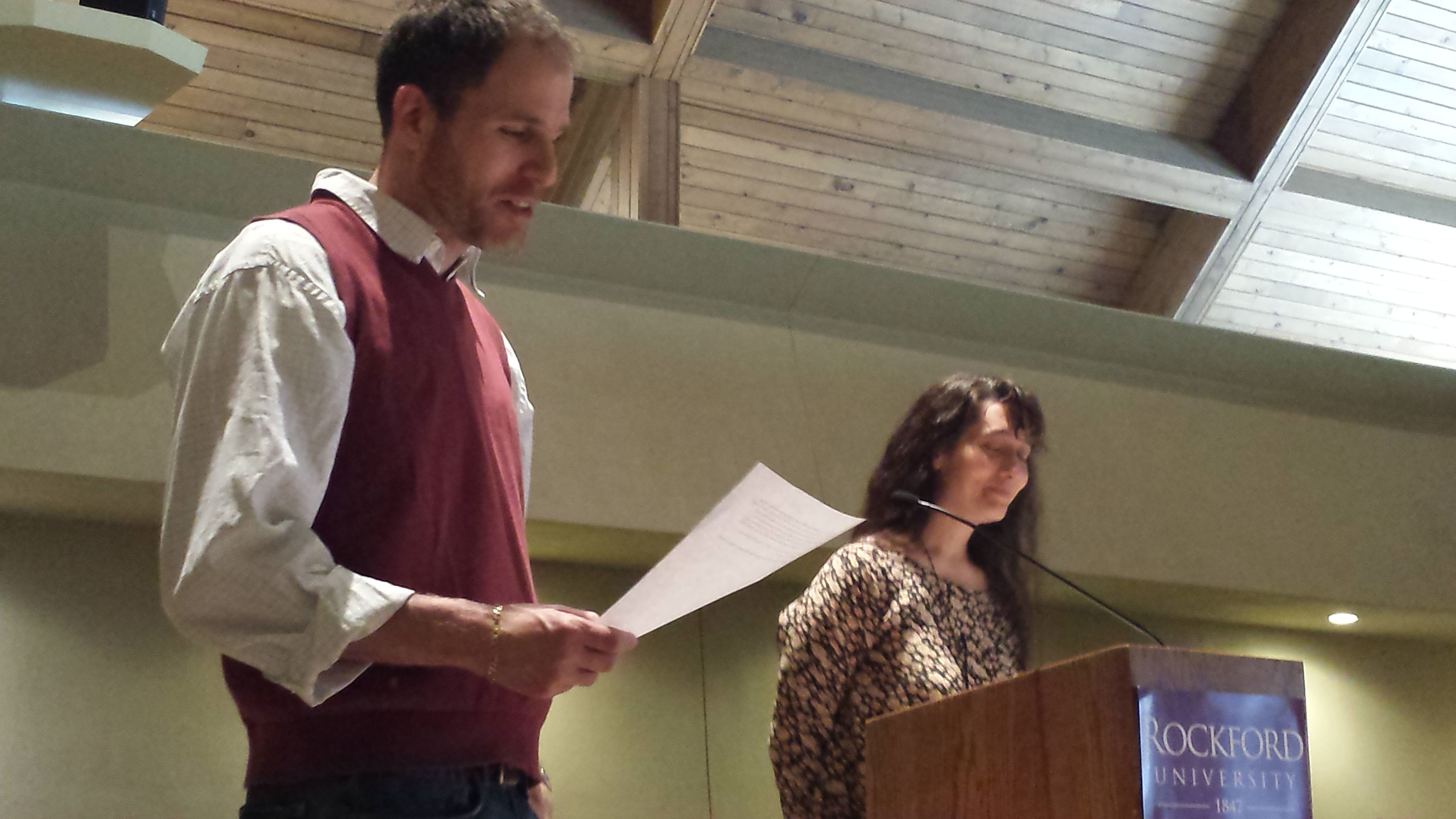
Carrie-Ann tells me that she’ll be blogging her talk soon and eventually posting it at her Academia site, but in general (I’ve read a copy), it’s a discussion (comparison/contrast) of Rand’s views on the moral psychology of work and/versus Mike Rowe’s as laid out on Rowe’s show, his web writings, and in his recent book Profoundly Disconnected.
(Incidentally, though not directly related to Carrie-Ann’s topic, this profile of NOL editor Brandon Christensen’s experiences with homelessness is at least indirectly relevant to the topic and very much worth reading. Not quite a “dirty job” but a “dirty education”: the lengths to which some people will go to get a college degree!)
One basic claim that Rand and Rowe seem to have in common concerns the morally redemptive nature of productive work across the spectrum of types of work–from “clean” to “dirty” (in Rowe’s sense of dirty). A corollary seems to be that it’s more in your interest to work than receive a hand-out, assuming that you’re capable of working. Another corollary seems to be that it’s more in your interest to do dirty work than receive a hand-out while holding out for clean work, assuming that you’re capable of doing the work in question.
A related implication is that when you look for work, ceteris paribus, the choiceworthy features of the work are its not-necessarily-remunerative virtue-realizing features,* not how much money you make from it. In other words, faced with two jobs each of which pays a sufficient amount, you ought to pick the virtue-promoting job over the more remunerative (but less virtue-promoting) one. Similarly, faced with two jobs, one of which is virtue-promoting and pays peanuts, and the other of which pays a lot but is immoral, you ought to pick the former. Those are all, of course, large claims that would have to be developed in ways that go beyond the paper in its current form.
One topic not discussed in the paper but badly in need of discussion is what Randian egoism has to say about the tension between a commitment to egoism and the existence of dangerous-but-necessary jobs, or even a commitment to egoism and the existence of necessary-but-merely arduous-and-messy jobs. Take jobs like military combat, policing (as well as prison work), fire-fighting, and certain types of construction work, farming, mining, and roofing, etc. They’re all necessary in the sense that they need to get done for the efficient or even minimal functioning of a modern society. If they didn’t get done, we wouldn’t have societies of the sort we’re used to.**
But what egoistic motivation beyond economic necessity or lack of better alternatives (in cases where those are applicable) would induce someone to take such a job? If there is no non-necessity-based egoistic reason for taking such a job, it seems rational to shun them. If it’s rational to shun them, then under ideal conditions, no egoists (or relatively few egoists) would be found in such jobs. Granted, conditions are rarely ideal, but the point is, the better the conditions, the fewer the egoists would gravitate toward such jobs, and under good conditions, few egoists would do them.
Suppose ex hypothesi that we’re in the near-ideal situation where the egoists are doing the “better” jobs and the worse jobs are done by non-egoists (by people whose reasons for doing those jobs is inherently incompatible with egoism). Then it seems that in order to enjoy the fruits of modern society–itself an egoistically rational aim–egoists must of necessity rely on the work (and motivations) of non-egoists. If so, egoism is vulnerable to the charge of failing the test of universalizability or (putting the same point another way) requiring a (conceptual) form of parasitism. Egoism only works, in social terms, if many people aren’t egoists and the egoists rely on them in the way that Aristotle’s virtuous aristocrats rely on natural slaves.
I don’t mean to imply that the preceding objection is necessarily sound, just to suggest that it hasn’t gotten enough sustained attention by defenders of ethical egoism as it deserves. That said, Greg Salmieri (Rutgers, Stevens Institute) has been working on the closely-related topic of exploitation in Aristotle’s social theory. I expect that there’s some convergence between Carrie-Ann’s paper and Salmieri’s.
Meanwhile, to move from the virtue of productiveness to the vice of bestial cowardice, I have to confess that I ended up not attending the ACTC conference at which I was supposed to give my paper on the Nicomachean Ethics and the Grant Study (mentioned in the same post as Carrie-Ann’s paper). I finished the paper the night before I was supposed to leave, then got home to discover that my apartment had been infested with mice. (I’ve had an ongoing sporadic mouse problem these past few weeks, but my point is, when I got home, things crossed the hard-to-define-but-easy-to-discern threshold from mouse problem into mouse infestation.) The damn things kept me up all night, and then obliged me to turn from humane-but-totally-ineffective methods of rodent deterrence to inhumane, lethal methods drawn from years of personal observation of U.S. foreign policy.
I had mentioned my mouse problem in passing to my critical thinking students, one of whom turned my random complaint into a teaching moment by asking, “So why assume that you can’t learn to co-exist with the mice in your house?” Part of it (I said) was that mice spread disease. (Response: “Yes, but people spread disease, too. So you’d kill people if you thought they’d spread disease?”) But part of it, I must confess, is simply that I’m skeeved out by the thought–and not just the thought, but the actual physical reality–of sharing my bed with a passel or herd (or whatever it’s called) of feral mice. Granted, as a divorced single man, I should probably welcome the presence of anyone in my bed, but unfortunately, I don’t. (Yes, they’ve crawled into my bed at night with me in it, I’m not making that up.) I know it’s crude of me to put things this way, but I also can’t help mentioning that the mice pay no part of the rent and do not help at all with household chores.
What would Aristotle do? I don’t know, but here’s what he has to say, in what I think is the only mouse-related passage in the Nicomachean Ethics:
If, for instance, someone’s natural character makes him afraid of everything, even the noise of a mouse, he is a coward with a bestial sort of cowardice. (NE VII.5, 1149a7-8).
Yeah, well, call it another chapter from my ongoing memoir, Profiles in Bestial Cowardice. I almost think it’s worse than bestial cowardice. I mean, if I were a bona fide beast–something terrifying, like a tabby or a terrier–I’d at least have the courage to attack the mice mano a mano. But I’m a middle-aged twenty-first century American professor. I haven’t had a fist fight in decades. As it stands, I’ve just armed my apartment with a series of ultrasonic devices, traps, and poison in the hopes that I can drive the intruders away by high-tech methods of shock and awe. I guess we have to invent another category for people like me: sub-bestial cowardice. Or: Not-even-bestial cowardice. Or: pathetic over-civilized wimpiness.
Anyway, my new surge strategy seems to be working about as well as Bush’s did in Iraq and Obama’s in Afghanistan (wish list item: weaponized drones), but too late for my presence at the ACTC conference. My session starts in an hour, but I’m six hours’ drive away.
The point is, I write about virtue. I never said I had it.
*I had originally written “non-remunerative,” but that seems too strong.
**For interesting but in my view inadequate discussion of this topic, see chapter 11 of Alasdair MacIntyre’s Dependent Rational Animals and “Politics, Philosophy, and the Common Good” (reprinted in Kelvin Knight’s The MacIntyre Reader). Though not an egoist, MacIntyre faces a version of the problem mentioned in the text, but contrary to the impression he gives, never really resolves it.
From the Nicomachean Ethics to the Grant Study
[Here as promised is a first draft of the paper I’ll be giving this Saturday at the annual conference of the Association for Core Texts and Courses in Plymouth Harbor, Massachusetts. Papers for the conference are supposed to be short, non-technical treatments of a core text or two appropriate for undergraduate teaching, along with a rationale for teaching them. This year’s theme is the relation between the arts and sciences in undergraduate education. Comments are welcome, though I probably won’t see them until next week. I’ll add hyperlinks next week as well. This discussion was quite helpful to me in thinking things through.]
A pre-Thanksgiving expression of gratitude
I’ve always had slightly mixed feelings about Thanksgiving—it’s not like Halloween is for me—but like most denizens of the First World, I certainly have my share of things to be thankful for. I suppose that sense of gratitude excludes the students who repeatedly fail to do the reading in the classes I teach (and text while I explain the reading they haven’t done); my loud and insensitive upstairs neighbors, who keep me up with with their late night and early morning stomping and yelling; the criminals who’ve recently been filling the police blotters with their exploits in my neighborhood; and the near-death experiences I have every day (often twice a day) while driving the Garden State Parkway. But there’s plenty to be grateful for despite all that. This post consists of an enumeration of some of those things–partly to express my gratitude in a public way, partly to induce readers to reflect on similar things in their experience, and partly just to share some of the discoveries involved. Call it a pre-Thanksgiving expression of gratitude.
One of the great joys of blogging is the opportunity it affords for discovering talented, dedicated people you’d never heard of before, and might never have heard of or interacted with but for the grace of WordPress. That goes for everyone who’s contributed to this blog since its inception this summer—co-bloggers, commenters, ‘likers’, and lurkers alike. Thanks to all of you. But I particularly wanted to take a moment to mention a small handful of bloggers and websites I’ve recently discovered through ‘likes’ on PoT, which have recently become big favorites of mine.
One is Brandon Christensen’s Notes on Liberty, which I’ve come to regard as the most interesting and intelligent libertarian blog on the Internet–and for whatever it’s worth (often, alas, very little), I’ve read them all. Between the NoL folks who come here (mostly Brandon) and the PoT heads who go there (mostly me), we seem to have developed a nice synergy between NoL and PoT, and I hope that continues.
When my brain is up to it, I sometimes visit Blogistikon, “a little storehouse of thoughts, puzzles, and problems about ancient philosophy.” It’s an acquired taste, I realize: one of their latest posts is on “relativity in the Peri Ideon,” and one before that was on Aristotle’s conception of opaque and transparent relatives. Frankly, some of it would be all Greek to anyone (when it wasn’t all Latin). But I enjoy it, when I understand it.
A more accessible favorite of mine is Jackie Hadel’s Tokidoki world travel photo blog, which I discovered by means of a surprise ‘like’ by Hadel on one of my posts. (We don’t know one another at all.) The sheer number of photos on her blog is pretty staggering, but the ones of Bethlehem, Hebron, Jaffa, Jerusalem, and Tel Aviv brought back vivid memories for me. The ones of New York struck me as fresh and interesting, despite my having lived here (well, in New Jersey) for decades, and the ones of autumn in Japan not only induced me to want to go to Japan in the autumn, but managed to evoke some nostalgia for an autumnal trip that Kate Herrick and I recently took to southwestern Vermont, of all places. (You’ll have to look at Hadel’s photos to see why.) Hadel’s travel photos make an interesting study in comparisons and contrasts with those of my cousin Jawad Zakariya, who seems to have traveled just about as widely as she has—with eyes open and camera ready for some amazing shots, from Canada to Pakistan and points in between.
Browsing at Hadel’s site, I serendipitously discovered the poems of Kate Houck, which I now make sure to visit every few days, “for the love of words and what they inspire.” And I’m grateful to my Felician College colleague Richard McGarry for my belated but soul-gratifying discovery of the poetry of Mary Oliver. This particular discovery came not through the blog, but the old-fashioned way, after Rich pinned Oliver’s poem “Wild Geese” to the bulletin board of the faculty lounge, where I happened to see it. (It’s worth mentioning, incidentally, that it’s a direct violation of Felician College policy to pin anything, poems included, to a College bulletin board without the express approval and imprimatur of the office of “Felician College Events and Conference Services.” The operative premise seems to be that college faculty can’t be trusted to communicate with one another by means of flyers or other posted material, unless their communications meet the approval of an “Events and Conference Services” administrator–whether or not the administrator can herself be trusted to understand what the communications are about. “Wild Geese,” was not, I’m afraid, an approved communication, so that in reading it, soul-gratifying or not, I was breaking the law.)
The preceding stuff is pretty ethereal, I’ll admit—political theory, ancient philosophy, travel photography, and poetry. I’m thankful for all of it, but ultimately, Thanksgiving is really about gratitude for elementally material things, like food, drink, clothing, and shelter. To that end, I thought I’d draw attention to this item on world poverty, itself brought to my attention by Kate Herrick. Here’s the abstract from a quietly mind-blowing 2009 working paper by Maxim Pinkovskiy and Xavier Sala-I-Martin, “Parametric Estimations of the World Distribution of Income,” recently discussed at the Wall Street Journal and elsewhere.
We use a parametric method to estimate the income distribution for 191 countries between 1970 and 2006. We estimate the World Distribution of Income and estimate poverty rates, poverty counts and various measures of income inequality and welfare. Using the official $1/day line, we estimate that world poverty rates have fallen by 80% from 0.268 in 1970 to 0.054 in 2006. The corresponding total number of poor has fallen from 403 million in 1970 to 152 million in 2006. Our estimates of the global poverty count in 2006 are much smaller than found by other researchers. We also find similar reductions in poverty if we use other poverty lines. We find that various measures of global inequality have declined substantially and measures of global welfare increased by somewhere between 128% and 145%. We analyze poverty in various regions. Finally, we show that our results are robust to a battery of sensitivity tests involving functional forms, data sources for the largest countries, methods of interpolating and extrapolating missing data, and dealing with survey misreporting.
I don’t have the expertise to interpret their findings in any systematic or sophisticated way, and I realize that $1/day is a dismally low baseline. But an 80% reduction in world poverty rates over a 36 year period cries out for acknowledgement and gratitude, as well as for causal explanation and indefinite iteration. It’s debatable whether the cause of the amelioration is capitalism, globalization, or whatever, but the point is, whatever the cause, it can’t be chance. And that by itself is something to be thankful for, even if we still have a long way to go before everyone has in the way of material resources what a small minority of us can be thankful for having.
One last item, simultaneously from the world of spirit and of matter. For fourteen years now, my dear friend Carol Welsh has been fighting a recurrent brain (and now spinal) tumor called an “ependymoma.” She tells her story at her website, “Adult Ependymoma: A Patient’s Story.” That story has so far included “three brain surgeries, one gamma knife radiosurgery, a placement of a shunt, a course of radiation and oral chemotherapy called Temodar,” along with spinal surgery and a diagnosis of breast cancer. In the fourteen years that Carol has fought this disease—or these diseases, however one counts them–I honestly have not been able to grasp how a human being could endure such undeserved punishment and not only survive, but do so with Carol’s grace and equanimity. She is, as far as I’m concerned, the single most awe-inspiring paradigm of the virtue of courage I have ever known.
Among the many lessons I’ve learned from her, one philosophically interesting one is worth mentioning. We inherit a bias, largely I think from Aristotle, of conceiving of the virtue of courage in fundamentally masculine and militaristic terms. Aristotle tells us in Nicomachean Ethics III.6 that since death on the battlefield is the paradigm of courage, it is “wrong to fear poverty or sickness”; the capacity to face such fears is a mere analogue of courage, not the real thing. Carol single-handedly convinced me–by example rather than argument–of the anachronism and error of Aristotle’s account. It seems to me that William James was right, by contrast, to suggest the need for conceiving of moral equivalents to war, and by implication moral equivalents to the virtues valorized by war.
The military feelings are too deeply grounded to abdicate their place among our ideals until better substitutes are offered than the glory and shame that come to nations as well as to individuals from the ups and downs of politics and the vicissitudes of trade.
Having known Carol since college days, I’d say that Carol has for fourteen years exemplified the “better substitute” that James was wondering about. I’m thankful for the privilege of knowing someone with her courage.
Happy Thanksgiving Day, about a week and a half early.
Postscript, December 16, 2014: The Wall Street Journal story about world poverty made it to The New York Times the other day, describing it as “excellent news,” but burying it on the eighth page of the Sunday Business section. “[T]here is agreement,” the Times says, “that extreme poverty has been on the decline since the mid-1990s and that the decline has accelerated since 2000.” It then asks the obvious question: “What’s behind the shift?” But its answer is utterly uninformative:
Rising incomes in India and China are a major factor. Together, those two countries lifted 232 million people out of extreme poverty from 2008 to 2011 alone, according to one World Bank analysis.
OK, but why did incomes rise in India and China? Surely there’s a story there that deserves more comprehensive treatment than it’s gotten. On the face of it, it seems to me that libertarians have a better story to tell here than left-leaning liberals do. Liberals and leftists either need to tell a better story, or concede that libertarians have this part of the story right, and find a way of accommodating libertarian insights coherently within their conception of the economic world.
 Policy of Truth