[This was originally a postscript to the preceding post, but that made the post cumbersomely long, so on second thought I’ve reposted it here.]
I’m not sure whether there’s an academic literature on abortion and vigilantism, but if there is, I’m not familiar with it. As it happens, there’s an online journalistic literature on the subject that’s worth reading.
One of the earlier items I found was a 1994 symposium in the magazine First Things, “Killing Abortionists,” intended as a response to the actions of Paul J. Hill, who was convicted of killing an abortion doctor and a security guard in Pensacola, Florida. Apparently, he came up with the following rationale for his action: “Whatever force is legitimate in defending a born child is legitimate in defending an unborn child.”
None of the symposiasts notices what seems to me the obvious problem with this axiom: contrary to first appearances, it doesn’t really tell us what force is legitimate in either case. Imagine that child-killing was legal and widely practiced in American society. How informative would it be to know that you could stop this ubiquitous child-killing by “whatever force is legitimate”? How does the quoted phrase tell you what force is legitimate? Suppose you had to shoot your child-killing neighbor. Should you shoot him? Now suppose you had to shoot your sister. Should you shoot her, too? While we’re at it, suppose you had to start a civil war. Should you start one?
It doesn’t really help here to say, “Well child killing is wrong, and if I saw a child being killed in the street, why, I’d rush to its rescue and kill its killer.” The problem is, you’re not confronting a child being killed in the street. You’re confronting a society of child killers. It’s not the same thing. We can’t equate one-shot and iterative violence, abstract from the differences between them, and treat them as though they were interchangeable. They’re not.
Much of the symposium is pointless and evasive; the two theorists’ responses (Hadley Arkes and Robert George) are particularly so. Though I don’t agree with any of it, the one response that seems to me entirely on point is the late Cardinal O’Connor’s. Whether you agree with his arguments or not, it’s obvious that they can’t be dispatched by a few thought-experimental invocations of what Batman would do. For one thing, for Batman to be helpful, we’d need to know what Batman thinks of the Principle of Double Effect. Despite a childhood of watching the show, I don’t know whether he does (did). (Does Batman ever intend to harm anyone? I leave it as an exercise.)
In a famous piece in The Atlantic (September 1995), George McKenna lays out what he calls “A Lincolnian Position” on abortion (which ends up being a stridently anti-Lockean position as well). No pro-choicer is wholeheartedly going to agree with the position McKenna takes, but he does a good job of explaining why opponents of abortion can consistently take a political rather than terrorist/vigilante approach to its containment or abolition.
Zac Alstin’s 2009 piece, “The Moral Tableau of Abortion,” makes the arguable but plausible point (also made in the First Things symposium) that mothers are more causally central to the production of abortions than abortionists. Mothers constitute the demand that generates the supply side of the abortion industry. As long as mothers want abortions, supply for them will arise, however covert; you can attack the supply side all you want, but unless you change the minds of would-be consumers on the demand side, you won’t get rid of abortion. Since you can’t kill mothers without killing fetuses, it makes more sense as a long-range strategy to convince mothers not to have abortions than either to kill abortionists or kill mothers-and-fetuses.
Though he doesn’t make the point explicitly, since Alstin rejects consequentialism (p. 56, left column, fifth paragraph), he has a rationale for rejecting the idea that the goal of the anti-abortion movement is what we might call fetus rescue-maximization (or minimizing the numbers of fetuses killed). It’s questionable whether a campaign of assassination actually realizes fetus rescue-maximization, but whether it does or doesn’t, fetus-rescue maximization is not the goal. Of course, given his deontic-sounding rejection of consequentialism, it’s not clear that Alstin would agree with the reasoning I employ in the original post, but my point is, Alstin’s argument suggests that Brennan’s conclusion is not as easily secured as he (Brennan) thinks. (Incidentally, Alstin’s piece reminds me that Brennan’s post has a precursor in this Slate column by William Saletan.)
And that brings us up to date. Some of the best coverage of Colorado Springs I’ve seen has been at Slate (well, best if you like Planned Parenthood, as I do–even though I currently have no practical use for it whatsoever, and even though I personally prefer the name “Planned Non-Parenthood”).
This piece by Saletan calls Republicans out for the double standard they employ when it comes to anti-abortion vs. Muslim terrorism. Try to imagine the reaction if someone had said this in response to the Fort Hood or San Bernardino attacks: “Violence begets violence! So tell Uncle Sam to stop the violence with those drones, or we’ll just have to shoot up some more American civilians”! And this piece discusses the connection–ahem, alleged connection–between anti-abortion rhetoric and incitement to violence.
My favorite tidbit is the revelation (to me) that Ted Cruz has accepted the endorsement of Operation Rescue president Troy Newman, “a man who has called for abortion providers to be executed.” He doesn’t seem to be suffering for it. Imagine my going to Gaza this summer and getting the endorsement of Khaled Meshal and Musa Abu Marzouq. I’m sure they’ve said equally blood-curdling things about Israelis. I mean, if Ted Cruz can get away with consorting with would-be murderers, why can’t I? But trust me–I can’t. And wouldn’t. And won’t.
Deb Walker, the executive director of Citizens Project, said she understood why some people might have felt relieved when many national news reporters left town. But she also worried that the city of more than 400,000 may have missed a chance to have tough conversations about topics like gun control, abortion clinic safety and women’s access to reproductive health care.
Safety and fear have not loomed so powerfully over a debate, or an electorate, since the Sept. 11, 2001, attacks. But if the threat of terrorism has become the defining issue in the race, Republicans are sharply divided on the toughest and smartest strategies to prevent more attacks.
Well, at least if the attacks are initiated by Muslims.
“I promise you, the next time there is an attack on this country, the first thing people are going to want to know is, why didn’t we know about it and why didn’t we stop it?” Mr. Rubio said. “And the answer better not be, ‘Because we didn’t have access to records or information that would have allowed us to identify these killers before they attack.’ ”
The vague prior indications of an attack were roughly the same in the case of both Robert Dear and of the Malik/Farook duo. But in neither case was there literally probable cause to believe a crime was about to be committed (until the crime was imminent, of course). So what exactly is Rubio’s point? Does he think that people–or government officials–should start acting on hunches, whims, and fears? But then how to safeguard against idiocies of this sort? Or just overreactions to false alarms of this sort? The Obama Administration:
Josh Earnest, the White House press secretary, said in a briefing that the administration would not “second-guess the decisions that are made by local law enforcement officials in any community across the country” in responding to terror threats.
Why do people like Rubio think that their administrations will have predictive capacities that the last two administrations have lacked?
Jason Brennan has a post a few weeks back on abortion and self-defense (Nov. 30), written in the wake of the Planned Parenthood attack in Colorado Springs (Nov. 29). The point he makes is simple, and the argument he offers is, very narrowly construed, sound. But construe the conclusion slightly differently than he does, and the argument misses the point in an obvious way.
The claim in short is that if you think that abortion is murder, and its victims are innocent, you have the right to defend the innocent by force. If the force in question requires killing those who perform abortions, so be it. Brennan invokes a lot of “common law” reasoning to bolster the plausibility of the conditional*, but the appeal to common law is a dialectical fifth wheel that does no real work here. He’s just assuming what we all assume–that you can kill a killer. After some thought-experimental invocations of superheroes, we reach the conclusion that if you believe that abortion is murder, it would be permissible for you to go around killing abortion providers. Here’s the conclusion of the argument, put in the mouth of the would-be fetus defender:
“I will, if necessary (if there are no equally effective non-lethal means), kill any would-be child murders to stop them from killing children.” Again, this seems heroic, not wrongful.
Note the parenthetical. What we have here is a conditional claim whose antecedent involves another conditional. Let me re-phrase it slightly, without loss of authorial intention, but with a little gain in clarity:
If necessary, and if there are no equally effective non-lethal means, then kill those whom it’s necessary to kill in order to stop the killing.
Lots of modal claims going on there. Let’s rephrase once again:
If necessary, kill those it’s necessary to kill in order to stop the killing, but if it’s not necessary, do not do so.
What does “necessary” really mean here? I take it that “necessary” means “necessary for bringing about some end.” But the end is not plausibly construed as “bringing abortions down to zero, full stop, by all available means, regardless of any other normative considerations.” The end in question is some complex goal, e.g., a just society or the common good or whatever, where superordinate higher-order features of the goal regulate subordinate features, including strategies for achieving this or that political outcome.
So the anti-abortionist’s ultimate goal is not plausibly described as “do what’s necessary to stop the killing.” It’s “do what’s necessary to bring about the common good, stopping the killing in a way that’s compatible with bringing about the common good.” I’m pro-choice, but it seems to me that anti-abortionists (or pro-lifers or whatever we call them) are entitled to a plausible conception of post bellum considerations, no matter how militant they are about ending abortion. They don’t just want to end abortion, full stop. They want to live in a just society without abortion, and it may not be possible to do that if you try to end abortion by killing people. In any case, the two things–stop the killing and live in a just society without abortion–are not the same thing.
Suppose that abortion really is murder. In that case, killing abortionists would be one obvious means of stopping abortions, but killing would also likely have seriously adverse consequences. It might increase hostility for anti-abortionists to the point of instigating widespread persecution against them. It might even start a civil war. Further, it’s easier in talk than in practice to kill all and only the “right” people during a terrorist/vigilante campaign. Once the killing begins, the enterprise of killing is often overcome by some terrorist/vigilante equivalent of the fog of war, and the wrong people get killed with amazing frequency. Any of those outcomes could obtain, and any of them might end up being worse for the anti-abortion cause (much worse) than not killing abortion providers.
It’s hard to be precise about expected outcomes of this sort, so people reasonably disagree about them. Some people think that a campaign of killing would, all in, be good for the anti-abortion cause. Others disagree. Obviously, both the complexity of the calculations and the possibility of disagreement about them might help explain why even fervent anti-abortionists have a (disjunctive) principled reason for not going around killing abortionists. They may either think that doing so is self-defeating, or they might think that doing so might very well end up being self-defeating, and not worth risking, as long as there are relatively peaceful (or at least orderly) political means for achieving the same ends with fewer collateral damages.
In recent times, the history of the abortion controversy begins with a deceptively liberating case from the pro-choice perspective (Roe vs. Wade) and proceeds from there to a series of restrictions on the original Roe vs. Wade restrictions on abortion, so that abortion, though nominally legal in the U.S, is in many ways embattled and under siege. In other words, opponents of abortion rights have done a pretty creditable job of subverting the right to abortion by purely legal means. Of course, abortions do still take place, and on the anti-abortion view, those abortions are murder. But the question is whether a campaign of vigilante killing would have purchased more for them than the political-judicial campaign they’ve actually enacted. Hardly as obvious as Brennan’s argument suggests.
It’s an open question whether anti-abortionists could, by purely legal means, do a better job of subverting abortion rights than they could by killing abortionists. The United States ended slavery by warfare in 1865; Brazil ended slavery without warfare in 1888. Anti-abortionists could in principle plump for a Brazilian approach to the abolition of abortion on the grounds that while that approach would take longer, it might prove more counter-factually stable than a faster-acting but more violent approach. Arguably, violence would be counter-productive and self-defeating, possibly catastrophically so.
Since it makes no sense to enact a self-defeating strategy, and it’s highly risky to enact what could be (catastrophically) self-defeating, anti-abortionists need not worry that Brennan’s argument pushes them into wanton murder. Contrary to Brennan, “the” issue involved in the abortion debate is not just the moral status of abortion (though I agree that that’s the fundamental issue) but what to do about the fact that abortion is a complex issue that elicits widespread disagreement. In other words, the philosophical issue is not just the theoretical one of whether or not abortion is murder, but the practical one of what to do about the fact that certain ways of disagreeing about it are potentially murderous.
Now consider Brennan’s list of would-be objections to his argument:
There are a number of objections to this line of reasoning, including:
It’s wrong to engage in vigilante justice.
Batman must allow people to murder children because he has a duty to obey the law, and the law permits child murder.
Batman must not kill the child-killers, but must instead only use peaceful means.
Batman must not kill the child-killers, because it probably won’t work and won’t save any lives.
Batman must not kill the child-killers, because they mean well and don’t think they’re doing anything wrong.
Batman must not kill the child-killers, because the claim that “killing six-year-olds is wrongful murder” is controversial among reasonable people.
Batman must not kill the child-killers, because the government or others might retaliate and do even worse things.
I think these objections are either implausible (e.g., 2 is absurd), or are at best mere elaborations of the necessity proviso of defense killing. (E.g., #4.)
Putting aside (4), Brennan is right to say that these are pretty pointless objections. Objection (4) is where the action is. (Construed a certain way, [4] might well entail [1]: vigilante justice might be wrong because it’s likely to be ineffective, and it’s irresponsible to engage in a political strategy that might very well backfire. But I think Brennan intends [1] to mean that vigilante justice is deontically wrong qua violation of the law, full stop. So I’ll ignore it.)
Brennan dismisses (4) as a “at best a mere elaboration…of the necessity proviso of defense killing.” Well, that’s one way of putting things, and not a literally false one, I suppose. But it’s very misleading: a “mere elaboration” of a proviso can also explain why the proviso cannot be enacted under foreseeable conditions, and (4) does just that. In other words, what Brennan calls a “at best a mere elaboration” ends up explaining why, once we leave the thought-experimental laboratory, his suggestion makes no sense in the real political world where it’s supposed to have application.
Digression: the same sort of “elaboration” is the strategy behind what’s come to be called “contingent pacifism” in the just war literature; contingent pacifism is the strategy of justifying de facto pacifism by construing just war provisos in such a way that they can almost never be satisfied in the real world. This literature suggests that depending on how one construes its claims, just war theory (and its doctrine of necessity) can lead either to very hawkish policy prescriptions or to pacifism. But if the same theory leads different theorists to contrary outcomes with respect to the same issue, the differences between the different applications of the theory–the contingencies in question–can hardly be philosophically trivial. If my version of a doctrine leads me to wage war, and your version of the same doctrine prohibits you from ever going to war, it makes no sense to say, “Don’t worry, we’re agreeing on the theory; we just disagree on the contingencies.” In this case, the disagreement on the contingencies could mean the difference between a decade of war and a decade of peace. Conceptualizing that difference is a paradigmatically philosophical task.
Back to abortion: Not killing abortionists because you could get arrested, and/or because it would undermine the anti-abortionist cause, and/or because the collateral damages would be too high, and/or because it could start a civil war are not trivial considerations, whether “morally” or “practically.” From the first person perspective of an agent deciding what to do–not what to write in a blog post–these are all considerations of paramount importance. They make the difference between going ahead and killing someone and deciding not to. So a reader could grant 99.9999% of Brennan’s argument in principle, but still think that the 0.00001 remainder makes a crucial and theoretically significant difference to political practice. And he might insist that Brennan’s way of rendering the argument reveals a blind spot in his thinking about the relation between theory and practice.
I’d put the latter issue like this: Taken as an academic exercise, with all qualifications duly noted, and abstracting entirely from what would be necessary to enact his advice in practice, Brennan’s argument is perfectly sound. Taken as real-world political advice, however, and factoring in all relevant considerations–including prudential considerations about expected consequences–Brennan’s advice is myopic and insane. It seems to me that when the theoretical version of a prescriptive argument ends up sound, but the practical version of it is insane, we’re obliged to think harder about the relation between arguments, theory, and practice.
At a minimum, I think we’re obliged to note the huge gap that obtains between theoretical prescriptions and practical ones. It sounds oxymoronic, but it isn’t. A theoretical prescription is a prescription offered ex hypothesi, as an exercise in deontic logic, without pretending to guide real-life practice: it notes a normative entailment; it doesn’t claim to tell people what to do. A practical prescription is a prescription intended to guide practice, all things considered; it doesn’t just note an entailment, but tells us, all in, what to do.** Put differently, there is a huge difference between saying, “Your views entail that you should go out and kill people–but don’t actually do that, for God’s sake, I’m only pointing out where your views lead!” and saying, “Your views entail that you should go out and kill people–and if that’s where your views lead, so be it. So get your gun and hop to it!” Brennan is saying the former (I think), but you could be excused for interpreting him as saying the latter. The lesson here is paradox-like but not paradoxical: A prescriptive argument can be sound and yet defective as advice.
The underlying disagreement here, it seems to me, is a version of Hobbes versus Aristotle on prudence. Aristotle takes phronesis (‘prudence’) to be an intellectual virtue that guides individual, first-personal decisions. Despite its practical, individualized, contextualized, consequence-sensitive, first-personal nature, Aristotle insists that phronesis a legitimate object of philosophical inquiry and a legitimate source of knowledge (Nicomachean Ethics, VI.5-13). A view like this puts a certain premium on the nuts and bolts of deliberation, from acceptance of the premises that motivate an action down to the details of what ultimately produces the action in the real world. On an Aristotelian view, what’s philosophically interesting is not just the abstract schema that the agent accepts but how the agent translates that schema into the particularities of a particular action. “Translating a schema into the particularities of a particular action” is the work of phronesis.
Hobbes denies that prudence so conceived has any significant epistemic value (Leviathan, IV.46.1-6):
… we are not to account as any part thereof, that originall knowledge called Experience, in which consisteth Prudence: Because it is not attained by Reasoning, but found as well in Brute Beasts, as in Man; and is but a Memory of successions of events in times past, wherein the omission of every little circumstance altering the effect, frustrateth the expectation of the most Prudent: whereas nothing is produced by Reasoning aright, but generall, eternall, and immutable Truth.
Prudence, in short, is unscientific. It yields contingent, changeable, contextualized truths, neither important enough nor counterfactually stable enough nor wide enough in scope to count as genuine philosophical knowledge. How the agent translates an abstract schema into action is philosophically uninteresting. What matters is the schema–the model– itself. From this perspective, an inquiry into what the agent is, all things considered, to do seems too fine-grained, variable, and messy to be a genuinely philosophical or genuinely worthwhile activity.
Contemporary Hobbesians (as I’m thinking of them) prize thought-experimentation and social science at the expense of mere first-hand experience, and at the expense of an account of the requirements of first-personal deliberation (i.e., prudence). First-personal agents disappear from view, as do their deliberations and deliberative needs. From this perspective, the mere prudence required for intelligent political action is unworthy of philosophical inquiry. Anarchist Hobbesians have a plausible-looking rationale for this insistence: on their view, politics is an unworthy occupation, so it stands to reason that the epistemic virtues it require are themselves unworthy of sustained reflection.***
As I see it, one of the most valuable contributions of neo-Aristotelian theorizing (in the Nussbaumian mode) is to put social science and thought-experimentation in its place, and insist on the first-personal perspective of the agent and her deliberations–along with history, psychology, and common sense. On a view like this, it isn’t enough to know that if abortion is murder, and self-defense is justified, you can infer that defensive killing would be justified to save fetuses from murder. You need to know whether, even if that argument is sound, you should actually be out killing people. If so, you need to know whom to kill, when and how; how to prevent predictable disasters that arise when you start killing people; and how the killing enterprise fits into the larger aim of achieving the common good. That sounds like “mere strategy” to some people, but on an Aristotelian view, it’s precisely the kind of knowledge that the just and wise agent has, and that the political philosopher studies in order to grasp the nature of justice and wisdom.
Anyway, thought experiments and social science are of some, but relatively little value here. Eventually, thought experiments run out of prescriptive steam for the obvious reason that life isn’t an experiment. Social science runs out of useful things to say because we can’t do experiments on novel courses of action that no one has yet tried–but we can’t refuse to do novel things because there’s no existing social scientific literature about them, either. A virtue like phronesis is indispensable here, both for deliberative agents and for theorists theorizing about what such agents do. If you’re going to do something–e.g., engage in political action–you have to know how to do it, and the only way to know how to do something is to have done it (or have rehearsed doing something as much like it as possible). You need the kind of knowledge that Hobbes denigrates and that our neo-Hobbesians ignore.
Bottom line: even if you think abortion is murder, don’t do what Jason Brennan tells you. (PS: It’s not really relevant to my argument, but in case you’re wondering, I’m pro-choice on the abortion issue. I believe in abortion on demand from the moment of conception until birth, with some moral reservations about late abortion, while rejecting legal restrictions on it.)
*I corrected this sentence. It originally said, “antecedent of the conditional,” but what I meant was that Brennan invokes common law to bolster the plausibility of the conditional as such.
**I reworded the latter clause after posting. The previous version (which I’ve now forgotten) was wordier and somewhat unclear.
***”Anarchist Hobbesian” may sound like a contradiction in terms, but I don’t think it is. It could mean (a) an anarchist whose meta-philosophical views map onto Hobbes’s and/or (b) an anarchist whose account of political authority maps onto Hobbes’s, but who infers on that basis that no states have authority.
I’ve updated the October 2014 post on character-based voting yet again. Will I ever shut up about this? I mean, enough already, we get it: Jason Brennan is wrong about character-based voting, and Trump shows why. Blah blah blah. You almost get the sense that this blog is run by Fox News or something.
Is it too much to ask these days for conceptual clarity on a widely used term? This is the nth news item I’ve read in the past week or so using the term ‘radicalisation’ without providing the slightest hint of what it means. What is radicalisation? What are its contours? Is it a political category? Is it a socio-political category? What is it to undergo radicalisation? Is it a surrogate for some clinical term, and if so can it be eliminated in favour of a clinical term with a psychiatric pedigree? Does it refer to a state of mind or a process? If it is a process is it an exclusively external process whereby the subject of radicalisation is radicalised by someone else? Or is it an internal process whereby the subject of radicalisation radicalises himself? As someone who does quite a bit of work in a custodial institution, I’d like to do my part but can’t wrap my head around what the damn term means or how in a practical sense I’m supposed to apply it (or to whom it applies). As a dude in his early 30s, I’d like to be able to tell whether the smile I received on Wednesday from some hijab clad Veena Malik look-alike was a sign I still got it or whether it was a subtle invitation to commit a spousal jihad attack. Without any clarity on radicalisation there’s no way to know.
P.S.: You’ll have to excuse the British spelling. When in Rome…
P.P.S.: I just realised I left out the title. My bad.
I just happened to read Tim Sandefur’s memorial for his brother Daniel Kaufman, killed in the San Bernardino attack. I won’t try to summarize or contextualize; just read it for yourself. Please accept my heartfelt condolences, Tim.
Fernando Teson continues his dialectical winning streak on Near Eastern topics over at BHL. His latest is an attempt to defend a full-scale war against ISIS via “just war theory.” He presents his “case” (scare quotes, not a direct quote) in the form of a list of numbered propositions. I don’t know if he realizes that a list is not an argument, but this list obviously isn’t one, and doesn’t provide anything that begins to resemble a case for going to war against ISIS. The first item on the list is as follows:
The international community—represented by an appropriate military coalition—has a just cause to wage war on ISIS. That just cause is twofold: (a) the right of humanitarian intervention aimed at saving the populations in Syria and Iraq that are presently victimized by ISIS, and (b) the right of self-defense in response to ISIS’ attacks elsewhere.
I hate to belabor the obvious, but X has just cause to wage war against Y doesn’t entail that X ought, all things considered, to wage war against Y. At best having just cause to wage war is a necessary condition for deciding to wage war, in just the way that having a right to self-defense against someone who threatens you on the street is a necessary condition for deciding to fight back, but not by itself sufficient for deciding to fight back. Among the other considerations: the probability of victory; the nature of the victory envisioned and whether it’s worth fighting for; the price of having to fight relative to the benefits of fighting; the probable unintended consequences of fighting and their costs; etc. Teson doesn’t address any of those obviously relevant issues. He just invokes just war theory, handwaves his way through the details, and somehow concludes that it’s time to wage another Near Eastern war.
Another belaboring of the obvious: is it clear that full-scale warfare will diminish ISIS’s attacks on us? If so, what is the argument for thinking so? For now, the argument is MIA.
This is the mentality of our “expert” class of IR theorists: dominated by theories whose defects and indeterminacies they refuse to acknowledge, they seem incapable of learning from even the most recent history, and incapable of rising to the level of ordinary common sense. Yet another belaboring of the obvious: it’s going to take a hell of a lot more than Teson’s hand-waving to convince rational people that we ought to be venturing into another Near Eastern war (or any other kind of war) any time soon.
So try again, Teson. Or rather, do us all a favor and don’t try again. The accumulated weight of the unanswered questions in your arguments on this general topic are not exactly a credit to anything you’ve so far said on the subject. Time to hand the shovel up and stop digging.
Postscript, December 11, 2015: Fernando Teson may not regard my objections as worth responding to, and may not regard me as a worthy interlocutor, but I can’t imagine that he regards Andrew Bacevich as someone he can easily dismiss. This article from Wednesday’s New York Times gives a succinct summary, based on Bacevich’s arguments, of some of the most obvious objections to Teson’s “proposal.” And this article, published a year ago, gives readers a sense of the debate on ISIS we haven’t had, and aren’t having.
I have trouble understanding how anyone can be recommending war against ISIS while blithely ignoring issues like these:
If overwhelming firepower alone could guarantee success, the United States would have won the Vietnam War and emerged victorious from Afghanistan and Iraq. And 14 years after 9/11, the threat from Al Qaeda might have disappeared, rather than persisting, morphing and re-emerging as the Islamic State.
As if to underscore the inadequacy of a conventional military approach are terrorist attacks like the one last week in San Bernardino, Calif. It appears not to have been directed by the Islamic State, American officials say, but was simply inspired by it.
Middle East analysts across a broad spectrum — whether they call for more, fewer or different military interventions in the region — say that when it comes to the Islamic State, the West is acting as if it has failed to learn the lessons of the past.
Mr. Bacevich says “the lessons of these failures” are too rapidly forgotten as many Americans succumb to what he calls a form of militarism, “clinging to the illusion that because we have a splendid military, putting it to work will make things come out all right in the end.”
Unfortunately, he says, “little evidence exists to support any such expectation.”
Felician University has NGO status at the United Nations, and this evening I’ll be serving as the University’s representative to the UN at a screening of David Holbrooke’s new film, “The Diplomat,” a documentary on the life of his father, Richard Holbrooke (1941-2010). The screening begins with introductory remarks by Samantha Power, followed by a discussion moderated by David Holbrooke.
There’s an odd sense for me of the “road not taken” about this event, since I think I may well be one of the few philosophers there among all the diplomats. When I first went to college, I’d planned on joining the U.S. Foreign Service, majoring in Politics and minoring in Near East Studies. But I got distracted by philosophy in my junior year, and ended up (very hesitantly) applying to graduate school in philosophy my senior year–getting in to precisely one graduate program (Notre Dame), which I ended up attending.
Most days, I think it was the right decision, but some days I wonder about it (cf. Nicomachean Ethics X.7-8: not exactly a new “dilemma”). I can’t say that I’ve never looked back, but obviously, I haven’t gone back. Still, it’s a strange feeling to hang out with the club I once might have joined (or tried to join) while fleeing for another one.
December 9, 2015: The film screened in the UN’s Trusteeship Council Chamber to about 300 or so people, most of them (as far as I could make out) diplomats of one sort or another. Samantha Power had some interesting things to say, as did David Holbrooke, and Christina Gallach, the UN’s Undersecretary-General for Communications and Public Information.
I probably couldn’t summarize the film any better than Neil Genzlinger in The New York Times and Todd Purdum in Vanity Fair; I also happen to agree with both reviewers’ positive assessments. It’s a great film, but hard to access: unless you get to a screening, you’ll have to watch it via HBO Now, HBO Go, or HBO On Demand. But I’d highly recommend doing so, if only as an antidote to the venomous muck that constitutes the contemporary American political scene. I’ll have some comments on some of the broader philosophical and political implications of the film “soon.” (In PoT parlance, “soon” means “possibly within a year.”)
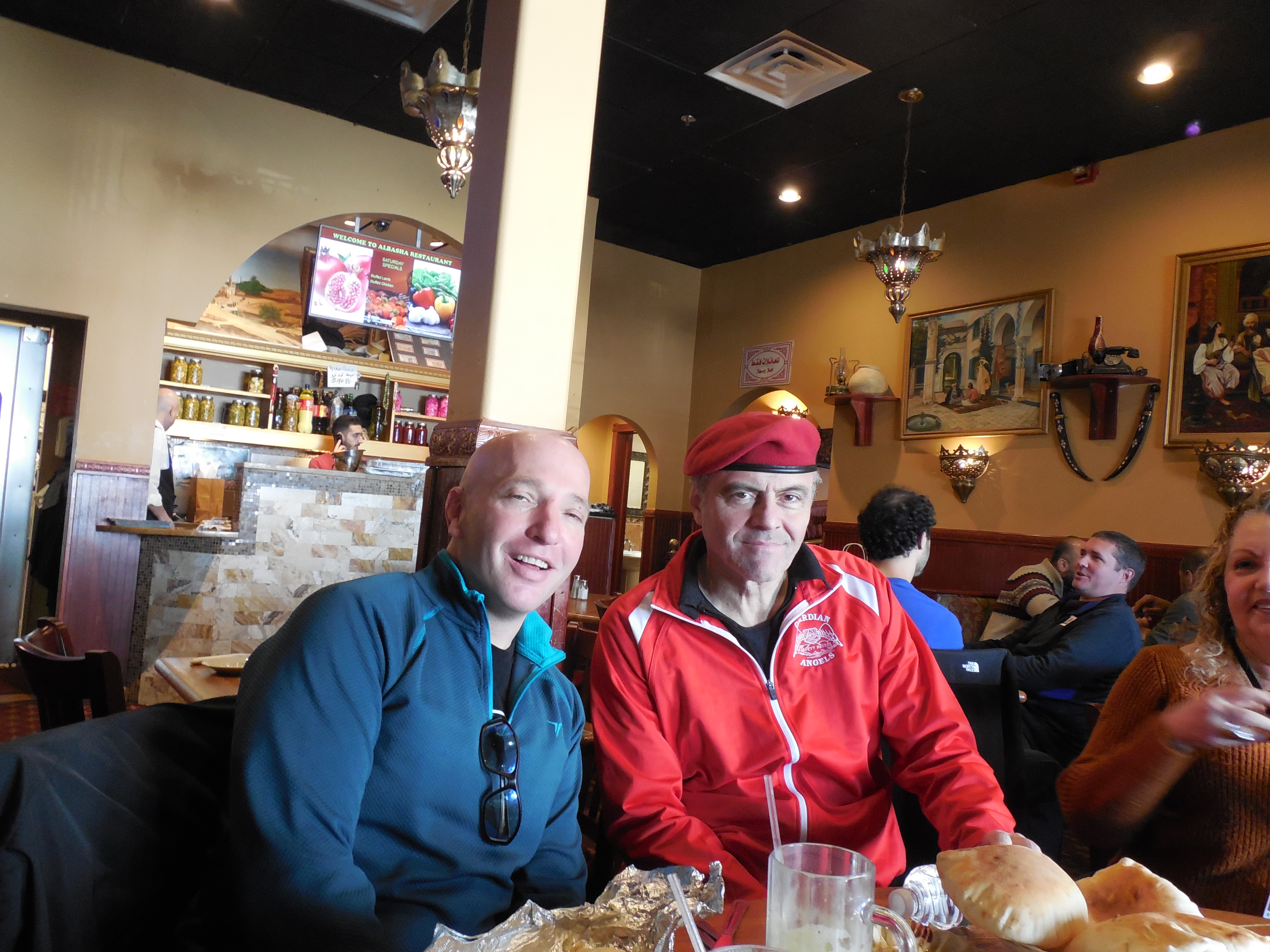
Just got back from the Hummus Summit with Curtis Sliwa this afternoon in Paterson. I’m pressed for time, as usual, so no time to write it up. For now, I’ll just post a few pictures (and silly captions), and write up a post later in the week.
Hey, what a town:
Oh wait, is there a double entendre here?
Curtis Sliwa and Noam Laden in Al Basha Restaurant.
A chance meeting on Main Street outside of the restaurant:
More later. And now, back to my day job as…what am I again, an assistant professor of something somewhere?
Postscript, December 7, 2015: Here’s coverage of the event in today’s Bergen Record. For obvious reasons, only bits and pieces of a wide-ranging two hour interview made it into the article.
Postscript, December 11, 2015: Now that I have a minute, I thought I’d comment on the significance of this event, over and above the opportunity to meet a celebrity and eat lunch at his expense (not that that’s trivial).
At one level, it was an opportunity for a show of solidarity: Curtis Sliwa and I make for unlikely collaborators, but the fact is that we agree on the celebration rumors. Contrary to the blanket rejections that we heard from Paterson city officials when we were investigating the celebration rumors, we both found credible evidence of a celebration-like disturbance in Paterson on 9/11. Contrary to Donald Trump’s defenders and Islamophobes across the land, neither of us found more than that, and neither of us have found the further stories that have been bruited about as plausible. (I’ll have more to say about those “further stories” in a separate post.)
I don’t know if Sliwa would agree, but I would add that the evidence we did collect was not itself definitive, either about the occurrence of an event, or about its celebratory nature. I regard it as likely that some such event took place, but I wouldn’t insist that it did, much less spread rumors (a la Fred Siegel) that small-scale celebrations were definitely occurring throughout the area. (I’ll have more to say about Siegel’s comments on MSNBC in a separate post. For now, I’ll simply note that in a week’s time, he hasn’t acknowledged an email I sent him care of the Manhattan Institute, asking for clarification of his references to me on Joe Scarborough’s show.)
At another level, the event was an opportunity to set the record straight. Trump used Sliwa’s name to spread his, Trump’s, lies. Fred Siegel has used my name to spread his, Siegel’s, confabulations. Sliwa said that there was a small disturbance in Paterson on 9/11; Trump used that to claim vindication for his own bullshit. I said that it was likely that there was a small disturbance in front of the public library in Paterson, and said in print that it was likely that a dozen or less were involved; Siegel has used that to claim that there were “demonstrations” (“a couple of dozen people at most”). I don’t know any better way of calling out bullshitters except to keep calling them out for their bullshit. In that respect, the Hummus Summit could well have been named The Anti-Bullshit Summit, except that that name probably wouldn’t have gone well with lunch.
At a third level, the event was a demonstration of the malign power of rumor. Noam Laden, the other invitee to the Summit, described how he had bought the Paterson celebration rumor hook, line, and sinker for fourteen years, inferring that Paterson would be unsafe for Jews (he’s Jewish) given what the rumor implied about the sensibilities of those who live there. Though he lives in Jersey City (an irony of its own), he hadn’t set foot in Paterson since before 9/11 for fear of having to deal with a neighborhood full of terrorist sympathizers. The result was that he stopped eating at one of his favorite restaurants and shunned Paterson until he was convinced by Sliwa to attend the Summit there. I give Laden credit for admitting all that, and for reversing his earlier views.
Incidentally, Laden told us that his brother’s name is Ben, and that in the wake of 9/11, his brother had endured a fair bit of serious, non-joke-intending harrassment for having the name “Ben Laden.” I know I overuse the line, but this story forces me to repeat it: is there any final answer to the question, “How stupid can you get?”
Though we didn’t happen to discuss the point at the Summit, I suspect that Noam Laden’s worries about Paterson were exacerbated by the Paterson Protocols controversy of 2002, in which I also happened to play a cameo role. The story was originally broken by Daniel Pipes, receiving widespread coverage at the time not just in the mainstream press, but in Marc Levin’s 2005-2006 documentary film “Protocols of Zion.” I think the 9/11 celebration rumors are best understood in the light of this later controversy; it’s the later controversy that retrospectively gives the rumors the apparent plausibility that they seem to have. (I have yet to collect all of my Paterson writings and all of my writing on Muslim anti-Semitism in one place, but I probably should.)
Sad but true: North Jersey suburbanites treat north Jersey’s cities in the way that non-Arab Israelis treat the West Bank or Gaza. As far as they’re concerned, Jersey’s cities are scary, crime-ridden “no-go zones” where civilized people fear to tread. Mention “Newark,” “Paterson,” or “Jersey City” to the average north Jersey suburbanite, and with remarkable frequency you’ll get the response, “Oh, I don’t go there.” Unsurprisingly, the suburbs are a semi-gated, exclusively zoned echo chamber of genteel racial and class-based stereotypes. (In fairness, I should probably say that a person might legitimately want to avoid driving to Jersey City given the misery involved in getting there: driving into Jersey City during rush hour is not altogether different from driving into Jerusalem from Ramallah via Qalandia Checkpoint.)
These attitudes seem to be an artifact of the 1980s and 90s, when crime rates soared, and city streets were indeed unsafe to walk. But that was decades ago. It doesn’t seem to matter that crime rates have recently fallen to record lows. The fact remains that our cities are still alien territory. It shouldn’t be a surprise, then, that rumors flourish about them. That’s what rumors are for: they speak the otherwise unspeakable about the irredeemably alien, and north Jersey’s urbanites are apparently as alien to its suburbanites as literal aliens might be to earthlings. The lesson here seems to be that for all of the cosmopolitan pretensions of the New York metro area, we don’t seem to get out much.
One wonders how a country is supposed to hold itself together when its citizens are so alienated by and from the people who live a couple of neighborhoods away that they instinctively shun them on the basis of the wildest rumors about them. A house divided….?
*As a Jersey City resident, Laden is not a suburbanite, so the point I’m making here is not about him. My point is that his story draws attention to the phenomenon I’m describing, not that he himself exemplifies it.
The one thing people are sure to know about Descartes—who know anything about him at all—is that he said (approximately), “I think, therefore I am.”
Therefore, it is ironic that Descartes was not the first to say this. Consider the following:
…I am most certain that I am and that I know and delight in this. In respect of these truths, I am not at all afraid of the arguments of the Academicians [i.e., skeptic philosophers], who say, “What if you are deceived?” For if I am deceived, I am. For he who is not, cannot be deceived; and if I am deceived, by this same token, I am. And since I am if I am deceived, how am I deceived in believing that I am? for it is certain that I am if I am deceived. Since, therefore, I, the person deceived, should be, even if I were deceived, certainly I am not deceived in this knowledge that I am.
This passage is from St. Augustine’s City of God (XI.26). The reference to the Academics is significant. Augustine was evidently aware of philosophical skepticism and concerned to answer it at least in some respects—just as was Descartes. Moreover, Augustine contrasts the frailty of sense-perception as a means of knowledge with the certainty of “another and far superior sense, belonging to the inner man” (XI.27)—just as does Descartes. Immediately preceding the passage quoted above, Augustine asserts that our knowledge of our own existence is not subject to illusion just because it is not derived from the bodily senses, which only produce in us images resembling sensible objects, not the objects themselves. Intellectual knowledge, such as the knowledge we may demonstrate of our own existence, is free of “any delusive representation of images or phantasms.”
Clearly, Augustine’s cogito was not merely a transient thought which he failed to fully recognize or develop. According to Roy Sorensen (A Brief History of the Paradox, Oxford U.P., 2003, p. 170), Augustine presents the argument no less than seven times in assorted works. (Some other references I’ve found are The Trinity (10.10.14) and the Enchiridion (7.20).) Of course, Augustine does not employ his cogito as the foundational argument for an elaborate epistemology and system of knowledge. Still, in view of the fame the cogito argument acquired with Descartes, it seems odd that Augustine’s prior claim is so little known.
Did Descartes rip off Augustine? He claims not. However, Sorensen is not convinced, pointing out the ubiquity of the cogito in Augustine’s writings and the popularity of Augustine with Descartes’s Jesuit teachers at La Flèche.
In any event, Descartes employed his cogito in one important way that Augustine did not. Specifically, he thought it demonstrated the prior certainty of consciousness, by which I mean loosely that the mind is better known than the body. For example, a visual experience as of an object—a cup, say—in front of me may or may not really be of a cup, but it is unquestionably an experience. Descartes realized that only “thought,” by which he meant to include any conscious event, could support his argument. It wouldn’t do, for instance, to say, “I walk, therefore I am,” even though walking supports the logic of the argument, as presented by Augustine above, just as well as being deceived. Try substituting “walk” for “be deceived” in the passage above. Except where being deceived refers specifically to being deceived about one’s own existence, as opposed to being deceived in general, the logic of Augustine’s argument remains undisturbed. Thus, the fact that the event in question is being deceived appears to be almost incidental in Augustine’s cogito. But it isn’t; only an event involving conscious “thought” will support the argument. And this implies that the reality of thought is more securely knowable than the reality of the objects of thought. This is a point that Augustine may have missed, even though, with his talk of images and phantasms, he had the conceptual tools that would have enabled him to do so.
The prior certainty of consciousness, after going more or less unchallenged for nearly 300 years after Descartes, finally came to be controversial and to be rejected by many philosophers. But I am inclined to think it is true and that the cogito provides a pretty good argument for it. (Of course, the further uses Descartes made of the prior certainty of consciousness, for instance as support for mind–body dualism, are another matter entirely.) In this respect, Descartes saw more deeply into the cogito, even if he did not invent it.



 Policy of Truth