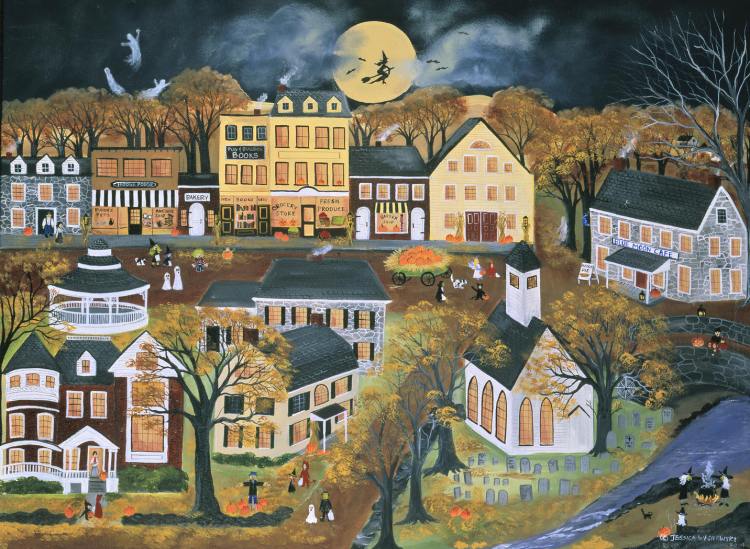
Happy Halloween

Halloween has, for as long as I can remember, been the only holiday I’ve ever been able to take seriously or wholeheartedly to celebrate. As an ex-Muslim, I have a certain affection for Ramadan, but Ramadan isn’t really a holiday, and unfortunately, none of the Muslim holidays (the Eids) are seasonal, seasonality being an essential property of a real holiday. (In fact, generally speaking, Muslims have trouble figuring out when exactly their holidays are supposed to take place–another liability of being a member of that faith.) Having spent a decade in a Jewish household, I have some affection for some of the Jewish holidays–Yom Kippur and Passover, though not Hannukah or Purim–but always with the mild alienation that accompanies the knowledge that a holiday is not one’s own: it’s hard to be inducted into a holiday tradition in your late 20s, as I was. I like the general ambience of Christmastime, at least in the NY/NJ Metro Area, but unfortunately, once you take the Christ out of Christmas, you take much of the meaning out of it as well–Christmas without Midnight Mass being an anemic affair, and Midnight Mass without Christ being close to a contradiction in terms. Not being a Christian, I find it hard to put Christ back into Christmas, mostly because I have trouble putting him anywhere at all.

The secular holidays are, I’m afraid, a sorry set of excuses for holidays. I’ve trashed Columbus Day on this blog, Independence Day on another, and I endorse Christopher Hitchens’s description of New Year’s Eve as the “worst night of the year” (and U2’s description of the Day as essentially unremarkable). Thanksgiving is too damn complicated, given its connection to family, and the political holidays (Presidents’ Day, MLK Day, Memorial Day, Veterans’ Day) are either too political, too contrived, and/or too somber to count as real holidays. Labor Day is a day off, not a holiday. It’s not the same thing.

danse-macabre-966x1024.jpg (966×1024)

So what’s left? The purest, most innocent, most seasonally appropriate, most nostalgic, and most celebratory of all holidays, Halloween. I’ll concede this much: El dia de los muertos, All Saints’ Day, and All Souls’ Day are all perfectly respectable cousin-holidays to Halloween and fit for post-Halloween celebrations, but their value supervenes on that of Halloween; in and of themselves, they don’t quite cut it, at least for me. (Scary thought: only a philosopher could manage to use the words “supervene” and “Halloween” in the same sentence.) What all four holidays have in common is a properly autumnal and properly macabre preoccupation with mortality, which is the only point of having a holiday in the first place. The point of a holiday is to celebrate life  in the shadow of death–in the full knowledge that it’s there, lurking in the shadows and crevices of life, and in the full knowledge that though it’s there, we could care less.

inness_early_autumn.jpg (923×613)

It’s a near tragic fact that Halloween itself almost went extinct. I have nostalgic memories of Halloween from childhood, but sometime in the mid-80s, Halloween’s luster was dimmed by a series of candy poisonings, razor-bladed apples, and other scares (or so we were led to believe); I distinctly remember when Halloween was cancelled–abolished, outlawed–in my town in the mid-80s. It took a long time for the holiday to recover from its de jure abolition, and  just as it seemed to have been doing so, it was cancelled two years in a row in the Metro Area for climatological reasons–for the freak snowstorm of 2011, and then for Hurricane Sandy in 2012. It made a comeback last year, and I’m hoping it makes a bigger one this year. All systems appear to be “go” for a comeback: Halloween falls on a Friday this year; the weather is supposed to be perfect; and judging from the neighborhoods I’ve seen across north Jersey, everyone–infants, adults, and everyone in-between–is more than ready to celebrate.

Main+Street+Halloween-a.jpg (1432×1050)

Every holiday has an aesthetic, and needs artwork to match. In recent times, I’d nominate Tim Burton as the Master Artist of Halloween. Going further back in time, I might award that title to Bram Stoker, Mary Shelley, or Washington Irving. (I know, I know: Poe or Hawthorne should be in there, but they do less for me. Feel free to come up with your own nominations and leave them in the comments.) Anyway, over the years I’ve been surprised to discover how many people–or at least, how many Americans between the ages of 20 and 50–have childhood  memories of listening to some version of Camille Saint-Saens’s little piece, “Danse Macabre,” around Halloween-time. I myself remember listening to a version of it playing over an animated “filmstrip” (remember those?) of dancing skeletons, care of my grade-school music teacher, Mrs. Davidson–to whom I’m eternally grateful. Unfortunately, I haven’t been able to find a video version of the filmstrip anywhere. That said, there are lots of versions of “Danse Macabre” online; I couldn’t quite find the perfect one, but this one had the right quirkiness about it. Enjoy.

P.S., For a more musically satisfying version of “Danse Macabre,” check out Clara Cernat and Thierry Huillet’s version for violin and piano, just a click away once the preceding clip finishes.

P.S., October 31, 2014: Here’s an amusing piece from the Times’s “Friday Files,” on Halloween celebrations from back in the day–1895, 1914, and 1926.

P.S., November 1, 2014: Well, Halloween certainly made a comeback in my area. Here’s a link to a local news story about the house featured in my header (which I’ll keep up for the rest of the weekend). You probably don’t want to miss this extremely frightening 38 second video:

It does seem to me that the general character of Halloween has changed since my day (the 70s and 80s) to accommodate the helicopter-parent/over-regulatory/risk-averse sensibilities of the modern age. Carrie-Ann Biondi points out to me that in most north Jersey towns, Halloween has now, by municipal fiat, been ordered to take place between the hours of 6 pm and 8 pm. So if you trick-or-treat before 6 or after 8, you’re breaking the law. And true to form, around 7:45, the po-po came by to clear everyone off the streets. There was a huge, festive block party in one of the decorated neighborhoods of Glen Ridge–the crowd there was in the hundreds–but most of the other streets were empty. So the trend is now toward adult-“organized” partying rather than the old undirected play of yore. I suppose that adult-organized is safer–and as with anything with the word “adult” in it, certainly has more sex appeal–than old-fashioned trick-or-treating, but it does seem to me that something’s been lost.

I can’t end this rant without saying that our municipalities need some push-back as far as their over-regulation of ordinary life is concerned. Libertarians and others spend a lot of time complaining about the over-reaching powers of the federal government, but the truth is that municipalities need to be curtailed as much as any other branch of our over-zealous government. There doesn’t seem to be any aspect of life immune to the paternalism of municipal ordinance (and lots of ordinary life that needs more regulation than it gets). Maybe that’s an argument for spending less time on blogs and more in town council meetings, pushing back on the people in Town Hall who perpetually seem to want to push the rest of us a bit too far.

Incidentally, Kate Herrick points out to me that my anti-non-Halloween rant missed Easter–true enough–about which I’d say more or less what I said about Christmas.

One last PS: Some examples of the paternalism I mentioned before, care of Carrie-Ann Biondi:

1. Seven weird laws regulating Halloween from various places.

2.  Snowhill, Maryland reserves the right to re-schedule Halloween at will, and prohibits masks for anyone over the age of 12.

3. More age limits.

4. Yet another curfew, from Fishkill, New York.

I try to keep the language clean here at PoT, but honestly, these laws seem pretty fucked up to me.

Respondeo:

Refuse! Resist!

The first thing we do, let’s criticize all the lawyers

I stick it to the lawyers’ guild at this discussion at Lawyerist.com. I’m responding to Sam Glover (and others), “Why Are Lawyers So Expensive? I’ll Tell You Why.” As far as I’m concerned, he doesn’t.

Ironically, I’m the Pre-Law Advisor at Felician College.

I might add that some of my best friends are lawyers. Seriously.

Postscript, November 2, 2014: I was away for most of the weekend, so I didn’t visit Lawyerist.com to see how the Expensive-but-So-Totally-Worth-It lawyers had responded to my criticisms of their special pleading for their inflated fees. I just did.

In four days, the author of the piece, Sam Glover, who conspicuously “LOL’d” my initial comment, has backed off, shut up, and moved on without responding to anything I said. I’ve now asked another commenter, who admitted to increasing his fees on the basis of snap judgments of his clients’ “unrealistic expectations,” whether he’d be willing to universalize that judgment and allow service providers in other fields–doctors, therapists, mechanics, plumbers, educational institutions, insurance companies–to do the same without legal interference, oversight, or regulation. I’m morbidly curious to hear the answer.

It’s not that I lack respect for the legal profession as such. It’s a necessary and valuable profession with many noble practitioners. Nor do I much mind that such people have large incomes and live accordingly. What I mind is how many others of them are arrogant, misologistic sophists who thrive on the undeserved deference they get in our society, and who, despite their inflated egos, six-figure incomes, and delusional self-conceptions, cannot argue their way out of a paper bag. There are plenty of lawyers out there fitting that description, and a great number of them seem to congregate at Lawyerist.com. I wouldn’t be surprised if some of them billed for being there–in which case I don’t mind giving them a run for their money. Unfortunately, I can’t bill for it, but philosophers don’t live by bread alone.

By the way, I should probably add that not only are some of my best friends lawyers, but so are some of my best former students!

Crime and emergencies (part 2): reconciling self-defense and gun control

For obvious reasons, people are talking a lot about guns nowadays. I’m a big fan of gun control, and make no bones about being one. It’s always seemed to me that gun control follows from a commitment to the idea of government as having a legitimate monopoly on the use of force, and not being an anarchist, I endorse the relevant commitment. I’m also committed to a right of self-defense, which in my view entails a right to the most efficacious means of self-defense compatible with the government’s monopoly on the legitimate use of force. As far as life in the U.S. is concerned, as I see it, that entails a circumscribed (hence regulated) right to acquire firearms for purposes of self-defense. In other countries where guns are themselves scarce, I would have no objection to an outright ban on the acquisition of firearms by private citizens. But guns aren’t scarce in the United States, and there is no justified or realistic way of banning them outright. (For a discussion of the perils and problematics of weapons control, check out my inadvertently timely Reason Papers piece, “The Contested Legacies of Waco.” For an excellent discussion of the empirical issues regarding gun control, see James Jacobs, Can Gun Control Work?)

In a democracy, a political position is only as strong as the weakest link in the constituency that supports it. Put another way, a political position is only as strong as its supporters’ ability to deal with the strongest objection to it. One of the reasons why gun control has done so poorly in the U.S. (in the sense of not commanding adequate political support) is undoubtedly that the NRA has too much power. But another reason is the sheer cluelessness of so many of those who defend it.

The cluelessness concerns a relatively obvious question. Suppose you believe in the justifiability of gun control. Still, people have a right to self-defense. If there are lots of guns out there, and lots of criminals with the desire to use them against the innocent, how do we ensure that our justifiable desire to regulate the sale and acquisition of firearms doesn’t subvert the equally justifiable desire to sell or acquire them in the exercise of a right of self-defense? That’s a problem that requires a solution. It’s not a rhetorical question that one can evade or dismiss as having been manufactured by the NRA or Smith & Wesson.

I realize that the desire for self-defense can be abused or exaggerated via grandiose superhero fantasies, errors of probabilistic reasoning, confirmation bias, hasty generalization and so on, but so can the desire for regulation. When all is said and done, it is just patently obvious that if we have a right of self-defense, we need access to the means of its exercise, and if criminals have firearms, non-criminals need (regulated) access to them as well in order to defend themselves against armed criminals. But no. Defenders of gun control have decided that what we’re to do when faced with armed and dangerous criminals is to reach for our phones and call 911. Presumably, the criminals will give us the time to do this, and all will go well as we wait for the police to arrive. If we cannot manage to call 911, well then, we’re out of luck. We must acquiesce in whatever the criminals want and let them have their way. Even Hobbes doesn’t go as far as that in Leviathan, but that hasn’t stopped defenders of gun control from recommending subservience to the commands of those who wield force against the rest of us. The resort to quixotic, primitive denial of obvious facts about crime has, in certain quarters, become the epitome of “liberal” sophistication.

Consider a column in this morning’s New York Times by Gail Collins, easily the most clueless of the Times’s columnists. I happen to agree with much of what she says in defense of gun control. Then, predictably, we reach this set of claims:

And while we have many, many, many things to worry about these days, the prospect of an armed stranger breaking through the front door and murdering the family is not high on the list. Unless the intruder was actually a former abusive spouse or boyfriend, in which case a background check would have been extremely helpful in keeping him unarmed.

Really? How about an armed stranger breaking in through the back door? Or a window? Doesn’t it matter where one lives? Maybe Gail Collins feels safe in her neighborhood, but does that mean that everyone should feel equally safe in theirs?

As it happens, an intruder tried to break into my apartment this past Sunday night or Monday morning through the living room window. I was asleep in my unlocked bedroom a few yards away. He or they didn’t manage to break all the way in, and didn’t ever get inside; they just managed to cut the screen of the window with a box cutter, and then to discover that it probably wasn’t worth breaking into this particular apartment, possibly because there was so little in it worth stealing. That didn’t stop them (I’m assuming it was the same people) from successfully breaking into a number of other dwellings in my neighborhood that same night.

Since the local police blotter hasn’t yet come out, I don’t know whether the intruders in question were armed, and don’t know whether anyone managed to confront them or get injured in the process. But people are regularly robbed in my neighborhood, and occasionally those robberies go wrong; when they do, the victims are sometimes shot. Rapes take place here with alarming frequency. The cars in the parking lot of my apartment complex have regularly been broken into during the year that I’ve lived here. On a more trivial but rather annoying note, my New York Times (like the Luddite I am, I still get the paper version) is stolen at least once every two weeks. Lesson: crime is real.

Though this Monday’s incident was my first break in in this particular neighborhood, it’s not the first time I’ve had to deal with a break-in. It’s the third. On one occasion, someone tried to break into my bedroom via the window as I was sleeping: the window in question was maybe a yard away from me, and it was unnerving to be awakened by the sound of someone forcing the window so close to my ear. I wasn’t armed, but I had no choice but to confront him. There really wasn’t time to find the phone and call the police. I guess I was threatening enough to scare him away—I must have been reading Nietzsche or Schopenhauer or something–but I’d rather have been armed. On another occasion, I happened on someone in the process of breaking into my car (luckily, he was too busy trying to steal it to notice me). In that case, I was able to call the police, and they happened to get there in less than a minute, but as they apprehended the suspect, he made it clear to everyone that he meant me harm beyond the theft of my car (he came out and said so). I’ve never been carjacked myself, but I’ve seen a carjacking take place at a hundred yards’ distance, and a good friend of mine has been carjacked. A distant friend of mine was put in the hospital after being robbed, and the spouse of someone I know was murdered in a robbery. (P.S., on a different note: I’ve also faced a menacing individual wielding a gun in a park–to this day I’m not sure whether the gun was real or fake–so I know what it’s like to be on the terror-laden receiving end of what seemed like imminent gun violence. Having a gun of my own would not have helped in that instance, and using one would probably have led to a blood bath.)

None of this (I think) is particularly remarkable as far as suburban New Jersey experience is concerned; I don’t think I’m some kind of wild statistical crime-experience outlier. What I don’t understand is why such experiences are so distant from people like Gail Collins as to be unreal to them. But alas, they’re not unreal. They happen, and they have to figure into the discussion about gun control with a degree of respect for the victims that liberals like Gail Collins conspicuously seem to lack.

Here is another example, also from The New York Times, admittedly at a higher level of sophistication and respect for facts than Collins’s column. It’s by Gary Gutting, a professor of philosophy at Notre Dame, and (at least indirectly) an erstwhile graduate school mentor of mine.

Our discussions typically start from the right to own a gun, go on to ask how, if at all, that right should be limited, and wind up with intractable disputes about the balance between the right and the harm that can come from exercising it. I suggest that we could make more progress if each of us asked a more direct and personal question: Should I own a gun?

A gun is a tool, and we choose tools based on their function. The primary function of a gun is to kill or injure people or animals. In the case of people, the only reason I might have to shoot them — or threaten to do so — is that they are immediately threatening serious harm. So a first question about owning a gun is whether I’m likely to be in a position to need one to protect human life. A closely related question is whether, if I were in such a position, the gun would be available and I would be able to use it effectively.

Unless you live in (or frequent) dangerous neighborhoods or have family or friends likely to threaten you, it’s very unlikely that you’ll need a gun for self-defense. Further, counterbalancing any such need is the fact that guns are dangerous. If I have one loaded and readily accessible in an emergency (and what good is it if I don’t?), then there’s a non-negligible chance that it will lead to great harm. A gun at hand can easily push a family quarrel, a wave of depression or a child’s curiosity in a fatal direction.

Gutting at least recognizes the possibility that those who live in dangerous neighborhoods may need a gun for self-defense. But he makes the point in passing, with grudging reluctance, and without feeling the need to ask some obvious questions about the implications of his own admission.

Gutting’s claim implies that if you do live in a “dangerous neighborhood” there is some likelihood that you might need a gun for self-defense (assuming that you get the training to use it, etc.) At least, it’s rational in some contexts to think you do. But what exactly is a “dangerous neighborhood”? A “dangerous neighborhood” is presumably where the armed criminals are. So where is that? And how does one figure it out?

One could look at published rates of crime or look at crime blotters. But crime rates change and crime blotters are statistically unreliable snapshots of reported crimes during a given week. (And reported crime is not crime.) Further, criminals are not universally stupid or lacking in means of transportation: they have an entrepreneurial attitude toward criminality. No entrepreneur worth her salt would open a small business based on the kind of information that determines conventional attitudes toward “dangerous” or “safe” neighborhoods. Decisions of that kind require refined and intensive local knowledge and a measure of sheer guesswork. They’re also highly fallible. Given that, putting aside obvious mistakes or errors of judgment, there is no way to get on some epistemic high horse and proclaim that one ought only to open a psychotherapy office in a “psychotherapy-heavy neighborhood,” or a restaurant in a “dining-out neighborhood,” or a grocery store in a “grocery neighborhood.” Judgments about where to open a business are highly tentative and fluid, mostly vindicated by the results of the experiment rather than by some antecedent facts obviously available to everyone at t.

The same is true of crime. There is no such thing as a neighborhood that is “dangerous” now and forever. Danger fluctuates. Criminals migrate.  Yesterday’s dangerous neighborhood becomes safe. Yesterday’s safe neighborhood becomes dangerous. I am not sure where Gutting gets his armchair sociologist’s picture of “dangerous neighborhoods” sporting banners that say “Dangerous Neighborhood” above them. In my experience, such banners do not exist. If you want to insist on the concept of “dangerous neighborhood,” you’d have to say that the whole of the New York/New Jersey Metro Area is a “dangerous neighborhood.” I can’t think of any location in New Jersey that I would regard as somehow immune to criminal violence. If that’s so, Gutting’s “dangerous neighborhood” advice is a pious gun control vacuity. It gives no clear advice about where one can legitimately own a gun because it appeals to a concept that has no clear criteria of application.

I’ve visited neighborhoods in southwestern Vermont where people leave their doors unlocked at night or when they leave their homes because they regard themselves as living in “safe neighborhoods.” But their safe neighborhoods would become dangerous the moment it occurred to criminals that their inhabitants were complacent enough to regard their neighborhoods as “safe.” No one would be naïve enough to believe that Vermont is a crime-free zone. Crime takes place there. That it takes place more in some areas of the state than others doesn’t mean that those statistical distributions are facts of nature. They can change without warning. Most people would encourage people who don’t lock their doors to rethink their complacency. I’d do the same for those who think that guns are obviously superfluous in supposedly “safe” neighborhoods.

No neighborhood is so safe that you can, without further thought, leave yourself totally vulnerable to criminal depredation in one. Any neighborhood could be a dangerous one the day the right criminal shows up in it. So whether one “needs” a gun or not for self-defense is far more complicated a matter than Gutting admits. He himself piles up the complications for his view without seeing that they undercut the supposedly clear-cut claim he makes that most of us do not need guns.

Until defenders of gun control wise up and deal with the problem of crime as an unpredictable emergency that could strike anyone, gun control has no chance of success in this country. In this respect, its defenders are almost as much to blame for its political failure as its opponents.

Postscript, April 25, 2016: This article about crime in San Francisco is a nice confirmation of the point I make in the preceding few paragraphs, not that I’m suggesting that the criminals described in it should necessarily be shot.

O Canada

Here’s a post worth reading by Mike Reid (Notes on Liberty), on recent events in Canada.

Despite its overt religiosity, I like their national anthem better than ours. I’d sing it in honor of them…but I doubt my singing would count as an honor to anyone.

Hey Canada: don’t let the bastards wear you down, eh?

P.S., a bit later the same day: A “resolutely Canadian” reader draws my attention to Justin Trudeau’s apt speech on the attacks, probably better than anything I can muster up right now, and also (unlike me) authentically Canadian. An excerpt:

In the days that follow, there will be questions, anger and perhaps confusion. This is natural, but we cannot let it get the better of us. Losing ourselves to fear and speculation is the intention of those who commit these heinous acts.

They mean to shake us. We will remain resolved.

They want us to forget ourselves. Instead, we should remember.

We should remember who we are. We are a proud democracy, a welcoming and peaceful nation, and a country of open arms and open hearts. We are a nation of fairness, justice and the rule of law.

We will not be intimidated into changing that.

If anything, these are the values and principles to which we must hold on even tighter. Our dedication to democracy and the institutions we have built is the foundation of our society. And a continued belief in both will guide us correctly into the future. Staying true to our values in a time of crisis will make us an example to the world.

I don’t usually think of Canada as an “example to the world,” but after the job we’ve done of it lately, I’m willing to give it a try.

Defining “emergency” (Part 1)

I’m in the middle of editing, and writing a contribution for, Reason Papers’s forthcoming symposium on the epistemology, ethics, and politics of emergencies. (Though I’ll be contributing an essay to it, credit for the idea of the symposium goes to Carrie-Ann.) The topic turns out to be an amazingly interesting and fertile one, with ramifications in a number of directions, including the epistemology and semantics of definition; the application, scope, and stringency of moral principles; the scope and content of rights; the proper role of government; the rule of law; and so on.

The topic has been made particularly timely by a number of recent events–the recent Ebola outbreak; the state of emergency declared this past summer in Ferguson, Missouri after the riots; the states of emergency declared during Hurricane Sandy in 2012; the states of emergency that have been thought to obtain after the terrorist attacks of 9/11, etc. But those phenomena hardly exhaust the applications of ‘emergency’: once you start looking for emergencies, you find them everywhere, often in the most unlikely places. And then there are emergency-cognates, like disasters, catastrophes, crises, epidemics, and pandemics, as well as pseudo-emergencies of every kind.

At the most basic level, emergencies are events that are ontologically and normatively discontinuous from “normal” events. It’s part of the very concept of an emergency that it’s an exceptional sort of event, that it involves danger, and that it demands urgent attention and action. Given those facts, emergencies drastically affect the content and application of normative principles–epistemic, ethical, and political: principles that apply to ‘ordinary’ life don’t apply, or at least don’t apply in the same way, to emergencies. Ordinarily, we expect people to form their beliefs on the basis of the evidence for them–but in emergencies, guesses and hunches become acceptable. Ordinarily, we expect people not to kill, torture,  kidnap, steal from, trespass on, cheat, deceive, or manipulate others–but in the right kind of emergency (some would say) just about anything goes. Ordinarily, we’re governed by the rule of law, including constitutional law, but in emergencies, we either bend the rules, or are governed by open-ended edict or fiat. And so on.

Given this, emergencies give rise to a difficult dilemma in need of solution. On the one hand—call it the rigorist hand–there’s the danger that the invocation of “emergency exceptions” to moral principles serves as a rationalization or excuse for ad hoc exception-making. The concept of an “emergency” seems ill-defined and elastic, and “emergency exception” seems like a magic wand by which moral principles are undercut and effectively ignored. If we define “emergency” too broadly, every form of duress becomes an “emergency,” so that the concept loses its meaning, and emergency exceptions serve to subvert the stringency of the moral principles that are supposed to govern normal life. At a certain point, a moralist has to put his foot down and insist that duress requires the exertion of moral strength and endurance in the name of normality rather than exception-making in the name of abnormality. But the appeal to “emergencies” is one of the most seductive ways of evading this responsibility. From the rigorist perspective, then, emergencies are philosophically important primarily because we have to put them in their place. Emergencies, the rigorist insists, are marginal exceptions in life. We should cordon them off as essentially irrelevant to normal life, and focus our attention on the non-exceptional rules that govern normal life.

On the other hand—call it the pragmatist hand—there’s the danger that if we ignore emergencies, or minimize their significance or frequency, we ignore a real phenomenon that affects the proper application of moral principles. All principles, even the most stringent, apply within a specific and in-principle specifiable context. If we ignore the difference between emergencies and non-emergencies, we apply principles designed for one context to a context where they lack application. In doing so, we run the risk of sacrificing things of greater value to things of lesser value on the basis of a robotic commitment to empty verbal formulations masquerading as moral principles. In doing that, we risk the dangers of imposing pointless burdens on those suffering great duress, invoking “morality” as a pseudo-justification for our dogmatism. From this pragmatic perspective, we ought to take emergencies seriously because emergencies are an extreme instance of duress, and duress is a ubiquitous but easily-ignored part of our moral life. Goodness is fragile, and emergencies underscore that fact in an acute way.

The rigorist and pragmatic views are, of course, one-sided caricatures of possible positions. Each view gets something right, but each view ignores the merits of the other view, and thereby gets something wrong. A good dialectician would have to work through the two views, integrating their best insights, discarding what each view gets wrong, and fashioning an alternative to them that avoids the pitfalls of either view. The task would be to strike the mean between rigorist and pragmatist extremes.

I’ve argued elsewhere—very briefly and tentatively, in a footnote (p. 219 n.29)—that Ayn Rand appears to have been the first writer to have ‘thematized’ the topic of emergencies in twentieth-century English-speaking philosophy. (If I’m wrong about that, as I very well could be, I’d be interested to hear about it in the comments.) Her discussion appears in “The Ethics of Emergencies,” a 1963 essay published in her 1968 essay collection, The Virtue of Selfishnessand anthologized every now and then in philosophy textbooks. I have mixed feelings about the essay, as I do about much that Rand wrote.

On the “pro” side, I think she gets four or five things basically right.

(1) Most fundamentally, she gets the basic framing issue right:

It is important to differentiate between the rules of conduct in an emergency situation and the rules of conduct in normal conditions of human existence. This does not mean a double standard of morality: the standard and the basic principles remain the same, but their application to either case requires precise definitions. (Ayn Rand, “The Ethics of Emergencies,” The Virtue of Selfishness, p. 54).

In other words, some principles straddle emergencies and non-emergencies, retaining their identity across both contexts, but taking different forms in the one context as opposed to the other. Good theorizing keeps both facts in mind. It’s not enough for a theorist to insist on the sameness of the principles that apply to emergencies and non-emergencies; she has to explain how a principle can prescribe opposite courses of action in emergencies as opposed to emergencies and yet be the same principle. Nor is it sufficient for a theorist to insist on the need for exception-clauses in emergencies, based on the dissimilarity of emergencies to non-emergencies. She has to explain why the exception clauses exemplify the general and universally applicable principles that apply to both contexts. In other words, if it’s wrong to lie in ordinary life, but right to lie in an emergency, what needs explanation is what single principle is exemplified in both contexts, and how that single principle demands truth-telling in the one case and lying in the other. The constraint seems to me a plausible one, even if Rand herself doesn’t explain exactly how it works, and even though most theorists (in my experience) seem to violate or ignore it.

Having said that, it’s worth adding that some philosophers have emphasized the constraint. For better or worse, Mill does so in the last few paragraphs of Utilitarianism. A more recent example is Alasdair MacIntyre’s trio of papers on moral dilemmas and truth-telling in Part II of Ethics and Politics: Selected Essays, Volume 2 (2006). Another interesting discussion is Thomas Hill’s “Making Exceptions Without Abandoning the Principle: or How a Kantian Might Think about Terrorism,” in Dignity and Practical Reason in Kant’s Moral Theory (1992). There are, of course, many others.

I think Rand gets some other things right.

(2) She’s right, I think, that the philosophical literature misuses emergencies and moral dilemmas to the point of systematically indulging in fallacious appeals to the emotions in order to induce readers to accept otherwise under-argued moral claims. (Peter Singer’s drowning child example is a paradigm of this approach–an approach my graduate school roommate Patrick Kain once aptly dubbed “The Argument by Surely Operator,” as in, “Surely, we would all save the child…”  Interestingly and counter-intuitively, both Singer and Rand regard it as utterly uncontroversial that one has an obligation to save the drowning child, but neither of them has an argument for it. I have never, in twenty years of reading on the subject, seen or heard a bona fide argument for saving the child beyond table-pounding appeals to intuition, consensus, or plain old emotion.)

(3) Unlike much of the literature, Rand insists on defining “emergency.” It’s amazing how much of the literature discusses emergencies without ever defining the term.

(4) Again, unlike most of the contemporary analytic literature, Rand’s definition of “emergency” takes the form of a definition by genus and specific difference (“An emergency is an unchosen, unexpected event that…”) rather than biconditional equivalence (“An emergency takes place if and only if…”). This is a large topic, but I tend to think that the traditional Aristotelian format for definitions has advantages over the newer analytic one. I’m also inclined to think that Rand’s definition of “emergencies” is basically right, while admitting that she says nothing in defense of it, and admitting that any any adequate defense of it would probably require revisions to it.

Unfortunately, I also find Rand’s essay seriously defective. I see at least seven or eight basic problems.

(1) For one thing, though the essay is titled “The Ethics of Emergencies,” it’s not primarily about the ethics of emergencies at all. In my edition, the essay is about eight pages long, and is about a variety of topics, none of them particularly well developed. Rand opens the essay with a page-and-a-half-long well-poisoning polemic against the misuse of emergency scenarios in ethics. Another four pages go to a paradoxically illuminating but ill-argued explication of the egoistic basis of human relationships. A mere page and a half discusses emergencies. Another half page concludes the polemic against the misuse of emergency scenarios in ethics, focusing on the role that such scenarios play in defending altruism. Despite the title of the essay, then, the discussion of emergencies ends up being a mere afterthought to, and application of, the claims about the egoistic basis of human relationships. The cumulative result is that the essay is torn between at least two different topics–relationships and emergencies–and fails to do justice to either topic.  For that reason, though I think the essay has some worthwhile things to say, it is, on the whole, a failure.

There are other serious failures of argumentation in it, failures that have essentially gone undiscussed in the “literature” on the subject, almost all of it written by writers sympathetic to Rand. (For a notable exception, read pp. 100-104 of Carrie-Ann’s 2008 Reason Papers review of Tara Smith’s Ayn Rand’s Normative Ethics.)

(2) In discussing egoistic relationships, Rand repeatedly stresses that a rational egoist forms a hierarchy of values, incorporates other people’s well-being into that hierarchy, and then treats others well-being as part of his own. What she doesn’t explain is how or why anyone would do that. Yes, if you incorporate others’ well-being into your own, you come to treat their well-being as part of your own, and thereby promote their good while promoting your own. But why would an egoist do that? What benefit does an egoist get by making the initial choice? She doesn’t explain. Her failure to explain would, by itself, merely be an omission rather than a defect in her view (or in the essay), but having omitted a discussion of that crucial topic, she then goes on to make very strong claims about the structure that a rational hierarchy of values would have to take, as well as the actions that would have to follow from its adoption. But unless she specifies the benefit that an egoist gets from doing as she prescribes, she’s not entitled to such claims. What we need but don’t get in the essay is a derivation of other-regard from egoistic self-interest, not a rhetorical deflection of the accusation that egoists are mean people.

(3) Rand divides her discussion of other-regard into two parts: how an egoist deals with his intimates, and how he deals with strangers. As for intimates, she says, we incorporate their welfare into ours based on their past track record of virtue. Roughly speaking, the more virtuous they are, the more deeply integrated into our own welfare; the less virtuous, the less so. Though there’s deep truth in this claim, it’s also a gigantic oversimplification. But never mind that for now; let’s accept it ex hypothesi. One problem is that it explains how egoistic relationships continue, not how they come to be. I can continue to incorporate your welfare in my hierarchy of values based on your past track record insofar as you have a past track record (with me). But there has to be some initial point at which you lacked a track record (with me). How then do relationships begin?

The same problem applies even more problematically to strangers. A stranger by definition has no track record with another stranger. So we can’t incorporate the welfare of strangers into our own on the basis of their past track record of virtue. What then do we do? Rand acknowledges the problem here, and claims to deal with it, but what she says is very compressed and obscure (p. 53). We grant a stranger a “generalized respect and good will,” she says, on the basis of “the potential value he represents” (my italics). Later she describes the rationale for this respect and good will as “a consequence, an extension, a secondary projection” of one’s own self-esteem (p. 53, my italics).

There’s an intriguing idea lurking here, but taken at face value Rand’s claims are pretty puzzling. Why does a stranger “represent” any value to me at all, especially if I’ll never see him again? And why does he “represent” value rather than straightforwardly being valuable to me (or not being so)? Elsewhere, in the context of the debate about abortion, Rand derides the idea that potentialities are morally significant (“Of Living Death,” reprinted in The Voice of Reason). There, she says, the embryo and fetus are merely potential human beings, hence not rights-holders. Here, however, the argument asserts that a stranger is potentially valuable, hence valuable. The latter inference seems ad hoc, and the two claims together seem inconsistent. Rand doesn’t seem to have had a consistent position on the normative significance of potentialities, a problem, I suspect, that lies at the heart of the common accusation that she has no adequate ethical account of children, the family, and moral patients.

Finally, the language of “projection” is equivocal and potentially problematic. What does it mean? Here are some possibilities:

  • We project the value of the stranger in the Goodman-Quine sense of treating his being-valuable-to-us as a “projectible” predicate.
  • We project the value of the stranger in the Humean or Freudian sense of ascribing to him traits that belong to us.
  • We project the value of the stranger simply in the sense of expressing our self-value in relation to him, treating him as its proper object and beneficiary.
  • Some combination of the preceding.
  • None of the preceding.

Unfortunately, she doesn’t say a word to decide between the options.

(4) Rand rather arbitrarily asserts that we ought to give assistance to strangers only in emergencies, but she never explains either the restriction or the ought:

  • Why help only in emergencies (as opposed to elsewhere)?
  • Why help in emergencies at all (as opposed to not helping even there)?

Again, she says little or nothing to clarify.

(5) Rand equivocates as to whether helping strangers in an emergency is a moral obligation (an “ought”) or merely a permission (a “may”). Sometimes she suggests that we ought to help strangers in an emergency (as long as the risks to us are “minimal”), implying that anyone who doesn’t help is morally defective, or lacking in virtue (specifically, lacking in integrity). Sometimes she suggests that we may help others in an emergency if we wish, but only if we do so from a sense of good will, and only if we want to, implying that we are not defective if we don’t help. Both claims can’t be right, and the latter claim contradicts Rand’s insistence, elsewhere, that her Objectivist Ethics is an ethic of conditional “necessities,” according to which every morally right act is a conditional imperative necessitated by “the conditionality of life” (“Causality Versus Duty,” in Philosophy: Who Needs It). Prima facie, a necessitated permission is a contradiction in terms.

(6) Having told us that we ought only to assist strangers in an emergency, Rand abruptly contradicts this claim, and tells us that it’s permissible to assist strangers in cases of illness or poverty that aren’t emergencies (p. 55). What she’s saying here may be a concession to commonsense, but in the context of the essay, it really seems like nonsense. Either we help others only in emergencies, or we help others in emergencies and elsewhere. We can’t have our “only” and eat it. An additional problem here is that her definition of “emergency” leaves no clear way of conceptualizing medical emergencies. But medical emergencies are a paradigm case of emergencies.

(7) Though I’m inclined to agree with her definition of “emergency,” she shows no awareness of how controversial it is, or of the most obvious objections that a reader might have to it (namely, that it seems too narrow). Even if I ended up agreeing with her definition, however, I’d have to disagree with her applications of it to cases.

(8) Rand conspicuously fails to meet her own adequacy-condition for a discussion of the subject, as described above.

For present purposes, as well as for purposes of my RP symposium contribution, I want to continue the task that Rand started–defining “emergency” by genus and specific difference. As I see it, the two basic definitional questions about emergencies are these:

(a) What are emergencies?

(b) Of what kinds of thing are emergencies properly predicated?

The two questions are verbally distinct but conceptually interconnected. Any answer to (a) probably constitutes an answer to (b), though I don’t think that the reverse is bound to be the case.

Rand defines an emergency as “an unchosen, unexpected event, limited in time, that creates conditions under which human survival is impossible” (“Ethics of Emergencies,” p. 54). She adds, in elaboration of the definition, that “[i]n an emergency situation, men’s [sic] primary goal is to combat the disaster, escape the danger, and restore normal conditions” (p. 54). Presumably by “men” she means “rational agents acting rationally”: men aren’t the only people who respond to emergencies, and some men fail to respond to them at all.

In any case, Rand takes “emergency” to contrast with “events that take place in normal conditions,” so that either (i) “emergency” and “normal-condition event” are correlatives, or (ii) “emergency” is defined in terms of (and as a basic deviation from) some conceptually prior notion of a “normal-condition event.” I’m inclined to think that (ii) is the case. If so, a great deal of the definition of “emergency” depends on spelling out that prior conception of metaphysical “normality.”

“Normality” is a notoriously difficult concept to define in a non-circular, non-statistical way.  The concept is one to which Rand often helps herself, and which bears some unclarified relation to what she elsewhere calls “the benevolent universe premise.” But it also finds its way fairly often into the non-Randian literature, whether in discussion of emergencies or other topics. Here’s one example from the scholarly literature on Aristotle’s ethics: The virtuous agent, Terence Irwin writes, “will correctly regard as dominant those rational and rigid states of character that secure complete happiness in moderately favourable external circumstances” (“Permanent Happiness: Aristotle and Solon,” in Aristotle’s Ethics: Critical Essays, p. 15, my italics). I take Irwin’s reference to “moderately favorable external circumstances” to pick out a concept similar to Rand’s notion of “normal-condition events.” “Favorable circumstances” seems to do analogous work for Aristotle as for Rand.

There’s a lot going on behind Rand’s definition–a lot of questions to be asked of it, and a lot of refinements to be made to it even on the most charitable reading. Here are a few questions that seem to me worth asking, and which I hope to address in my RP essay.

  1. Suppose that “emergency” is parasitic on some prior notion of metaphysical normality. What is metaphysical “normality,” and how is it to be conceptualized prior to and independently of “emergency”? On the other hand, if “metaphysical normality” and “emergency” are correlatives, is there some other concept that allows us to break free of the conceptual circle they form?
  2. Rand says that emergencies are unchosen, but why, or in what sense, can’t you bring an emergency on yourself? Does Rand mean that you can’t self-consciously bring about an emergency under that description (“I’m going to bring about an emergency right now”), or does she mean that you can’t chose to bring about an emergency, full stop? If I plan to commit suicide, and then start to enact the plan, is the enactment not an emergency even if it’s genuinely life-threatening? There’s something right about her claim, but it has to be made more precise and explicit than she makes it.
  3. Rand says that emergencies are “unexpected.” Does that mean that they’re unpredictable? If so, why, or in what sense, can’t they be predicted? Mutatis mutandis, the same follow-up questions apply here as in #3. If, for instance, I correctly predict a hurricane, and correctly predict that it will lead to fires in a certain city, is Rand’s point that the subsequent fires aren’t emergencies? Or is her point that while “fires” are predictable of the hurricane as event types, the corresponding event-tokens are unpredictable emergencies? In other words, what is expected (but not an emergency) is “fires resulting from the hurricane”; what is unexpected and is an emergency is, say, the particular fire that breaks out on Broad Street at 10:43 pm during the hurricane. If so, Rand’s view seems to imply that while the hurricane itself is not an emergency, unexpected micro-events caused by it could be.
  4. That, however, raises another set of questions. How predictable does an event have to be to qualify as “predictable”? I may not be able to predict that I’ll have a serious traffic accident today, but if I’m on the road and see a bus hurtling toward me–and have nowhere to go as it does–I may be able to predict, a few seconds before the event, that a serious traffic accident (construed as an emergency) is about to happen. Does that sort of predictability count or not? Here again, Rand’s definition needs some “chisholming.”
  5. What justifies the stricture that emergencies are “limited in time”? The claim seems plausible, but needs an argument. Among the considerations that make it plausible: human pre-history lasted a long time but involved an enormous degree of pain, suffering, and duress; we might be inclined to regard the latter phenomena as emergencies if we suffered them, but there is something problematic about describing hundreds of thousands of years of human history as one long “emergency.” Supposing that emergencies are limited in time, how are the limits set? After all, some wars (or totalitarian dictatorships) last decades or centuries, and create life-threatening conditions. Does Rand want to deny that wars or dictatorship are emergencies? (It’s worth remembering that her novel We the Living features a protagonist who lies and cheats her way through life in order to survive as best as she can under Soviet socialism.) Perhaps, as in the hurricane case, only unexpected micro-events within wars or dictatorships are emergencies, but the macro-events themselves are not. If so, recurring causal chains of emergencies under long-lasting emergency-prone conditions are not (qua chains) emergencies, even if they require massive adjustments to the adoption and practice of “normal” moral principles (as they obviously do). Similar issues arise about life in, say, prisons, concentration camps, totalitarian states, and epidemics–generally, of phenomena unfavorable to life but durably long. (For an interesting novelistic portrayal of life in an epidemic, I’d recommend reading or watching Somerset Maugham’s The Painted Veil. [Afterthought, October 23: Obviously, another one is Camus’ The Plague!]).
  6. Rand says that emergencies “create conditions that make human survival impossible.” Prima facie, this seems too strong. Most dictionaries tell us that emergencies threaten life, health, and/or property, or raise the probability of threats to survival.  Why insist on the strong modal claim–that emergencies create survival-impossible conditions? Further, does survival have to be threatened at all in an emergency? Imagine a case where someone gets her hand terribly stuck in a glass pickle jar, and calls 911. Is that an emergency? (That’s a real example described to me by a paramedic.) What about bathroom emergencies, e.g., desperately needing to use the bathroom but not being able to find one?
  7. Suppose that we accept Rand’s definition as stated. Does the definition entail that “emergency” and “non-emergency” is a proper distinction, i.e., mutually exclusive and jointly exhaustive? Or is it compatible with the existence of borderline events between emergencies and non-emergencies, or events that fall into neither category?
  8. Suppose that emergency/non-emergency is a proper distinction. Is it a sufficiently  fine-grained distinction, or are there non-emergencies that are sufficiently like emergencies to justify our thinking of them as quasi-emergencies, and to justify our creating a precise, fine-grained vocabulary to describe them (e.g., ‘crises’)?

I’m curious what readers think about any or all of this. In later posts, I’ll offer some answers of my own.

P.S.: Here’s a directly relevant article from out of today’s New York Times science section: “Ethicist Calls CPR Too Risky in Ebola.” I have no specialized knowledge of the issue, but Fins’s advice strikes me as nearly self-evident. I also agree with Fins that the issue needs to be discussed more widely than it has.

I was, incidentally, somewhat surprised to discover that medical ethicists don’t just regard “self-sacrifice” as virtuous, but as a special virtue of its own. Does anyone know of a good argument for that?

I’m curious to know whether Arthur Caplan has an argument for the claim that it would be morally wrong for health care workers to invoke Fins’s advice in cases of patients who are asymptomatic for Ebola but have (or even may have) come into contact with an Ebola patient. It simply isn’t obvious to me that health care workers have a duty to resuscitate in cases where there is–symptoms or not–a reasonable basis for believing that someone might have Ebola. Medical ethicists seem to me in the bad habit of offering prescriptions about the risks that health care providers are obliged to bear without really being able to explain why they should or must bear them. Relatedly, it’s worth pointing out that you can’t prove that p by asserting that you “can’t help thinking that p must be true.”

Marx’s Theory of the State

In recent years, I have oscillated between a garden-variety liberal egalitarianism and a more radical form of Marxism.Lately, I am leaning more towards the latter.  One of the reasons is that I find Marx’s theory of the state much closer to the truth than any liberal view of the state.  In what follows, I will summarize Marx’s theory of the state, as I understand it.  Much of this is indebted to the work of one of my former teachers at Wisconsin, Andrew Levine, who has written on this topic many times over the years.  My hope is that some people who generally disagree with Marx might find his theory of the state more congenial to their views than they would have expected.

According to Marx, every state is a dictatorship.  That is to say, every state is imposed by extra-moral, extra-legal force.  As I understand it, this is an explanatory claim.  Even if there is some kind of moral justification for the state, that plays no role in the correct explanation of the existence or nature of the state.  Rather, the correct explanation of the existence and nature of the state is that it is brought about by force, and maintained in the same way.  That is what Marx means when he says that every state is a “dictatorship.”  Now here is the element of the theory that is distinctively Marxian.  According to Marx, every state is a class dictatorship.  For Marx, the basic units of society, and the principal agents of change in human history are social classes, which are defined by their role in human production.  Moreover, in every class-divided society, one or more of these classes rules the other classes.  There is always a ruling class, and one or more subordinate classes.  Now, here is Marx’s theory of the state.  According to Marx, the state is the organizing committee of the ruling class.  It is the instrument through which the ruling class coordinates and exercises its rule of the other classes, and thereby maintains its status as the ruling class.  Through the state, the ruling class resolves intra-class conflicts, and creates and enforces the rules and policies that ensure their status as the ruling class.  That’s what the state does, and that’s what the state IS.  In a capitalist society, the ruling class is the capitalist class, who own the means of production, and they dominate the proletariat, who own no means of production.  So in a capitalist society, the state is the organizing committee of the capitalist class, through which they coordinate their rule.

At this point, notice the sharp contrast between Marxism and standard varieties of liberalism.  Liberalism has always been a philosophy of reform.  Liberals want to reform the state, and thereby reform society.  They want to use the state to socially engineer a better society.  Marx would say that in any class-divided society, that is impossible.  The reason is that in any class-divided society, the state is, and always will be the instrument of the ruling class.  Even when such a state makes concessions to a subordinate class, it is only because the ruling class deems this necessary to preserve its status.  So the difference between liberals and Marxists is really quite severe.  Where liberals are relatively optimistic about the prospects for reforming the state, Marxists are deeply skeptical.  For a Marxist, the only way to cure what ails us is to revolutionize our society, and the only way to do that is for the subordinate classes to take over the state, exercise their own class dictatorship, and ultimately eliminate class divisions in society.  Once classes are eliminated, there will be no more role for a state (since states are class dictatorships), and the state will “wither away.”  People sometimes forget that Marx’s final vision is actually anarchist — there will be no state.

Is there compelling empirical evidence for Marx’s theory of the state?  That’s a large question, and I can’t hope to answer it here.  But here are two pieces of evidence to add to the mix.

1. In his recent book, Affluence and Influence: Economic Inequality and Political Power in America (2012), the political scientist Martin Gilens adduces convincing evidence that the United States government is disproportionately responsive to the preferences of the most affluent members of American society, at the expense of both the poor and the middle-class.  This is based on a rigorous examination of the facts.  More precisely, Gilens’ research shows that “When less-well-off Americans hold preferences that diverge from those of the affluent, policy responsiveness to the well-off remains strong, but responsiveness to lower-income groups all but disappears.” (Gilens, 2012: 5)

2. The bailout that was initiated by the Bush administration, and then completed by the Obama administration.  Enough said.

Goodbye, Columbus*

Monday October 13th is Columbus Day–a state and federal holiday, observed in New Jersey by the cessation of most business across the state (government offices, schools, colleges, universities, banks, and most other businesses or agencies are closed–except, of course, where frantic Columbus Day sales are taking place). The implication would seem to be that Christopher Columbus is a person morally on par with Martin Luther King, Jr., George Washington, Abraham Lincoln, the signers of the Declaration of Independence, the veterans of our foreign wars, the servicemen and -women of our armed forces, and last but not least, Jesus Christ.

What did he do? As far as popular historiography is concerned, the answer is simple: he discovered America. In 1492, he sailed the ocean blue in the Pinta, the Nina, and the Santa Maria. And, lo, America came into existence, or at least came into the domain of human knowledge. Unfortunately, popular historiography has been saying the same damn thing now for decades, in defiance of a more sophisticated and accurate historiography that’s been trying to get a hearing for at least two decades, and realistically, for a lot longer. Most of the rest of North America has gotten the message. But not us. (To be fair, Alaska, Hawaii, Oregon, and South Dakota have opted out of Columbus Day. Pathetically, Spain and Italy–with even less to brag about–are even more enthusiastic than we are.)

I haven’t yet gotten around to reading Kirkpatrick Sale’s classic text, The Conquest of Paradise: Christopher Columbus and the Columbia Legacy (1990), but I have read, and would highly recommend reading, Tzvetan Todorov’s The Conquest of America: The Question of the Other  (1984). Don’t be turned off–if you’re apt to be turned off–by the post-Modern-sounding subtitle. The dedication page is pretty straightforward:

The captain Alonso Lopez de Avila, brother-in-law of the adelantado Montejo, captured, during the war in Bacalan, a young Indian woman of lovely and gracious appearance. She had promised her husband, fearful lest they should kill him in war, not to have relations with any other man but him, and so no persuasion was sufficient to prevent her from taking her own life to avoid being defiled by another man; and because of this they had her thrown to the dogs. –Diego de Landa, Relacion de las Cosas de Yucatan, 32

I dedicate this book to the memory of a Mayan woman devoured by dogs.

That passage isn’t about Columbus per se, but what Columbus did hardly differs from it in any essential way.

Columbus’s motive, in his own words (as quoted by Todorov):

At the moment when I undertook to discover the Indies, it was with the intention of beseeching the King and Queen, our Sovereigns, that they might determine to spend the revenues possibly accruing from the Indies for the conquest of Jerusalem; and it is indeed this thing which I have asked of them. (p. 11).

My desire was to pass by no single island without taking possession of it. (p. 45)

His first action, upon encountering the natives:

He called upon them to bear faith and to witness that he, before all men, was taking possession of the said island–as in fact he then took possession of it–in the name of the King and of the Queen, his Sovereigns. (p. 28)

Unfortunately, it didn’t occur to Columbus that they didn’t understand his language, and he didn’t understand theirs. What happens next is kind of predictable:

These are, indeed, very wild people, and my men are very importunate; finally I took possesion of lands belonging to this quibian [village chief]. As soon as he saw the houses we had built and a lively trade going on, he determined to burn everything and to kill us all. (p. 46).

So there’s a war. Guess who wins? And what the victors do?

They would make good and industrious servants…They are fit to be ruled…(p. 46)

From here one might send, in the name of the Holy Trinity, as many slaves as could be sold as well as a quantity of [timber]. If the information I have is correct, it appears that we could sell four thousand slaves, who might be worth twenty millions and more. (p. 47)

I can’t summarize the whole thing, of course; I encourage you to get a copy of the book and read it for yourself. But perhaps the best one-line summary is Todorov’s apt claim that Columbus, “discovered America but not the Americans” (p. 49).

At any rate, if we’re going to “celebrate” Columbus Day, we may as well be clear about what we’re celebrating. We’re celebrating the words and deeds of a theocratic conqueror and slave-merchant whose fundamental ambition was to use the wealth of the “Indies” to re-conquer the Holy Land–in other words, someone who wanted to enslave the people of one continent to put the people of another continent to the sword. It’s not really clear what part of that is worth celebrating, and no one interested in celebrating this holiday seems to want to talk about it in any straightforward fashion.  For all of the brave talk about “diversity” and “multiculturalism” we’ve heard over the past few decades, and the fears that sensitivity to other cultures has all “gone too far,” that cheap set of evasions is where things still stand. We’re the last country on the continent to be able to look the truth about Christopher Columbus in the face and deal with it in a rational way.

Allan Bloom opened his 1987 book, The Closing of the American Mind with this famous passage:

There is one thing a professor can be absolutely certain of: almost every student entering the university believes, or says he believes, that truth is relative. If this belief is put to the test, one can count on the students’ reaction: they will be uncomprehending…The relativity of truth is not a theoretical insight but a moral postulate, the condition of a free society, or so they see it. They have all been equipped with this framework early on, and it is the modern replacement for the inalienable natural rights that used to be the traditional American grounds for a free society. (p. 25)

There’s some (non-relativistic) truth to that. Tellingly though, Bloom continues with the polemical claim that it’s a mistake to the combine intensive study of “the traditional American grounds for a free society” with the intensive study of “non-Western” cultures for fear of contaminating the former by the latter:

One of the techniques of opening  young people up is to require a college course in a non-Western culture. Although many of the persons teaching such courses are real scholars and lovers of the areas they study, in every case I have seen this requirement–when there are so many other things that can and should be learned but are not required, when philosophy and religion are no longer required–has a demagogic intention. The point is to force students to recognize that there are other ways of thinking and that Western ways are not better. It is again not the content that counts but the lesson to be drawn. (pp. 35-36)

Obvious questions spring to mind. How many cases had Bloom actually seen? Why would the cases he’d seen determine the very nature of the requirement? If the content is to be ignored, where does the lesson come from? And what, at any rate, is the basis for the claim that “philosophy and religion are no longer required”?

But never mind the details. The thing to focus on is the deliberate, studied parochialism implicit in Bloom’s conception of education: students are to try to grasp the meaning of “natural rights,” but to conceive of it only as the traditional American grounds for a free society; they’re to apply it only to us, and study no one and nothing else that might challenge how they conceive of rights, or might challenge how they apply the principle to cases. Somehow, despite this, Bloom expects to conquer relativism.

The approach was bound to fail, and in Columbus Day, we have the clearest case of its failure. Columbus Day is a holiday for people who can manage to spout the rhetoric of “natural rights”  on the Fourth of July; play lip service to racial equality on MLK Day or Lincoln’s birthday; spend Memorial Day valorizing those who died to overturn slavery in the Civil War as well as those who fought genocide in the Second World War; go to Midnight Mass every Christmas Eve to honor Jesus’s Crucifixion at the hands of the Roman imperium–and then, on the second Monday of every October, unapologetically intone pieties about a (literally) racist imperialist slavedriver who inaugurated a veritable genocide on this continent. It’s a holiday, in other words, for people who have memorized the mantras of “the American creed” but have not grappled in any serious way with the moral realities or complexities of cross-cultural interaction, whether as a historical matter or in the present day. And given the staying power of this holiday, that seems to amount to a lot of people.

I’d like, at some point, to be able to educate (part of) a generation out of such claptrap. It won’t be done Bloom’s way, and it won’t be done quietly. But I’d like to get it done, even if it means having to go in to work and teach class on (what used to be) Columbus Day. I like having the day off as much as anyone, but Columbus Day is the the epitome of a vacation day with a guilty conscience. Rename it and re-conceive of it, as other countries have done, and I’m glad to take the day off. But until then, Columbus Day should remain a day that deserves ridicule, censure, and rejection. At some point, a showdown will have to be had with its supporters. And that day, I predict, will be a real day of discovery.

*I changed the original (anemic) title of this post a few minutes after hitting “Publish.”

Philosophy, Psychiatry, Psychology: Some Resources and Announcements

I have no way of knowing where the readers of this blog live, but I know that some of you have an interest in issues at the intersection of philosophy, psychiatry and psychology. So, in one way or another, this post is for you.

(1) On Saturday, December 6 (1-5 pm), the Felician Institute for Ethics and Public Affairs will be holding its third annual fall symposium in the Castle View Room of Felician’s Rutherford, New Jersey campus (located on the second floor of the Student Union Building).* This year’s topic is “Psychiatric Medications: Promise or Peril? An Interdisciplinary Discussion.” The symposium will feature four speakers:

Whitaker’s work featured prominently in a much-discussed two-part review by Marcia Angell in The New York Review of Books; for another view of Whitaker’s work, check out this highly critical review by E. Fuller Torrey, along with Whitaker’s response.

I’ll be moderating one session; the other will be moderated by Ruvanee Vilhauer, Professor of Psychology at Felician and until recently, chair of the Psychology Department here. It should be an exciting afternoon, so if you’re in the area and interested, I hope you’ll consider attending. Thanks to Jacob Lindenthal of Rutgers New Jersey Medical School (NJMS) for his advice in putting the event together. Thanks also to Dr. Lindenthal for putting together the Mini-Med School event that I attended this past spring at NJMS, and which, in part, provided the inspiration for the Felician event.

The event is free and open to the public. Refreshments will be provided.

P.S. The papers from the 2012 symposium, on Robert Talisse’s Democracy and Moral Conflict, were just published in Reason Papers and Essays in Philosophy. The papers from last year’s symposium, on Christine Vitrano’s The Nature of Value of Happiness, will be published in Reason Papers in 2015.

(2) Other metro-area conference announcements:

  • On Sunday, November 2, the Northeast Counties Association of Psychologists will be presenting a lecture by Kenneth Frank, “Practicing Psychotherapy Integration: Can Neuroscience Help?” at the Cresskill Senior Center in Cresskill, New Jersey. Details here. I’ll be there along with a few PoT people (so to speak), so if you’re in the area, stop by (though there’s a fee). Thanks to Peter Economou for the suggestion.
  • The Association for the Advancement of Philosophy and Psychiatry has been around since 1989, but for some reason I just managed to notice its existence (obviously a case of narcissistic personality disorder), but it’s jam-packed with valuable resources. Their last conference was in New York; their next conference has yet to be announced. Christian Perring heads the New York-area chapter (small world!).

(3) On a related note, as a fledgling counseling student, I was recently obliged to buy my personal copy of DSM-5, the Fifth Edition of the Diagnostic and Statistical Manual of Mental Disorders. Meanwhile, to make sense of it, I’ve been making my way through Gary Greenberg’s The Book of Woe: The DSM and the Unmaking of Psychiatry. I’ve only gotten about 80 or 90 pages into Greenberg’s book (it’s about 400 pages long), but it’s a great read so far.  Greenberg is a psychologist with an anti-psychiatry ax to grind; he’s also a great writer and a clear thinker who knows how and when to raise the relevant philosophical issues. The book raises some important questions not just about psychiatry per se, but about the logic of classification and the axiology of health and disease. I recently read and enjoyed Greenberg’s Manufacturing Depression: The Secret History of a Modern Disease, but I happen to like Book of Woe better. Highly recommended, for whatever that’s worth.

*The location was changed on October 22, 2014. It had previously been scheduled for a location on the Lodi campus. 

The Freedom Fetish

As I will define it, freedom is the absence of interference by other people.  Interference can be understood either broadly or narrowly.  Understood broadly, to interfere with someone is to bring it about that she has no reasonable alternative to performing a particular action.  If I hold a gun to your head and demand your wallet, then I bring it about that you have no reasonable alternative to giving me your wallet. So I have interfered with you in this broad sense.  But similarly, if you are starving, and I offer you a hazardous job on exploitative terms, then in the broad sense, I have again interfered with you, since I have brought it about that you have no reasonable alternative to accepting a hazardous job on exploitative terms.  For that reason, some people might reject the broad understanding of interference, and opt for a very narrow understanding.  On the narrowest understanding, to interfere with a person is to make it physically impossible for her to act in any other way that to perform a specific action (or omission).  Thus, if I tie you down, then I interfere with you in this narrow sense.  As far as I can tell, there is a spectrum of ways of defining interference, with the broadest definitions on one end of the spectrum, and the narrowest definitions on the other end.  I suspect that there are many possible definitions along the spectrum.  For my purposes here, I believe that any one of these definitions will suffice.  That is to say, I think that what I have to say will apply to freedom on any of these definitions.  Freedom is the absence of interference, on any of these various ways of specifying the concept of interference.

Now here is my question.  Why should we value freedom?  More precisely, why should we think that there is a right to freedom in a wide range of cases?  This question goes right to the heart of liberalism.  What I will do here is to survey some traditional answers.  I think that there are serious problems with every one of them.  I will suggest that one answer has the best prospects, but I’m still not sure whether those prospects are very good.

The first answer is that freedom is instrumentally valuable as a means to the end of human well-being.  To say that freedom is valuable as a means to the end of human well-being is to say that, all things being equal, freedom increases the probability of a higher level of well-being.  More precisely, for any given person, if that person is free, then all things being equal, it is more probable that she will achieve a relatively high level of well-being than if she is not free.  If freedom is instrumentally valuable in this sense, then that might ground a right to freedom.  The basic problem with this answer to the question was recently brought to my attention by Daniel Haybron, in the last two chapters of his book The Pursuit of Unhappiness (2008), and Sarah Conly, in the first two chapters of her book Against Autonomy (2013).  Haybron and Conly both summarize the extensive evidence from psychology and behavioral economics that human beings are systematically prone to a wide range of biases and errors in both thought and action, and that these biases and errors render us poorly equipped to pursue our own well-being.  I will not try to summarize those findings here.  To my mind, the evidence is strong enough to cast significant doubt on the idea that freedom is instrumentally valuable to us.  It casts at least enough doubt to make the instrumental value of freedom too weak and unstable a basis for anything like a right to freedom.

The second answer is that freedom is intrinsically valuable – valuable in itself, and for its own sake.  Remember that the kind of freedom that we are considering here is the absence of interference.  Is the absence of interference intrinsically valuable?  This is a difficult question, but I think that the answer is either “no,” or “not very much.”  Here I will just argue for the weaker conclusion – “not very much”.  Suppose that I know, somehow, that if I were not interfered with in the near future, then I would act in ways that would bring about slightly more harm than good for me.  Moreover, I also know that if someone interferes with me, then that will bring about slightly more good than harm for me.  By hypothesis, there are no effects in either of these two cases that are not included in the final assessment that is built into the descriptions of the cases.  Then what should I prefer – to be interfered with, or not to be interfered with?  My own intuition is that I should prefer being interfered with, for the simple reason that I will be better off if I am interfered with.  Now here is the thing to notice: this argument involves only the slightest amount of difference in well-being.  So the upshot, as I see it, is that if freedom is intrinsically valuable, then its value is so small that it can be outweighed even by the slightest amount of well-being in any other respect.  That seems to me too little value to constitute the basis for a right to freedom.

At this point, many people will say that my search has mistakenly prioritized the good over the right.  I have assumed some kind of consequentialist basis for the right to freedom.  However, the basis of the right to freedom is a duty that we owe to people to respect their freedom, regardless of the value that freedom has for them.  On the face of it, I find this view strange.  Just consider this statement: “I owe it to you to give you freedom, which is completely worthless to you.”  That sounds odd to my ear.  But I know that it doesn’t sound odd to everyone – not at all.  So let’s dig in deeper.  The usual basis for this view is the broadly Kantian idea that people deserve respect, and since people are naturally free creatures, that requires respecting their freedom. In order for this foundation to do the work that it’s supposed to do, we need a single sense of “freedom” in which it is true both that people have it, and that it deserves respect.  I think that the recent empirical research, cited above, together with some thought experiments, casts doubt on that assumption.  If freedom just means “capable of acting,” then people are free in this very minimal sense.  People can perform actions.  But does the ability to act, regardless of the degree of irrationality involved, deserve respect?  I think not.  Suppose that my father is told that he could have a surgery that has a 10% chance of success, and he wants to have it because it was described to him in that way.  If he were told that it has a 90% chance of failure, which is also true, then he would decline the surgery.  (This is a common cognitive error.)  Does his ability to act on this well-known error deserve respect?  It seems to me that it doesn’t.  Given the research cited above, this problem generalizes.  Human beings are deeply, systematically irrational.  The mere ability to act, when it is driven by such irrationality, does not deserve respect.  That’s my intuition.  So, given the way people are, psychologically speaking, I don’t think that their actions deserve respect just because they are actions.  I’m sure that some people will disagree with me at this point, but that’s my intuition.

This brings me to what I think is the final, and most plausible view.  Freedom has what Ian Carter and others call constitutive value.  Freedom is a necessary constituent of a larger state of affairs that is, itself, intrinsically valuable.  That state of affairs is acting autonomously.  Autonomous action is intrinsically valuable, and it deserves respect.  To act autonomously is to act competently from motives that are, in an important sense, “one’s own.”  I won’t even begin to try to give an account of autonomy or autonomous action here.  That’s a very large question.  I think that, of all the views canvassed so far, this one has the best prospects.  But it also has some interesting implications.  First of all, if this view is correct, then there is no right to freedom of non-autonomous action.  Second of all, if this view is correct, then if we have a right to any sort of freedom, it is actually autonomy that we have a right to. That, in turn, would mean that we owe people the tools that they need to become autonomous.  That might, in turn, require interfering with people’s negative freedom sometimes, in order to provide other people with the tools that they need to become autonomous.  For example, if some parents want to indoctrinate their children to such a degree that their children are incapable of becoming autonomous adults, then we will have to prevent that, since those children have a right to become autonomous adults.  So this view will have some significant implications.

But I’m not really sure about this view either. For one thing, I’m not really sure of the extent to which human beings are capable of becoming autonomous, at least to a degree that is significant enough to do the work that is needed here.  Second, I’m not sure that autonomy has the degree of value that is needed to do the work here.  In the end, I’m tempted to say that our love of freedom, in every sense of the word, might be something of a fetish. Call it the freedom fetish.