Fernando Teson on “The War on ISIS”: How to Start a War with a Non-Sequitur

Fernando Teson continues his dialectical winning streak on Near Eastern topics over at BHL. His latest is an attempt to defend a full-scale war against ISIS via “just war theory.” He presents his “case” (scare quotes, not a direct quote) in the form of a list of numbered propositions. I don’t know if he realizes that a list is not an argument, but this list obviously isn’t one, and doesn’t provide anything that begins to resemble a case for going to war against ISIS. The first item on the list is as follows:

  1. The international community—represented by an appropriate military coalition—has a just cause to wage war on ISIS. That just cause is twofold: (a) the right of humanitarian intervention aimed at saving the populations in Syria and Iraq that are presently victimized by ISIS, and (b) the right of self-defense in response to ISIS’ attacks elsewhere.

I hate to belabor the obvious, but X has just cause to wage war against Y doesn’t entail that X ought, all things considered, to wage war against Y. At best having just cause to wage war is a necessary condition for deciding to wage war, in just the way that having a right to self-defense against someone who threatens you on the street is a necessary condition for deciding to fight back, but not by itself sufficient for deciding to fight back. Among the other considerations: the probability of victory; the nature of the victory envisioned and whether it’s worth fighting for; the price of having to fight relative to the benefits of fighting; the probable unintended consequences of fighting and their costs; etc. Teson doesn’t address any of those obviously relevant issues. He just invokes just war theory, handwaves his way through the details, and somehow concludes that it’s time to wage another Near Eastern war.

Another belaboring of the obvious: is it clear that full-scale warfare will diminish ISIS’s attacks on us? If so, what is the argument for thinking so? For now, the argument is MIA.

This is the mentality of our “expert” class of IR theorists: dominated by theories whose defects and indeterminacies they refuse to acknowledge, they seem incapable of learning from even the most recent history, and incapable of rising to the level of ordinary common sense.  Yet another belaboring of the obvious: it’s going to take a hell of a lot more than Teson’s hand-waving to convince rational people that we ought to be venturing into another Near Eastern war (or any other kind of war) any time soon.

So try again, Teson. Or rather, do us all a favor and don’t try again. The accumulated weight of the unanswered questions in your arguments on this general topic are not exactly a credit to anything you’ve so far said on the subject. Time to hand the shovel up and stop digging.

Postscript, December 11, 2015: Fernando Teson may not regard my objections as worth responding to, and may not regard me as a worthy interlocutor, but I can’t imagine that he regards Andrew Bacevich as someone he can easily dismiss. This article from Wednesday’s New York Times gives a succinct summary, based on Bacevich’s arguments, of some of the most obvious objections to Teson’s “proposal.” And this article, published a year ago, gives readers a sense of the debate on ISIS we haven’t had, and aren’t having.

I have trouble understanding how anyone can be recommending war against ISIS while blithely ignoring issues like these:

If overwhelming firepower alone could guarantee success, the United States would have won the Vietnam War and emerged victorious from Afghanistan and Iraq. And 14 years after 9/11, the threat from Al Qaeda might have disappeared, rather than persisting, morphing and re-emerging as the Islamic State.

As if to underscore the inadequacy of a conventional military approach are terrorist attacks like the one last week in San Bernardino, Calif. It appears not to have been directed by the Islamic State, American officials say, but was simply inspired by it.

Middle East analysts across a broad spectrum — whether they call for more, fewer or different military interventions in the region — say that when it comes to the Islamic State, the West is acting as if it has failed to learn the lessons of the past.

Mr. Bacevich says “the lessons of these failures” are too rapidly forgotten as many Americans succumb to what he calls a form of militarism, “clinging to the illusion that because we have a splendid military, putting it to work will make things come out all right in the end.”

Unfortunately, he says, “little evidence exists to support any such expectation.”

“The Diplomat”

Felician University has NGO status at the United Nations, and this evening I’ll be serving as the University’s representative to the UN at a screening of David Holbrooke’s new film, “The Diplomat,” a documentary on the life of his father, Richard Holbrooke (1941-2010). The screening begins with introductory remarks by Samantha Power, followed by a discussion moderated by David Holbrooke.

There’s an odd sense for me of the “road not taken” about this event, since I think I may well be one of the few philosophers there among all the diplomats. When I first went to college, I’d planned on joining the U.S. Foreign Service, majoring in Politics and minoring in Near East Studies. But I got distracted by philosophy in my junior year, and ended up (very hesitantly) applying to graduate school in philosophy my senior year–getting in to precisely one graduate program (Notre Dame), which I ended up attending.

Most days, I think it was the right decision, but some days I wonder about it (cf. Nicomachean Ethics X.7-8: not exactly a new “dilemma”). I can’t say that I’ve never looked back, but obviously, I haven’t gone back. Still, it’s a strange feeling to hang out with the club I once might have joined (or tried to join) while fleeing for another one.

December 9, 2015: The film screened in the UN’s Trusteeship Council Chamber to about 300 or so people, most of them (as far as I could make out) diplomats of one sort or another. Samantha Power had some interesting things to say, as did David Holbrooke, and Christina Gallach, the UN’s Undersecretary-General for Communications and Public Information.

I probably couldn’t summarize the film any better than Neil Genzlinger in The New York Times and Todd Purdum in Vanity Fair; I also happen to agree with both reviewers’ positive assessments. It’s a great film, but hard to access: unless you get to a screening, you’ll have to watch it via HBO Now, HBO Go, or HBO On Demand. But I’d highly recommend doing so, if only as an antidote to the venomous muck that constitutes the contemporary American political scene. I’ll have some comments on some of the broader philosophical and political implications of the film “soon.” (In PoT parlance, “soon” means “possibly within a year.”)

Thanks to Dr. Mary Norton for the opportunity.

Hummus Summit in Paterson (2)

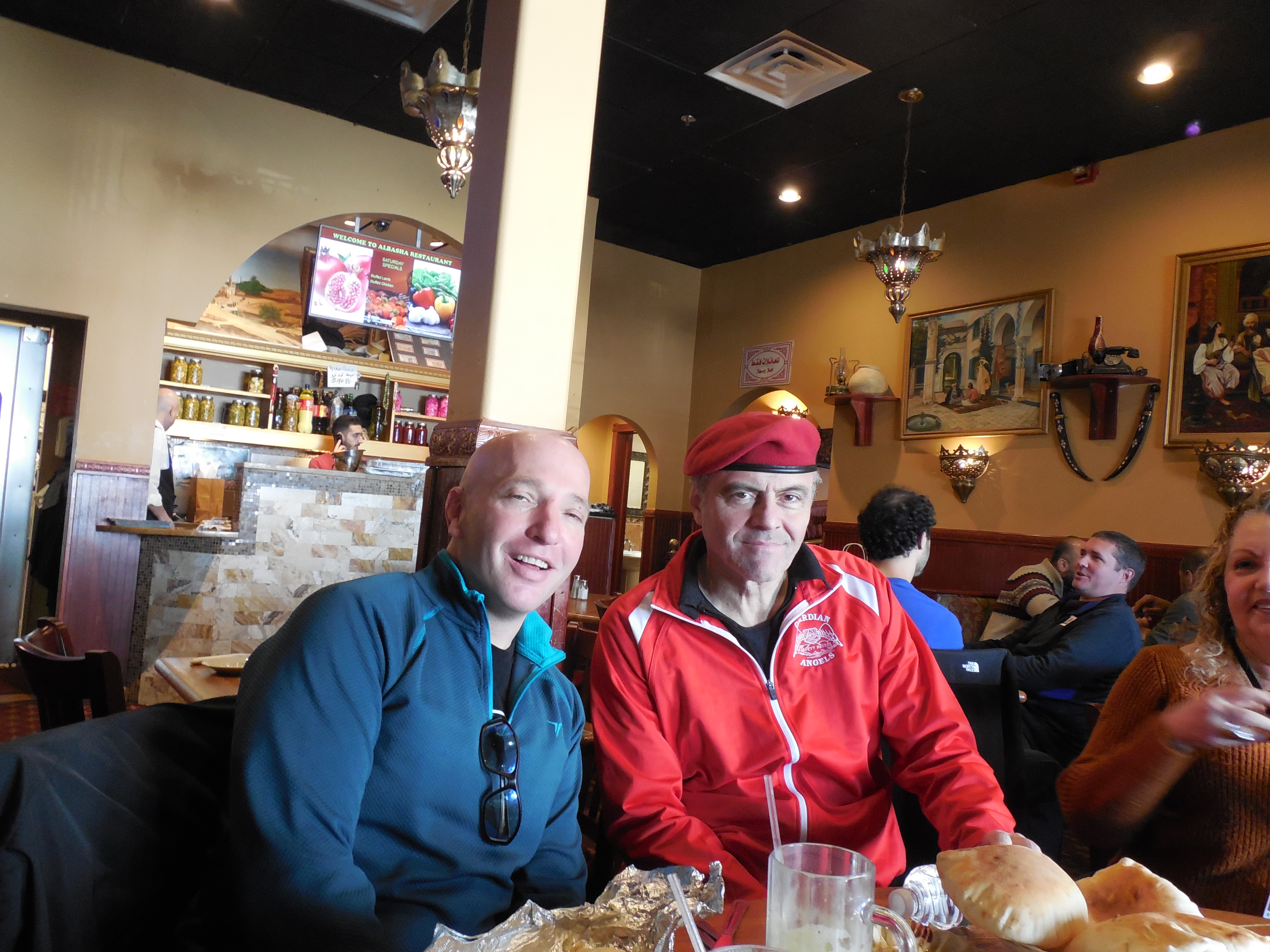
Just got back from the Hummus Summit with Curtis Sliwa this afternoon in Paterson. I’m pressed for time, as usual, so no time to write it up. For now, I’ll just post a few pictures (and silly captions), and write up a post later in the week.

Hey, what a town:

welcome

Oh wait, is there a double entendre here?

mainstreet

Curtis Sliwa and Noam Laden in Al Basha Restaurant.

curtisnoam

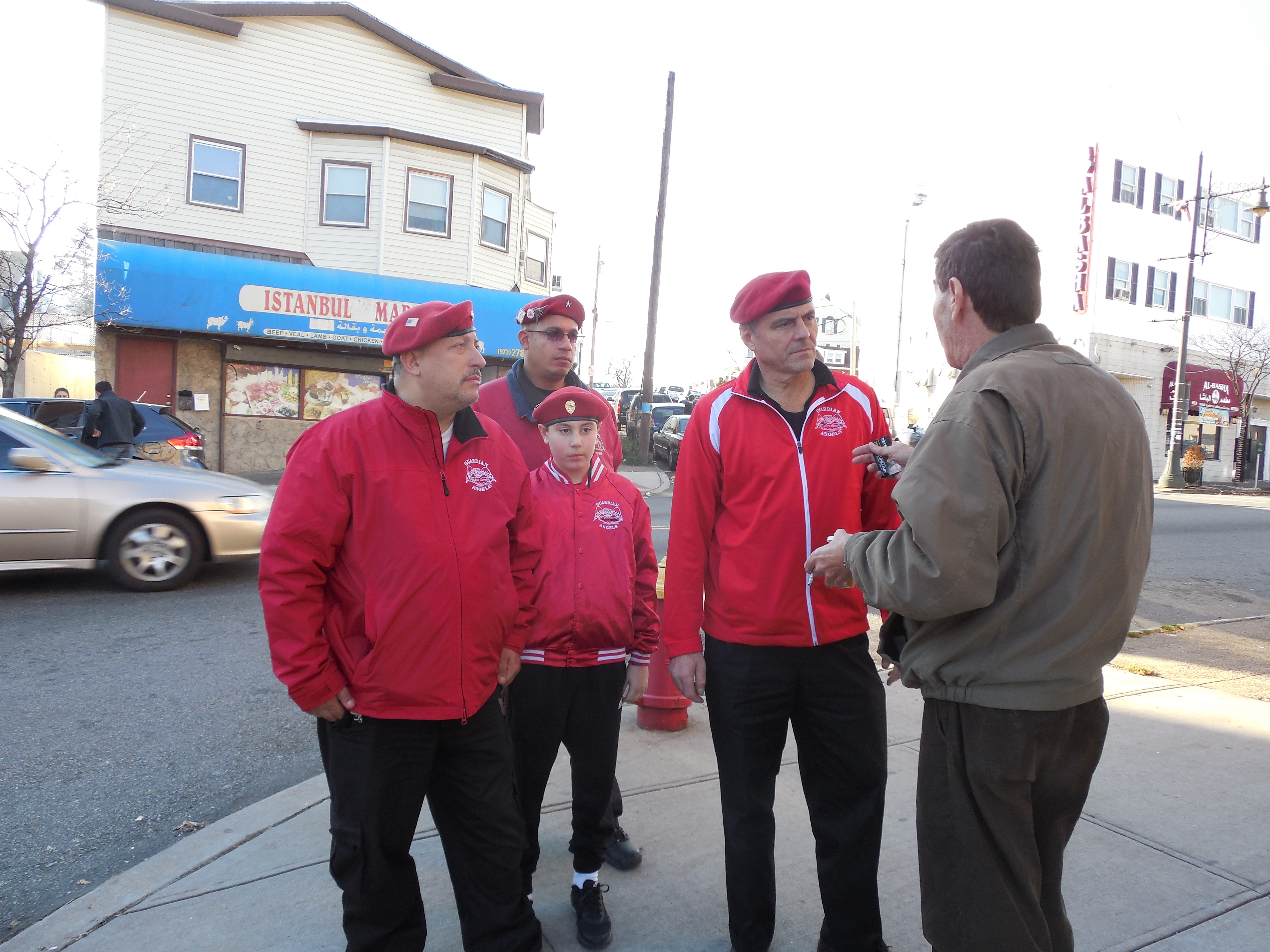
A chance meeting on Main Street outside of the restaurant:

curtis1

More later. And now, back to my day job as…what am I again, an assistant professor of something somewhere?

Postscript, December 7, 2015: Here’s coverage of the event in today’s Bergen Record. For obvious reasons, only bits and pieces of a wide-ranging two hour interview made it into the article.

Postscript, December 11, 2015: Now that I have a minute, I thought I’d comment on the significance of this event, over and above the opportunity to meet a celebrity and eat lunch at his expense (not that that’s trivial).

At one level, it was an opportunity for a show of solidarity: Curtis Sliwa and I make for unlikely collaborators, but the fact is that we agree on the celebration rumors. Contrary to the blanket rejections that we heard from Paterson city officials when we were investigating the celebration rumors, we both found credible evidence of a celebration-like disturbance in Paterson on 9/11. Contrary to Donald Trump’s defenders and Islamophobes across the land, neither of us found more than that, and neither of us have found the further stories that have been bruited about as plausible. (I’ll have more to say about those “further stories” in a separate post.)

I don’t know if Sliwa would agree, but I would add that the evidence we did collect was not itself definitive, either about the occurrence of an event, or about its celebratory nature. I regard it as likely that some such event took place, but I wouldn’t insist that it did, much less spread rumors (a la Fred Siegel) that small-scale celebrations were definitely occurring throughout the area. (I’ll have more to say about Siegel’s comments on MSNBC in a separate post. For now, I’ll simply note that in a week’s time, he hasn’t acknowledged an email I sent him care of the Manhattan Institute, asking for clarification of his references to me on Joe Scarborough’s show.)

At another level, the event was an opportunity to set the record straight. Trump used Sliwa’s name to spread his, Trump’s, lies. Fred Siegel has used my name to spread his, Siegel’s, confabulations. Sliwa said that there was a small disturbance in Paterson on 9/11; Trump used that to claim vindication for his own bullshit. I said that it was likely that there was a small disturbance in front of the public library in Paterson, and said in print that it was likely that a dozen or less were involved; Siegel has used that to claim that there were “demonstrations” (“a couple of dozen people at most”). I don’t know any better way of calling out bullshitters except to keep calling them out for their bullshit. In that respect, the Hummus Summit could well have been named The Anti-Bullshit Summit, except that that name probably wouldn’t have gone well with lunch.

At a third level, the event was a demonstration of the malign power of rumor. Noam Laden, the other invitee to the Summit, described how he had bought the Paterson celebration rumor hook, line, and sinker for fourteen years, inferring that Paterson would be unsafe for Jews (he’s Jewish) given what the rumor implied about the sensibilities of those who live there. Though he lives in Jersey City (an irony of its own), he hadn’t set foot in Paterson since before 9/11 for fear of having to deal with a neighborhood full of terrorist sympathizers. The result was that he stopped eating at one of his favorite restaurants and shunned Paterson until he was convinced by Sliwa to attend the Summit there. I give Laden credit for admitting all that, and for reversing his earlier views.

Incidentally, Laden told us that his brother’s name is Ben, and that in the wake of 9/11, his brother had endured a fair bit of serious, non-joke-intending harrassment for having the name “Ben Laden.” I know I overuse the line, but this story forces me to repeat it: is there any final answer to the question, “How stupid can you get?”

Though we didn’t happen to discuss the point at the Summit, I suspect that Noam Laden’s worries about Paterson were exacerbated by the Paterson Protocols controversy of 2002, in which I also happened to play a cameo role. The story was originally broken by Daniel Pipes, receiving widespread coverage at the time not just in the mainstream press, but in Marc Levin’s 2005-2006 documentary film “Protocols of Zion.” I think the 9/11 celebration rumors are best understood in the light of this later controversy; it’s the later controversy that retrospectively gives the rumors the apparent plausibility that they seem to have. (I have yet to collect all of my Paterson writings and all of my writing on Muslim anti-Semitism in one place, but I probably should.)

A final point: Laden’s story draws attention to a quiet but pervasive phenomenon in north Jersey, namely, the quasi-segregationist attitudes that north Jersey suburbanites have vis-a-vis its cities. In other words, I don’t think Laden’s pre-Summit attitudes are atypical, and don’t think that they’re limited to fears of Arabs or Muslims.*

Sad but true: North Jersey suburbanites treat north Jersey’s cities in the way that non-Arab Israelis treat the West Bank or Gaza. As far as they’re concerned, Jersey’s cities are scary, crime-ridden “no-go zones” where civilized people fear to tread. Mention “Newark,” “Paterson,” or “Jersey City” to the average north Jersey suburbanite, and with remarkable frequency you’ll get the response, “Oh, I don’t go there.” Unsurprisingly, the suburbs are a semi-gated, exclusively zoned echo chamber of genteel racial and class-based stereotypes. (In fairness, I should probably say that a person might legitimately want to avoid driving to Jersey City given the misery involved in getting there: driving into Jersey City during rush hour is not altogether different from driving into Jerusalem from Ramallah via Qalandia Checkpoint.)

These attitudes seem to be an artifact of the 1980s and 90s, when crime rates soared, and city streets were indeed unsafe to walk. But that was decades ago. It doesn’t seem to matter that crime rates have recently fallen to record lows.  The fact remains that our cities are still alien territory. It shouldn’t be a surprise, then, that rumors flourish about them. That’s what rumors are for: they speak the otherwise unspeakable about the irredeemably alien, and north Jersey’s urbanites are apparently as alien to its suburbanites as literal aliens might be to earthlings. The lesson here seems to be that for all of the cosmopolitan pretensions of the New York metro area, we don’t seem to get out much.

One wonders how a country is supposed to hold itself together when its citizens are so alienated by and from the people who live a couple of neighborhoods away that they instinctively shun them on the basis of the wildest rumors about them. A house divided….?

*As a Jersey City resident, Laden is not a suburbanite, so the point I’m making here is not about him. My point is that his story draws attention to the phenomenon I’m describing, not that he himself exemplifies it.

Augustine’s Cogito

The one thing people are sure to know about Descartes—who know anything about him at all—is that he said (approximately), “I think, therefore I am.”

Therefore, it is ironic that Descartes was not the first to say this. Consider the following:

…I am most certain that I am and that I know and delight in this. In respect of these truths, I am not at all afraid of the arguments of the Academicians [i.e., skeptic philosophers], who say, “What if you are deceived?” For if I am deceived, I am. For he who is not, cannot be deceived; and if I am deceived, by this same token, I am. And since I am if I am deceived, how am I deceived in believing that I am? for it is certain that I am if I am deceived. Since, therefore, I, the person deceived, should be, even if I were deceived, certainly I am not deceived in this knowledge that I am.

This passage is from St. Augustine’s City of God (XI.26). The reference to the Academics is significant. Augustine was evidently aware of philosophical skepticism and concerned to answer it at least in some respects—just as was Descartes. Moreover, Augustine contrasts the frailty of sense-perception as a means of knowledge with the certainty of “another and far superior sense, belonging to the inner man” (XI.27)—just as does Descartes. Immediately preceding the passage quoted above, Augustine asserts that our knowledge of our own existence is not subject to illusion just because it is not derived from the bodily senses, which only produce in us images resembling sensible objects, not the objects themselves. Intellectual knowledge, such as the knowledge we may demonstrate of our own existence, is free of “any delusive representation of images or phantasms.”

Clearly, Augustine’s cogito was not merely a transient thought which he failed to fully recognize or develop. According to Roy Sorensen (A Brief History of the Paradox, Oxford U.P., 2003, p. 170), Augustine presents the argument no less than seven times in assorted works. (Some other references I’ve found are The Trinity (10.10.14) and the Enchiridion (7.20).) Of course, Augustine does not employ his cogito as the foundational argument for an elaborate epistemology and system of knowledge. Still, in view of the fame the cogito argument acquired with Descartes, it seems odd that Augustine’s prior claim is so little known.

Did Descartes rip off Augustine? He claims not. However, Sorensen is not convinced, pointing out the ubiquity of the cogito in Augustine’s writings and the popularity of Augustine with Descartes’s Jesuit teachers at La Flèche.

In any event, Descartes employed his cogito in one important way that Augustine did not. Specifically, he thought it demonstrated the prior certainty of consciousness, by which I mean loosely that the mind is better known than the body. For example, a visual experience as of an object—a cup, say—in front of me may or may not really be of a cup, but it is unquestionably an experience. Descartes realized that only “thought,” by which he meant to include any conscious event, could support his argument. It wouldn’t do, for instance, to say, “I walk, therefore I am,” even though walking supports the logic of the argument, as presented by Augustine above, just as well as being deceived. Try substituting “walk” for “be deceived” in the passage above. Except where being deceived refers specifically to being deceived about one’s own existence, as opposed to being deceived in general, the logic of Augustine’s argument remains undisturbed. Thus, the fact that the event in question is being deceived appears to be almost incidental in Augustine’s cogito. But it isn’t; only an event involving conscious “thought” will support the argument. And this implies that the reality of thought is more securely knowable than the reality of the objects of thought. This is a point that Augustine may have missed, even though, with his talk of images and phantasms, he had the conceptual tools that would have enabled him to do so.

The prior certainty of consciousness, after going more or less unchallenged for nearly 300 years after Descartes, finally came to be controversial and to be rejected by many philosophers. But I am inclined to think it is true and that the cogito provides a pretty good argument for it. (Of course, the further uses Descartes made of the prior certainty of consciousness, for instance as support for mind–body dualism, are another matter entirely.) In this respect, Descartes saw more deeply into the cogito, even if he did not invent it.

Hummus Summit in Paterson (1)

I’m writing this between performances of Felician Live, but just a little note to say that I’ve accepted Curtis Sliwa’s invitation to appear at his Hummus Summit at noon tomorrow at Al Basha Restaurant in notorious Paterson, New Jersey. I’m honored to be invited, it’s in a good cause, and I’m not one to decline a meal (or even a bit of hummus) at Al Basha. Looking forward to it and will definitely blog it when my schedule returns to sanity. More later.

Postscript, December 6, 2015:  Here’s an item at a blog called “Western Journalism,” mentioned on Donald Trump’s Twitter feed. It’s called “Watch: ‘Chilling’ Video Just Surfaced That Could PROVE Trump Was Right About 9/11 Celebrations.” Yeah, I watched it all right. What’s “chilling” is the caliber of this commentary on it:

Fox News host Eric Bolling emerged Tuesday as one of the few media voices to support Trump.

“I remember specifically the news reports about Jersey City,” Bolling said. “They said people were on the roofs watching the planes fly in. They were tipped off prior to the thing, and this was a narrative that was going on. I remember video. I don’t remember if it was Pakistan or Paterson.”

Pakistan, Paterson: what’s the difference? And what difference does it make that neither place is Jersey City? (Or that he’s probably confusing Pakistan with Palestine, and Palestine with East Jerusalem?) Contrary to the blog’s suggestions, what the item really proves is that there is no final answer to the question, “How stupid can you get?”

As for the “proof” itself, it’s worse than a joke. I’ve been away from things for a bit, but when I get the chance (hopefully mid-week) I’ll try to comment on the Pablo Guzman video mentioned here as well as the Giuliani-Kerik testimony and other interesting odds and ends on the celebration rumors that I’ve recently seen (or will end up seeing between now and then).

Episodes in Absurdity

I made The New York Times today. Kind of ironic. I subscribe to the Times, but my delivery guy failed to deliver my paper today.  I guess I link to the Times often enough here, so it’s about time they linked to me.

Kind friends tell me that I was mentioned on Fox News last night and MSNBC this morning.* The irony here is that I hate television and haven’t owned one in years, so I didn’t see either segment.

I just met the new Dean of our Business School. A colleague introduced us, and he said, “Oh, so you’re that guy.” I guess I am.

The funny thing is that I’ve been spending most of my time this week rehearsing for this. Just when you thought life couldn’t get any more absurd. For some reason the advertising for the event doesn’t seem to mention that humor is supposed to be involved, but then again, false advertising is illegal.

I have no intention of doing any TV interviews, but my brother has already started giving me advice on how to do them:

For Mom’s sake, wear something nice.

Postscript, 4 pm: Here’s the segment from O’Reilly’s show on Fox. I regard it as essentially solid. Here’s the segment from Scarborough’s show on MSNBC with Fred Siegel. I don’t regard it as solid, but I’m going to reserve comment on the specifics until I have the time to contact Professor Siegel and ask him for some clarifications. (*I’ve revised the original post to reflect the fact that I’d originally said that both segments were on Fox, but one was on MSNBC.)

I have to take a break from Trump and celebration rumors for a few days to get some work done. It’s the end of the semester, and I can’t afford to keep up this pace of blogging right now. So feel free to comment, but don’t expect much in the way of posting or commenting from me until at least next week. 

Curtis Sliwa vs. Donald Trump

As I’ve said elsewhere, I had a long conversation with Curtis Sliwa in the course of my research on the Paterson celebration rumors. He had gone to Paterson to do street-level interviews before I had done so. He told me what he’d heard, and urged me at the time to follow suit and talk to people on the street. I followed his advice, and ended up essentially re-confirming what he had told me: there was credible testimonial evidence of a disturbance involving 6-12 kids in front of the public library on South Main Street in the mid-morning of 9/11.

This testimony wasn’t air tight. It wasn’t clear that it was true, and it wasn’t clear exactly what it said. It simply indicated that something disturbance-like had taken place on the morning of 9/11 in that area, that it had involved kids, that it had dispersed quickly, and that the event in question had been interpreted as celebratory. Like me, Sliwa dismissed the idea that a large celebration had taken place, but he got flak from the Paterson authorities for claiming that anything at all had happened. The official story emanating from Paterson’s city officials was that nothing of any kind had happened anywhere in Paterson. I spoke with a few city officials, and am skeptical of that categorical rejection. In other words, I basically agree with Sliwa. There may be shades of difference between Sliwa’s view and mine, but on every important issue, I think we agree.

I found it unfortunate that Sliwa wasn’t taken sufficiently seriously at the time. Given his past history of controversy, he wasn’t regarded as a fully credible journalist. I was aware of the past history, but the fact remains that I found him credible, candid, and sincere. We interviewed different people at different times, but the stories they told converged.

He describes me on his Twitter feed as one of his defenders. I’m proud to say that I am, and I’d like to think he’s one of mine. He knows what this fight is about. He was there in the trenches when it mattered, along with the handful of us who chased leads until we were ready to drop, and obsessed about this story when everyone else thought we were crazy. That’s more than can be said of a lot of Johnny-come-lately BS artists who have decided to posture as experts after the fact.

Unsurprisingly, Sliwa is fighting Donald Trump in the same fight for truth and evidence that I regard myself as fighting. Check out his Twitter feed, and you’ll see yet another instance of Trump’s dishonesty at work. I’m completely in Sliwa’s corner on this. It’s not a case of “may the best man win.” As far as I’m concerned, the fight is over, and the winner has already been crowned.

Postscript: Crucial reading on this from MTV News. Sliwa and the reporter, Julianne Ross, are dead-on. It’s Trump who owes Sliwa an apology, not the other way around. Frankly, Trump owes the American people an apology. I would suggest making amends by dropping out of the presidential race and shutting his mouth for awhile.

From RINO to DINO: A Travelogue

Here’s a featured letter in today’s New York Times. It describes a view similar to one I held for a long time, but it also presents a major puzzle that any moderate Republican has to resolve.

To the Editor:

Year in and year out, Republicans fail to find the words to convince the public that there is a beating heart at the core of their beliefs. Stereotypes are often inaccurate but they are easy to sell, and Democrats have no trouble flogging their favorite — the callous, unthinking Republican, extremist in view and out for himself.

The facts reveal a softer party profile. According to a Gallup Poll in June, 42 percent of Republicans and Republican-leaning independents consider themselves to be conservative on both social and economic issues, the lowest level since 2005. Another 44 percent are some version of moderate, either on both social and economic issues or just social issues.

And so, quiet moderates are half our number — not the impression we get from the media. Disparaged as RINOS (Republicans in Name Only) by fellow party members further to the right, many now are happy to take on the name. Pro-choice, pro-gun-control and accepting of same-sex marriage, they consider the culture wars peripheral. Their G.O.P.’s first priority is championing private enterprise, the engine that drives the nation, pays its bills, rewards ingenuity and creates jobs.

They have a thoughtful regard for the environment but also care about a form of inequality that Democrats prefer to ignore — that the cost of swapping fossil fuels for renewable energy falls disproportionately on the shoulders of the poor because it slows growth. And so their natural wariness of the accuracy of climate models is prudence, not ignorance.

They know that an infusion of new talent and energy from outside our borders has always been the country’s greatest strength and watch with dismay Donald Trump’s ugly posturing in favor of deporting 11 million immigrants. Most support a sensible plan for amnesty.

They do not feed on anger and resentment. They believe that it is our obligation to look after those in need.

They want to create, not diminish; transform, not long for a mythical past. They are collaborators, not obstructionists.

Greenwich, Conn.

The writer is a longtime registered Republican.

One problem here is that the author is presenting herself as a social liberal and economic conservative while citing figures that say that 42% of Republican-like people are social and economic conservatives. Given the mismatch, the 42% figure doesn’t seem all that meaningful. As for “44% are some kind of moderate,” part of the problem is the vagueness of “moderate,” and part of the problem is that that 44% only seems moderately exercised about the calamity that seems to have befallen the party. They are, to paraphrase Barry Goldwater, moderates about everything, including the defense of truth and the pursuit of justice. That’s why they’re “quiet.” In other words, politically speaking, they’re complacent, apathetic, and ultimately useless.

The boilerplate about “private enterprise” is weak tea. Fringe players aside, we’re all committed to “private enterprise” nowadays. The devil is in the details.

As for the natural wariness of the accuracy of climate models, it would be more impressive if the Republican Party had a genuine commitment to science in the first place. But the Republicans’ “natural wariness of climate models” looks more like a natural wariness of science itself than of climate models in particular.

So here is the puzzle. Suppose that you’re a social liberal broadly in favor of private enterprise. You face serious obstacles within the Republican Party. So why not become a Democrat? The only obstacle would seem to be the widespread belief that the Democrats reject free enterprise. They don’t, really, but even if they did, why is their rejection of free enterprise a bigger obstacle to joining them than the Republicans’ rejection of reality?

Fernando Teson on the Palestinian State

Fernando Teson’s opening gambit on a discussion of the two-state solution to the Israel-Palestine dispute:

Almost everyone has by now accepted the two-state solution for the Israeli-Palestinian dispute.

I wasn’t aware of that. Evidence, please?

While we wait for Teson’s response, feel free to read the Wikipedia entry on the One-state Solution at your leisure. It doesn’t seem to cohere with his claim.

If the wait is long enough, you can also read through Reason Papers’s 2012 symposium on Sari Nusseibeh’s version of the one state solution from his book, What Is a Palestinian State Worth? (Note: The RP link goes to a long PDF that requires lots of scrolling down. You can also access the symposium this way, if you find it more convenient.)

As PoT readers know, I spent two months in Palestine this summer teaching at Al Quds University. My experience doesn’t cohere with Teson’s off-the-cuff claim any more than the Wikipedia entry does. And don’t make me haul out back issues of the Journal of Palestine Studies, please. Because you know what will happen if I do?

Postscript, 10 pm: I wonder whether Professor Teson could explain in mathematical terms how majorities of 63% of Israelis and 53% of Palestinians amount to “almost everyone.” Do 37% of Israelis and 47% of Palestinians = no one? Feel free, Professor, to use scratch paper and show your work.

If Israelis and Palestinians don’t count, what about retired American diplomats in far-out radical publications like U.S. News and World Report? I mean, the one-state solution is so marginal an idea that it’s being discussed at conferences at obscure places like Harvard.

Oh, not pro-Israel enough for you, huh? Well, then, how about the current Israeli administration? Or Caroline Glick?

Oh wait, too far to the right for you, huh? Well, then, let’s make a left turn. Wrong part of the left? You could always talk to the nice folks at Dissent. They were “rethinking” things five years ago.

While we’re turning left, why not talk to some Arabs along the way? Like this one.

You want a cross-section of ethnicities? Try this. Not that I want to overdo things….