Just a quick update on the progress of the mini-campaign here in New Jersey for municipal resolutions in favor of the Immigrant Trust Act. About a dozen or so resolutions passed between December 2024 and March 2025. After about two months of Council appearances, Resistencia en Acción and allies won a resolution here in Princeton on August 11th. My impression is that the Princeton win has generated the press coverage that’s breathed new life into the campaign.
Prior to the Princeton win, press coverage of the ITA issue was sporadic, an article here and there. Most of the coverage of the immigration issue itself was negative, depressingly focused on ICE raids and their after-effects, or else on Delaney Hall detention center and the arrests taking place there. It wasn’t until the Princeton win that press coverage took a different turn. July and August produced a cluster of articles across multiple formats (print, online, radio, TV) focused on Princeton —in fact, focused specifically on Resistencia and its unique brand of politics–which re-directed attention to what could be done to resist ICE. The lead up to the August 11 Princeton Council meeting, plus the reaction to the win, constituted two distinct rounds of press coverage. Resistencia’s active, defiant, even dramatic response to the failed ICE raid in Trenton was a third. Those three rounds of press coverage turned the tide.
To my surprise, a pro-ITA resolution passed in Edison (a town I had trashed here at PoT), just a few weeks after the win in Princeton, largely through the efforts of Movimiento Cosecha, New Labor NJ, and Semilla Roja NJ. A pro-ITA resolution is now on the agenda at Newark City Council, and from what I’ve heard or read, efforts of various kinds are under way in Bound Brook, Scotch Plains, Highland Park, New Brunswick, and Montgomery. In addition, Wind of the Spirit has lobbied more directly for the ITA (as opposed to a municipal resolution) at the offices of State Senate President Nicholas Scutari in Clark. That’s only as far as I personally happen to know, focused largely on Central Jersey. I’m sure further efforts are underway elsewhere in the state of which I’m unaware.
I’ve argued the case for an ITA resolution in Montgomery, and will be speaking there again tonight. There’s been some vague talk of a resolution in West Windsor as well. Fortunately, it’s election season in West Windsor; both the mayor’s office and a few council seats are up for grabs this November. I’ve submitted a resolution-related question to West Windsor Forward, the organization behind the forthcoming electoral debate on Sept. 25, in the hopes that they’ll ask it of the candidates. And I’ll be following up with an in-person appearance at West Windsor Township Council on September 29th. Bound Brook, Scotch Plains, Highland Park, and New Brunswick are also on my agenda.
As far as Mercer County is concerned, we already have resolutions in Trenton and Princeton; if we can get Montgomery and West Windsor, I’d like to think that we can get Hightstown, Hopewell, Lawrence, Ewing, and East Windsor as well. I’m less optimistic about Hamilton, Robbinsville, or Pennington, but it’s worth a try. I would eventually like to take this campaign to Essex County, where I grew up, and see what can be made of it in Montclair and the Oranges.
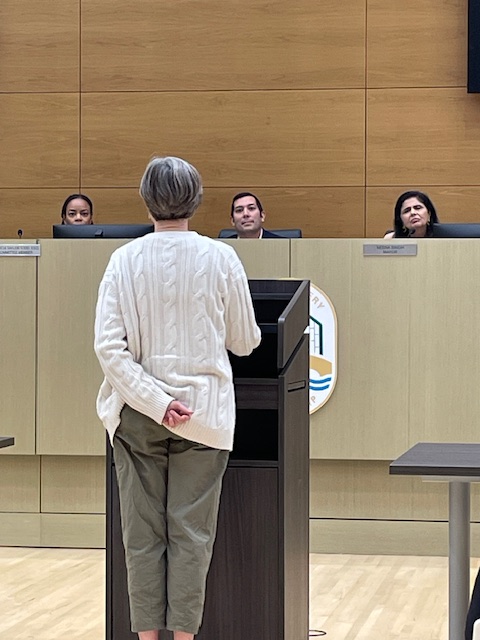
Montgomery Town Council, Sept. 2025
Thomas Paine famously complained about New Jersey in The American Crisis. “I must confess, that I do not see upon what grounds, either of policy or honesty, they can justify their conduct; for their conduct has been INFAMOUS.” Paine coined the phrase “summer soldier and sunshine patriot” to describe the people of “the Jerseys,” East and West in those days, rather than North, South, or Central. He had a point. New Jersey was like that for awhile–an immobile, apathetic mass–but things changed. As usual, Jerseyans sat around doing nothing until they figured out which way the wind was blowing, and then joined the winning side. It could work again.
It’s ironic that the places we’re fighting over now–Trenton, Princeton, Morristown, Bound Brook–are the very places contested in the American Revolution. The issues themselves are the same: “He has endeavoured to prevent the population of these States; for that purpose obstructing the Laws for Naturalization of Foreigners; refusing to pass others to encourage their migrations hither…” That’s just one of the many complaints from the Declaration’s bill of particulars that so perfectly fits the present. It’s only a matter of time (I like to think) before people look up from their pizza, their pork rolls and/or Taylor ham, their flat screen TVs and their laptops, and figure it out.
You’d think that our rulers were trying to start a war with us, and counting on our fabled somnolence to get away with it. It strikes me as a bad bet. New Jerseyans sleep a lot, but they’re not exactly easy to deal with once awake. Think of the Newark Rebellion of 1967. Think of the labor riots of the early twentieth century, or the ones of the mid nineteenth. Think of the battles of Trenton, Princeton, Monmouth, Springfield, and Bound Brook. Think of the graves of the war dead in the cemeteries at Princeton, Bloomfield, Elizabeth, Hackensack, Musconetcong, Manalapan, and Shrewsbury. The story these events tell is not a cheerful one, but of people pushed to their limits, taking to the streets to kill each other and above all, their rulers. I often used to wonder what it would take to get me angry enough to want to follow suit. I didn’t think there was such a thing, but I now suspect there is.
We’re a long way from that, I guess, but headed unmistakably in that direction. Unfortunately, you see the urgency on the faces of the activists, less so on the poker faces of the politicians they address. The politicians still have time to get it, and the activists still have time to explain, but time, as always, is running out. Once it runs out, so will the need for explanation. Either events will make things clear, or they’ll make explanation pointless. In place of explanation, we’ll get recrimination, and with recrimination, regret. At that point we’ll learn that what’s past is prologue, but also proof of concept. What happened once can always happen again.
 Policy of Truth