Most years, on 9/11, I’ve brought this post back up to the top and re-posted it. I want to do something different this time. I want to give a brief (or semi-brief) answer to one of the most pressing questions that arises on 9/11: why do Americans not learn from history? Or to narrow it a bit: why do Americans learn nothing from the military history of their own country?
It’s tempting to think that what they lack is acquaintance with “the facts.” There’s some truth to this, but I don’t think it’s the right way of putting the answer. What Americans lack is not something that can be remedied by piling up and presenting more facts for their consumption. What they lack is any framework within which to fit the facts, and within which the facts will stick in long-term memory. They lack any sense of the questions to which facts are an answer. Put somewhat differently, the problem they face is more philosophical than simply historical.
There are two ways of coming at the topic of warfare. You can either regard warfare as an activity that’s subject to the principles of justice, or not. Those who take the first position are known as exponents of the just war tradition; those who take the second have the unfortunate, confusing name of “realists.” Since I don’t think realists can learn any lessons from history that are worth learning, let me put them aside. I realize that “the just war position” typically names a narrower and more elaborate view than the bare idea that warfare is governed by the principles of justice, but let me set that complication aside, as well.
Suppose we focus on the bare-bones just war position: that warfare is governed by the principles of justice. If so, there are three basic questions worth asking of any war or prospective war or war-like activity:
- Who is the aggressor in the conflict at hand? Who initiated the violence that demands or deserves a war-like response? (ad bellum)
- What are the rules governing the conduct of the war? (in bello)
- What is the war realistically supposed to achieve? (post bellum)
Question (1) expresses what theorists call ad bellum considerations. Question (2) expresses in bello considerations. And question (3) expresses post bellum ones.
There’s a further question whether each question can be answered independently of the others, or whether the answers are in some sense intertwined. This is commonly expressed by asking, for instance, whether in bello rules are determined by ad bellum considerations. Put more colloquially: does the aggressor, by virtue of being the aggressor, forfeit some of its right to fight? Does the defender, by virtue of being the defender, deserve an advantage on the battlefield that the aggressor lacks? If so, the answer to (2) depends on the answer to (1)–the dependence thesis. Alternatively, we could imagine that both parties fight by exactly the same rules regardless of who is the aggressor. In this case, the answer to (1) and (2) have separate and severable answers–the independence thesis.

9/11 Memorial, Eagle Rock Reservation, West Orange, New Jersey (photo: Irfan Khawaja)
Though this is less often discussed, analogous considerations apply to the intended aims of the war. The party with the more justifiable post-war aims might have more of a right to fight; the party with the less justifiable ones might have fewer or none. So you could have a dependence and independence thesis for post bellum considerations as well as ad bellum ones, along with a further complex issue over how post bellum considerations relate to ad bellum ones. Could an aggressor with a more defensible post bellum view have more rights than a defender with a less defensible one? Etc.
Obviously, there are many more permutations here (many more than I can articulate right now), but the basic thought is clear enough. To evaluate a war, we need to identify the aggressor, identify the rules by which the war is to be conducted, and identify the aims for the sake of which the war is to be fought. Without this framework in place, the facts have, so to speak, no place to go. If you abstract entirely from ad bellum, in bello, and post bellum considerations–or happen to be totally unclear or confused about the distinctions involved or have no idea as to their importance–you won’t understand any war or anything in war, no matter how many facts you happen to know.
This applies to combatants as well as spectators. You could fight for years in the trenches of a war, but if you had no idea who the aggressor was, no idea of the distinction between permissible and impermissible war-time conduct, and no idea of the ultimate aim of the war, your experiences would ultimately be a story of your personal disillusionments and confusions, not a coherent account of the war itself.
Now reflect on what you’ve learned from journalistic accounts of the wars of, say, the last fifty or sixty years. How clear or explicit are these accounts about the three issues under discussion here?
Take ad bellum considerations. Line up any of the wars of the last fifty or sixty years and ask yourself: who was the aggressor? To do this, you not only need to know the relevant history, but you need a non-arbitrary starting point for your historical inquiry. Did the “War in Gaza” really start on October 7, 2023? Did the “War on Terror” really begin on September 11, 2001? Did “the” Iraq War begin in March 2003? When War X precedes War Y, does Y begin with the beginning of X, or does it have its own beginning? Etc.
To answer these questions, you not only need a defensible conception of first-uses of force, but of those uses that are relevant to going to war. Shoplifting is a first-use of force, but you can’t legitimately go to war over a stolen slice of pizza (or, as in the Trojan War, over who gets to sleep with Helen). Getting this issue right–how we identify the Archimedean starting point of a war, and attribute the first move to the guilty party–is a lot harder than it seems. My aim here is not to get it right, but to point out that journalistic treatments almost never do, because they almost never make the attempt. Journalists have two defective methods: either they wait a few decades and plagiarize the historians, or they seize on what they regard as the most dramatic recent event, then presumptively treat it as the originary event. Neither method identifies the aggressor. Plagiarism passes the buck; dramatics bypass the issue.
Now take in bello considerations. Obviously, if in bello considerations depend on ad bellum ones, then if you don’t have an adequate account of the ad bellum ones, you’ll never have an adequate account of the in bello ones, either.
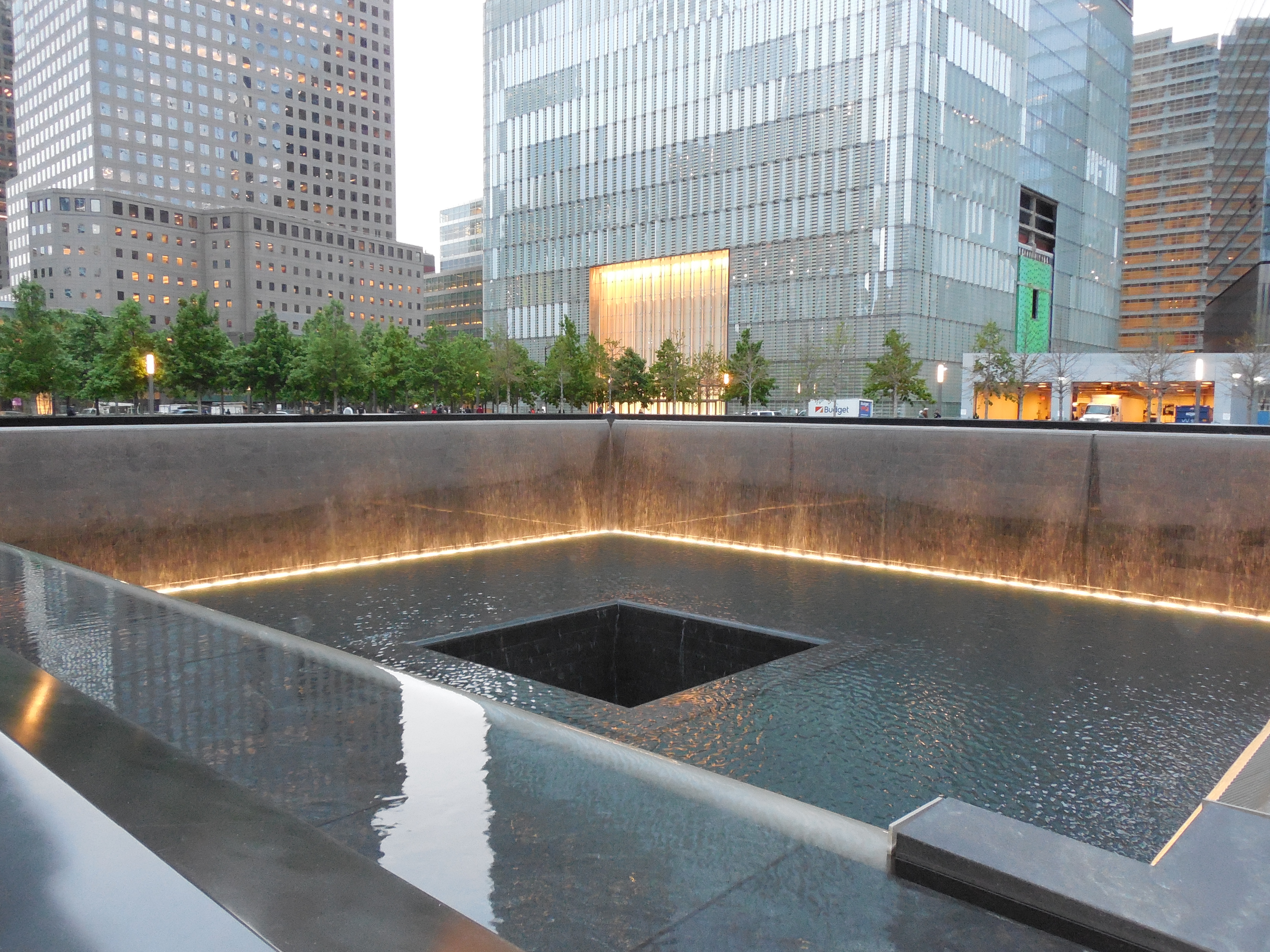
Reflecting Pool, 9/11 Memorial, New York, New York (photo: Irfan Khawaja)
But set that aside. Suppose you just focus on the in bello considerations on their own. One of them concerns non-combatant immunity: non-combatants are considered innocent, hence not legitimate targets in warfare. But how is “non-combatant” defined? An army consists largely of personnel who do no actual battlefield fighting. Are they all targets or all immune? If they’re all targets, then so are the civilians who are their functional equivalents in the economy. Most modern economies are highly integrated. So that spreads the targets pretty wide. On the other hand, if military supply lines are immunized from fighting because they’re not literally fighting on the battlefield, we’re led to a somewhat absurd and unrealistic conception of warfare that starts to look more like a game than a fight. But that’s not what war is.
We’ve now reached the point at which the U.S. Army has a Civilian branch, which it proudly advertises under the rubric of Army Civilian Careers. The Open AI summary:
An Army Civilian is a non-military U.S. citizen or lawful permanent resident employed by the U.S. Army to perform critical functions in areas like engineering, healthcare, cybersecurity, and administration, filling over 500 different career paths. These civilian employees provide essential skills and stability to the military, supporting the Army’s mission and national security while enjoying benefits like competitive pay, professional development, and job satisfaction
These are the people who regularly accuse Hamas of “hiding among civilians.” I can’t unravel all of the complexities involved in one post–or two, or even ten. The military’s depth of ingression into our society is a mind-blowing thing. For now, I just want to point out that it’s very, very unlikely that any of the journalism you consume unravels even the tiniest fraction of this story, or tries.
So when people talk about the evil or the necessity of killing “civilians,” ask yourself exactly what that’s supposed to mean. Hitler was a civilian. So were Eichmann and Mengele. So was Stalin. So is Trump. So is the King of Saudi Arabia, as well as the Prime Minister of Israel, and the Supreme Leader of Iran. So is Hamas, so are the Israeli settlers, and so was the KKK. Meanwhile, four civilian tech leaders have been sworn in as senior officers in the U.S. Army. It’s unclear whether any of them could personally bust a grape in a fruit fight, but put them in front of a computer and they’re militarily lethal.
More ambiguities: The President of my former university was a (corrupt) naval admiral, and is now the president of Texas Southern University. Is he military, civilian, or just a hybrid opportunist? All armies have reservists, and a reservist is part civilian and part military. Does that make them legitimate targets? You could say that a reservist not on duty is no different from a civilian, hence immune–but a soldier not fighting is no different either, and generally not immune. It seems pretty arbitrary.
Many of the military students I taught (and I taught a large number) saw themselves as career-minded civilians who happened to be practicing civilian trades in the army–tech, supply chain, engineering, etc. Many of them regarded it as practically coincidental that they happened to be employed at military facilities, including Joint Military Bases like the one at Fort Dix in South Jersey. Such students saw themselves as civilians of a sort, but their work was clearly military in nature. Legitimate targets? Or naïve, therefore innocent civilians?
I myself contemplated working as a janitor for VA facilities in New Jersey and at McMurdo Station in Antarctica, where military personnel support scientific research under the Antarctic Treaty. I didn’t get either job, but they paid well, and as far as Antarctica was concerned, I was ready to go. I’ve volunteered both time and money to Walter Reed Army National Military Medical Center, all to injured veterans of U.S. wars–wars which I now oppose. But for better or worse, that was my contribution to the war effort back then. A civilian enterprise or a military one? American universities often house ROTC units, and in some cases receive millions of dollars in grants, funding, and contracts from the Defense Department, aka the Department of War. Is it then fair to call such universities military-civilian institutions? I could go on and on, and many have. The point is, less of this is clear than the average journalist would have you believe, in which case they’re clarifying less than needs clarification.

Wounded Knee Monument, Pine Ridge Indian Reservation, South Dakota (photo: Irfan Khawaja)
Finally, post bellum considerations. Military officials and politician-strategists often speak glibly about “victory,” but it’s perennially unclear even in theory what they’re talking about. Victory at what price? Victory for what end? Victory with what probability of success? All of these things are as crucial as they are unclear, and as unclear as they are easy to lie about. Meanwhile, journalists often invoke the idea of an “end game” to a war, as though the phrase itself provided the light at the end of the tunnel. But the snappy, business-like idea of an “end game” is at least as unclear as the victory-propaganda exploited by strategists and politicians. The issue is not simply how the war will end, but what’s to follow once it does end. “Victory” treats war as though once achieved, you’re done, and the war can just be turned off and put into storage. Calling it an “end game” is like confusing the ninth inning of a baseball game with the route you intend to take to get home. Your team could strike out the other side in nine pitches, but though that wins the game, it leaves you in the stadium. It doesn’t get you home.
Take any war of the last fifty years. Find the chronological midpoint of the war. Now read around and reflect on the quality of peoples’ thinking about what they thought would happen a decade or two or three from that point. A generalization: it’s pathetic. Even the best predictions are wrong. Not even the most knowledgeable person has any clue.
If so, can anyone really know what a given war is about? If the reasons for going in will change a year after you’ve begun, and become inscrutable phantoms a week after that, what exactly are you doing when you go? Most adults plan their lives with some sense of where they’ll be a decade from now. If prediction is literally impossible, is it really possible to know what you’re doing even at the outset? If not, is there really a point to doing it? These are obvious questions. But they’re precisely the questions that few want to bring up in the middle of a war for fear of casting doubt on the entire enterprise, and raising unwanted questions about sunk costs. Macbeth puts the point well (Macbeth, Act 3, Scene 4):
I am in blood
Stepped in so far that, should I wade no more,
Returning were as tedious as go o’er.
In other words, as with sex so in war: once you’re in, it’s hard to leave. But hard as it is, there are times when you’ve got to consider the consequences, and act accordingly.
If knowledge of the end is part of knowledge of the process, and we lack knowledge of the former, we lack knowledge of the latter. Applied to war, that seems to suggest that we generally have no idea what’s going on at any time in any war. And that, perhaps, explains why we learn so little. We learn so little from the wars we fight because we had no idea what was going on while they were happening, a problem that isn’t remedied when we accidentally reach the end, and in relief, decide that it’s now time to put the whole matter behind us.
I rarely credit my father with anything, but there’s one point on which I have to acknowledge the vast superiority of his wisdom to mine. Unlike me, my father has always, consistently, been against war–every war of the last sixty years, no matter who fought it, how, or to what end.

Christ Hospital, Jersey City, New Jersey. Photo credit: David Zembrana. The second plane in the New York part of the 9/11 attack flew directly over this building.
He got his start as an urban trauma surgeon in Newark and Jersey City, treating his fair share of stabbings and gunshot wounds for the first several years of his career. I assume that that experience, which began in his early 20s, played a formative role. He later watched 9/11 happen in real time–watched the second plane fly directly over his head and into the second World Trade Center tower. He then operated on injured members of the FDNY, and then put up with years of random, hostile questions from colleagues about whose side he was really on. For a man as wedded to conventional respectability as he was, it stung. He rarely spoke about it, and was notably inarticulate when he tried. The one and only coherent thought he expressed was that it–9/11–should never have happened, and neither should the wars that followed it. “So many innocents have died,” he would intone, leaving the sentence hanging in space, as though there was no more to be said.
I was much slower to learn his wisdom: credulity got the better of me for far too long. My father’s anti-war dogmatism had always struck me as unsubtle and simpleminded, but I eventually learned what it had to teach. It was in fact more sophisticated and grounded than any of the sophistries that had convinced me of the “necessity” of war. I learned my lesson for good when I realized, well into my 40s, that the partisans of war lacked answers to the most obvious questions that needed answering. Worse than that, they worked harder to obscure the questions than to answer them. You could be forgiven for wondering whether they really wanted the questions answered. So it was no wonder that they never succeeded. The only advice I can give is never to trust anyone who doesn’t want those questions answered, and to make yourself the kind of person who does. Structured curiosity may not be a recipe for world peace, but it certainly beats the alternatives. And considering the alternatives, that should make it an easy choice.
 Policy of Truth
Pingback: When Self-Defense Is “Terror” | Policy of Truth