This ridiculous letter to the Wall Street Journal is making the rounds in certain quarters as though it enunciated some profound “gotcha”-level truth.
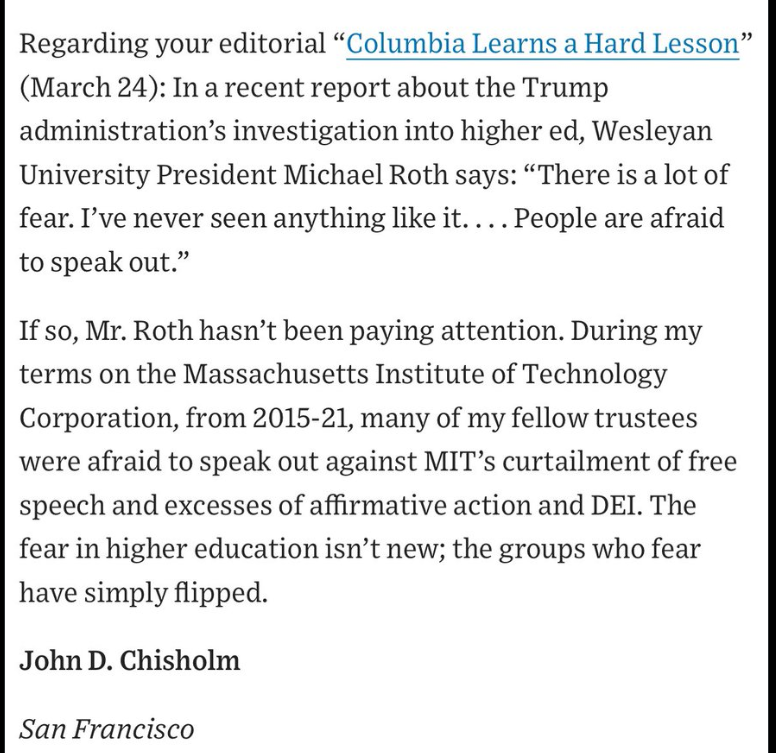
John Chisholm is a man with an estimated net worth of $20.3 million. He was, for six years, a Trustee at MIT. The Trustees of a University are its de facto owners, with veto power over every function of the university, from hiring, firing and promotion, to curricular selection, to budgeting, to investments, to PR, to logistics. They are, in other words, the most powerful persons on any university campus, the people to whom the entire university, including its highest executive officers, answers. Even if by some act of God, Chisholm had been ejected from his position, nothing of consequence would have happened to him. So what was he afraid of? His shadow?
A reality check: there’s a difference between cowardice and fear. Real fear is an apprehension of real danger. Cowardice is the propensity to feel fear when there’s nothing to be afraid of. There’s a difference.
John Chisholm faced no real danger at MIT. The fear he claims to have felt was actually an expression of cowardice; the dangers he imagines were figments of his overactive imagination. Meanwhile, the people to whom he compares himself face defamation, arrest, assault, prolonged imprisonment, abuse while in prison, deportation, bankruptcy, and the destruction of their careers. Apparently, in the moral netherworld Chisholm inhabits, the one thing can be equated with the other. The powerful are in the same boat as the powerless. Consequences are the same as their absence. Mean tweets are the same as being kidnapped off the street by masked, armed men.
In short, cowardice is the new courage. Which only makes sense in a world where falsehood is the new truth.
 Policy of Truth