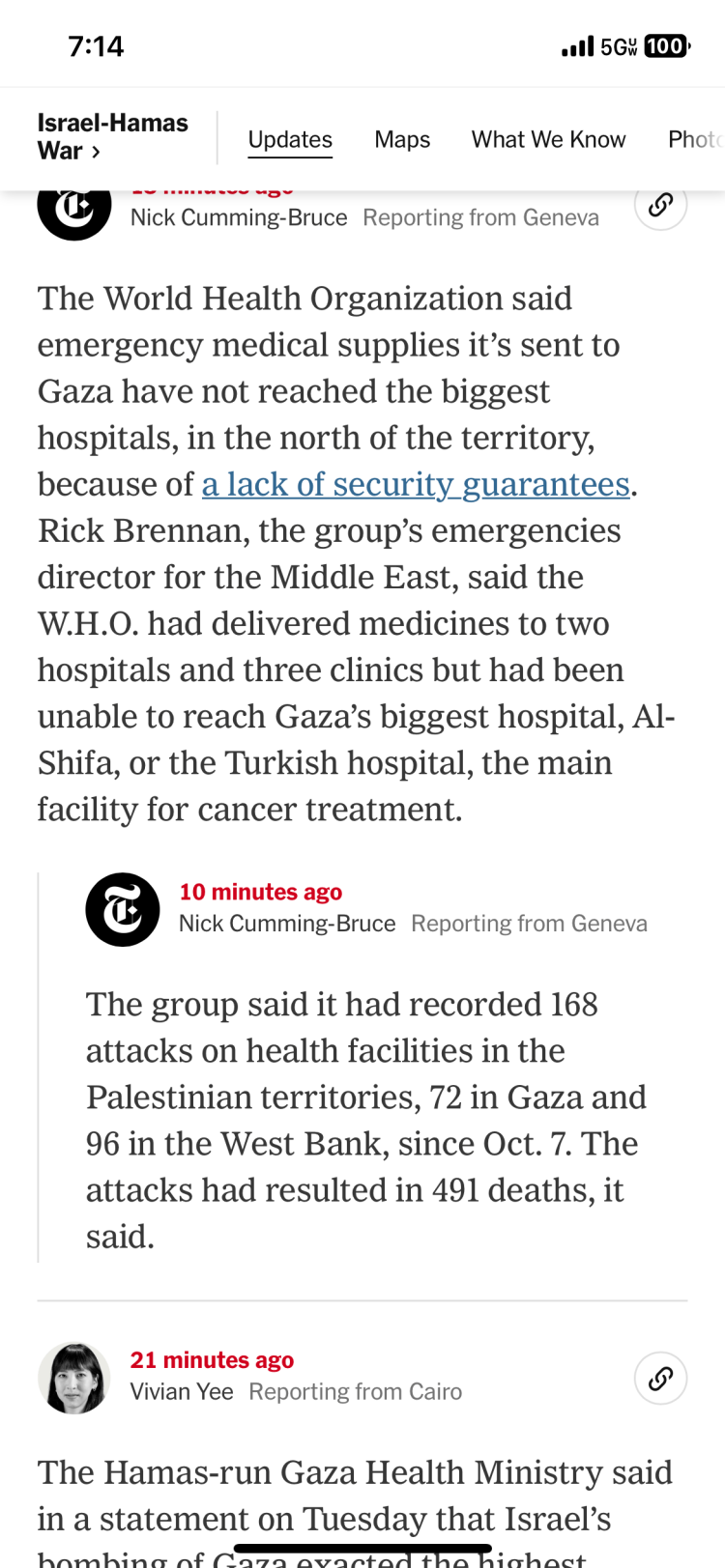
It’s frequently asserted as an unchallengeable axiom that Hamas uses health facilities as a base of military operations, so that Israel is forced–by Hamas’s callous, murderous use of human shields–to target these facilities. I’m very skeptical of this claim, but let me set that particular skepticism aside for now. Consider this item below, which comes from a neutral third party, the World Health Organization (WHO). What it reports is a series of Israeli attacks on Palestinian health facilities.
Let’s suppose that Hamas does indeed use health facilities as a base of operations, thereby treating the patients and staff as innocent human shields. Still, that claim leaves us with a quantitative problem. How often? Put another way, how do we determine, in particular cases, whether this accusation is true? (a) Do we simply treat it as an axiom that regulates any evidence we receive about Palestinian health facilities hit by Israeli fire? Or (b) do we treat each case on its own merits, granting as much credence to the “human shield” hypothesis as is warranted by the evidence in each case, and taking it from there?
(a) Taking the first option, the inference is: if a Palestinian health facility is hit by Israeli fire, the default assumption is that it must have been hit innocently. Either it was hit purely by accident, or it was hit because it was in some sense being used as a shield. Wild anomalies aside, there is no other option.
If so, then in this case, from the fact that 168 Palestinian health facilities were hit since October 7, and 491 Palestinians killed, we can infer that all 168 facilities were either being used by terrorists, or were hit purely accidentally, or some combination of these. We can also infer that all 491 of those killed were either terrorists or collateral damage, i.e., victims hit while Israel was conscientiously trying to target terrorists. No further inquiry is required. It might come as a surprise that a greater number of facilities, 96, were hit in the West Bank, away from the main combat zone, than in Gaza. But life is surprising. We may either dismiss this apparent discrepancy as an anomaly, or conclude that there are more terrorists in the West Bank than we realized–indeed, more use of health facilities by terrorists there than we realized.
(b) Taking the second option, we reach a more indeterminate verdict, but also a more inclusive one. The second option includes all of the possibilities included in the first. But it also includes the possibility that some of the health facilities were deliberately or recklessly (or otherwise culpably) targeted by the Israelis. In the limit case, it includes the possibility that all were. If so, some of the 491 killed were victims of homicide or murder. In the limit case, all were. As for the West Bank, what it suggests is that there are indeed more terrorists there than we realized. It’s just that the terrorists are Israeli.
The item itself doesn’t tell us which approach to adopt. Neither does some authority figure. The decision between the two is one we “all” have to make. But the decision between the two itself has to be the product of reasoned argument, not the product of dogma, reflex, tribal allegiance, partisan affiliation, or wishful thinking. It too often is the latter.
The first approach strikes me as involving a problematic degree of a priorism and question-begging. It assumes Israeli good faith from the outset, then structures the evidence accordingly. The strategy is to shut down explanatory possibilities to avoid multiplying the ones that need consideration.
The second approach involves a great deal of evidential stringency, but given evidence, a higher likelihood of tracking truth as correspondence to reality. Where evidence is lacking, it demands agnosticism. Granted, agnosticism comes with its own price: it exonerates the guilty when evidence is lacking to inculpate them. But it does the same for the innocent. The overarching strategy is to multiply explanatory possibilities, then evaluate the evidence for each possibility before shutting a given one down.
The intrinsic connection between evidence and truth-tracking seems a point in favor of the second approach. There may be objections to the second approach, but it can’t be a legitimate objection that it’s biased against Israelis or biased in favor of Palestinians. It’s biased in favor of evidence, a bias to which we should all be willing to plead guilty.
 Policy of Truth