I was saddened to read of the passing of Fr. David Burrell, CSC, Hesburgh Professor of Philosophy and Theology at the University of Notre Dame. He passed away on Sunday, October 1st. I knew Fr. Burrell when I was a grad student at Notre Dame in the 1990s, but regrettably never took a class with him, and have only recently–decades after the fact–come to understand and appreciate his work.
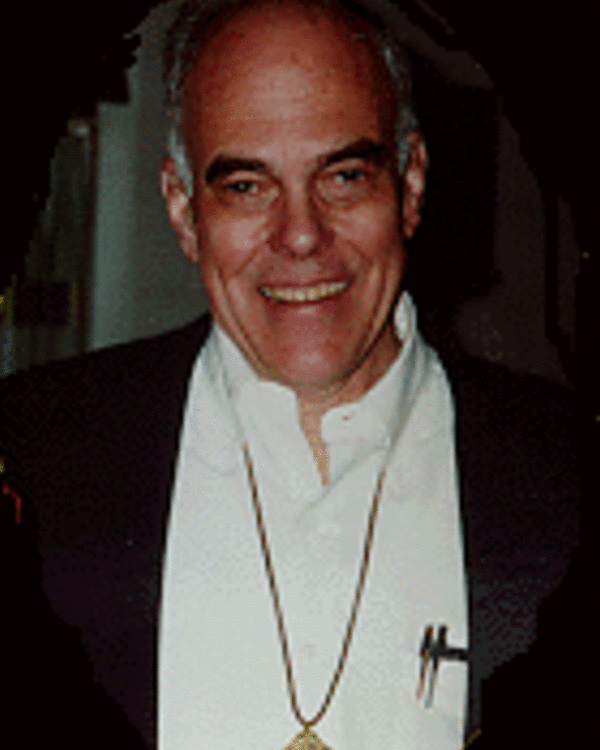
In some ways, his work proves the aphorism (actually, just hyperbole I’ve just concocted on the spot) that the high point of multiculturalism was the High Middle Ages, something that becomes apparent on a mere perusal of his work, but that only really becomes clear after a sustained engagement with it. Fr. Burrell’s declared area of specialization was “comparative issues in philosophical theology in Judaism, Christianity, and Islam,” and his work was a hymn to that enterprise. Here’s a particularly clear and accessible (in both senses) paper that I’ve recently been mulling over, “Thomas Aquinas and Islam” [19 page PDF] (2004), written during his “apprenticeship” at Notre Dame’s Tantur Ecumenical Institute in Jerusalem.
I was a bit too much of the village atheist to appreciate Fr. Burrell’s work when I was at Notre Dame, but it grew on me after awhile, and I now more clearly see its value. He was a multiculturalist before the term acquired either easy currency or opprobrium, the (nowadays?) rare comparativist who saw the comparativist’s enterprise as fully compatible with the pursuit of truth. In that respect, his attitude contrasted (and contrasts) with two extremes one commonly encounters in contemporary discourse–belligerent truth-talk in the service of ethno-national tribalism, and ethnic cheerleading at war with the concept of cross-cultural truth. Fr. Burrell found the mean between those extremes, and clarified it for anyone open to clarification.
He was, in short, a multiculturalist in the best sense. He’ll be missed, but his work is a monument to an ongoing project that will endure as long as human beings desire to understand one another, and themselves.
 Policy of Truth