Since 2018, I’ve written ten posts here questioning the mainstream narrative on the so-called Parkland shooting–that is, the shooting, by Nikolas Cruz, at Marjory Stoneman Douglas High School in Parkland, Florida on February 14, 2018.* The shooting left seventeen dead and seventeen injured. Cruz was arrested on the day of the shooting, charged with the murders, then tried and convicted, and eventually sentenced to life in prison. The shooting gave rise to a widely-publicized student movement in favor of gun control.
But the part of the incident that has gone under the radar screen is the treatment meted out to School Resource Officer and Sheriff’s Deputy Scot Peterson, the police officer assigned to protect the school, and accused of “failing” to enter the building, Building 1200, where the shooting took place.** Peterson is (absurdly) on criminal trial for his conduct in the case, accused of seven counts of felony child neglect, three of culpable negligence of a child, and one of perjury. His trial began this past Wednesday, June 7th in Fort Lauderdale, Florida. Criminal charges aside, Peterson faces civil liability in a wrongful death suit initiated by the father of one of the victims, and has, since 2018, suffered the opprobrium of widely being regarded as a “coward” for “failing” to enter Building 1200 to save the victims inside.
Early press reports essentially took for granted that Peterson was guilty of everything of which he’d been accused, claiming as a matter of fact that he “failed” to enter Building 1200 in the full knowledge that the gunman was there, and uncritically repeating factoids and accusations tending to cast aspersions on his character. Few attempts, if any, were made to ascertain what Peterson knew, could have known, or could have done in real time. Few attempts were made to offer a detailed chronology of events as they happened in real time, to explain the options facing any particular first-responder, to describe the communications failures that plagued the scene, to mention the physical difficulties of localizing gunfire outdoors in a dynamic situation, or to describe the internal bureaucratic politics that would have provided incentives for the selection and persecution of a scapegoat like Peterson.
Instead, the narrative quickly took on the tones of the usual morality play: Kids died, a cop appeared to “take shelter” for forty-five minutes instead of rushing into harms’ way, the shooter left the scene unchallenged and unscathed, only to be caught elsewhere. So, it was concluded–and repeated, ad nauseam–that Peterson was obviously a coward, obviously liable, obviously guilty. Heads needed to roll, and his was one of the easiest to chop off.
Actually, none of it was obvious. None of it was true. After writing the first four posts on Parkland, I decided to re-double my efforts to get at the truth of the charges against Peterson. At first, I was mostly just skeptical of the mainstream narrative, content to raise questions about it, and content to leave the matter there. But that didn’t seem like enough. I needed answers, and I’ve spent a good part of the last five years looking for them. I’ve read just about all of the relevant information in the public domain, and taught some of it for a few semesters to my criminal justice students at Felician University until I resigned my position there in May 2020. I eventually became friends with Peterson, and, over several long emails and phone calls, have tortured him with questions about the case, forcing him to live and re-live the trauma of that day simply to satisfy my personal curiosity. I guess sometimes the practice of a “policy of truth” requires a bit of insensitivity. But all for a good cause.
Beyond that, I happen to be in possession of (to my knowledge) unpublished expert testimony by Philip Hayden, an expert in police tactical matters. Hayden is a decorated combat veteran who was badly wounded in Vietnam, and a former FBI agent responsible for the arrests of “several hundred” violent criminals. To my mind, Hayden’s report demonstrates conclusively that Peterson was not to blame for “failing” to enter the building where the shooting took place.*** The report is the only written account I’ve read that shows a full comprehension of the complexity of the facts, and a full understanding of why the accusations against Peterson are either unproven or straightforwardly false.
I’ve asked Peterson’s attorney for permission to post Hayden’s report here, and will do so once I get that permission (which I’ve already gotten from Hayden). Having read the report, I simply do not understand how anyone in full comprehension of Hayden’s testimony could hold Peterson responsible for the deaths of the victims of the Parkland shooting. Granted, almost no one has read it. Put it this way: anyone who wants to hold Peterson responsible for “child neglect” or “cowardice” owes us an explicit, sustained engagement with the facts contained in Hayden’s testimony. Until then, there’s no reason to take such claims seriously, except as expressions of the malice and/or ignorance (often culpable) of the people making them.
Copyright: South Florida Sun Sentinel, 2023.
I am at this point certain beyond any reasonable doubt that the charges against Peterson are all false. I don’t know how else to put it: he is not guilty of any of the criminal charges against him, of wrongful death, or of “cowardice.” He’s not really guilty of anything. He’s a mortal man who did the best he could under the horrific circumstances he faced. He should be acquitted in the ongoing criminal trial, exonerated of any liability for wrongful death in the matter, and exonerated of the ignorant, evidence-free charges of “cowardice” that have haunted him since 2018.
Perhaps the only consolation of the last few years is that press coverage of Peterson’s case has improved somewhat since 2018; reporters no longer reflexively buy into the charges popularly made against him. But that’s just the first step toward a long-overdue correction of the record. It’s time to recognize what the accusations against Peterson have really been all along: an expression of the desire to scapegoat a convenient target, to ask the impossible, to beat up indiscriminately on law enforcement, to indulge in cheap sanctimoniousness and moral self-righteousness at the expense of a middle-aged white guy, and to impose suicidal risks on first-responders in order to virtue-signal about their failures to do so. Arguably, the attempts to wreck Peterson’s reputation have also served as camouflage for the opportunism, dishonesty, and gaslighting of local law enforcement, whose shenanigans and incompetence have mostly gone unnoticed by the press.
If you’re the praying type, pray for Scot. If not, spare a thought for him. But either way, ask yourself how we got to this insane pass: someone brings a gun to a school and shoots it up, but our moral opprobrium falls on the guy who, in the confusion, was unable to localize shots fired within less than two minutes’ time on a large suburban high school campus, where the shots could have been coming from anywhere. We expected one guy suicidally to rush into a building where he was outgunned, and clear the whole building before the suspect left. Never mind that he had no knowledge of what was happening inside, and that the suspect could see him but not vice versa. We expect Peterson to know that there was “only” one shooter when there could, for all he knew, have been a half dozen. So easy to play with someone else’s life, to blame someone else for the failure in real life of our TV-generated hero fantasies, and to turn someone else’s tragedy into a made-for-TV drama. Enough damage has been done. It’s time to put a stop to it, not to multiply it without limit.
The trial is expected to last two months.**** I’m hoping to blog some of it as it happens, and will certainly blog the verdict and its outcome. I’ve promised Scot to visit him in North Carolina where he now lives and celebrate with him when “this is all over” (whatever that really means). I’d like to keep that promise by visiting him at home–not in prison. For now, he has my friendship, my moral support, and every word I can say or write that will help defend his rights and reputation, and, perhaps, to bring this sad chapter to a close.
*I corrected this first sentence after posting, having originally written “four” instead of “ten”: I remembered the first set of four posts I’d written in 2018, but had forgotten the second set of six that I wrote in 2019-2020. The four posts are: (1) “Whatever Happened to Patient Confidentiality?”; (2) “The Premature Demonization of Scot Peterson“; (3) “What If the Educator Is the Shooter?“; (4) “Lockdowns and Legalities.” The second post is the one most relevant to the topic at hand.
I wrote six more posts across 2019-2020 specifically defending Peterson, under the title “The Unwarranted Demonization of Scot Peterson.” Those can be found by putting the quoted phrase into the blog’s search engine.
**Scot Peterson is to be distinguished from the unrelated Scott Peterson, convicted in 2004 in California of the murder of his wife Laci Peterson.
***I thank my friend Kevin Bolling for having passed this material on to me.
****Corrected. I had originally written “one month.”
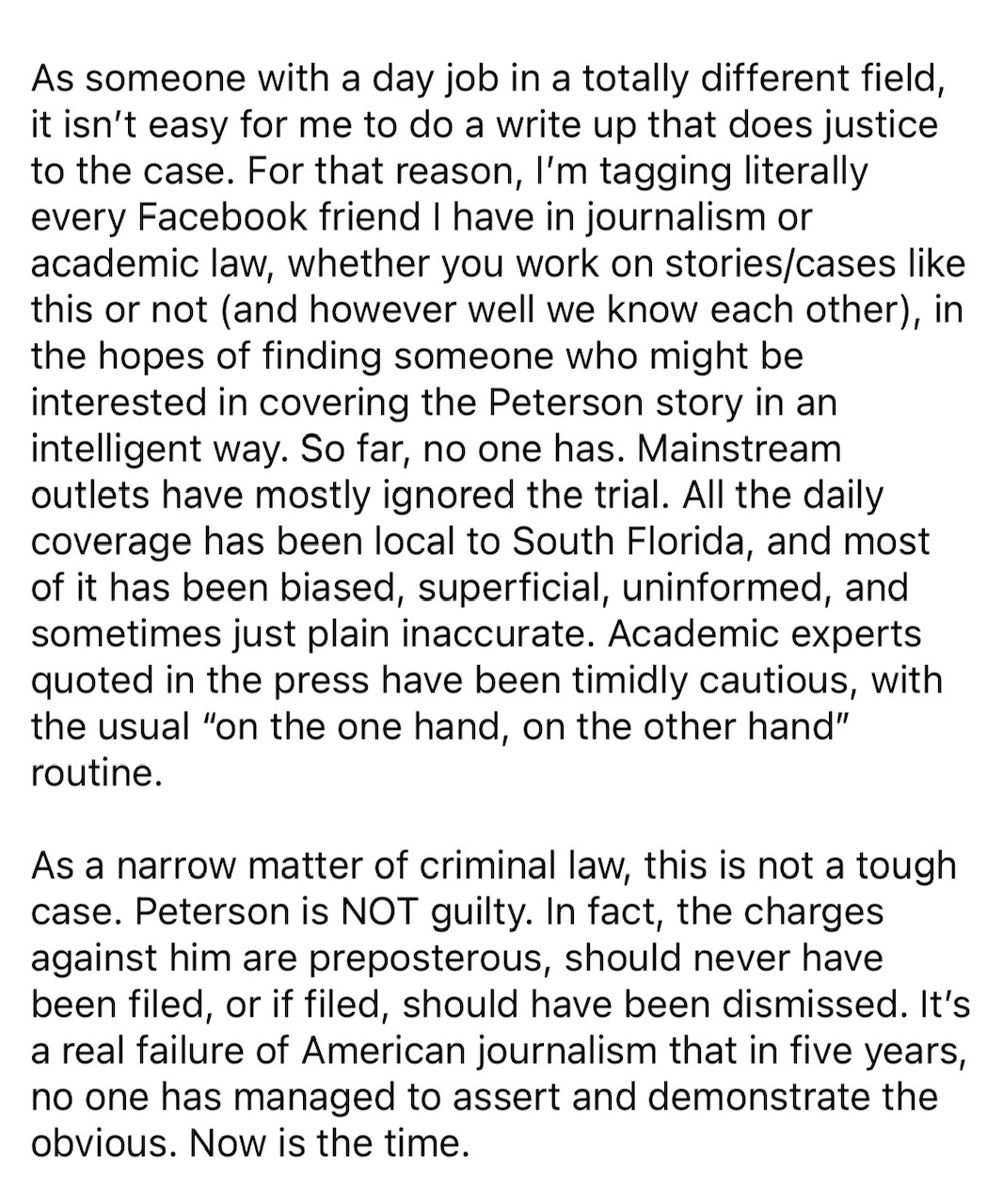
A call I put out on Facebook, June 20, 2023:

 Policy of Truth
Pingback: The Parkland Trial (3): The Hayden Report | Policy of Truth