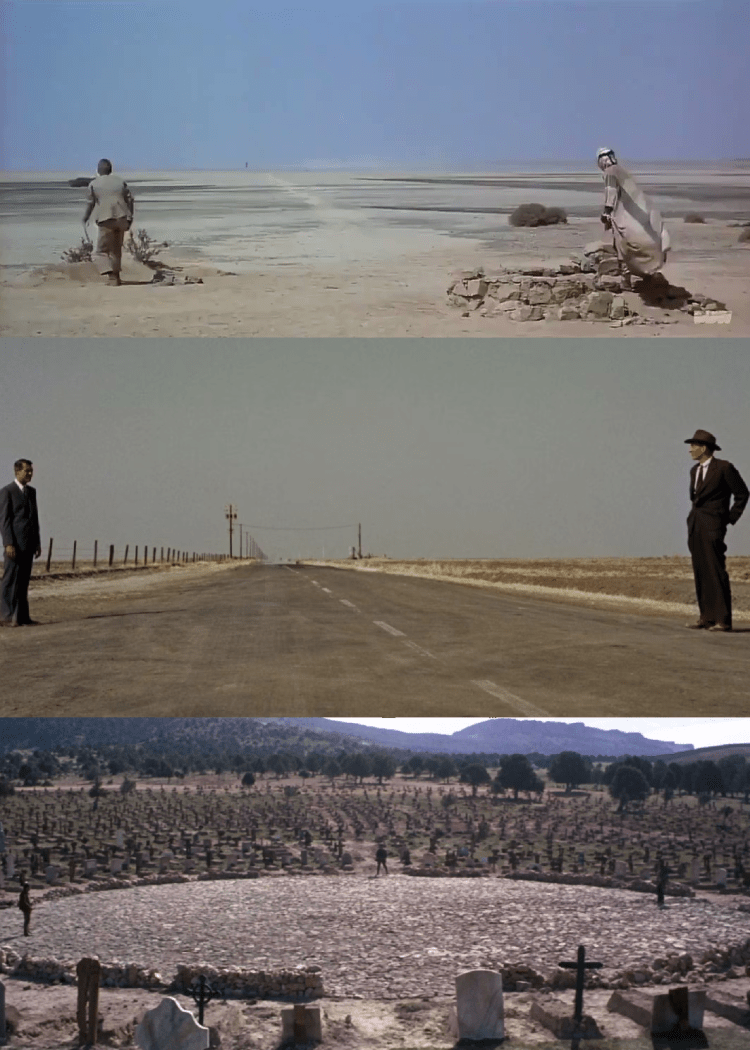
Back in the 90s there was a controversy, now happily long settled (and so perhaps unfamiliar to many of my younger readers), about “letterbox” versus “pan-and-scan” video formats. See, most movies by then were widescreen (and this had been so for decades), but television screens were still 4×3, which had been the dominant aspect ratio for theatrical movies when commercial television first became widespread – which meant that movies with a wider aspect ratio (which soon became the majority), when shown on television, either had to leave out whatever was happening at one or both sides if the screen, or else shift back and forth between them (the latter option being the origin of “pan and scan”), even if the original scene had been intended to be static. You can see how this mismatch between theatrical and televisual aspect ratios would ruin, for example, scenes like these three from Lawrence of Arabia, North by Northwest, and The Good, the Bad, and the Ugly, all of which could show one of the main characters in a scene only by completely eliminating another.
As home video became more widely available, there arrived on the scene a format that by some failure of marketing savvy was called “letterbox” (from the shape of, y’know, a letterbox; who are the ad wizards who came up with this one?) rather than – as it should have been called, and eventually was – “widescreen.” This format showed the entire widescreen scene on a 4×3 screen by leaving the top and bottom of the screen blank, which had the visual effect of black bars at the top and bottom. We’re so used to such a format today that we don’t really even see the black bars, or see them as black bars, but they were very salient to 90s audiences used to having their entire screens filled, and there was initially a lot of resistance to the letterbox format.
Some of the objections were confused (many thought that the black bars meant something was left out, whereas it was the fullscreen pan-and-scan versions that were actually leaving something out). Some were merely odd (many viewers found the black bars “distracting,” which seems hard to believe today; I actually found it hard to believe even back then, and had many frustrating arguments with pan-and-scan advocates). There were also more legitimate objections: most televisions had smaller screens and poorer resolutions than today, and a letterbox format made images smaller and harder to see. For a long time, home video companies would offer many of their movies in both fullscreen and widescreen formats, allowing buyers to choose, while most movies broadcast on television continued to be presented in fullscreen (i.e., pan-and-scan). Film critics waged campaigns to educate the public, showing comparisons of letterbox and pan-and-scan version of the same shot to demonstrate how much was lost in the latter.
In the early 2000s, there was an awkward transition period where television screens in public places like bars and restaurants would often show images shot in one format squeezed or stretched into another format, as proprietors struggled, or failed to struggle, with the learning curve of adjusting the aspect ratios on their devices. And some television studios would even try to make their shows look more cinematic by presenting them in fake letterbox, that is, slapping black bars at the top and bottom of scenes shot in fullscreen and thus eliminating information. Verily I say unto you, they have their reward.
Nowadays, television screens and computer monitors are generally larger, wider, and higher-resolution than their 90s predecessors, plus we’re all used to black bars at either the top and bottom or the sides of our screens (depending on which way the shortfall lies for the particular content in question), and presenting movies in their native aspect ratio is simply the default format. Gaudeamus igitur.
 Policy of Truth
I guess you’re right! I hadn’t noticed!
LikeLike
I was aware of this, but did not know the semi-technical details or the history. Worth knowing!
LikeLike
So you’re expecting us to believe that all this just “happened” without essential reliance on federal regulation?
LikeLike